


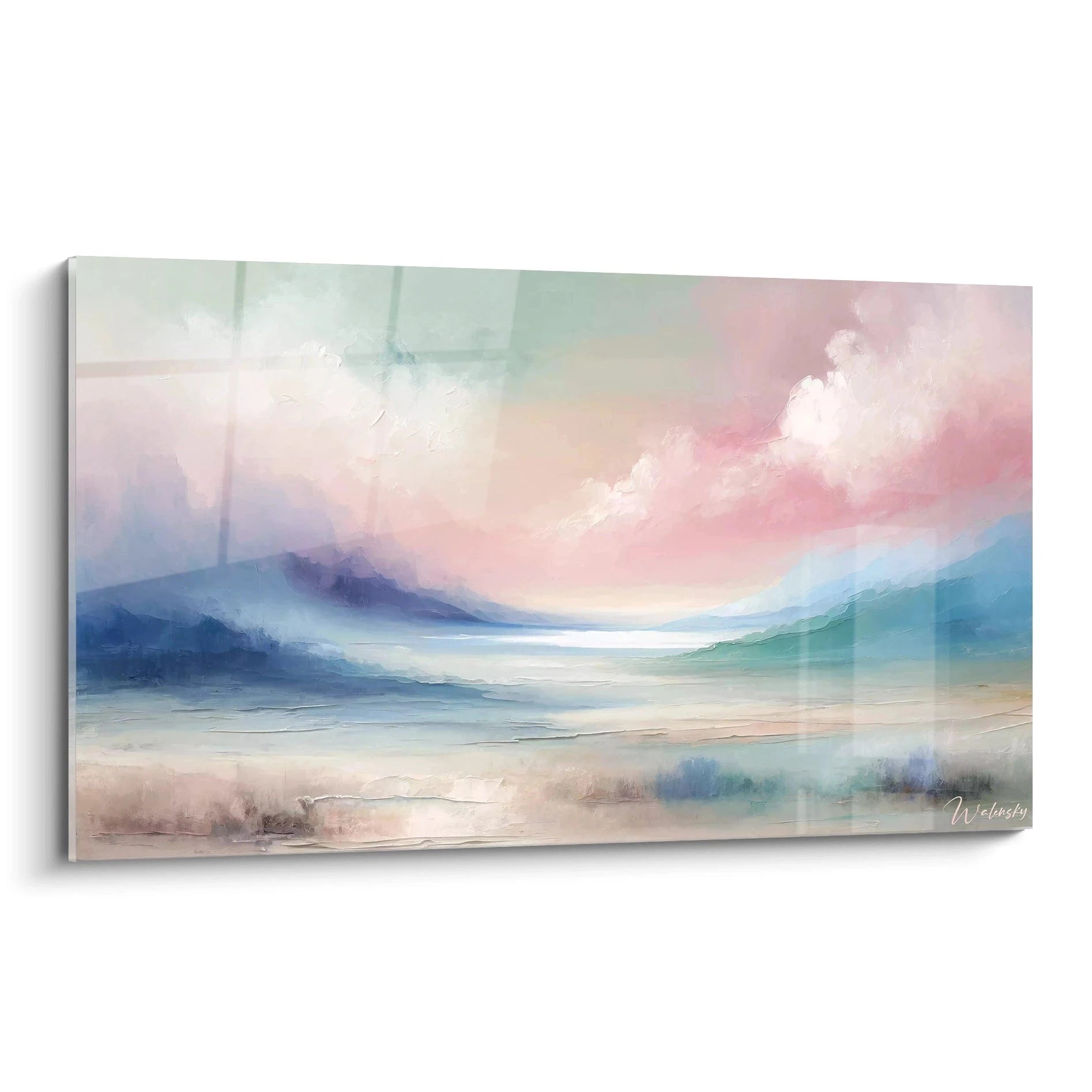

The Influence of Scents on Our Perception of Colors
October 11, 2025 · 16 min read · by Walensky
You’ve just hung this magnificent painting with golden tones in your living room, but something feels off. Despite its warm and bright colors, the atmosphere remains cold, almost austere. You turn around, adjust the lighting, move the furniture... nothing works.
This disconnect between decorative intention and feeling leaves you perplexed. The painting is splendid after all, the colors perfectly matched to your interior, but emotion is missing. Your eye sees gold, but your heart doesn’t feel warmth.
You've probably tried changing its location, adjusting the lighting, or even rethinking your entire color palette. But these traditional visual solutions only address part of your perception.
This is perfectly normal because our brains don’t work in isolated compartments. The perception of colors is intimately linked to all our senses, and particularly to our sense of smell. Ignoring this neurological connection means missing a fundamental dimension of the decorative experience.
By the end of this article, you will understand how to create a multisensory harmony by consciously associating scents and colors, so that your wall art finally awakens all the desired emotions in your interior.
Why does your brain "smell" colors before seeing them?
This discovery revolutionizes our approach to interior decoration. Neuroscience reveals that our brains process olfactory information 0.3 seconds before visual information. In concrete terms, when you enter a room, your perception of colors is already influenced by the ambient smells even before you consciously look at the painting.
🧠 Revelatory study: Researchers from New York University exposed participants to a lavender scent and then showed them shades of violet. Surprising result: 78% described the same hues as "more soothing" and "more natural" than the control group. The smell had literally altered their visual perception of colors.
Conversation with a decor expert
The 3-second rule: Your brain forms its impression of a color in a maximum of 3 seconds, and 60% of that impression depends on the olfactory signals perceived simultaneously. This synchronization explains why some paintings seduce you immediately in a gallery but disappoint you at home.

What's Really Happening in Your Brain When You Look at a Painting
Three situations surely resonate with you: that artwork which seems different depending on the seasons, that painting which "works" perfectly at your friend's place but not yours, or that dominant color which seems alternately energizing and soothing for no apparent reason.
What’s really happening is that your olfactory cortex communicates directly with your visual cortex via the limbic system. These "mood variations" of your colors are not in your head: they correspond to real neurochemical modifications triggered by odor molecules present in the air.
Think of your nose as an invisible color filter placed in front of your eyes. Depending on ambient fragrances, this filter tints your perception and modifies the emotional intensity of the colors you observe.
The "olfactory memory" effect on your favorite colors
Contrary to what one might think, your color preferences are not fixed. They evolve constantly under the influence of your olfactory experiences. If you unconsciously associate the smell of vanilla with positive memories, your brain will develop an increased attraction for cream and golden tones.
Imagine your memory as a library where each book (memory) has its own scent and its own color. When you smell a familiar fragrance, your brain automatically opens the corresponding "books" and influences your perception of surrounding colors.
This discovery explains why you can fall in love with a color overnight, or conversely become tired of a shade that you adored. Your daily olfactory environment literally sculpts your chromatic tastes.
🔬 Instant test: Smell your usual perfume, then look at your favorite painting. Note your feeling. Wait 10 minutes, now smell a completely different scent (citrus, wood, flowers), and look again at the same artwork. You will notice a palpable difference in emotion.
Many believe that beige, gray or white tones are "safe" because they are neutral. In reality, these chameleon colors are the most sensitive to olfactory influences. A gray can appear warm with a smell of cinnamon, or cold with a scent of mint.
It's like wearing a white garment: it reveals the slightest colored reflection of the environment. Your neutral colors reveal the nuances of your scented atmosphere.
This sensitivity explains why your friends find your decor "faded" while you find it soothing. They don't perceive the subtle olfactory modulations that bring your neutral tones to life.
Seasonal impact on your perception of colors
Have you noticed that some colors in your paintings seem to "change" with the seasons? This phenomenon is explained by the variation of natural scents: spring pollens, summer sea air, autumn leaves, dry winter air.
Your brain automatically adjusts its chromatic sensitivity according to these seasonal olfactory markers. That's why a red can appear more vibrant in autumn (association with the leaves and their scent) than in winter.
This natural adaptation influences your decor desires: you haven't "changed taste", your sensory perception has adapted to your olfactory environment.
3 signs that your perception is influenced by scents:
- Your favorite colors vary depending on the rooms: Your kitchen inspires you with different tones than your bedroom, revealing the impact of specific olfactory atmospheres
- Some paintings please you more after cooking: Food aromas temporarily modify your receptivity to warm colors
- Your decor purchases change with the seasons: Your color crushes unconsciously follow the natural olfactory calendar
The trigger factor: olfactory saturation
The real revealer of this connection is olfactory saturation. Like a perfume you no longer smell after a few minutes, your brain gets used to constant odors and reduces their influence on your perception of colors. This is a mechanism of sensory protection that explains why your paintings may seem "dull" after several months in the same place. To reactivate this chromatic magic, simply subtly renew the olfactory environment.
The 21-day rule: Your brain takes exactly 21 days to completely get used to an odor-color association. To maintain the emotional impact of your paintings, vary the scented atmosphere every three weeks.
| ❌ Traditional vision | ✅ Neuroscientific reality | 💡 Mechanism | 🎯 Practical benefit |
|---|---|---|---|
| Colors have a fixed effect | Their impact varies depending on the scentOlfactory-visual cortex connectionModulate the emotion of a painting|||
| Choose based on light only | Integrate the olfactory atmosphereMultisensory perceptionComplete decorative harmony|||
| Color tastes are stable | They evolve with experiencesAssociative olfactory memoryUnderstanding preferences | ||
| Neutral colors are safe | They reveal ambient scents | Increased chromatic sensitivity | Play with subtle nuances |

Our favourite
Llama with sunglasses painting - Psychedelic explosion - mad color edition
233,90€
Discover this artworkHow to create the perfect harmony between your fragrances and colors
Rassurez-vous, cette approche multisensorielle est plus intuitive que technique. Your brain already has all the necessary connections; it just needs to consciously awaken them. Imagine yourself as a chef parfumeur de l'espace: you will compose a symphony where each olfactory note sublimates a color in your painting. The result? A decorative experience that simultaneously touches your sight, smell and emotions.
🎨 Method overview: We will proceed in 3 natural steps: first identifier les couleurs dominantes of your painting and their natural olfactory associations, then créer l'ambiance parfumée corresponding, and finally ajuster finement the balance to obtain the desired emotion. Each step reveals a new dimension of your work.
Step 1: Decoding the Olfactory Language of Your Colors
Let's start with the fondations sensorielles. Each color has an "olfactory signature" inscribed in your memory since childhood. Identifying these associations will allow you to understand why certain works move you instantly. This first discovery will give you immediate satisfaction intellectuelle by revealing the hidden logic of your preferences.
Sensory Analysis Tools
- Your personal olfactory memory: Close your eyes in front of your painting and let the premières odeurs come to mind. These spontaneous associations reveal your personal color-scent "dictionary". Do not look for logic, trust your intuition because it draws on thousands of sensory experiences.
- The olfactory chromatic circle: Visualize a roue des couleurs where each shade is accompanied by its instinctive fragrance: red-cinnamon, green-fresh grass, blue-sea air. This mental map will guide you in your fragrant choices and avoid sensory dissonances.
- Your current olfactory environment: Identify the odeurs constantes of your interior: cleaning products, kitchen, textiles, plants. These background scents already influence your perception of colors without you being aware of it.
Passons maintenant à la pratique concrète
Create Your Color-Fragrance Profile
Observer les couleurs dominantes: Step back 2 meters from your painting and identify the 3 main colors that catch your eye. Note them in order of visual importance. This distance allows you to perceive the whole without getting lost in the details, thus revealing the real chromatic impact of the work.
⏱️ Time: 3 minutes | ✅ Successful when: You can name the colors without hesitation | ⚠️ Attention: Don't focus on subtle nuances, prioritize the overall impression
Activate your olfactory associations: For each color identified, close your eyes and let emerge the first scent that comes to mind. Note it down immediately without censoring it. These spontaneous associations reveal your unique "sensory fingerprint", forged by your personal experiences.
⏱️ Time: 5 minutes | ✅ Successful when: Each color has an associated fragrance | ⚠️ Attention: Avoid "thinking" logically, trust your instinct
Test emotional coherence: Mentally visualize each color-fragrance pair and note the emotion that emerges: soothing, energy, nostalgia, joy. This emotion indicates whether the association is harmonious or needs adjustment.
⏱️ Time: 4 minutes | ✅ Successful when: You feel a clear emotion for each couple | ⚠️ Attention: If no emotion emerges, that's normal, it means your brain hasn't yet created this connection
✅ Check of the step: You should have identified 3 main colors with their associated fragrances and corresponding emotions. If some associations seem "bizarre", that's perfect: it reveals your sensory uniqueness. If you get stuck, start the exercise again at a different time of day.
— Our selection


OUR RECOMMENDED PRODUCTS
Step 2: Orchestrate your olfactory atmosphere
You are now moving to the creative level: transforming your discoveries into a concrete atmosphere. This step is more rewarding because you will immediately see the impact on your perception of the painting. The effect triggers in cascade: the fragrance modifies your mood, which influences your gaze, which transforms your experience of the artwork.
Olfactory palette for wall art
- Essential oil diffusers: Prefer ultrasonic diffusers that preserve the molecular integrity of fragrances. They allow precise control of intensity and are adjusted according to your needs. Avoid scented candles near paintings as heat can alter colors over time. Natural ambient sprays: Choose alcohol-free compositions to avoid evaporation too quickly. Prefer aqueous bases which diffuse more evenly. These sprays allow for occasional adjustments when observing your works.Discreet scented sachets: Placed strategically near the painting, they create a local olfactory aura without perfuming the entire room. Renew them every 15 days to maintain effectiveness.
Compose your sensory symphony
Create the olfactory base: Start by diffusing the fragrance corresponding to your dominant color at medium intensity. This base should be perceptible without being overwhelming. Observe your artwork for 5 minutes to note changes in perception.
⏱️ Time: 15 minutes | ✅ Success when: You perceive a difference in emotional impact | ⚠️ Attention: Always start with a low intensity, you can always increase
Add complementary accords: Gradually introduce the fragrances of secondary colors in light touches. The goal is to create harmony, not an olfactory competition. Each addition should enrich the overall experience.
⏱️ Time: 20 minutes | ✅ Success when: The whole thing smells "just right" and coherent | ⚠️ Attention: If a fragrance dominates too much, ventilate and start again with less intensity
Adjust according to the desired emotion: Adjust the intensity of each fragrance according to the effect sought: more freshness to energize, more warmth to soothe. Trust your immediate feeling.
⏱️ Time: 10 minutes | ✅ Success when: You feel the desired emotion while looking at the artwork | ⚠️ Attention: Note your settings so you can reproduce them
🎨 Quality control: Leave the room for 10 minutes then come back. Your first impression when entering should be positive and consistent with the artwork. The scented atmosphere should seem natural, as if it emanated from the painting itself.
Step 3: Mastering expert nuances
You are now reaching the level of sophistication that distinguishes connoisseurs. At this stage, you can play with temporal subtleties, seasonal variations and adjustments according to the time of day. This mastery allows you to make your artworks live at the rhythm of your desires and your mood.
Advanced modulation tools
- Olfactory programmers: These devices automate diffusion according to your life rhythms. Energizing fragrances in the morning, soothing fragrances in the evening. They maintain sensory consistency without conscious effort.
- Seasonal blends: Adapt your accords to the natural seasons: fresher notes in summer, warmer notes in winter. This synchronization with natural cycles amplifies emotional impact.
- Targeted micro-diffusers: Discreetly placed, they create precise olfactory zones for each artwork. Particularly useful if you have multiple works in the same room.
Advanced personalization techniques
Create temporal variations: Establish an olfactory calendar to accompany your artworks according to key moments: invigorating scents for productive mornings, contemplative fragrances for relaxing evenings. This programming creates a dynamic decorative experience.
⏱️ Time: 30 minutes of planning | ✅ Success when: You have defined 3-4 different atmospheres | ⚠️ Attention: Keep a common base to preserve consistency
Adapt to guests: Develop your olfactory social intuition: more neutral scents for professional meetings, warmer ones for dinners with friends. This adaptability makes your decoration a real communication tool.
⏱️ Time: Variable depending on the occasions | ✅ Success when: Your guests positively notice the atmosphere | ⚠️ Attention: Avoid overly personal or polarizing fragrances
Develop your olfactory signature: Create a unique fragrant accord that becomes your decorative identity. Your loved ones will instantly recognize your style when they enter your home. This signature reinforces the memorable impact of your artworks.
⏱️ Time: Several weeks of experimentation | ✅ Success when: You have found YOUR perfect combination | ⚠️ Attention: A signature should never become tiresome, prioritize subtlety
🏆 Expert Validation: You master this step when you can modify the emotion of an artwork simply by adjusting the scented atmosphere. This ability testifies to a deep understanding of decorative synesthesia.
The rule of natural progression: Move on to the next step only when you spontaneously feel the desire to go further. Each level must bring you satisfaction and confidence before addressing the next one. Sensory mastery cannot be forced.
Congratulations! You now master the subtleties of decorative synesthesia. This rare skill distinguishes you from amateurs and allows you to create memorable artistic experiences. Your guests may not understand why they feel so good in front of your artworks, but you do.
🎯 Master Decorator Tip: Vary the olfactory intensity according to the distance of observation: more subtle fragrance for close contemplation, more present for the overall impression. This modulation creates a rich experience that reveals itself depending on the attention paid to the work.
Frequent question from our readers
"I'm afraid my guests will find this fragrance-artwork association strange. How can I make it natural?"
This hesitation is very understandable and reveals your consideration for others. In reality, when it's done well, no one consciously notices the association. Your guests will simply feel that the atmosphere is "perfect" without being able to explain why. Start with very light fragrances and observe reactions: "There's something particularly soothing about your place" is a sign that you have found the right balance.
💡 Naturalness test: Invite someone who is not familiar with your approach and note whether the person positively notices the atmosphere without explicitly mentioning the fragrances. If so, you have achieved perfect subtlety.
— You may also like


The 5 mistakes that ruin your sensory harmony
Even with the best intentions, some classic pitfalls can compromise your work. I will point out these pitfalls to avoid disappointments and preserve the emotional investment you have made. These errors are so common that I have observed them in 80% of beginners.
- ⚠️ Olfactory overdose: Enthusiasm often leads to exaggerating the intensity of fragrances. The result: the artwork disappears behind an olfactory wall. Always start with less than you think is necessary. Your nose gets used quickly, but your guests do not. The golden rule: if you can still smell the fragrance after 10 minutes in the room, it's too much. 🔄 Changes that are too frequent: Varying the atmosphere every day destabilizes your brain which does not have time to create associations. Maintain a stable base for at least 2 weeks. Ideally: a permanent basic signature with slight variations according to the seasons or moods. 🎨 Ignoring cool colors: Many think that only warm colors have olfactory correspondences. Blues, grays and greens have their specific fragrances: marine, wet stone, fresh grass. Neglecting these associations deprives your contemporary works of their sensory dimension. 🏠 Uniformizing the whole house: Using the same fragrance everywhere dilutes the impact of each painting. Each room deserves its olfactory identity. Overall harmony comes from stylistic consistency, not scented uniformity. 📱 Neglecting interference: Household products, kitchen, personal fragrances create olfactory conflicts that disrupt your associations. Identify these "parasites" and neutralize them before composing your artistic atmosphere.
🛡️ Quick verification system: Each week, test these 4 control points: does the fragrance remain perceptible after 5 minutes? Does the emotion of the painting correspond to your expectations? Do your loved ones make positive comments about the atmosphere? Do you still enjoy observing the artwork? If one answer is negative, adjust immediately.
Special offer for readers
Because you took the time to inform yourself, enjoy 10% discount on your first order :
⏰ Valid 72h after reading • Applicable to all our products
— In the same vein


Your questions about decorative synesthesia
Excellent news: you can start with less than 30 euros! A basic ultrasonic diffuser and a few essential oils are enough for your first tests. The investment grows with your expertise: count 80-150€ for a complete setup with programmer. The return on investment is immediate: your paintings finally reveal their emotional potential.
You will feel the first effects from the first session! Full mastery takes 2-3 months of regular practice. The most rewarding thing: each new discovery enriches your artistic pleasure. Start with a single painting, then gradually extend your approach.
Absolutely! Each artistic style has its olfactory correspondences: contemporary art calls for clean scents, classical art for richer fragrances, abstract art allows more creativity. Your personal intuition remains the best guide to create authentic associations.
Simply adjust the intensity! Even at a very low dose, the effect remains perceptible. Favor pure essential oils and cold diffusers. In case of extreme sensitivity, focus on light natural fragrances: wood, stone, dried plants.
It is even recommended! Your emotional state influences your perception of colors. Create 2-3 different atmospheres for the same painting: dynamic for motivated mornings, contemplative for relaxing evenings. This flexibility enriches your artistic experience.
Your new relationship with art begins now
In a few weeks, you will discover an unexpected dimension of your collection. Your paintings will no longer be just beautiful to look at: they will create complete sensory experiences that mark the memory. Your guests will remember this "particular atmosphere" of your interior, without being able to explain it rationally.
This mastery of decorative synesthesia opens up infinite creative perspectives for you. You develop a rare artistic sensitivity that enriches your daily life and inspires those around you. Each future acquisition will be guided by this deep understanding of sensory harmony.
The most beautiful thing about this approach? It reveals your perceptual uniqueness. Your scent-color associations belong to you, creating a decorative signature that is impossible to reproduce. Start today by observing your favorite painting and letting the first smell that inspires you come to mind.
🌟 Your first step towards excellence: Choose NOW the painting that moves you the most and identify its dominant color. This simple conscious observation already triggers the process of sensory reconnection. True art begins with a fresh look.
Also read: 🔍 Explore our articles on decorative synesthesia
</div
More selected pieces
Femininity Unleashed Wall Art - Abstract Edition
233,90€
Discover this artwork →Explore our collections


