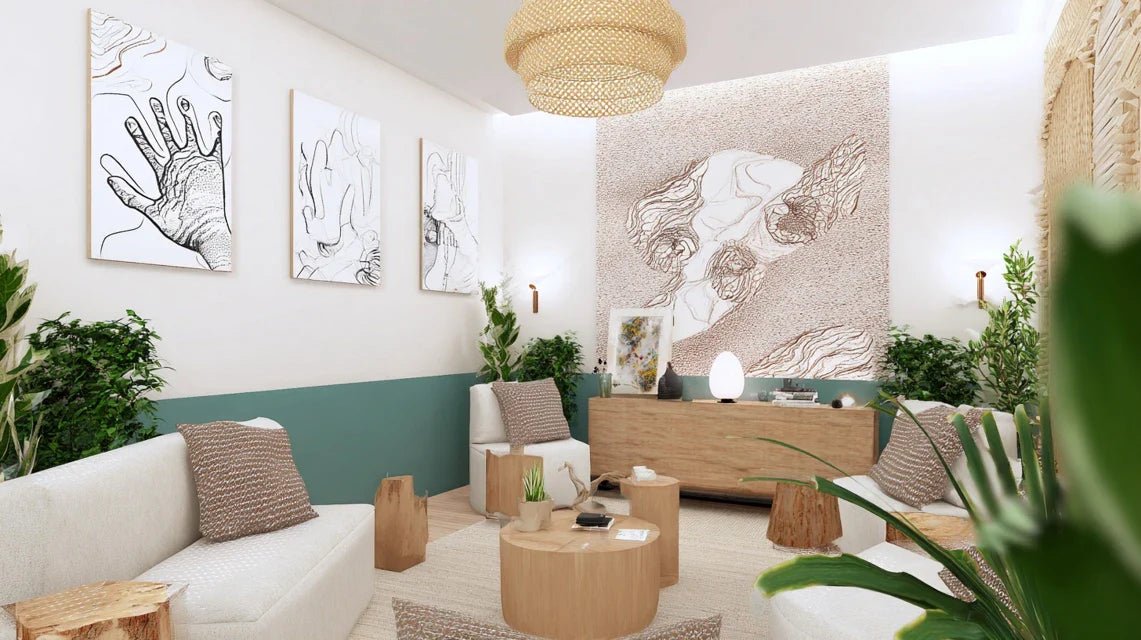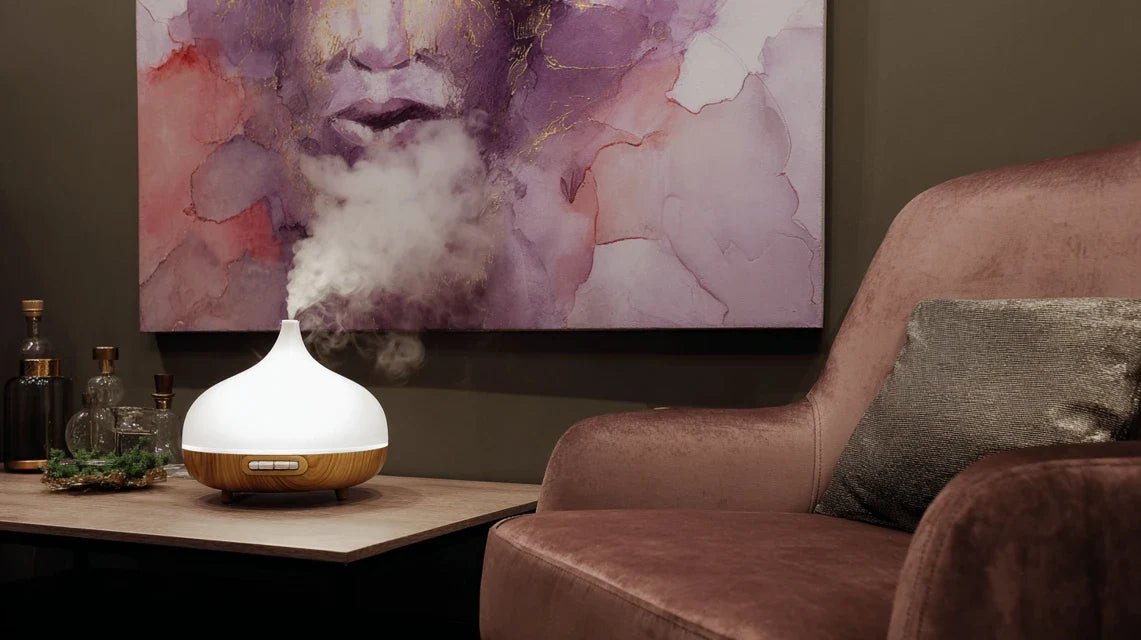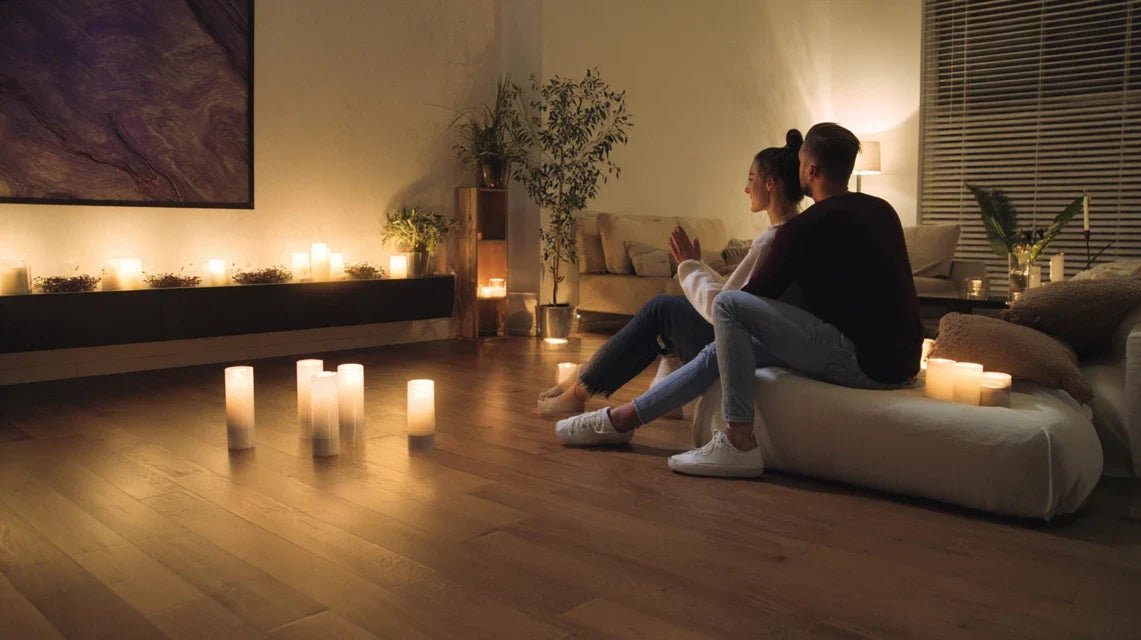
You enter your living room after a long day, and something feels off. Your beautiful paintings are there, perfectly hung, but the atmosphere lacks that comforting warmth you had imagined. The space feels cold, impersonal, almost clinical.
The colors of your artwork are still magnificent, the light highlights every detail, but that feeling of truly being at home eludes you. You feel this dull frustration of not managing to create the cozy atmosphere you dreamed of.
You may have tried changing the lighting, rearranging your furniture, or even adding colorful cushions. But nothing seems to transform your interior into that emotional refuge you visualize in decor magazines.
This is perfectly normal! Most people focus only on the visual aspect of their decoration, forgetting that our emotions are governed by several senses simultaneously. Your brain needs sensory coherence to create lasting memories and deep emotions.
By the end of this article, you will discover how to subtly combine visual art and fragrances to create an atmosphere that will impress your guests and transform your daily life into a rich and memorable sensory experience.
Why isn't your decor creating the expected emotion?
Traditional decoration only stimulates one sense: sight. Yet, 75% of our daily emotions are influenced by smells, which travel directly to our limbic system without passing through the filter of reason. If you’re still waiting to create this synergy, you're missing the opportunity to transform your interior into a true emotional sanctuary.
🏠 Customer testimonial: "I invested in beautiful abstract canvases for my living room, but my guests remained polite without more. The day I paired a sandalwood fragrance with my earthy-toned works, the atmosphere completely changed. Now, my friends ask me my secret and stay for hours at my place."
💬 Conversation with a decor expert
The rule of complementary senses: When smell and sight work together, they create memories 5 times more lasting than a single stimulus. Your guests will remember your interior for months, not just minutes.
What's really happening in your brain
Do you recognize these situations: you admire a painting but the emotion fades after a few minutes? Your guests compliment your decor but don't seem truly touched? You yourself no longer feel that initial joy towards your favorite works?
This isn’t a matter of taste or artistic quality. Your brain quickly gets used to isolated visual stimuli, a phenomenon called “sensory adaptation.” Without olfactory anchoring, your finest works become “background decor.”
It's like watching a movie without sound: technically perfect, but emotionally incomplete. Your nervous system instinctively seeks this multisensory consistency to create memorable experiences.
The illusion of "sufficient" decoration
Contrary to what 90% of homeowners think, a visually perfect interior doesn't guarantee well-being. Neuroscience reveals that our positive emotions are born from the synergy between multiple senses, not isolated beauty.
Imagine your nose as a direct shortcut to your emotions: unlike your eyes which analyze first, your sense of smell instantly triggers sensations. That’s why the scent of Proust's madeleine was so powerful!
This discovery changes everything in your decorative approach. You can multiply the emotional impact of your works by 3 by creating harmonious “sensory couples.” No more need to accumulate objects: intelligence is synergy.
🧠 Instant test: Look at your favorite painting for 30 seconds. Note how you feel. Now, take a deep breath of a pleasant fragrance and look again. Is the emotion more intense? More lasting?
Your brain processes 11 million pieces of visual information per second, but only 40 olfactory ones. Result: smells deeply mark your emotional memory, while your eyes are constantly “zapping.”
It's like comparing a whisper in the silence to a scream in the crowd: the fragrance captures the attention of your unconscious when your conscious vision is already saturated.
That’s why you can pass by the same painting for months without really “seeing” it. Associated with an olfactory signature, it becomes fascinating each time you pass by. Your guests will notice this difference immediately.
The emotional synergy effect
When your senses collaborate instead of competing, they create an “emotional cocktail” effect: 1+1 = 5. Your paintings no longer just decorate; they transform the atmosphere of your daily life.
Carefully observe: in the spaces that truly mark you (spa, luxury boutique, memorable restaurant), visual art and olfactory ambiance are always coordinated. It's never a coincidence.
This synergy even influences your productivity, creativity, and daily well-being. Your interior becomes a true tool for personal development, not just decoration.
3 signs that your decor lacks sensory depth:
- The "showroom" effect: Your guests admire but don't linger, like in a cold museum
- Rapid fatigue: You yourself no longer notice your favorite works on a daily basis
- Lack of ambiance: Your interior is beautiful but doesn't tell an emotional story
The trigger: thematic consistency
The secret to unforgettable atmospheres? Consistency between the visual message and the olfactory emotion. A nautical painting with an oceanic fragrance, an abstract red artwork with spicy notes... This harmony acts as a natural emotional amplifier, creating an immersive experience that your brain encodes as "extraordinary".
The rule of sensory signature: Each space in your interior can have its own “identity” visual and olfactory. The cozy living room, the stimulating office, the soothing bedroom... Test by choosing a pilot room and observe the difference in 48h.
| ❌ Traditional decor | ✅ Multisensory approach | 💡 Neurological mechanism | 🎯 Perceived benefit |
|---|---|---|---|
| I look at my paintings for a few seconds | I enter a complete sensory universe | Simultaneous activation of several brain areas | Immersion of 5 to 15 minutes per contemplation |
| My guests compliment out of politeness | They spontaneously ask me my secret | Stimulation of the emotional limbic system | Authentic and admiring conversations |
| My interior is pretty but impersonal | It tells my story and my tastes | Creation of lasting memorable associations | A deep feeling of being "at home" |
| I constantly buy new objects | I rediscover my existing works | Perceptual renewal through synergy | Sustainable and economical satisfaction |
How to create your first visual-olfactory synergy
Rest assured, you don't need to revolutionize your interior! Sensory synergy is built gradually, like a gardener who combines the colors and fragrances of his flowers. We will proceed in 3 logical steps: first identify your emotional style, then create the first accords, finally refine the harmony. In 3 weeks, your interior will have found its soul
🎯 Overview: Step 1 = Decode your preferences (analysis of your current artworks), Step 2 = Create initial pairings (gentle experimentation), Step 3 = Master the art of ambiance (personalized expertise). Each step brings you closer to your unique "sensory signature".
Step 1: Decipher Your Emotional Language
Let's start by listening to what your current decor choices reveal about your emotional world. Your artworks are the foundations on which we will build your olfactory identity. This step will give you the satisfaction of finally understanding why certain ambiances resonate with you more than others.
What You Need for Analysis
- Your 3 favorite artworks from the house: Regardless of style, choose those that evoke the most spontaneous emotion. Step back 2 meters for an overall view. Avoid artworks you like "intellectually" – we are looking for instinctive emotion, not aesthetic taste.
- An emotional notes notebook: A simple tool to record your immediate feelings without censorship. The goal is to capture your spontaneous associations before your mind filters them. Your first impression is always the most revealing of your sensory personality.
- A source of natural light: Window or neutral white lighting to see the authentic colors of your artworks. Colored artificial light distorts your perception and compromises the analysis. This is the difference between a precise analysis and an approximation.
Now, let's move on to the emotional analysis of your preferences
How to Decode Your Emotional Style
Observe your chromatic dominants: Note the 2 main colors of each chosen artwork. Red/orange = energy and passion, Blue/green = serenity and freshness, Earth/ochre = warmth and security. These colors reveal your deep emotional needs, not just your decorative tastes.
⏱️ Time: 10 minutes | ✅ Success when: You clearly identify 2-3 recurring color families | ⚠️ Attention: Don't overanalyze – your first impression counts more than color theory
Identify your emotional textures: Soft and organic materials (watercolor, pastels) = need for cocooning, Sharp and structured textures (geometry, architecture) = search for dynamism, Reliefs and materials (impasto, collages) = desire for sensory richness. Your texture choices predict your olfactory affinities.
⏱️ Time: 5 minutes | ✅ Success when: You recognize your dominant "texture family" | ⚠️ Attention: Distinguish what truly attracts you from what seems "correct"
Note your spontaneous associations: In front of each artwork, immediately write down 3 words that come to mind. Then 3 memories or sensations. These associations reveal your natural bridges to the olfactory universe. "Forest" → woody notes, "Sea" → marine freshness, "Spices" → oriental warmth.
⏱️ Time: 15 minutes | ✅ Successful when: You have 9 words + 9 sensations noted spontaneously | ⚠️ Attention: Resist the temptation to "correct" your first associations
✅ Step 1 Check: You should have identified your dominant emotional palette (2-3 colors + 1 texture family + 9 personal associations). It's normal if some artworks don't "speak" to you today – our sensitivity evolves. Keep only those that create an immediate emotional resonance.
OUR RECOMMENDED PRODUCTS
Step 2: Create your first sensory accords
Now that you know your emotional language, let's transform these discoveries into concrete experiences. This step is more rewarding because you will immediately see the impact on your daily well-being. The snowball effect begins: a successful atmosphere makes you want to explore other associations.
Your starting olfactory palette
- 3 complementary test fragrances: A warm note (vanilla, wood, amber), a fresh note (citrus fruits, mint, eucalyptus), a floral/green note (lavender, herbs, jasmine). Choose light ambient perfumes, not personal perfumes. Avoid industrial scented candles that are too aggressive. Discreet cold diffuser: Device that preserves odor molecules without burning them. Heat diffusers destroy subtle notes and create an unpleasant saturation. The quality of diffusion directly impacts your comfort and that of your guests. Atmosphere testers: Strips or tissues to test accords before diffusion. A fragrance that is pleasant in isolation can become overwhelming in a confined space. Always test the harmony in the actual volume of your room.
How to create perfect harmony
Match emotional temperature: Warm colors (red, orange, ocher) with warm fragrances (cinnamon, sandalwood, vanilla). Cool colors (blue, green, gray) with fresh notes (mint, eucalyptus, marine). This "temperature" correspondence is instinctive and works for 95% of people.
⏱️ Time: 20 minutes of testing | ✅ Successful when: The association gives you an immediate feeling of “rightness” | ⚠️ Attention: A fragrance can smell different depending on the temperature of the room
Dial in the subtlety: Start with a very low intensity (2-3 drops for 20m²). The goal is for your guests to feel well without identifying the source. Gradually increase until you reach your comfort level. A successful ambient fragrance is one that's noticed when leaving, not upon arrival.
⏱️ Time: 3 days of adjustment | ✅ Successful when: You notice the fragrance intermittently, not constantly | ⚠️ Attention: Your nose gets used to it quickly – ask a friend for their opinion
Synchronize the moments: Activate your diffuser 30 minutes before "artwork" moments (reading, relaxation, reception). Your brain will gradually associate the visual emotion with the olfactory ambiance. Turn off during meals to avoid gustatory interference.
⏱️ Time: 1 week of observation | ✅ Successful when: You naturally anticipate activation according to your activities | ⚠️ Attention: Avoid continuous diffusion which creates habituation
🎯 Checkpoint 2: Your first synergy is successful when you feel a clear emotional difference between "with" and "without" fragrance in front of your artworks. Your loved ones notice the particular ambiance of your interior without being able to explain why. If the effect isn't obvious, adjust the intensity or test another olfactory family.
Congratulations! You now master the basics of sensory synergy. This final step takes you from amateur to connoisseur. You will create such personal ambiances that your interior will develop its own recognizable and envied "signature".
Your advanced ambiance laboratory
- Expanded fragrance palette: 6-8 complementary fragrances allowing for blends and seasonal variations. Include rare notes (iris, vetiver, light oud) to create your uniqueness. Invest in artisanal fragrances rather than synthetic ones for an authentic signature. Zoned diffusion system: Possibility of adapting the ambiance according to spaces and moments. Main diffuser + spot diffusers to create olfactory "bubbles". Each major artwork can have its own atmosphere without creating cacophony. Notebook of personal formulas: Note your successful blends with exact proportions, weather conditions, reactions observed. Your best creations will become reproducible and you can share them with knowledgeable friends.
How to develop your expertise
Create exclusive "couples": Associate each major artwork with a specific fragrance (e.g., your red abstract painting with a cinnamon-orange blend). This personalization creates a unique emotional link between you and your artworks. Your guests will feel your authentic attachment.
⏱️ Time: 2 weeks of experimentation | ✅ Successful when: Each artwork triggers a distinct and predictable emotion | ⚠️ Warning: Avoid more than 3 scents simultaneously in the same space
Master temporal variations: Adapt the intensity according to the seasons (more intense in winter), moments (softer in the evening), occasions (more sophisticated for entertaining). Your interior breathes and evolves like a living being. This mastery will impress even decoration experts.
⏱️ Time: 1 month of adjustments | ✅ Successful when: Your loved ones notice the "personality" changing of your interior | ⚠️ Warning: Keep a recognizable base to preserve your identity
Develop your signature blends: Create 2-3 personal formulas by combining your favorite fragrances. Start with 70% of a base + 30% of an accent note. These unique creations will become your "signature" that no one can exactly reproduce.
⏱️ Time: 3 weeks of experimentation | ✅ Successful when: You obtain 2-3 harmonious and reproducible blends | ⚠️ Warning: Test for a long time before validating – some blends evolve poorly over time
🏆 Verification step 3: Your expertise is confirmed when your guests spontaneously talk about the "unique atmosphere" of your interior and ask you for advice on theirs. You feel a renewed pleasure in front of your artworks and your daily well-being has clearly improved.