

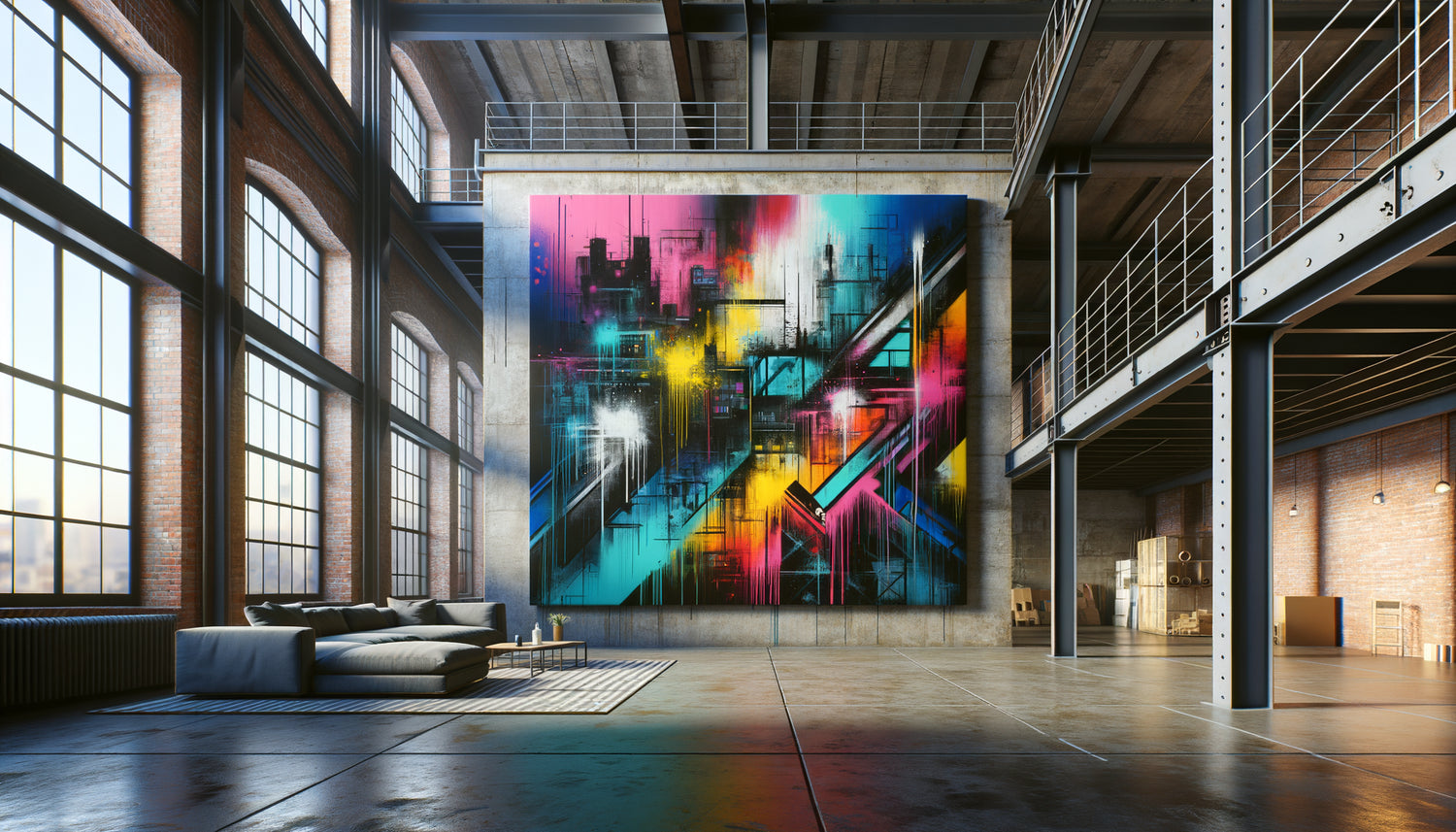
The first time I transformed an old textile factory into a living space, I found myself facing 200m² of raw walls, exposed metal beams and concrete as far as the eye could see. My client, a tech entrepreneur, gave me this challenge: 'I want these walls to tell something, to vibrate.' That's when street art became an obvious choice. Not as added decoration, but as a natural dialogue between industrial architecture and urban art.
Here’s what street art brings to an industrial loft: it amplifies the rebellious soul of the space, creates powerful focal points in XXL volumes, and weaves an organic link between the history of the place and contemporary culture. Three assets that radically transform the perception of your interior.
Yet, faced with the profusion of works available, many hesitate. How to choose without falling into cliché? How to avoid the 'improvised art gallery' effect which lacks coherence? How to respect the authenticity of street art while creating a harmonious space?
Rest assured: street art and industrial lofts share the same DNA – that of transgression of codes, appropriation of spaces, celebration of imperfection. After fifteen years designing lofts across Europe, I have developed an approach that works every time.
In this article, I reveal the essential principles for selecting street art paintings that will enhance your industrial loft, creating that perfect alchemy between raw architecture and urban artistic expression.
The natural alliance between street art and industrial architecture
There is an obvious kinship between street art and industrial aesthetics. Both have emerged from the margins, abandoned spaces, places that society had left behind. When Banksy paints on a crumbling wall or Shepard Fairey posts his posters on factory facades, they use exactly the type of surfaces you find in your loft: raw concrete, exposed brick, oxidized metal.
This connection goes beyond aesthetics. Street art celebrates authenticity, refuses the superficial, embraces imperfections – exactly what an industrial loft does by exposing its pipes, IPN beams and imperfect walls. When you hang a street art painting in this environment, you are not decorating: you are prolonging a conversation already started by the architecture.
I notably worked on a Bordeaux loft where the red brick walls from the 1920s dialogued with a series of stencil portraits inspired by the style of C215. The effect was striking: it was impossible to determine where the history of the building ended and where the artistic intervention began. This organic fusion is precisely what you should seek.
XXL formats: when scale makes all the differenceThe first mistake I regularly see? Artwork that’s too small, lost on immense walls. In an industrial loft, volumes are generous, ceiling heights often reach 3.5 to 4 meters. wall art disappears completely in that space.Think big. Really big. Street art works lend themselves wonderfully to monumental formats: a minimum of 120x180 cm for a main wall, and ideally 150x200 cm or more to create a real visual impact. This scale also corresponds to that of street art in the street – urban murals are measured in meters, not centimeters.
The rule of thirdsTo determine the ideal size, I use this simple method: your wall art should occupy about one third of the width of the wall it dresses. On a 4 meter wall, aim for a work at least 130-140 cm wide. This proportion creates a natural balance between the power of the artwork and the breathing space.
In a recent project in Lyon, we installed a triptych representing a fragmented urban mural on 4 meters long. Each panel measured 120x200 cm. The result? A work that structured the entire open space of the loft, creating a subtle visual separation between the living area and the dining area, without partitioning.

The color palettes that enhance concrete and steel
Street art offers an explosion of colors, but not all harmonize with the industrial aesthetic. Your loft already has a dominant color base: gray of the concrete, brown of the oxidized metal beams, red of the bricks, black of the metal. Your street art must dialogue with these tones, not fight them.The powerful monochrome optionBlack and white works systematically in an industrial loft. Stencil portraits, urban typography, grayscale graphic compositions create immediate sophistication. This monochrome approach reinforces the raw character of the space while bringing an undeniable artistic dimension.
Think big. Really big. Street art works lend themselves wonderfully to monumental formats: a minimum of 120x180 cm for a main wall, and ideally 150x200 cm or more to create a real visual impact. This scale also corresponds to that of street art in the street – urban murals are measured in meters, not centimeters.
The rule of thirdsTo determine the ideal size, I use this simple method: your wall art should occupy about one third of the width of the wall it dresses. On a 4 meter wall, aim for a work at least 130-140 cm wide. This proportion creates a natural balance between the power of the artwork and the breathing space.
In a recent project in Lyon, we installed a triptych representing a fragmented urban mural on 4 meters long. Each panel measured 120x200 cm. The result? A work that structured the entire open space of the loft, creating a subtle visual separation between the living area and the dining area, without partitioning.
The color palettes that enhance concrete and steel
I remember a Parisian loft where three street art paintings depicting urban silhouettes in black and white completely transformed the atmosphere. The owner had chosen works inspired by JR's collages, those monumental faces that seem to emerge from the walls. The contrast with the polished concrete created a captivating visual tension.
Strategic touches of color
If you prefer color, opt for street art with a limited but intense palette. One or two saturated tones on a neutral background – bright red, electric yellow, Klein blue – bring that urban energy without visually overwhelming the space.
Paintings inspired by urban pop art, with their blocks of primary colors, work particularly well. Think stylized aerosol bombs, détourned logos, icons of popular culture reinterpreted. These works create powerful visual anchors in the large volumes of the loft.
Street art themes that resonate with the loft spirit
Not all street art styles are equally suitable for an industrial loft. Some themes create a natural resonance with the architecture and history of the place.
Assumed urbanity
Representations of the city – skylines, subways, tags, graffiti, street scenes – reinforce the loft's urban identity. These street art paintings establish a continuity between the exterior and interior, reminding you that your living space is part of the fabric of the city.
One of my clients collected photographs of street art taken in different metropolises: a Berlin wall, a Melbourne alleyway, a London passage. Transformed into large-format paintings, these works created an imaginary geography that mentally expanded the loft's space.
Aesthetic protest
Street art often carries a message, a social critique, a political vision. In an industrial loft – a space historically associated with the working class and then appropriated by gentrification – these committed works add a fascinating narrative depth.
The détournement of icons, the impactful typographic messages, the anonymous figures of everyday life immortalized by art: these themes create spaces that are not only beautiful but also provoke reflection and fuel conversations.
Gestural abstraction
Abstract compositions inspired by graffiti – paint drips, urban calligraphy, chromatic explosions – bring pure energy. These street art paintings act as splashes of life in the austerity of concrete and steel.
In a Brussels loft, we installed an abstract work 2 meters high, composed of colorful drippings and superimposed tags. The effect was spectacular: the artwork seemed to have captured the very essence of street art, that controlled spontaneity which characterizes the best urban interventions.

The art of staging: where and how to hang
The location of your street art paintings largely determines their impact. In an industrial loft, the open space configuration offers unique possibilities but requires strategic thinking.
The main accent wall
Identify the wall you see first when entering, or the one that visually structures the space. This is where your major street art painting should reign. A single large format is better than several small pieces scattered. This concentration creates a powerful focal point that anchors the entire arrangement.
Position the center of the artwork at approximately 145-150 cm from the floor – the standard museum height, which corresponds to the natural eye level. In a loft with high ceilings, you can raise it slightly so that the work breathes better in the volume.
Installation in series or wall gallery
If you opt for several street art paintings, create a thoughtful composition. The 'gallery wall' hanging works well in a loft, provided that thematic or chromatic consistency is maintained.
My favorite technique? Asymmetrical grid: artworks of different sizes organized according to an invisible grid, with regular spacing (about 8-10 cm between each frame). This approach structures visually without excessive rigidity, creating a balance between order and spontaneity – exactly the spirit of street art.
The directional lighting trick
A beautifully lit street art painting instantly gains presence. Install spotlights on rails or adjustable wall lights that create a uniform wash of light over the artwork. In an industrial loft, this functional lighting naturally integrates into the aesthetics of the place while theatricalizing your paintings.
I recently equipped a Lille loft with exposed electrified rails in matte black metal, with adjustable LED spotlights. The system illuminated three large-format street art paintings while reinforcing the industrial vocabulary of the space. Functionality and aesthetics merged perfectly.
Ready to transform your industrial loft into a contemporary urban gallery?
Discover our exclusive collection of Street art paintings that will perfectly complement the raw soul of your industrial space.
When urban art meets industrial authenticity
Imagine yourself in your transformed loft. That concrete wall which seemed austere now vibrates with a new energy thanks to this monumental stencil portrait. The metal beams are no longer simple structural elements but a natural frame that enhances your collection of street art paintings. Your space is now telling a story – the story of the city, urban culture, and your own artistic sensibility.
Street art paintings do not decorate an industrial loft: they reveal it, amplify it, complement it. They create that rare alchemy where architecture and art merge in organic coherence. Start with a major work, one that speaks to you viscerally. Let it inhabit the space for a few weeks. Then, gradually, build your collection by listening to what the space suggests.
Your industrial loft is waiting for only one thing: that you offer it the art it deserves, the kind that celebrates its raw authenticity while infusing it with the vibrant life of the street.
Frequently asked questions about street art paintings in an industrial loft
Are street art paintings really suitable for all industrial loft styles?
Absolutely, but the approach varies depending on the level of finish in your loft. If you have retained a very raw look – untreated concrete, exposed pipes, authentic patina – prioritize street art paintings with strong black and white compositions or with saturated primary colors. These works create an assumed contrast that enhances the roughness of the materials. If your loft has a more refined and contemporary industrial aesthetic – polished concrete, brushed metal, careful finishes – you can explore more sophisticated street art pieces, with mixed techniques or abstract compositions inspired by graffiti. The key is to respect the visual vocabulary of the place: street art and industrial architecture share this celebration of authenticity and unconventionality. In any case, simply avoid overly polished or academic works that would clash with the rebellious spirit of the loft. I have accompanied dozens of very different projects, from hyper-raw lofts to refined industrial penthouses, and each time, street art paintings have brought that urban soul touch that was missing.
Should street art paintings be framed or left raw?
This question comes up systematically, and my answer depends on the desired effect. Street art paintings on canvas without a frame reinforce authenticity and spontaneity – the artwork seems to have been torn directly from an urban wall. This approach works wonderfully in a very raw loft where you are looking for that visceral connection with the street. The edges of the canvas, often painted in continuity with the work, become part of the composition. On the other hand, if your loft has a more sophisticated industrial aesthetic, a simple frame can create an elegant highlighting. Then opt for frames in matte black metal, unvarnished raw wood, or even brushed steel – materials that naturally dialogue with industrial architecture. Absolutely avoid gilded frames, ornamental moldings or excessively wide mats that distort the spirit of street art. In several projects, I have also used floating plexiglass frames that create a particularly striking modern suspension effect with graphic street art paintings. Test both options by visualizing the whole thing mentally before deciding.
How to create consistency if I want several street art paintings of different styles?
Stylistic diversity can be an asset if orchestrated intelligently. Rather than seeking perfect uniformity – which would contradict the spirit of street art – create subtle connecting threads that unify your collection. First principle: limit your color palette even if styles vary. For example, works exclusively in black-and-white-red, or compositions sharing the same tones of blue and orange. This color consistency creates visual harmony even if techniques differ. Second strategy: unify by theme. Street art paintings all representing urban elements – even in varied styles – will tell a coherent story. Portraits, typography, street scenes can coexist if they speak of the city. Third approach: harmonize formats and hanging arrangement. Works of different styles but similar dimensions, hung according to a regular grid, will create a structured collection despite diversity. In a Berlin loft, I installed six street art paintings in completely different techniques – stencil, collage, gestural abstraction – but all in 100x100 cm format and all featuring black and yellow. The result was surprisingly coherent while celebrating the creative diversity of street art.


