I've spent ten years exploring artists’ warehouses from Bushwick to Berlin, Shoreditch to Marseille. And each time, the same scene repeats: a collector falls in love with a masterful street art piece, then hesitates. Their gaze oscillates between the raw, authentic work and its framed version, more subdued. This hesitation reveals much more than a simple aesthetic choice.
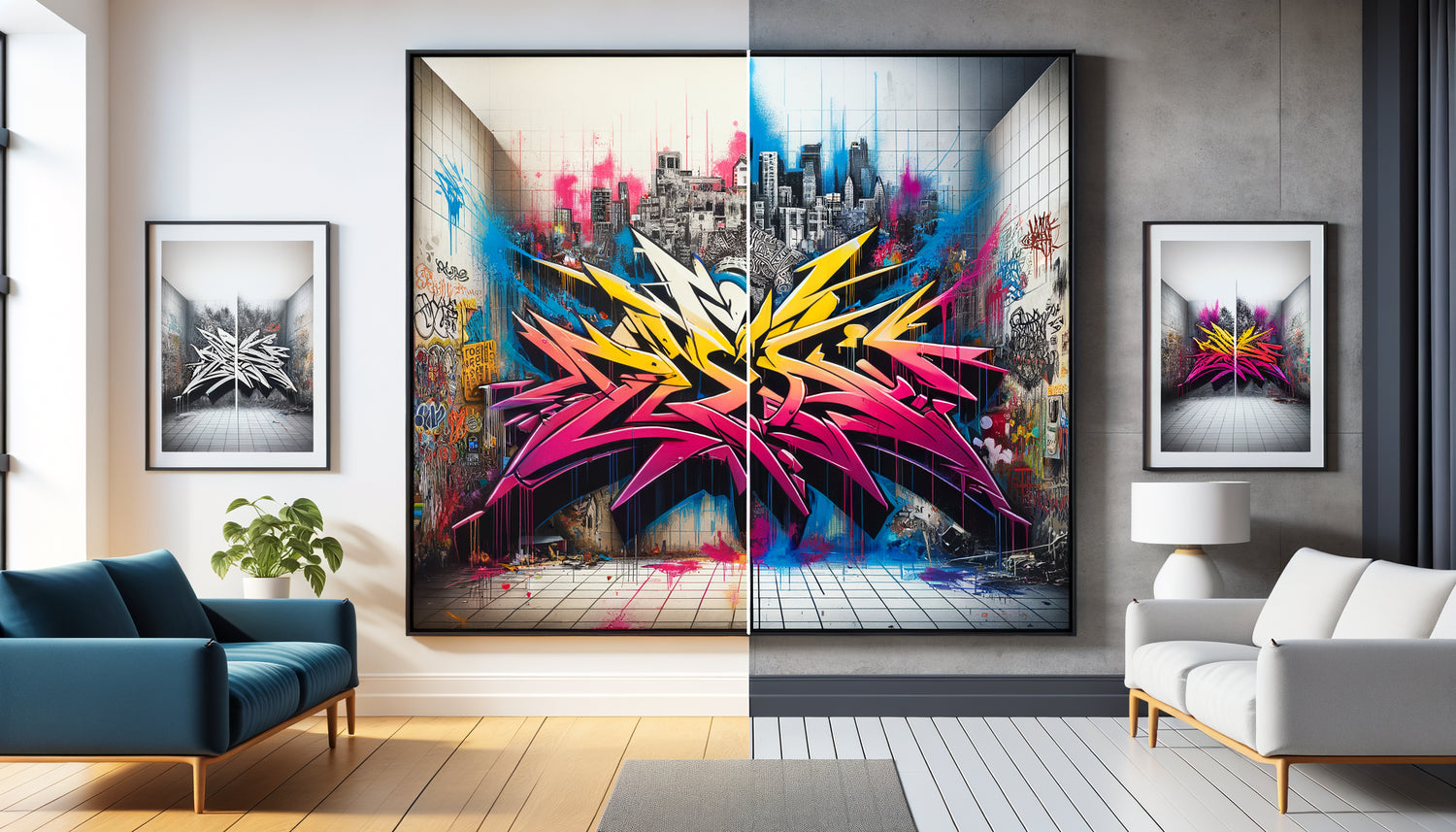
Here's what a wall art street art framed or unframed brings: a visual signature that transforms your interior into an urban gallery, flexibility of integration according to your lifestyle, and protection adapted to the emotional value of the work. The dilemma is not technical; it's identity-related.
You’ve probably felt this frustration: craving a street art piece on Instagram, imagining it on your wall, then freezing when choosing. Framed to protect the investment? Unframed to keep that raw energy that seduced you? Conflicting advice abounds, and you find yourself paralyzed.
Rest assured: there are no bad choices, only decisions misaligned with your environment and sensitivity. After advising hundreds of buyers and observing the evolution of their interiors, I realized this question hides three essential dimensions: authenticity, preservation, and spatial harmony.
I’m going to reveal how to choose based on what really matters to you, beyond decorative conventions.
The raw soul of street art without a frame
The wall art street art without a frame breathes. Literally. When you hang a bare canvas, without barrier or border, you invite the energy of the street into your living room. The irregular edges, sometimes splashed with paint, tell the artist's gesture. This raw materiality creates an unparalleled emotional proximity.
I’ve seen minimalist Scandinavian apartments totally transformed by a single unframed piece. The contrast between the pure white walls and the graphic violence of street art generates a fascinating visual tension. Without the mediation of a frame, the work seems to float, as if torn from a Brooklyn wall to land in your space.
This approach is particularly suitable for large formats. A wall art street art of 120x80 cm without a frame occupies the space with a raw, almost aggressive presence. The absence of border amplifies its dimension, as if the work overflowed its own limits. It's the choice of purists who want to preserve urban authenticity.
The concrete advantages of unframed
Beyond aesthetics, a frameless street art painting offers valuable flexibility. Changing walls, moving house, reorganizing: you handle the artwork without constraint. Economically, the absence of a frame also means an investment focused on the art itself rather than its setting.
This freedom does have its downside. The edges of the canvas are exposed to friction, dust, and direct UV rays if you're near a window. I’ve seen collectors cry over damaged corners after a poorly prepared move. Frameless street art requires particular vigilance and thoughtful hanging.
The protective sophistication of the frame
Framing a street art painting is a fascinating cultural translation. You take a language born of transgression and introduce it into the classic vocabulary of art. This apparent contradiction creates all the magic.
A well-chosen frame does not domesticate the work; it amplifies it. I discovered this truth in a Parisian loft where a black matte Banksy dialogued with Haussmannian moldings. The frame created a visual buffer zone, an area that allowed the contemporary artwork to coexist with historic architecture without conflict.
A framed street art painting naturally integrates into mixed interiors, where different eras and styles coexist. The frame acts as a translator, allowing the artwork to converse with your other decorative elements. This is particularly relevant if you collect multiple artistic styles.
Protection and heritage enhancement
Let's talk pragmatism: a frame protects your investment. UV protective glass, distance between the canvas and the pane, reinforcement of corners, relative sealing against humidity... Professional framing multiplies the lifespan of your street art painting. If you buy a valuable piece, this protection quickly becomes profitable.
The frame also changes the economic perception of the artwork. A bare canvas can seem relaxed, almost provisional. The same painting framed acquires gravity and legitimacy that impresses visitors. This psychological dimension counts if you consider your collection as transmissible heritage.

Decoding your space and lifestyle
The real question isn't “framed or unframed?” but “who are you and how do you live?”. Your decision should reflect your daily reality, not a disconnected Pinterest aspiration.
If you have young children, curious pets, or if you regularly host lively parties, the framed street art canvas under glass is essential. Protection isn't a luxury, it’s a necessity. I’ve seen too many beautiful works damaged by a soccer ball or an enthusiastic dog paw.
Conversely, if you live in an urban studio with an industrial aesthetic – exposed brick, visible piping, polished concrete – the unframed option integrates organically. The artwork becomes a natural extension of your architecture, like a graffiti would have appeared on your converted factory wall.
Your frequency of redecorating also counts. Urban nomads who move neighborhoods every two years will prefer the lightness of the unframed option. Homeowners settled in for the long haul can invest in custom framing that permanently enhances the artwork.
The smart compromise : the American box frame
Between the brutality of the unframed and the formality of traditional framing there is an elegant third way: the American box frame. This framing technique leaves a space between the canvas and the frame, creating a fascinating floating effect.
Your street art canvas seems to float in its frame, preserving its raw dimension while benefiting from a protective structure. It's the favorite option of contemporary galleries because it solves the dilemma: visual authenticity AND physical preservation.
The American box frame works particularly well with works on thick stretcher bars, where the depth of the canvas becomes an aesthetic element in its own right. The frame emphasizes this three-dimensionality without stifling it. For a modern interior seeking this perfect balance between casualness and sophistication, it is often the ideal solution.
Adapt the choice according to artistic technique
Not all street art works are equal when it comes to this question. A limited edition screen print almost systematically justifies museum framing: anti-reflective glass, rabbet, simple frame. These fragile pieces deserve maximum protection.
Conversely, a thick acrylic canvas with relief paint loses its tactile impact under glass. These textured works gain by breathing, exposing their materials, their saturated colors and their furious brushstrokes. The unframed street art canvas then reveals all its sensory power.

The coherence of your wall: thinking in collections
A common mistake: buying artworks one by one without a global vision. Six months later, you find yourself with an incoherent patchwork – three framed canvases, two unframed, a mix of frame styles. Visually, it's chaos.
If you start a collection of street art, establish a rule from the beginning. Either all framed in the same style (black matte, natural wood, brushed metal...), or all unframed for an assumed gallery wall. This visual discipline transforms an assemblage into a coherent collection.
I accompanied a collector who cleverly mixed: his masterpieces (80x120 cm and larger) remained unframed to maximize their impact, while the medium formats (40x60 cm) were uniformly framed in black matte. The result created a clear visual hierarchy, naturally guiding the eye.
This approach also works over time. Start by acquiring your street art paintings without frames to limit the initial investment. Over the years, you can gradually have your favorite pieces framed, creating a natural evolution of your collection that tells your story as an enthusiast.
Ready to make your choice with confidence?
Discover our exclusive collection of Street art that will transform your interior into a contemporary urban gallery, with or without frame according to your vision.
Your decision, your signature
You understand: there is no universal answer to the question « framed or unframed? ». Your choice must reflect three personal dimensions: your aesthetic sensibility, your practical lifestyle, and your heritage vision of art.
The unframed street art painting calls you if you are looking for maximum authenticity, if your interior already breathes urban industrial, and if you accept increased vigilance in maintenance. It's the choice of the purist, the one who wants the raw energy of the street at home.
Framing is a must if you integrate street art into an eclectic environment, if you prioritize long-term protection, or if you compose a mixed collection requiring visual unity. It's the choice of the thoughtful collector who sees beyond the moment.
Visualize your wall in five years. Imagine yourself in front of your favorite street art painting, the one that always captures your attention upon waking up. Is it bare, powerful, immediate? Or framed, protected, integrated into a sophisticated ensemble? This mental image gives you your answer.
Now, trust your instinct. The artwork that moves you deserves a presentation that amplifies that emotion, not constrains it. Your wall awaits its urban signature, free or framed, but always authentically yours.
FAQ : Your questions about framing street art
Does a frameless street art painting lose value over time?
No, the artistic value of a work does not depend on its framing. However, its condition directly influences its market value. A well-maintained frameless street art painting – hung away from sources of humidity, protected from direct UV rays, handled with care – perfectly retains its value. The essential thing is the authenticity of the artwork and its provenance. Many collectors actually seek out unframed pieces for their raw character. If you are considering a future resale, keep all certificates of authenticity and document the history of the work, framed or not.
Can you frame a street art painting purchased without a frame later?
Absolutely, and it's even a smart strategy. Buying your frameless street art painting allows you to first invest in the artwork itself, then choose the ideal frame once the work is installed at home. You will see how natural light interacts with the colors, how the artwork dialogues with your furniture. This observation period of a few weeks will guide you towards the perfect frame style: modern and understated, industrial, or even luxurious depending on the desired effect. Choose a professional framer who understands the specifics of street art for a museum-quality result.
What type of frame should you choose to avoid betraying the urban spirit ?
The mistake would be to impose a rococo gilt frame on a contemporary urban artwork! To respect the DNA of street art, prioritize raw materials and clean lines: matte black frame, brushed metal, unvarnished wood, or industrial aluminum. The American crate remains the most relevant choice as it preserves the raw presence of the work while protecting it. Avoid overly classic marie-louise frames and ornamental frames. If you are unsure, observe how contemporary galleries present their street art works: the sobriety of the frame always enhances the artwork without visually competing with it.