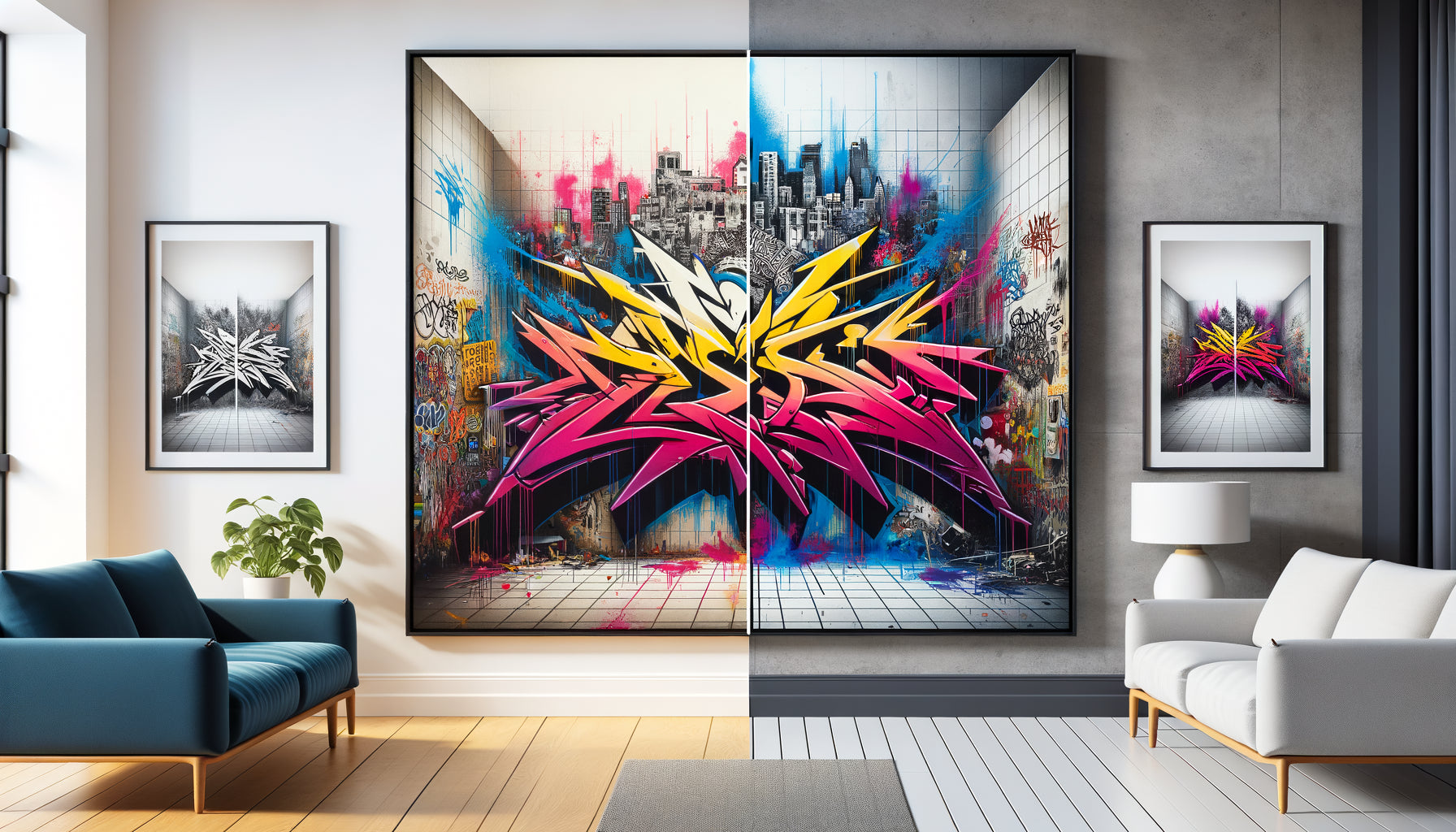
Last year, at an underground auction in Shoreditch, I saw a buyer hesitate between two similarly sized street art pieces. One was offered at €800, the other at €8,000. Same technique at first glance, same format, same graphic universe. Yet, one came from a promising emerging artist, the other from a name already established in the New York gallery circuit. This scene perfectly illustrates the dilemma many collectors face: how to determine the fair price of an original street art when the differences can be so dizzying?
Evaluating the price of an original street art painting relies on three fundamental pillars: the artist's notoriety and trajectory within the street art ecosystem, the intrinsic characteristics of the work (technique, size, year of creation), and the dynamics of the secondary market which reveals the actual demand for that artist. These elements combined allow to distinguish a judicious acquisition from an overvalued impulsive purchase.
You are fascinated by this graphic canvas seen in a gallery, but the displayed price leaves you perplexed. Is it justified? Are you facing a future gem or an overpriced work? Without a reading grid, it is difficult to decide. And this uncertainty can lead you to miss exceptional opportunities or, worse, lead you towards disappointing investments.
Rest assured: the evaluation of a street art painting obeys tangible criteria, far from the elitist mystery that is sometimes attributed to it. With the right keys to read, you will develop an astute eye to decipher prices and make informed decisions. I share with you today the concrete methods that I systematically apply to evaluate each work that passes through my hands.
The artist's rating: decoding the creative trajectory
Even before analyzing the artwork itself, the notoriety of the street artist constitutes the foundation of any evaluation. But be careful: it is not simply a matter of counting Instagram followers. I always examine several cross-referenced indicators to understand the real positioning of a creator.
First, their exhibition history. An artist who has exhibited in recognized galleries (Lazarides in London, Jonathan LeVine in New York, Magda Danysz in Paris) benefits from institutional legitimacy that is reflected in prices. These galleries play a role of qualitative filter. Next, I observe their presence in the permanent collections of museums or cultural institutions. A work acquired by MOCA Los Angeles or MACVAL Vitry-sur-Seine definitively anchors an artist in the history of contemporary art.
The secondary market also provides valuable insights. On platforms like Artprice or Artsy, I research previous auction results. An artist whose works are regularly resold above their initial acquisition price demonstrates sustained demand. Conversely, repeated unsold items signal an overvaluation.
Finally, the scarcity of production comes into play. Some street artists produce massively, which mechanically dilutes the unit value. Others deliberately limit their production, creating a tension between supply and demand that propels prices. I have seen emerging artists whose pieces start at €1,500 simply because they only create 15 paintings per year.
The intrinsic criteria of the work: beyond aesthetics
Once the artist's context has been assessed, the artwork itself reveals characteristics that directly influence its price. The technique used is the first criterion. An original painting in acrylic or spray paint, entirely hand-made, will always be worth more than a retouched silkscreen print or digital impression. The distinction is crucial: some galleries present limited editions as originals, creating a detrimental confusion.
Dimensions also matter, but not linearly. A large format (over 120x120 cm) is visually impressive and often justifies a high price due to the decorative impact and the amount of work invested. However, I have noticed that medium formats (around 80x100 cm) sometimes sell better because they adapt to more interiors. The pricing evaluation must therefore integrate practicality beyond prestige.
The year of creation and artistic period
In street art, chronology is particularly important. Works created during the ascending phase of an artist, before his major recognition, possess a unique historical value. I have seen a 2008 painting by a currently famous artist sell three times the price of a recent similar piece, simply because it testified to his pre-recognition period.
The signature and certificates of authenticity represent non-negotiable elements. An original street art work without certificate immediately loses 30 to 50% of its potential value. This document, ideally issued by the representative gallery or the artist themselves, guarantees traceability and will greatly facilitate a future resale.

Understanding Price Ranges According to Artist Profiles
To quickly assess a proposal, I use a reading grid that segments the street art market into several categories. Emerging artists, recently graduated from art schools or self-taught with less than 5 years of exhibition experience, generally offer original works between €500 and €2,500. This is the most accessible segment but also the riskiest: only a minority will confirm their potential.
Regionally established artists, recognized within a specific geographic ecosystem (for example, highly sought after in Berlin but little known elsewhere), operate within a range of €2,000 to €8,000. They benefit from solid local demand but their limited reach caps prices.
At the higher level, internationally recognized artists whose works circulate in several countries, exhibit at major fairs (Art Basel, Frieze) and have a structured gallery representation, display prices between €8,000 and €50,000. At this stage, you are investing in a relatively secure value with a documented market history.
Finally, icons of street art (think Banksy, Shepard Fairey, Invader, JR) reach peaks exceeding €100,000 for their major original pieces. Here, we leave the territory of decoration to enter that of pure heritage investment.
Warning signs that should make you doubt
During my visits to galleries and online platforms, I have developed a radar to detect problematic practices in the pricing of street art paintings. First red flag: an abnormally low price for an established artist. If an original work by a recognized creator is offered 40% below its usual rating, ask yourself questions about its authenticity or condition.
Conversely, be wary of inflated prices for artists with no verifiable history. Some galleries artificially create value by presenting unknown emerging artists at the rates of confirmed artists, relying on buyers' ignorance. Always check consistency: an artist without auction presence, without documented exhibitions, should not exceed €3,000 for an original, whatever the apparent quality.
The absence of a certificate of authenticity, as mentioned, constitutes a reason for rejection. Similarly, a vague provenance (“acquired from a private collector” without further clarification) should raise your vigilance. In assessing an original street art painting, traceability equals credibility.

Where to compare prices and refine your judgment
To build your own expertise, nothing replaces systematic comparison. I regularly consult several complementary resources. Databases like Artprice record worldwide auction results and allow you to track the evolution of an artist's price over several years. It is an essential tool to verify whether the requested price aligns with actual transactions.
Street art galleries generally display their prices online or upon request. Comparing rates for artists of similar profile (same seniority, same reach) gives you reference points. Do not hesitate to contact galleries directly: most are transparent and educational with sincere collectors.
Contemporary art fairs are also valuable observatories. At events like Urban Art Fair in Paris or POW! WOW! in Hawaii, you can directly compare the proposals of dozens of galleries and refine your sensitivity to prices. Physical experience, dialogue with gallery owners and immediate comparison develop your eye much more effectively than online browsing.
The role of specialized platforms
Platforms like Artsy, Saatchi Art or Rise Art aggregate thousands of artworks with their prices displayed. Although they take a substantial commission (often 30-40%), they offer welcome transparency and allow you to filter by artist, technique, size and price range. I regularly use these tools to evaluate the pricing position of a street art painting before a purchase in a physical gallery.
Ready to take the step towards your first acquisition?
Discover our exclusive collection of Street art paintings that combine overflowing creativity and transparent prices, perfectly suited to demanding collectors seeking authenticity.
From evaluation to decision: trust your informed intuition
After analyzing all these objective criteria, evaluating the price of a street art painting ultimately incorporates a subjective dimension that should not be overlooked. A fair price only exists in the meeting between objective value (artist's rating, characteristics of the work, market dynamics) and your personal attachment to the piece.
I have seen collectors pay 20% above the rating for a work that resonated deeply with their personal history. And I have never heard them regret this deviation. Conversely, I have met buyers who grabbed a "good financial deal" for a piece that left them indifferent, and who resold it two years later without pleasure.
Street art, more than any other form of contemporary art, carries an emotional charge, a rebellion, an urban poetry that transcends Excel spreadsheets. If you have verified that the price falls within a range consistent with objective criteria, and that the work genuinely moves you, you probably have the right decision.
Your first acquisition may be modest in market value, but immense in satisfaction. It will mark the beginning of a different look at urban space, contemporary creation, your own interior. And it is precisely this transformation that justifies every euro invested in an authentic original street art painting.
Frequently Asked Questions
Does a street art painting gain value over time?
The answer depends entirely on the artist's trajectory. Statistically, only 10 to 15% of artists street art emerging artists will experience sufficient recognition for their works to appreciate significantly. On the other hand, for already established artists with a positive auction history, the probability of medium-term valuation (5-10 years) is much higher, often between 20% and 80% depending on profiles. The key is to buy first for aesthetic pleasure, considering any financial appreciation as a welcome but not guaranteed bonus. Prioritize artists whose work evolves, renews itself and generates growing critical interest rather than those who repeat a successful formula.
What is the price difference between an original and a limited edition?
The difference is usually significant: a unique original typically sells for between 5 and 20 times the price of a limited edition by the same artist. For example, if a numbered silkscreen print in an edition of 50 sells for €300, the hand-painted original work by the same creator will range from €2,000 to €6,000. This difference reflects the uniqueness, the creation time invested and the absolute rarity of the original. Limited editions offer an accessible entry point to discover an artist, but they are more decorative objects than heritage investments. For a true collection, always prioritize originals, even smaller ones, which retain their value better and carry the direct energy of the creative gesture.
How to negotiate the price of a street art painting in a gallery?
Negotiation is possible in most galleries, particularly during a first purchase or for significant amounts. My approach is to first demonstrate knowledge of the market and the artist, which establishes a dialogue of mutual respect. Then, I ask questions about provenance, exhibition history and the artist's prospects, signaling my seriousness. A negotiation margin of 10 to 15% often exists, especially if you pay cash or consider multiple acquisitions. Some galleries prefer to offer payment facilities rather than a direct discount. Don’t hesitate to ask if other works by the same artist are available at different prices, or to express your maximum budget: a good gallerist will seek to accompany you in your collection rather than force a one-off sale. The long-term relationship often takes precedence over the immediate transaction.