I discovered my first street art piece on recycled wood in the studio of an artist from the Belleville neighborhood. A European transport pallet transformed into a canvas, where a portrait of Basquiat exploded with colors. The veins of the wood crossed his face like urban scars. That day, I understood that some creations only make sense with the support they carry.
Here's what recycled wood street art concretely brings: a material authenticity that canvas cannot reproduce, a story that begins before even the first brushstroke, and an ecological dimension that resonates with contemporary urban values.
You love the raw energy of street art, but you find that prints on canvas lack character. You're looking for that soul, that imperfection that brings a room to life. Galleries offer sanitized works, and you feel that visceral connection with the street is missing.
Good news: recycled wood isn't just a support. It’s a co-author who dialogues with the work, bringing its memory and transforming each piece into a unique object. Let me show you why this alliance between street art and reclaimed material creates an alchemy you won't find anywhere else.
The memory of wood: when the support already tells a story
Each recycled plank bears the marks of its previous life. These traces of rusted nails, these scratches from forklifts, these stains of industrial oil: all become an integral part of the final work. I saw an artist from Marseille use a container door to paint a port scene. The impacts of salt and rust added a texture that fifteen years of academic technique could never have reproduced.
Street art on recycled wood refuses the virgin and neutral support. It embraces pre-existing history. Unlike a canvas stretched in a factory, a European pallet has already traveled, transported goods, survived the elements. This temporal patina adds an instant narrative depth. Your wall doesn't simply receive an image: it welcomes a fragment of industrial life reincarnated as art.
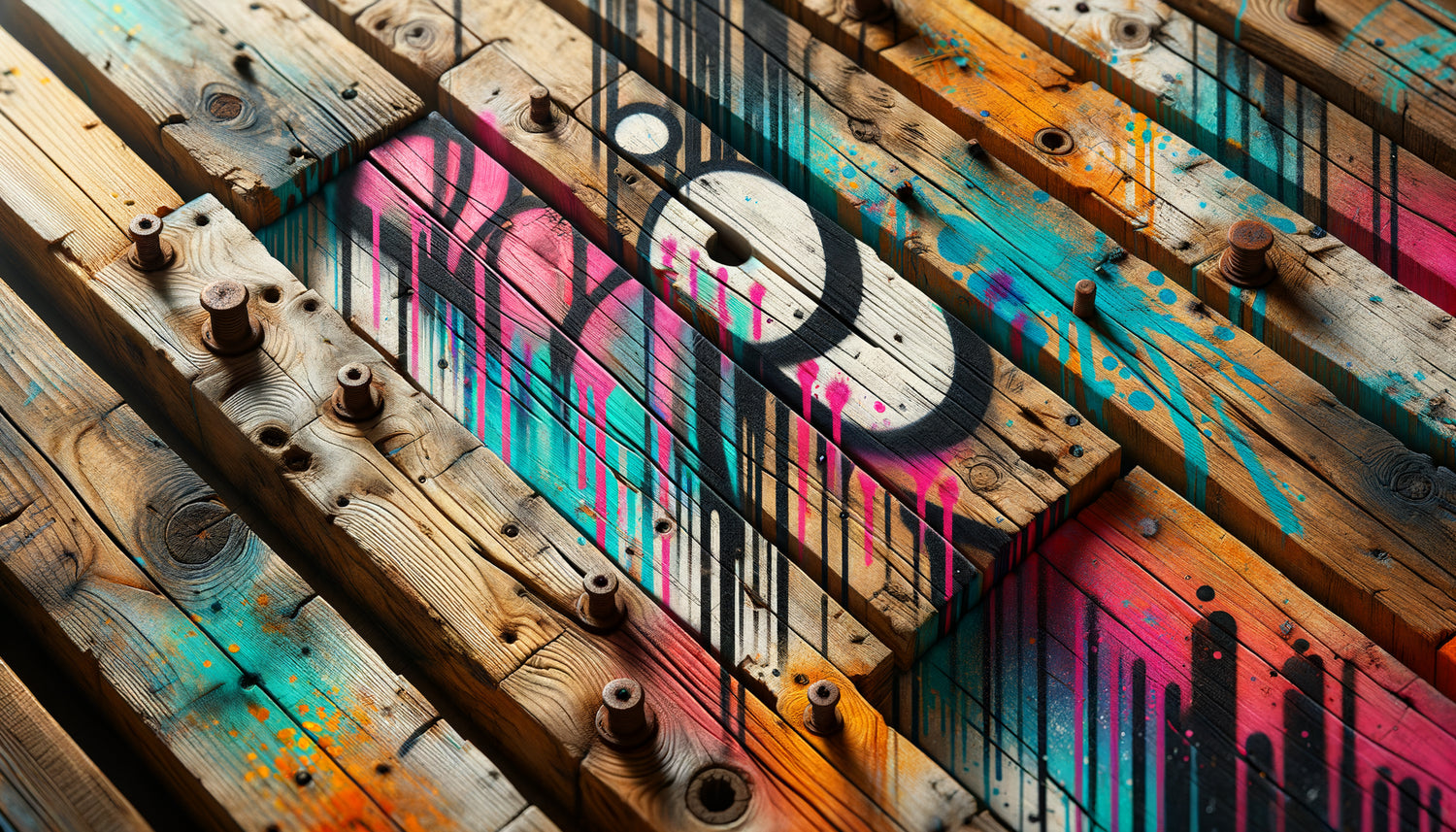
The natural color variations of the wood dialogue with the paint. A white stencil on a light section blends delicately, while the same shape on a dark part explodes with contrast. This unpredictability forces the artist to compose with the material, not against it. The result? street art paintings where each copy is truly unique, even when it's a series.
The tangible authenticity that’s missing from prints
Feel a canvas print: you sense a smooth, uniform, industrial surface. Feel a wall art street art on recycled wood: your fingers encounter roughness, cracks, reliefs. This tactile dimension creates an incomparable physical presence in your interior.
In my journey as a curator, I organized an exhibition comparing two versions of the same work by Miss.Tic: one printed on canvas, the other painted on reclaimed parquet slats. Visitors quickly passed by the canvas, but consistently stopped in front of the wood. They approached, examined the joints between the slats, followed the grain with their fingers. The materiality created engagement.
The weight of reality
A wall art street art on wood possesses a mass, a density that you physically feel. When you hang it, it anchors the space differently. It's no longer a light decoration: it's a sculptural object that changes the visual balance of the room. This material presence paradoxically reinforces the immaterial energy of urban art.
Light plays behave differently on wood. Unpainted areas absorb and reflect according to the angle, creating a work that evolves throughout the day. At 8 am, your wall art street art reveals raw textures. At 5 pm, grazing shadows sculpt the reliefs. This inherent life transforms your wall into a living scene.

Urban ethics: from waste to artwork
Street art was born from recovery: stolen spray cans, abandoned walls, neglected spaces. Painting on recycled wood extends this philosophy of subversion. A Berlin artist I met only works with planks found in demolition sites. For him, using new wood would betray the very essence of the movement.
This ecological consistency resonates powerfully today. Your guests don’t just see a beautiful piece: they perceive a commitment. Street art on recycled wood visually embodies values of circular economy and responsible creativity. In a living room, this ethical dimension adds a layer of meaning that simple aesthetics cannot provide.
The statistics speak for themselves: a standard European palette requires 15 to 20 kg of wood. Diverted into an artistic support, it escapes grinding or incineration. Multiply by thousands of artworks: the movement of street art on recycled wood becomes a significant collective ecological gesture, without ever sacrificing visual impact.
When imperfections become signatures
I used to work with collectors obsessed with perfection: impeccably stretched canvases, millimeter-perfect frames, museum-quality condition. Then I discovered another tribe, one that seeks happy accidents, poetic cracks, irregularities that humanize.
A street art painting on a pallet will never be perfectly rectangular. The slats have lived, moved, sometimes slightly warped. This imperfect geometry creates a fascinating visual tension with the often graphic precision of street art. A geometric stencil on a textured surface generates a dialogue between control and chaos, exactly what urban art seeks to capture.
The beauty of joints and cracks
The spaces between the slats become compositional elements. Some artists paint through these interstices, letting the wall breathe behind. Others integrate them as structural lines. I saw a mural where the vertical joints of a pallet divided a face into fragments, evoking the bars of an urban prison. The support did not carry the work: it co-created it.
The knots in the wood, these defects in the furniture industry, become eyes, planets, vanishing points. A clever street art painting exploits these natural accidents. Result: a work where nature and culture merge, where the tree continues its life as wall art.

The perfect match with contemporary interiors
Current interior design values material authenticity: polished concrete, raw metal, exposed brick. In this vocabulary, a street art painting on recycled wood speaks the language of honest textures fluently. It integrates naturally where a framed canvas would seem too wise, too conventional.
I transformed a loft in Lyon where we installed three large pieces on formwork wood. The dialogue with the metal beams and resin floor was immediate. The artworks didn't decorate the space: they extended its material DNA. This organic harmony is difficult to achieve with traditional supports.
Even in more classic interiors, a street art painting on pallet creates a calculated point of disruption. It breaks predictability without violence, brings urbanity without aggression. It’s the precious grain of sand that prevents decoration from slipping into the smooth monotony of magazines.
The specific techniques that enhance wood
Not all street artists work identically on recycled wood. Some lightly sand it to create a surface for adhesion while preserving the patina. Others attack the raw surface directly, accepting that paint will react differently depending on the porous or varnished areas.
Stencils take on a particular dimension on wood. The imperfections create micro-burrs that soften the contours, avoiding the mechanical coldness of the perfect stencil. It is this controlled imperfection that gives street art on wood its human warmth. The artist's hand becomes visible in the adjustments to the material.
Some creators play with contrasts of shine: matte areas on raw wood, glossy areas on sanded sections. This variation in texture within a single piece adds a visual complexity that only a heterogeneous support can offer. Your eye never fully rests, constantly discovering new details depending on the angle and light.
Ready to welcome a work that tells two stories?
Discover our exclusive collection of Street art paintings that transform your interior into an authentic urban gallery.
The conclusion imposes itself
You are not simply looking for a painting. You're looking for a presence, a silent conversation between matter and message. Street art paintings on recycled wood offer this narrative depth that industrial supports cannot simulate. They simultaneously carry the history of the material and the intention of the artist, creating a work with double temporality.
This week, look at your empty wall differently. Imagine not a posed image, but a fragment of urban history materialized. An object that has lived, been transformed, and continues to evolve in your space. Authenticity is not bought: it is cultivated by choosing pieces that reject aseptic perfection to embrace the imperfect beauty of reality.
Start by visiting local artists' studios, touch the artworks, feel the wood. Or explore online collections that detail the provenance of the supports. The right street art painting on recycled wood will speak to you immediately, and you’ll know that you’re not hanging a decoration, but a story looking for your wall.
Your questions about street art and recycled wood
Is there a risk that recycled wood will degrade over time?
This is a legitimate concern, and here's the reality: the wood used for pallets or industrial formwork is designed to withstand extreme constraints (humidity, weight, impacts). Once treated and stabilized by the artist, it is often more durable than a stretched canvas that can relax or tear. Street art paintings on recycled wood even gain character over time, developing an additional patina. Simply avoid direct exposure to sunlight and excessive humidity, as with any artwork. The beauty of wood lies in its noble aging: it does not degrade, it matures.
How do you securely hang a heavy wood artwork?
The weight is indeed greater than a classic canvas, but it’s manageable with the right system. For a street art painting on pallet of medium size (80x120 cm), count 8 to 15 kg. Use metal hooks suitable for the type of wall (drywall, concrete, brick) with a capacity greater than the actual weight. Most artists fix robust hanging systems to the back: metal cables, brackets or rails. If in doubt, two attachment points are better than one. And honestly, the weight adds to the presence of the artwork: when you install it, you physically feel that you’re hanging something important.
Does recycled wood cost more than a canvas print?
Paradoxically, not always. A high-end canvas print with frame can reach prices similar to a street art painting on recycled wood created by an emerging artist. The fundamental difference: you are paying for a unique piece or a micro-series, not for an industrial reproduction. The manual work of preparing the wood, sanding, treating represents hours that pre-stretched canvas does not require. But you invest in authenticity and rarity. Some artists offer accessible formats (40x60 cm) from 150-250 euros, quite affordable for an original artwork. True cachet is not measured by price, but by the irreplaceable presence in your space.