Last year, at an auction in London, I saw a collector spend €45,000 on what he believed to be an original Banksy artwork. Three months later, expertise revealed it was a limited edition print, certainly authentic, but worth around €3,000. This mishap is not uncommon in the world of street art, where the line between original and limited edition remains blurred for many buyers.
Here's what knowing how to differentiate an street art paintingoriginal artwork from a limited edition brings you: an informed acquisition that protects your investment, the certainty of acquiring a piece whose value actually corresponds to its authenticity, and the pleasure of displaying in your home a work whose nature and history you fully master.
Faced with a gallery wall or an online platform, you may feel this hesitation: how can you be sure not to confuse a unique piece with a numbered reproduction? Sellers sometimes use ambiguous vocabulary, and some artists deliberately muddy the waters by signing their editions massively. This confusion is not trivial: it can represent thousands of euros in difference.
Rest assured: with a few technical clues and an educated eye, you can perfectly identify the exact nature of a street art work. I am going to pass on to you the keys that I use daily to authenticate these pieces, from visual cues to accompanying documents, through the subtleties of manufacturing that only initiates know.
The first golden rule: understand what an original really is
An original street art painting refers to a work created directly by the artist's hand, on a unique support, with no possibility of identical reproduction. Specifically, it is a painting on canvas, a stencil applied manually to wood, or a mixed technique created in a single copy.
The fundamental difference lies in the creation process. For an original, the artist directly works the medium: each brushstroke, each projection of paint, each collage remains absolutely unique. Variations in texture, accidental drips, hesitations are integral parts of the work. Even if the artist reproduces a motif he has already used elsewhere, each manual execution generates microscopic differences impossible to duplicate.
Conversely, a limited edition arises from a mechanical or digital reproduction process. The artist creates an original artwork or a digital file, then uses printing techniques to produce multiple identical copies. These reproductions can be silkscreened, giclée on canvas, or printed in high definition. Each copy generally bears a number (for example 24/100, meaning the 24th copy out of 100 prints) and a signature.
This distinction does not diminish the artistic value of a quality limited edition. Some artists like Shepard Fairey or Invader have elevated silkscreening to a form of art in its own right. But the market value and scarcity differ radically: an original remains by nature a unique copy, while an edition, even limited to 10 copies, exists in several versions.
The visual clues that never deceive
Approach the artwork and examine its surface. This is where the first distinctive signs are revealed. An street art painting original has a relief texture, variable paint thicknesses, perceptible irregularities to the touch (with the seller's permission, of course). You will distinguish the individual brushstrokes, the areas where the paint accumulates, the places where it flows naturally.
On a limited edition, the surface remains hopelessly smooth and uniform. Even high-end reproductions on textured canvas cannot recreate these natural variations. Observe carefully the dark areas and gradients: on an original, you will perceive the superposition of layers of paint, while a print has a homogeneous surface, however sophisticated it may be.
The magnifying glass test reveals all
Equip yourself with a magnifying glass or use your smartphone's camera in macro mode. On a print, even excellent one, at high magnification you will distinguish a tiny dot pattern characteristic of printing processes. These dots form a regular structure, visible particularly in areas of solid color.
An original hand-painted artwork never has this screen structure. You will see fibers of canvas, particles of pigments, microcracks in the dried paint. In the black areas of an original stencil, the paint may have slightly bled under the mask, creating imperfect contours that street artists fully embrace.

The signature and numbering: decoding the codes
The way an artist signs their work provides you with crucial information. On an original street art, the signature is generally inscribed directly into the material, with a brush, marker or stencil. It is an integral part of the work, applied during the creative process or immediately after. Its texture blends in with that of the rest of the paint.
A limited edition almost always bears a numbering and a signature in pencil or fine-tip marker, affixed to the lower margin of the print. You will see mentions such as « 15/50 », « AP » (Artist Proof), « HC » (Hors Commerce), or « EA » (Épreuve d'Artiste). This standardized notation immediately identifies an edition.
However, be careful: some artists sign their originals in a similar way to editions, creating deliberate confusion. In this case, the absence of numbering is a strong indicator. A true original is simply signed, without mention of print run.
The support and materials speak for themselves
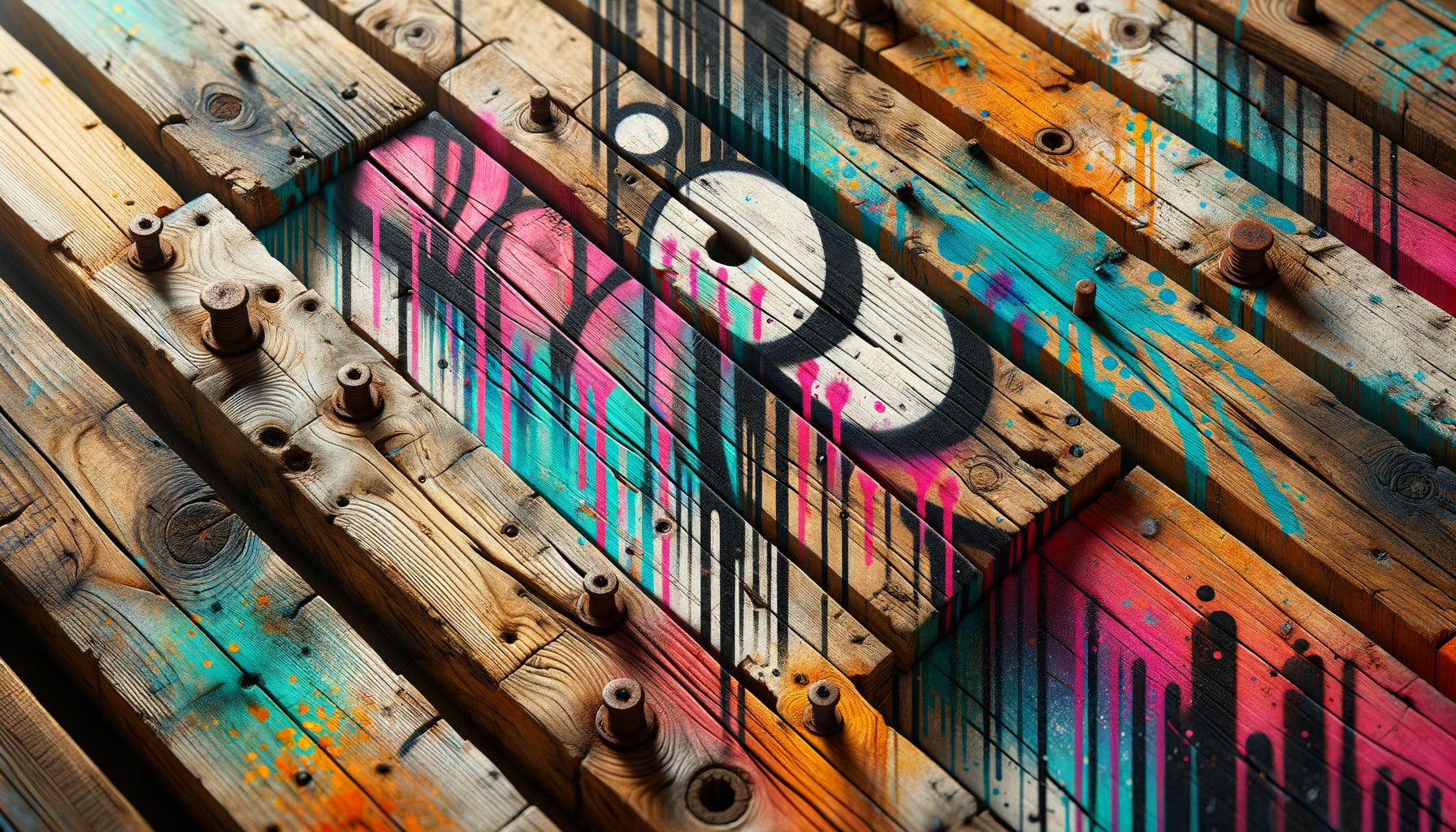
The choice of support often reveals the nature of the work. Street art artists creating originals prefer varied supports: canvases mounted on stretchers, raw wood panels, salvaged metal pieces, old doors, repurposed shutters. This diversity is part of the DNA of the movement, rooted in urban appropriation and the use of unconventional materials.
Limited editions are generally printed on standardized supports: museum-quality art paper, canvas prepared for digital printing, or high-definition photo paper. These supports offer impeccable quality, uniform whiteness, and perfectly smooth texture. Their technical perfection contrasts with the raw and sometimes imperfect character of original supports.
Turn the artwork over if possible. On the back of an original canvas work, you will often discover traces of handling, accidental paint splashes, and personal annotations by the artist. A limited edition mounted on a stretcher generally has a clean, industrial back, with possibly an imprint stamp or certificate glued on.

The authenticity documents that make the difference
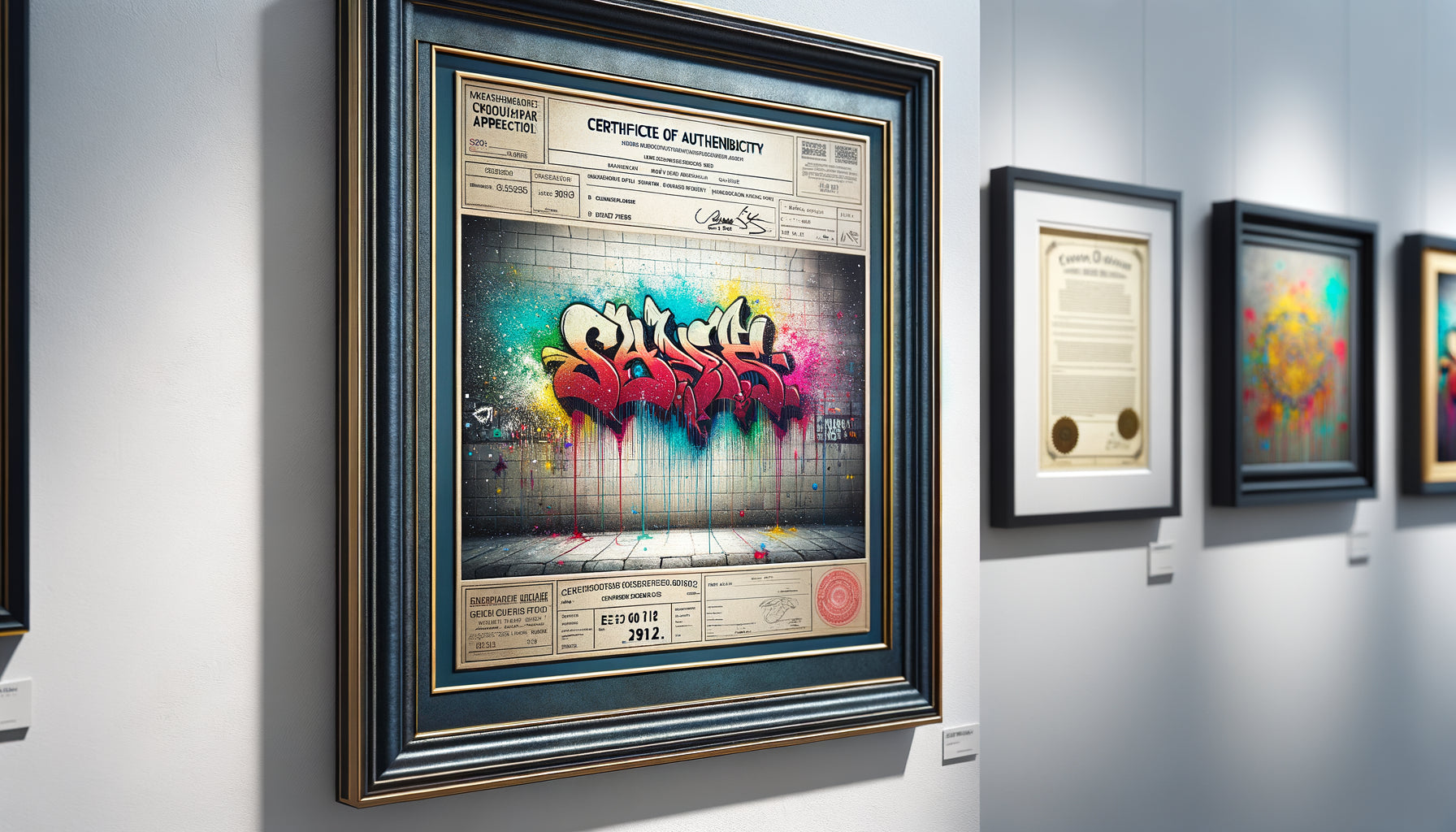
A valuable original street art painting systematically comes with a detailed certificate of authenticity. This document, written by the artist, their represented gallery, or a recognized expert, precisely describes the work: its exact dimensions, technique, year of creation, and most importantly explicitly states that it is an original unique piece.
The certificate for a limited edition clearly indicates the print number, the total number of copies produced, the printing technique used, and the name of the printer. Some prestigious editions also include a dry stamp from the artist or publisher, an additional security against counterfeits.
Beware of vague or generic certificates. A serious document includes photographs of the work, a unique registration number, sometimes a security hologram. For artists with a track record, check that the certificate comes from an official source: the artist's studio, Pest Control (for Banksy), or a recognized gallery specializing in street art.
Traceable provenance
The ownership history constitutes a crucial authentication element. For an original, document the chain of possession from the artist's studio: which gallery acquired it first? Do invoices or exhibition catalogs mentioning this specific piece exist? This traceability reassures authenticity and enhances the work.
Limited editions generally have a simpler provenance: direct purchase on the artist's website, acquisition in a gallery during a drop (limited release), or purchase on the secondary market with successive invoices. The transparency of this distribution chain protects you from forgeries or unauthorized reproductions.
Price as an indicator (but not as proof)
Not surprisingly, the price difference between an original and a limited edition can reach staggering proportions. For an established street art artist, an original typically sells for between 5,000 and 150,000 euros, depending on notoriety, dimensions, and complexity. A limited edition by the same artist ranges from 200 to 5,000 euros for recognized names.
This discrepancy reflects absolute rarity: a single copy versus several dozen or hundreds. But be warned, price is never proof in itself. Some unscrupulous sellers artificially inflate the price of an edition to make it appear original. Others sell off originals by emerging artists at prices comparable to those of editions by established artists.
Use the price as an alert signal: a Banksy original offered for €3,000 is bound to be a scam or misattribution. Conversely, a limited edition sold for €50,000 without particular justification (very low print run, historical importance) should raise your suspicion. Consult recent auction results on platforms like Artsy or Artprice to calibrate realistic price ranges.
Ready to acquire a street art work with confidence?
Discover our exclusive collection of Street art paintings that will transform your interior into a contemporary urban gallery, with the guarantee of total transparency on the nature of each piece.
Your first acquisition in complete peace of mind
You are now equipped to navigate confidently in the street art market. Remember that the differentiation between an original street art painting and a limited edition rests on a set of clues: relief texture, absence of printing grid, signature integrated rather than marginal numbering, unique support, explicit certificate, and consistency of price with the artist's rating.
Start with modest acquisitions to sharpen your eye. Visit specialized galleries, handle the works (with care), compare originals and editions side by side. This direct sensory experience is worth all theoretical guides. Do not hesitate to ask sellers specific questions: a serious professional will appreciate your informed approach and respond transparently.
Whether you ultimately choose an original for its absolute rarity or a limited edition for its quality and accessibility, the essential thing remains knowing exactly what you are acquiring. This knowledge transforms buying art from a risky bet into an informed decision, a source of lasting satisfaction. Your wall is waiting for that piece which will tell your story, that of an informed collector who masters the codes of contemporary street art.
Frequently asked questions about street art works
Can a limited edition take value like an original?
Absolutely, limited editions by certain street art artists experience spectacular appreciation on the secondary market. Shepard Fairey's screen prints or KAWS’ prints, initially sold for a few hundred euros, now reach several thousand during resales. However, the progression is generally less significant than for originals. The key lies in three factors: the growing notoriety of the artist, the restriction of the print run (prefer editions under 100 copies), and the cultural importance of the reproduced image. A limited edition constitutes an excellent entry point into contemporary art collecting, with a real appreciation potential if you choose wisely the artist and the time of acquisition. Keep the artwork impeccably, its authenticity documents and original packaging to optimize its future value.
How to verify the authenticity of an anonymous street artist?
Anonymous street artists like Banksy pose particular authentication challenges that require increased vigilance. For Banksy specifically, only Pest Control, his official authentication body, can issue a valid certificate – and still, only for works sold through his official channels. Many « originals » circulate on the market without this precious sesame, making their attribution highly speculative. For other less established anonymous artists, rely on the reputation of the selling gallery, look for photographs of the artist working on similar pieces, consult online databases and specialized forums where collectors share their knowledge. Purchasing works by anonymous artists requires double caution: prioritize recognized galleries that assume responsibility for attribution, and accept that a portion of doubt will always remain, which mechanically impacts resale value.
Should I prioritize an original by an emerging artist or an edition by an established artist?
This question divides collectors and depends entirely on your objective. If you are looking for aesthetic satisfaction above all else and the pleasure of owning a unique piece, an original work by a talented emerging artist will provide that incomparable experience, often for a budget under 2,000 euros. You directly support creation, participate in the emergence of a talent, and own a work of which you may be among the first to recognize the potential. If your motivation integrates a patrimonial and security dimension, a limited edition by an established artist offers more guarantees: established quote, liquidity of the secondary market, institutional recognition. The ideal strategy is probably to diversify your collection: a few editions by confirmed artists to anchor your approach in a recognized value, complemented by originals from emerging artists that reflect your personal sensitivity and present a higher speculative potential, even if more uncertain.