It's 7 p.m. You step through the threshold of your living room after a tiring day, and your eyes fall on this white wall that reflects back to you... nothing. No refuge. No breath. Just a void that amplifies the tension lodged between your shoulder blades. I have accompanied collectors for twelve years in their quest for soothing works, and this scene, I have heard it recounted dozens of times. The living room should be that sanctuary where the mind settles, yet so many interiors remain cold, silent, unable to bring us back to the essential.
Here's what serene landscape paintings bring to your living room: a visual window to horizons that slow down the mind, a natural presence that regulates the atmosphere, and an emotional anchor that transforms four walls into a haven of peace. You don't need to be an art expert or have a colossal budget. It is enough to understand which compositions dialogue with your need for calm, and how to install them so they breathe in your space.
Confusion often reigns: should you choose a dense forest or a pristine beach? Bright colors or soft hues? A large format or several small canvases? You may be afraid of making a mistake, of investing in a work that ultimately oppresses you rather than frees you. This hesitation is legitimate, because a landscape painting poorly chosen can weigh down a living room instead of soothing it. But rest assured: visual serenity obeys simple principles, almost intuitive, which I will reveal to you.
I promise you that at the end of this article, you will know exactly what type of landscape corresponds to your personality, your luminosity, and the atmosphere you are looking to create. You will discover why certain horizons soothe you instantly, and how to transform your living room into that bubble of tranquility you deserve.
The marine horizon: when immensity dissolves tensions
Marine landscapes possess this rare ability to dilate mental space. Facing an ocean stretching to the horizon, our gaze encounters no barrier, no obstacle. This visual infinity produces a measurable physiological effect: breathing slows down, shoulders relax. I have observed this phenomenon in so many customers installing a coastal scene in their living room.
Favor paintings where the sea occupies two-thirds of the composition, with a clear or slightly cloudy sky. Shades of cerulean blue, pearl gray and off-white create a cool palette without being icy. Avoid scenes of storms or waves that are too dynamic: they introduce movement where you seek stability. A deserted beach at dawn, with this milky light that erases contrasts, constitutes a masterful choice for a living room where we receive or meditate.
The format matters: a horizontal panorama amplifies this feeling of escape. Install it facing the main sofa, at eye level when seated, so that the artwork naturally becomes the focal point during your moments of relaxation. This maritime presence transforms your living room into a true place of decompression.
Mist Forests: The Call of Vertical Silence
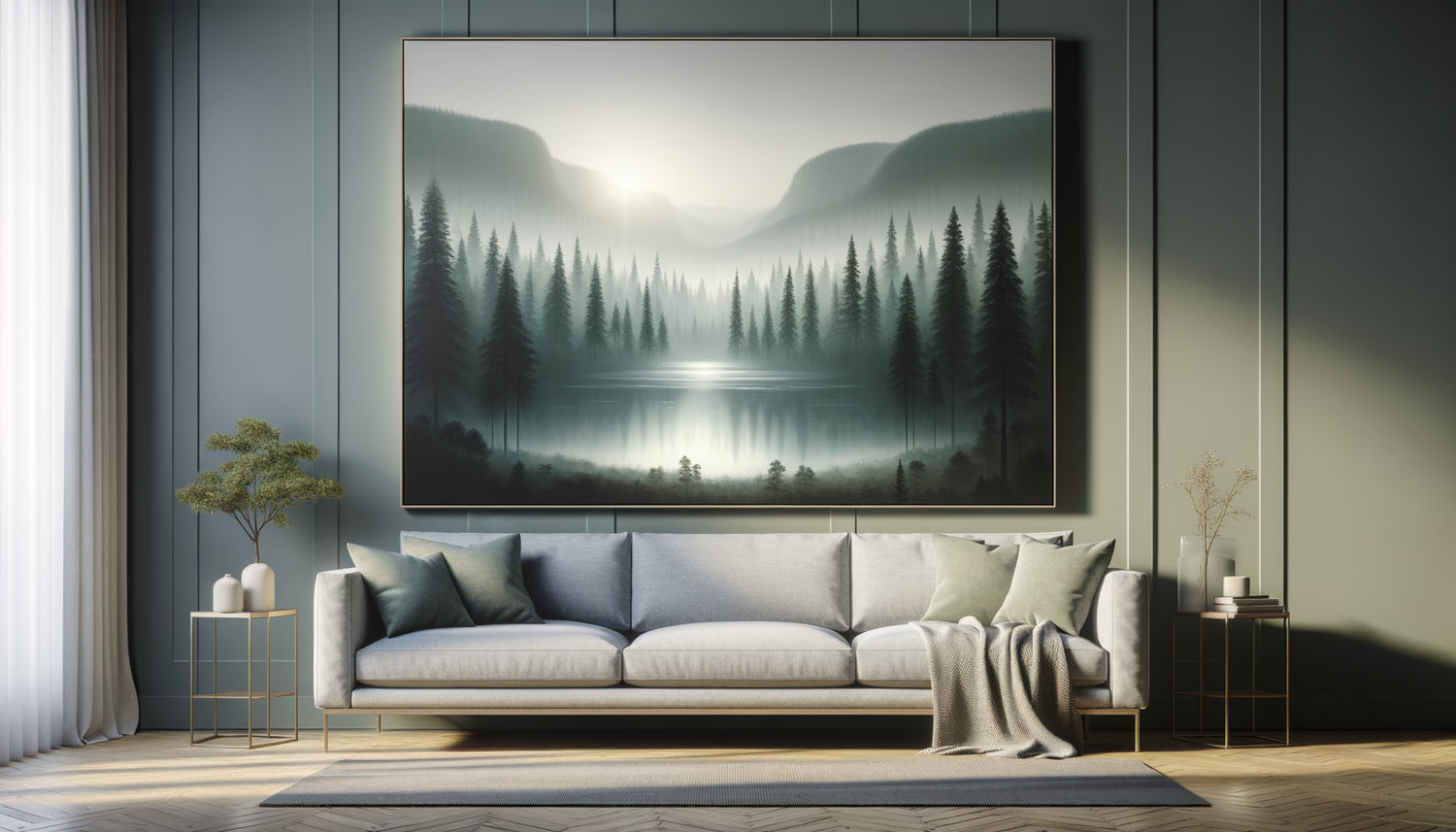
Where the ocean opens up to us, the forest envelops us. Forest landscapes shrouded in mist possess a mysterious depth that invites introspection. These vertical compositions, with their trunks aligned like cathedral columns, establish a visual silence that few other subjects manage to achieve.
Look for artworks where the mist softens distant details, creating multiple planes of depth. This technique, which Chinese painters mastered over a thousand years ago, allows the artwork to breathe. Undergrowth in verdant tones mixed with grays brings this organic freshness without assaulting the eye. A pine forest in winter, with its dark silhouettes emerging from a white veil, offers an almost monastic serenity.
These landscapes work wonderfully in living rooms with light-colored walls, creating a soft contrast that structures the space without fragmenting it. Position them on a wall perpendicular to the windows: grazing natural light will reveal the nuances and texture of the artwork throughout the day. I have seen entire interiors calm down thanks to this simple vegetal presence that brings nature back into the heart of the domestic sphere.

Distant Mountains: The Wisdom of Purified Summits
Mountain ranges seen from afar, immersed in a bluish atmosphere, embody permanence and stability. Unlike dramatic and dizzying peaks, these contemplative mountains do not challenge: they rest, majestic and serene in their mineral eternity.
Choose compositions where the mountains occupy the background, softened by atmospheric perspective which tints them lavender and indigo. A clean foreground – a meadow, a still lake – balances the verticality of the reliefs. This visual architecture creates a reassuring geometric harmony: the earth anchors us below, the sky opens up above, and the mountain connects the two with grace.
These mountain landscape paintings are particularly well suited to contemporary living rooms with clean lines. Their simple composition dialogues with minimalist furniture, while their depth compensates for spaces that can sometimes be too smooth. Square or slightly vertical format, install them on the clearest wall, without competition from bookshelves or decorative accumulations. Let this silent geology breathe.
Fields and meadows: the horizontality that soothes
The gentle expanse of wheat fields rippling in the wind, meadows dotted with wildflowers in spring: these rural landscapes reconnect us to a slow, almost agricultural temporality, which contrasts with urban frenzy. Their serenity comes from this unadorned simplicity, from these repetitive horizontal lines that lull the gaze.
Favor scenes with desaturated colors: golden wheat tending towards ochre, grey greens, pale skies. This earthy palette envelops without stimulating, it welcomes without exciting. A lavender field in Provence, photographed in the evening light that softens the violet in favor of powdery mauves, offers this vegetal presence without chromatic aggression.
These paintings work remarkably well in Nordic or rustic chic living rooms. Their pronounced horizontality visually widens narrow spaces. Install them above a low sofa or console: this low position reinforces the feeling of earthly anchorage they naturally provide. I have seen these countryside landscapes transform anxious interiors into bucolic refuges where time seems to suspend its course.

Landscape abstraction: when blur becomes refuge
Sometimes, serenity is born not from the recognition of a place, but from its blurred evocation. Abstract landscapes – where one guesses a horizon, a mass of vegetation, a reflection of water without being able to precisely name the scene – offer this freedom of interpretation that relaxes the analytical mind.
These works play on color gradients, vaporous textures, and smooth transitions between sky and earth. A painting where green blends into blue, where traces evoke reeds without drawing them precisely, allows your imagination to complete the image. This active participation paradoxically rests: you do not passively consume the work, you co-create it.
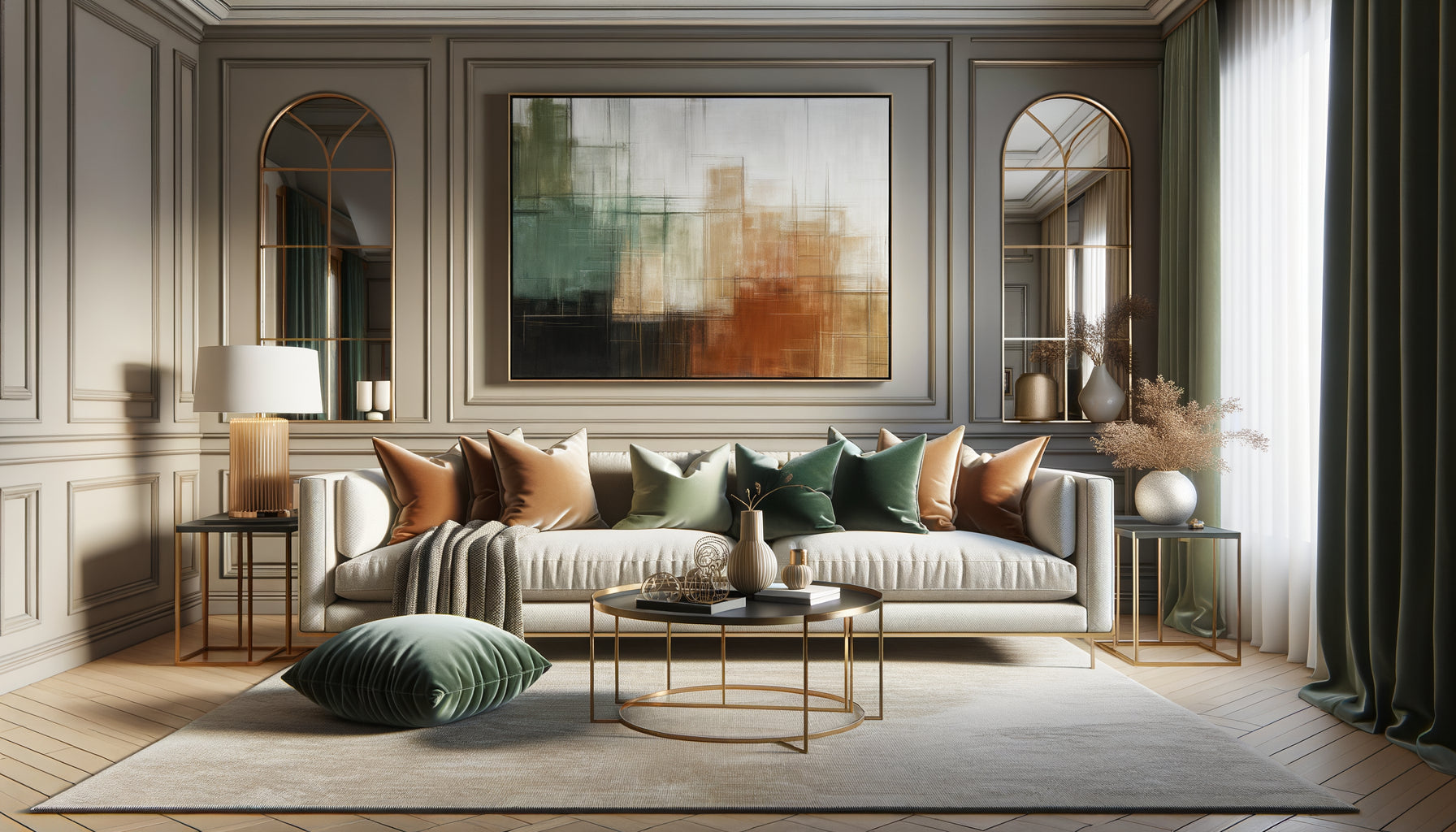
These evocative landscapes adapt to all styles of living room, from the most classic to the most contemporary. Their ambiguity makes them chameleons: they adopt the ambient tones, dialogue with your textiles, reflect your mood of the day. Large format is recommended, so that this colorful haze becomes a real dreamlike window. Highlight them with indirect spotlights that reveal the nuances without creating reflections. The effect is often magical: a portal to an undefined elsewhere that belongs entirely to you.
Light and frame: sublimate your serene landscape
A landscape painting can lose all its soothing power if it is poorly lit or framed inappropriately. Natural light should caress it without saturating it: avoid walls exposed to direct sunlight which will fade the colors and create blinding reflections. Prefer walls perpendicular to windows, or install curtains that soften daylight.
For artificial lighting, adjustable LED spotlights with a warm temperature (2700-3000K) reveal the details without distorting the tones. Position them at 30-40 degrees above the work, creating a soft beam that avoids harsh shadows. This attention to lighting transforms a simple painting into a living presence that evolves from morning to evening.
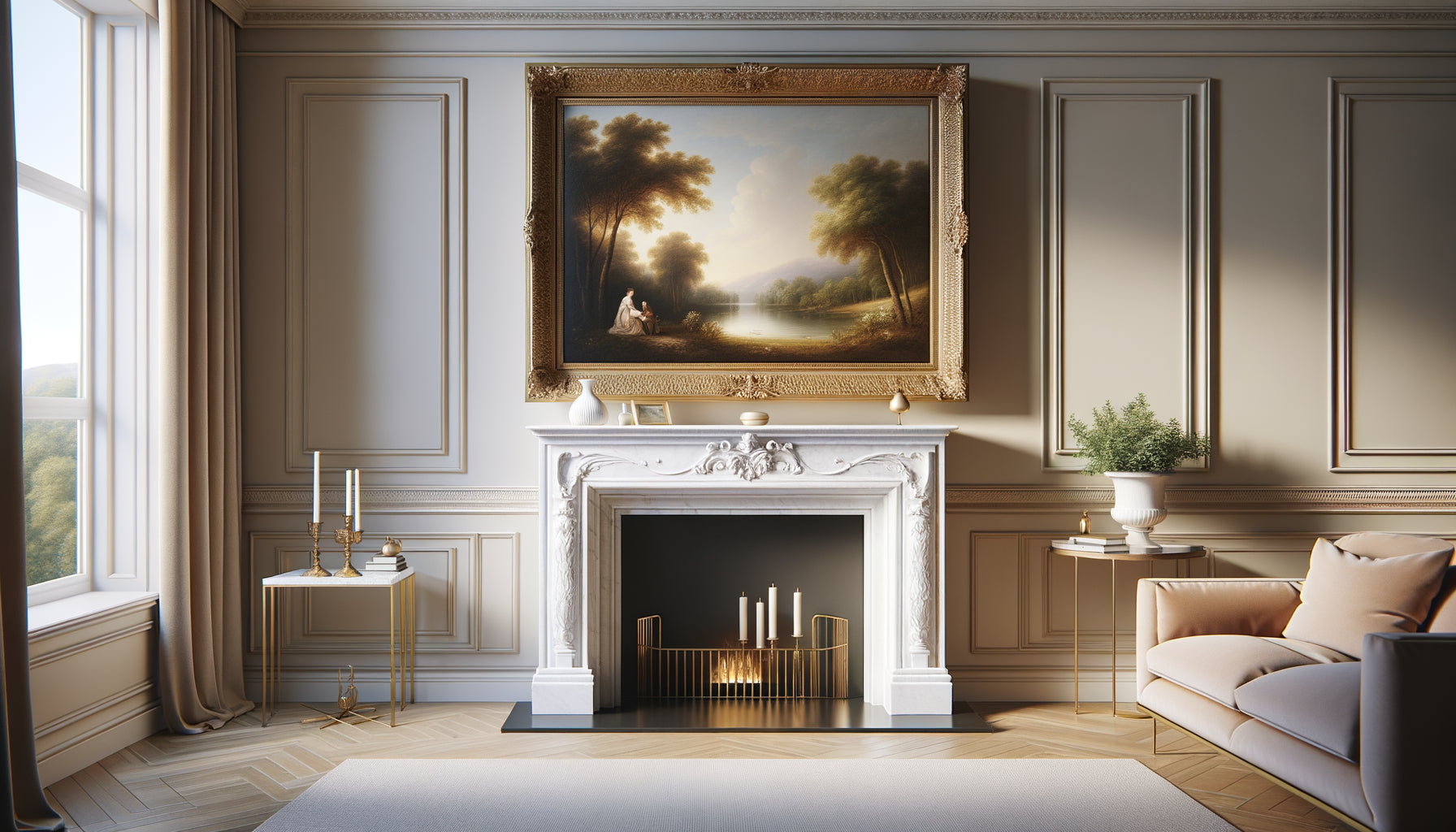
The frame should disappear or sublimate, never compete. For marine and mountain landscapes, thin frames in natural wood or brushed metal extend the purity of the scene. Forests and meadows accept slightly more present frames, in light oak that echoes the vegetal tones. Landscape abstractions often gain by remaining frameless, mounted on a deep chassis, so that the color seems to float on the wall. This attention to detail makes all the difference between a decoration and a true atmosphere of serenity.
Transform your living room into a visual haven of peace
Discover our exclusive collection of living room paintings that capture these contemplative landscapes to soothe your daily life.
Your living room, your visual sanctuary
Imagine that precise moment: you return home tomorrow evening, and your gaze meets this marine horizon which instantly expands the space, or this misty forest which envelops you in its silence. You settle into your sofa, and for the first time in a long time, you don't look for your phone, don't turn on the television. You simply stay there, your eyes fixed on this landscape that breathes for you, that reminds you that beyond the walls exist infinite expanses where time flows differently.
Serene landscape paintings don't decorate: they transform. They create that soothing presence lacking in so many modern living rooms. Start by identifying what type of horizon naturally calls to you – sea, forest, mountain, meadow or abstraction. Visit galleries, explore online collections, and above all, listen to your visceral reaction: the right painting makes you breathe differently as soon as you look at it.
Take the time to install it correctly, at the right height, with light that reveals its depth. And observe how your living room changes vibration, how it becomes that place where you finally settle down, where you find yourself again. This quest for visual serenity is not a superfluous luxury: it's a deep need that our saturated era makes more essential than ever. Your wall awaits its window to calm.
Frequently Asked Questions
What size painting should I choose for a medium-sized living room?
For a living room of 20 to 30 m², aim for a painting whose width covers between 60% and 75% of the width of the main piece of furniture (sofa or console) located below. Specifically, if your sofa is 200 cm wide, a format of 120 to 150 cm wide will create perfect visual harmony. Horizontal landscapes widen the space, while square formats (80x80 cm or 100x100 cm) are suitable for narrower walls. The frequent mistake is to choose too small: a timid landscape painting gets lost on a large wall and dilutes its soothing power. Don't be afraid of generous sizes – they create that enveloping presence that truly transforms the atmosphere. If your budget is limited, prefer one large piece rather than several small ones that fragment the gaze and prevent the serene contemplation you are looking for.
Can bright colors in a landscape still bring serenity?
Yes, provided that these vibrant colors are muted or balanced by large neutral areas. A field of red poppies may seem too stimulating, but if those reds are softened by an atmospheric haze that transforms them into dusty roses, and if the sky occupies 60% of the composition in pearl gray, the whole remains soothing. Serenity does not come from the absence of color, but from the harmony of proportions. An intense orange sunset is calming if these shades gradually blend into lavenders and midnight blues, creating a soft transition. Observe the rule of thirds: in a serene landscape painting, at least two-thirds of the surface should remain in gentle tones (pastels, grays, off-whites, earth tones). The remaining third can accommodate brighter accents that energize without overwhelming. Also trust your immediate feeling: look at the artwork for thirty seconds; if your gaze jumps around looking for a place to settle, the colors are too contrasting for your search of calm.
Should you change paintings according to the seasons to maintain a calming effect?
This idea may seem tempting, but I would not recommend it for landscape paintings intended to create serenity. True peace of mind comes from constancy, from that familiar presence which becomes an emotional landmark. Regularly changing artwork turns your living room into a gallery where you exhibit, rather than a sanctuary where you recharge. Instead, choose a timeless landscape – a misty forest, a calm ocean, distant mountains – whose atmosphere transcends the seasons. These purified scenes harmonize just as well with your winter throws as with your linen cushions. If you like variety, play with textiles, lighting or plants that surround the artwork, but leave the main piece unchanged. After a few months, it integrates so much into your daily life that you no longer consciously look at it, but you feel it – and it is precisely there that lies the true calming power of a well-chosen landscape in your living space.