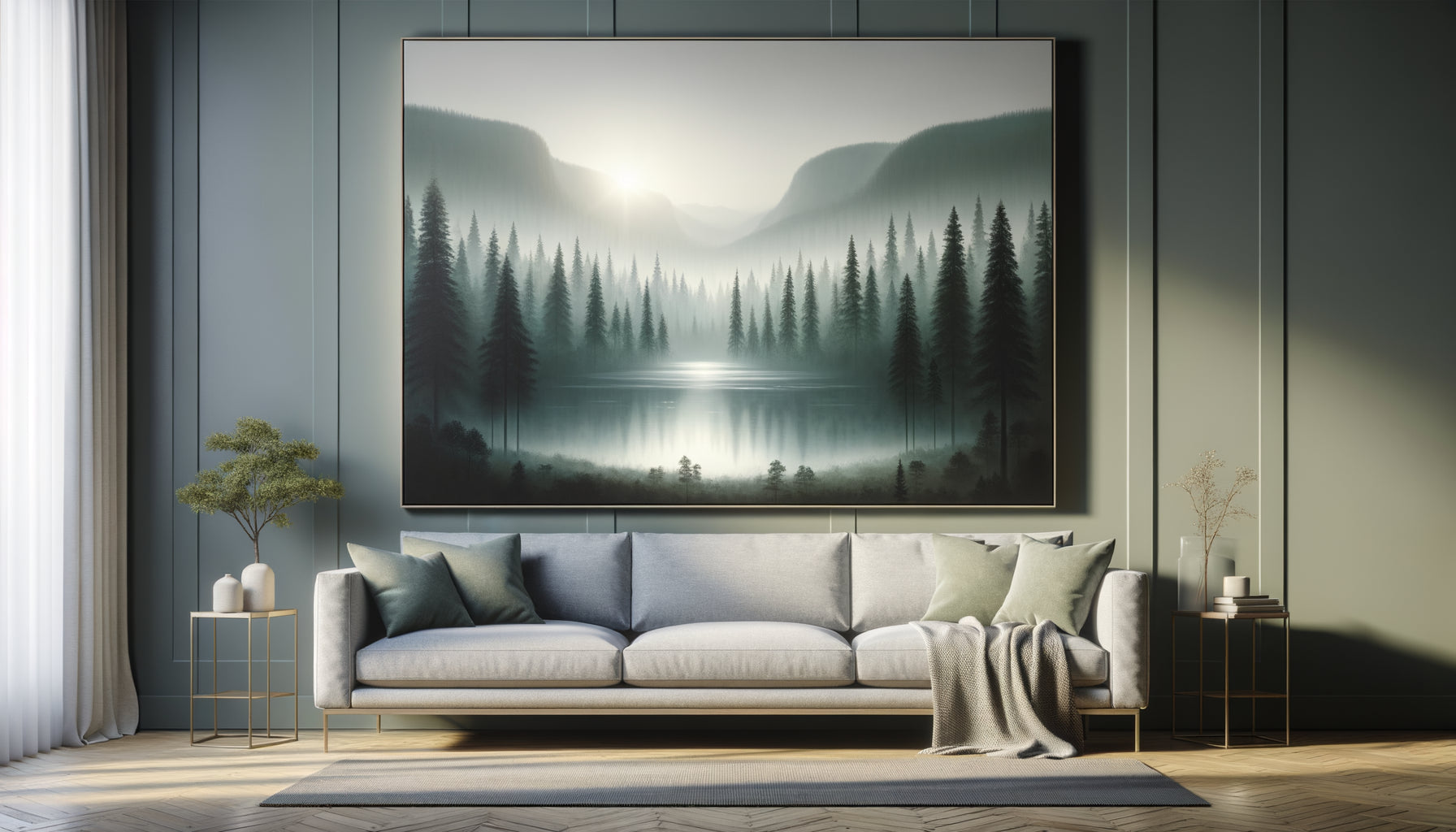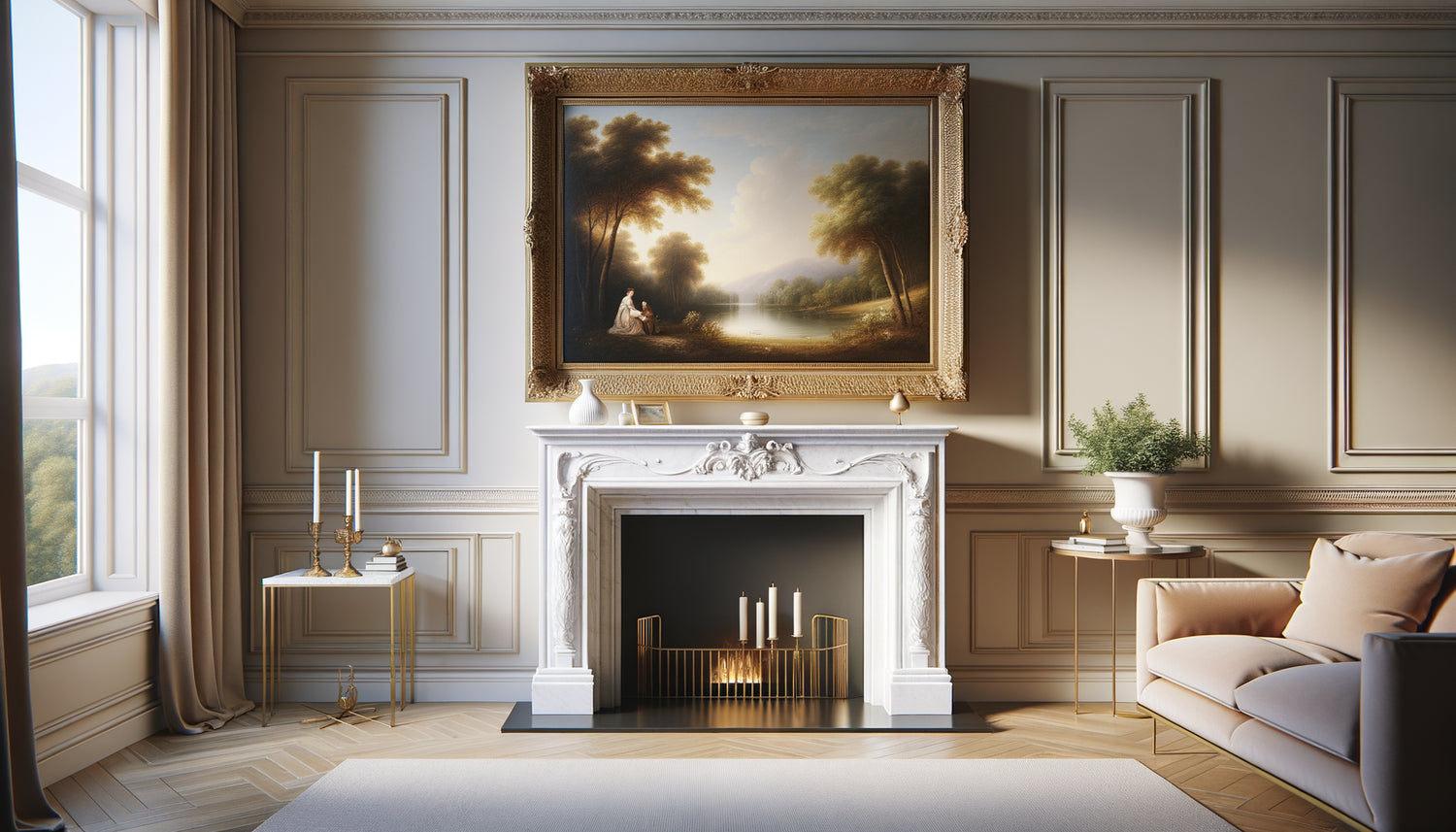
One winter evening, while visiting a Second Empire apartment in need of restoration, I discovered a spectacular living room: a Carrara marble fireplace proudly dominated the space, but the wall above it was desperately bare. The owner confessed to me: 'I have five beautiful paintings in my attic, but I don't dare hang them. What if I make a mistake?' This scene repeats constantly. The fireplace, centerpiece of so many living rooms, intimidates rather than inspires.
Here's what proper placement of a painting above a fireplace brings: it creates a masterful focal point that structures the entire room, it simultaneously enhances your artwork and your architecture, and it transforms a cold space into a warm place to live where the eye naturally finds its rest.
Many give up for fear of drilling in the wrong spot, damaging their work with heat, or simply creating a visual imbalance. Some leave that wall empty for years, depriving their living room of its true soul. Others accumulate decorative objects on the mantel without ever daring to tackle the wall itself.
Yet, positioning a painting above a fireplace requires no particular talent. Just a few precise guidelines, an understanding of proportions, and that confidence that comes from knowing exactly what you're doing. In the minutes that follow, you will discover the exact method I systematically apply, the one that transforms any living room into a harmonious and memorable space.
The rule of proportions: when architecture dictates its laws
Before even taking out a measuring tape, observe your fireplace as a sculptor observes their block of marble. The mantel height, the width of the hearth, the depth of the frame: these dimensions are not constraints, they are your musical score.
The fundamental rule I have applied for fifteen years? The painting should never exceed 75% of the width of the mantel. A 120 cm frame for a 160 cm mantel creates that perfect visual tension, that balance between presence and breathing room. Beyond that, you overwhelm the architecture. Below that, you create an unsettling void.
For height, the magic formula is between 10 and 20 centimeters above the mantel. Less, and your painting seems placed there by chance, like a guest hesitating to enter. More, and it flies towards the ceiling, losing all dialogue with the hearth. I personally use 15 cm as a starting point, then adjust according to ceiling height.
The fatal error of high ceilings
In Haussmann apartments or lofts, the temptation is great to raise the painting to 'fill the space'. Resist. A painting in a living room should remain accessible without tilting your head back. If your ceiling reaches 3.50 meters, prioritize a vertical composition rather than a position that is too high. The eye must be able to embrace the fire, the mantel and the artwork simultaneously in a natural movement.
Heat and preservation: protect without sacrificing
The question inevitably arises during my consultations: 'Will the heat damage my artwork?' A legitimate concern, but often disproportionate. I've seen century-old oils overlooking active fireplaces without noticeable damage, and modern prints degrading in six months.
The truth? It all depends on the type of heating and the type of work. An electric or bioethanol decorative fireplace emits negligible heat. A modern closed insert, even used daily, radiates its heat forward, not upward. On the other hand, a traditional open hearth generates significant rising thermal flows.
For active fireplaces with an open hearth, I systematically apply the back-of-the-hand test: after two hours of fire, bring your hand close to the wall at the intended location. If the heat is uncomfortable, your artwork will suffer too. Solution? Mount it 5 to 10 cm higher, or opt for a framed work under glass which resists thermal variations better.
Materials that withstand the test of time
Photographs under acrylic glass, prints on aluminum dibond, varnished canvases: all contemporary options that defy heat. Conversely, watercolors without protection, unframed papers or cheap inkjet prints will inevitably yellow. If you own a valuable piece, installing an elevated mantelpiece shelf of 15 cm creates an elegant thermal barrier while offering space for a few carefully chosen objects.

When the fireplace style guides your choice
A fireplace is never neutral. It carries a stylistic language that your wall-art-living-room should either extend or counterbalance intelligently.
Facing a classic marble fireplace with ornate moldings, two schools of thought clash. The first favors continuity: a romantic landscape, an old-fashioned portrait in a massive gilded frame. The whole exudes timeless elegance. The second dares to contrast: a bold geometric abstraction, a minimalist black and white that creates this fascinating tension between heritage and modernity. I have seen both approaches triumph, depending on the personality of the spaces.
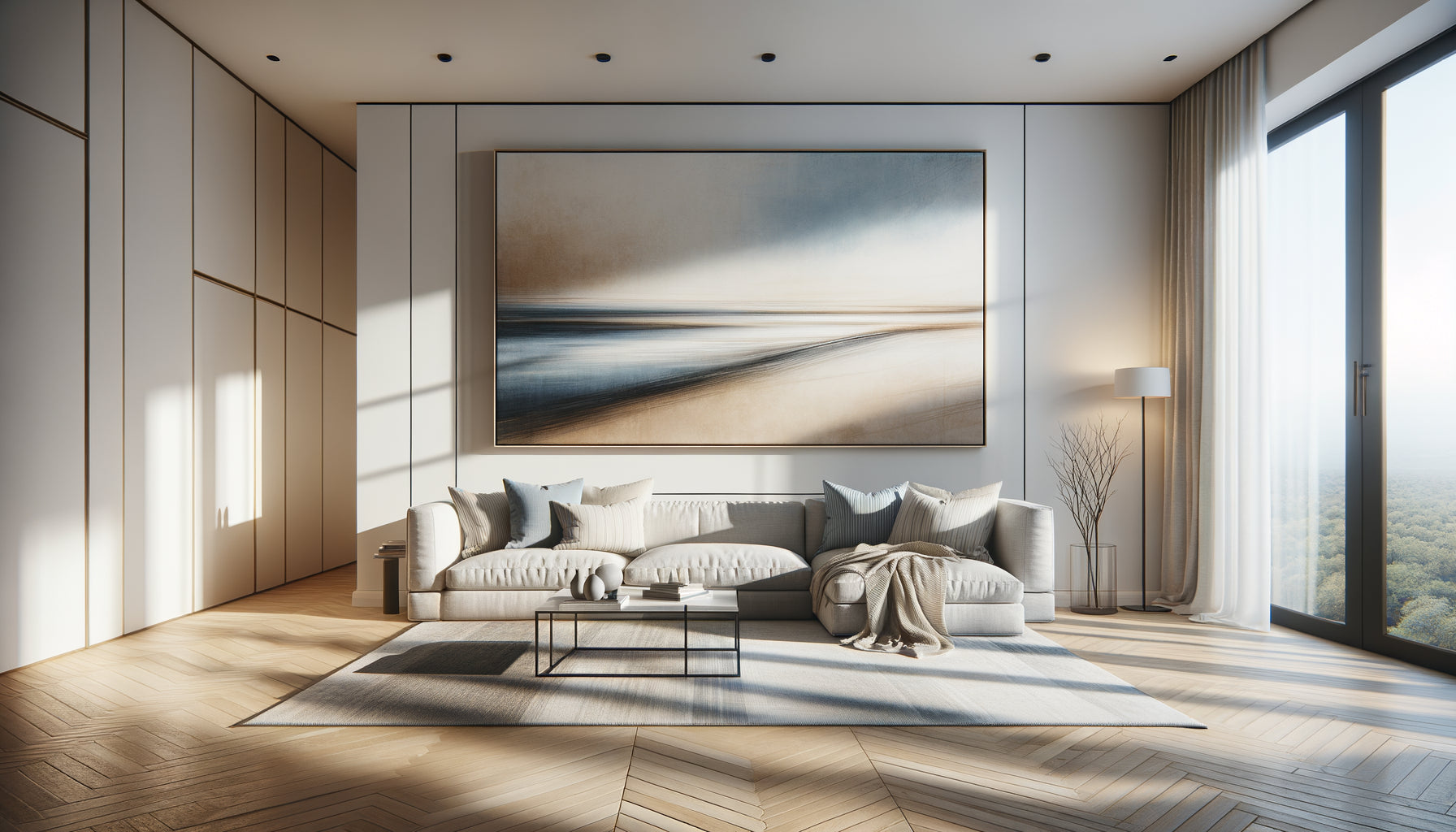
Contemporary fireplaces made of steel, concrete or raw stone generally call for graphic works with clean lines. A large, streamlined format, an architectural photograph, a monochrome composition: the dialogue is established by resonance rather than opposition. Here, the table positioning can even go down to 8 cm from the mantelpiece to accentuate the unified block effect.
The particular case of rustic fireplaces
Exposed stone, oak beams, raw wood mantel: the country charm requires a specific approach. Too sophisticated frames are jarring, too imposing formats overwhelming. Favor medium-sized works (60 to 90 cm), in simple frames made of natural wood or patinated metal. Scenes of nature, botanical compositions, rural landscapes flourish naturally there. And don't hesitate to hang your painting slightly higher (18 to 20 cm) to let the raw material of the stone breathe.
The art of composing with a fireplace mantel
The mantel is not just a support for candlesticks and photo frames. It's the visual link between your hearth and your painting in the living room, the mediation space where volumes are balanced.
Cardinal rule: less is definitely more. An overloaded mantel disperses the gaze, weakens the impact of the painting, transforms your focal point into a decorative clutter. I systematically recommend a composition with an odd number: three elements maximum, never more than five.
The technique of staggered heights works infallibly: a large vase (30-40 cm) on the left, two medium objects (15-20 cm) on the right, all spaced 20 to 30 cm apart. This dynamic asymmetry guides the eye upwards, towards the painting which dominates the composition. Absolutely avoid aligning objects of the same height: the effect is static, boring, it cuts the natural verticality of the entire fireplace-painting ensemble.
The rule of central void
Professional tip that I consistently apply: leave the center of the mantel empty, just below the painting. Place your decorative objects on the sides, creating a visual corridor that naturally rises towards the work. This central breathing space avoids confusion, clarifies the visual hierarchy, allows the painting to assert its primacy without competition.

Light and hanging: the details that change everything
A beautifully positioned painting can be ruined by poor lighting or an unstable fixing. After fifteen years of observing what really works, here are my non-negotiables.
For hanging above a fireplace, forget simple adhesive hooks. Even moderate heat weakens adhesives. Opt for fixings suitable for your wall: Molly for plasterboard, Fischer for stone or brick, chemical anchors for fragile old walls. A painting weighing 3 to 5 kg requires a fixing point capable of supporting 15 kg: the safety coefficient is non-negotiable.
Regarding lighting, indirect light remains my preferred solution. Recessed ceiling spotlights, angled at 30° towards the painting, create this soft illumination that reveals textures without creating reflections. Ideal distance: 100 to 120 cm between the spotlight and the center of the painting. If your configuration prohibits it, adjustable wall lights offer an elegant alternative, provided they are placed at frame height, never above.
The clear wire technique
For large formats (over 100 cm), I systematically use a double fixing: two fixing points spaced 40 to 60 cm apart, connected by a sheathed transparent steel cable. This method distributes the weight, prevents the painting from tilting under the effect of thermal air currents, and guarantees perfect stability even after years. The wire visually disappears, creating the illusion of a floating painting above the mantelpiece.
Beyond the rules: create your visual signature
Proportions, warmth, hanging: you now master the technique. But a living room with fireplace that is memorable transcends the rules. It tells a story, your story.
I have seen clients deliberately break the 75% rule with an immense 2-meter triptych, creating a spectacular gallery effect. Others superimpose several small formats in vertical composition, transforming the wall into a contemporary cabinet of curiosities. Boldness works when it is based on a deep understanding of fundamentals.
Seasonal positioning also offers fascinating possibilities. Some of my clients change their artwork with the seasons: a snowy landscape in winter, a luminous abstraction in summer. This rotation keeps the space alive, renews the gaze, creates that joyful anticipation of change. Fixing with a top rail or track facilitates these transformations without multiplying holes in the wall.
Never forget: a painting above a fireplace is never alone. It dialogues with the sofa opposite, with the side armchairs, with the natural light from the windows. Sit in different places in your living room before permanently fixing it. The painting should be visible and appreciable from every angle of life, not just from the entrance to the room.
Your fireplace awaits its soul
Discover our exclusive collection of living room paintings that will transform your home into a true focal point, with formats and styles designed to enhance every architecture.
Visualize your transformation
Imagine the moment, in a few days. You are settled in your favorite armchair, a cup in hand. Your gaze naturally falls on the fireplace, gently rises towards the perfectly positioned painting. The proportions sing just right, the light caresses the textures, the whole breathes that evidence of well-done things.
Your guests cross the threshold of the living room and instinctively stop. No need for words: their eyes say it all. It's no longer simply a living room with a fireplace and a painting. It’s your space, bearing your visual signature, telling your story through this subtle balance between architecture and art.
Start this weekend. Measure your mantelpiece. Evaluate your heights. Test different locations with masking tape. And when you feel that perfect alignment, that resonance between the place and the work, you will know that you have found it. It's never a question of luck or innate talent. Just an educated eye and renewed confidence.