I’ve spent fifteen years advising collectors on their acquisitions, and every time a client asks me whether they should choose a large painting or several small ones for their living room, I think of that Geneva collector. She had bought a monumental work measuring 2 meters by 1.50 for her fireplace. Magnificent. Then, six months later, she called me back: “I can’t see my living room anymore, I only see the painting.” She was right. And wrong at the same time. Because the problem wasn't the size of the painting, but the balance she hadn't found with the space.
Here's what a thoughtful choice between a large painting and several small ones brings to your living room: visual consistency that structures the space, an affirmed personality that tells your story, and flexibility that evolves with your desires. You’ve probably already found yourself in front of that empty wall, hesitating whether to make a strong statement with an imposing piece or create an intimate gallery with several works. This indecision is legitimate, as it touches on the very soul of your interior. Rest assured: there are no bad choices, only choices unsuitable for your space and temperament. I’m going to share what I've learned by accompanying hundreds of enthusiasts in this quest for perfect balance.
The cathedral effect: when a large painting structures the entire space
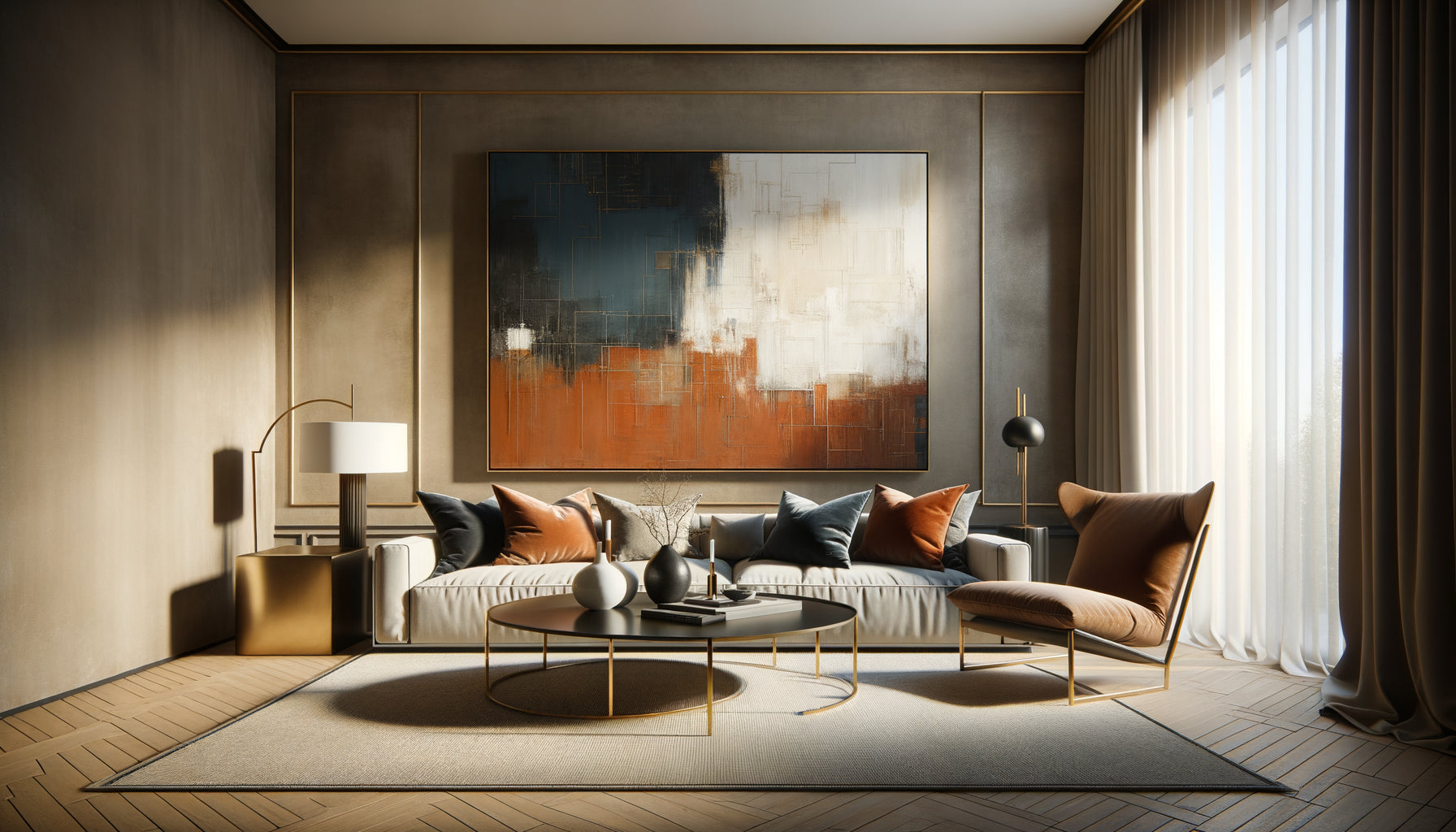
A large painting has this almost architectural power to redefine the proportions of a living room. I remember a Parisian apartment with ceilings of 3.20 meters: the living room seemed cold, disproportionate. We installed an abstract work measuring 1.80 by 1.40 above the sofa. The effect was immediate. The painting became the focal point that unified everything: the gaze anchored itself to it, conversations naturally turned around it.
This approach works particularly well in contemporary minimalist living rooms where furniture remains uncluttered. The large painting then becomes the visual punctuation, the element that infuses emotion into a rational space. It's also an ideal solution for dominant walls – the one that greets the eye upon entering the room. A large format imposes an immediate, almost monumental presence there, giving character without overwhelming.
The dimensions that work according to the size of the living room
For a living room of 15 to 20 m², prioritize a painting between 100 and 140 cm wide. Beyond that, you risk the “commercial gallery” effect where the artwork dominates at the expense of comfort. In a large living room of more than 30 m², dare formats from 160 to 200 cm: they will fill the space without saturating it, provided you respect a rule that I systematically apply: the painting should occupy about two-thirds of the width of the furniture it overlooks. This proportion creates a natural harmony that the eye instinctively appreciates.
I’ve found that large artworks work wonderfully in dual-function living rooms – those open spaces overlooking the kitchen or dining room. The generous format allows you to visually delineate the living area without erecting a partition, creating a subtle but effective psychological boundary.
The symphony of small formats: creating a living composition
Conversely, several smaller artworks offer a narrative flexibility that no large format can match. It’s like composing a playlist rather than listening to a single symphony: you create a dialogue between the works, telling a story in multiple chapters. I advised a young couple who were collecting watercolors from their travels. Arranging these six 40x50 cm artworks in a constellation above their library transformed that wall into a visual diary.
This approach excels in eclectic living rooms where styles mix, where you like to tell stories, layer eras and influences. You can play with formats (a 60x80 surrounded by four 30x40), with frames (vintage gold mixed with contemporary black frames), with subjects (abstract, figurative, photography). This gallery composition creates a dynamism that the large artwork alone cannot achieve.
The golden rules for composing a coherent wall of artworks
First rule: define an imaginary perimeter. Even before hanging anything, trace mentally (or with masking tape) a rectangle encompassing your entire composition. This virtual frame should respect the same proportions as for a large artwork: about two-thirds the width of the sofa or console. Within this perimeter, you can create movement, vary spacing.
Second rule that I consistently apply: maintain a visual thread. It could be a color palette (all your small artworks share a dominant hue), a theme (landscapes, geometric abstractions), or a frame style. Without this coherence, you risk the “scrap wall” effect rather than a personal gallery. I’ve seen magnificent compositions with seven totally different artworks, but all with light oak frames – this simple unity was enough.
Third tip: space your artworks 5 to 10 cm maximum. The further apart you place them, the more fragmented the composition becomes. The eye must be able to flow smoothly from one work to another, creating a global reading before lingering on each individual piece.

How Natural Light Influences Your Decision
Here's a parameter often overlooked: the orientation of your living room and its brightness should strongly influence your choice. A large artwork in a south-facing living room will receive spectacular variations in light throughout the day. I have seen an abstract oil painting with ochre tones literally ignite under the 5 p.m. sun – a daily spectacle that several small paintings cannot offer with the same intensity.
On the other hand, in a dimly lit or north-facing living room, several small artworks can create multiple bright focal points, especially if you install directional spotlights. Each work then becomes a source of reflected light, multiplying areas of interest in a space that could seem monotonous with a single large format absorbing the light.
The Importance of Reflections and Textures
If you opt for a large artwork with a glossy varnish or under glass, make sure no window creates an annoying reflection. I had to reposition a magnificent large format at a collector's house because, at certain times, the bay window turned it into an unusable mirror. Several small artworks offer more flexibility: you can play with inclinations, positions, avoid problematic areas.
What if You Mix Both Approaches?
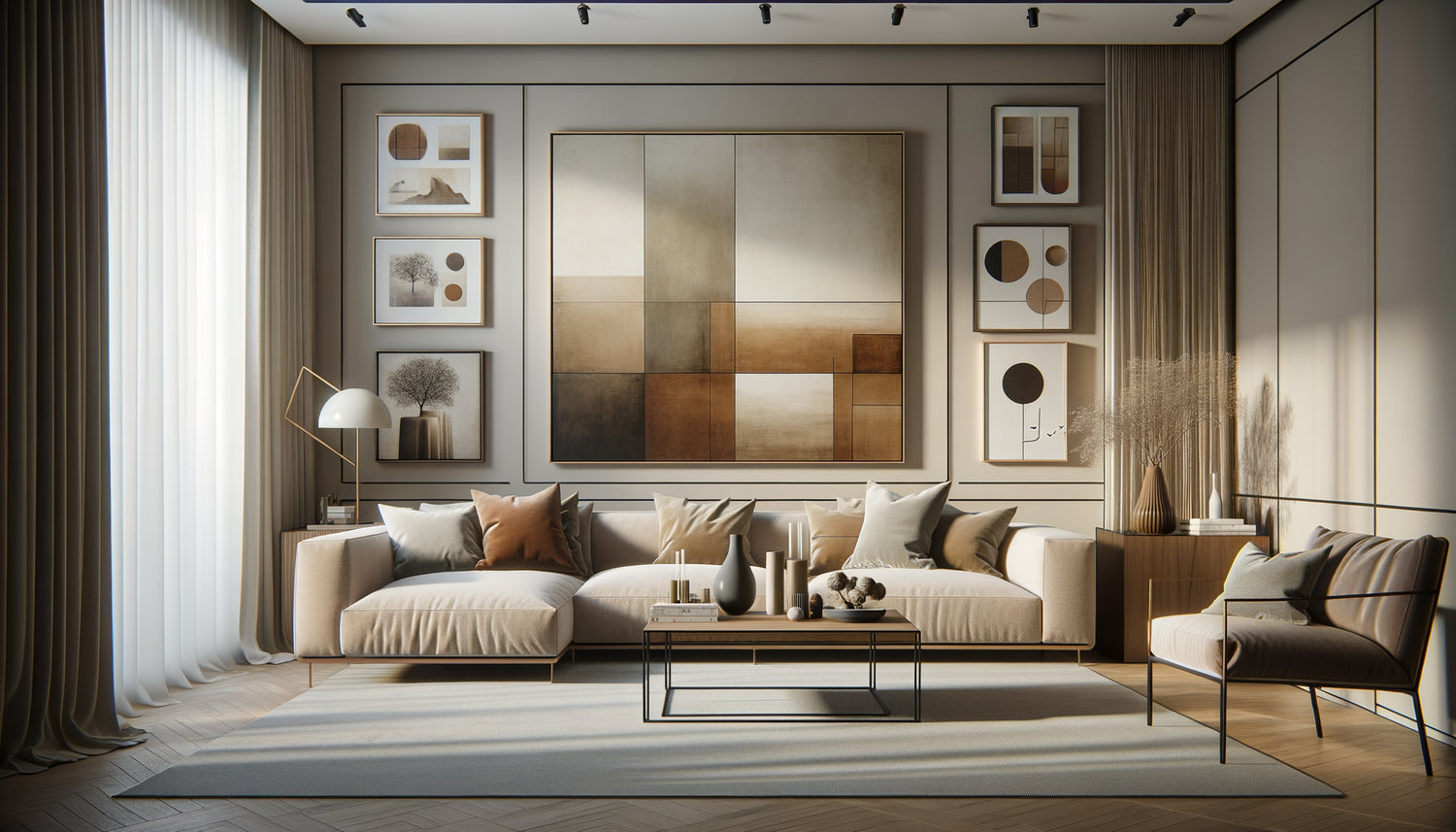
Here's my preferred solution, the one I suggest to 60% of my clients: the hybrid approach. A large artwork as a central anchor, complemented by two or three smaller satellite formats. This composition creates a clear visual hierarchy while retaining the narrative richness of multiple works.
Specifically, imagine a large 120x90 cm painting above the sofa, flanked by two 40x50 cm artworks on either side, slightly offset in height. Or a large vertical format near a window, dialoguing with three horizontal smaller formats on the adjacent wall. This approach works wonderfully in L-shaped living rooms or spaces with multiple walls to decorate.
The major advantage: you evolve with your collection. Start with the large painting that structures the space, then gradually add small pieces as you make discoveries, travel, and have crushes. Your living room becomes a living space that tells your journey rather than a frozen decoration.

Mistakes to Absolutely Avoid Depending on Your Living Room Configuration
First fatal mistake: ignoring the ceiling height. In a living room with low ceilings (2.40 m or less), a large vertical painting will accentuate the feeling of being crushed. Opt for horizontal formats or a composition of small paintings in line. Conversely, high ceilings call for either an imposing large vertical format or an ascending composition of several small paintings.
Second pitfall: failing to take circulation into account. A large painting placed on the wall you walk along when entering the living room will never be truly seen – you brush past it without looking at it. Reserve it for the wall that you face, the one that reveals itself when you are seated. Small paintings, on the other hand, can better withstand passageways: they can be discovered in fragments.
Third mistake I regularly observe: neglecting the scale of the furniture. A large painting above a narrow console will appear unbalanced, cantilevered. Similarly, several small paintings above a large corner sofa will create a scattered, insignificant effect. Harmony always arises from the proportion between the support (furniture) and the artwork.
Budget as a decisive factor
Let's be pragmatic: a large painting by an artist will often cost more than several small formats. If your budget is limited, starting with a composition of small paintings will allow you to acquire original works rather than a large format reproduction. You will gradually build your collection, and this approach has something more authentic, more personal. I have always preferred to advise three small original artworks rather than one large print, even of good quality.
Ready to transform your living room into an exceptional space?
Discover our exclusive collection of living room paintings that adapts to all configurations, from monumental formats to intimate compositions.
Visualize your transformed living room
Close your eyes for a moment. Imagine yourself in your living room, on a Saturday morning, the slanting light revealing the textures of your large painting – or dancing shadows between your carefully composed small formats. You have created a space that reflects you, where every glance cast towards these walls reconnects you with what moves you.
The real question is not “large or small”, but “what best serves your space and your personality”. If you like clear statements, assumed choices, strong presences: the large painting is your ally. If you prefer nuance, progressive collection, the dialogue between artworks: small formats will compose your visual symphony.
My final piece of advice: before making any purchase, **test with pieces of cardboard cut** to the intended dimensions. Attach them with masking tape to your walls. Live with them for a week. Observe how the light plays, how your gaze moves, how the space breathes or asserts itself. This simple simulation will reveal the obvious solution, the one that your intuition already knew.
Your living room awaits its transformation. A grand masterpiece or a constellation of small formats, the essential thing is that your choice tells your story, creates that emotion which transforms four walls into a personal sanctuary.
FAQ: Your questions about living room paintings
What is the ideal height to hang a large painting in my living room?
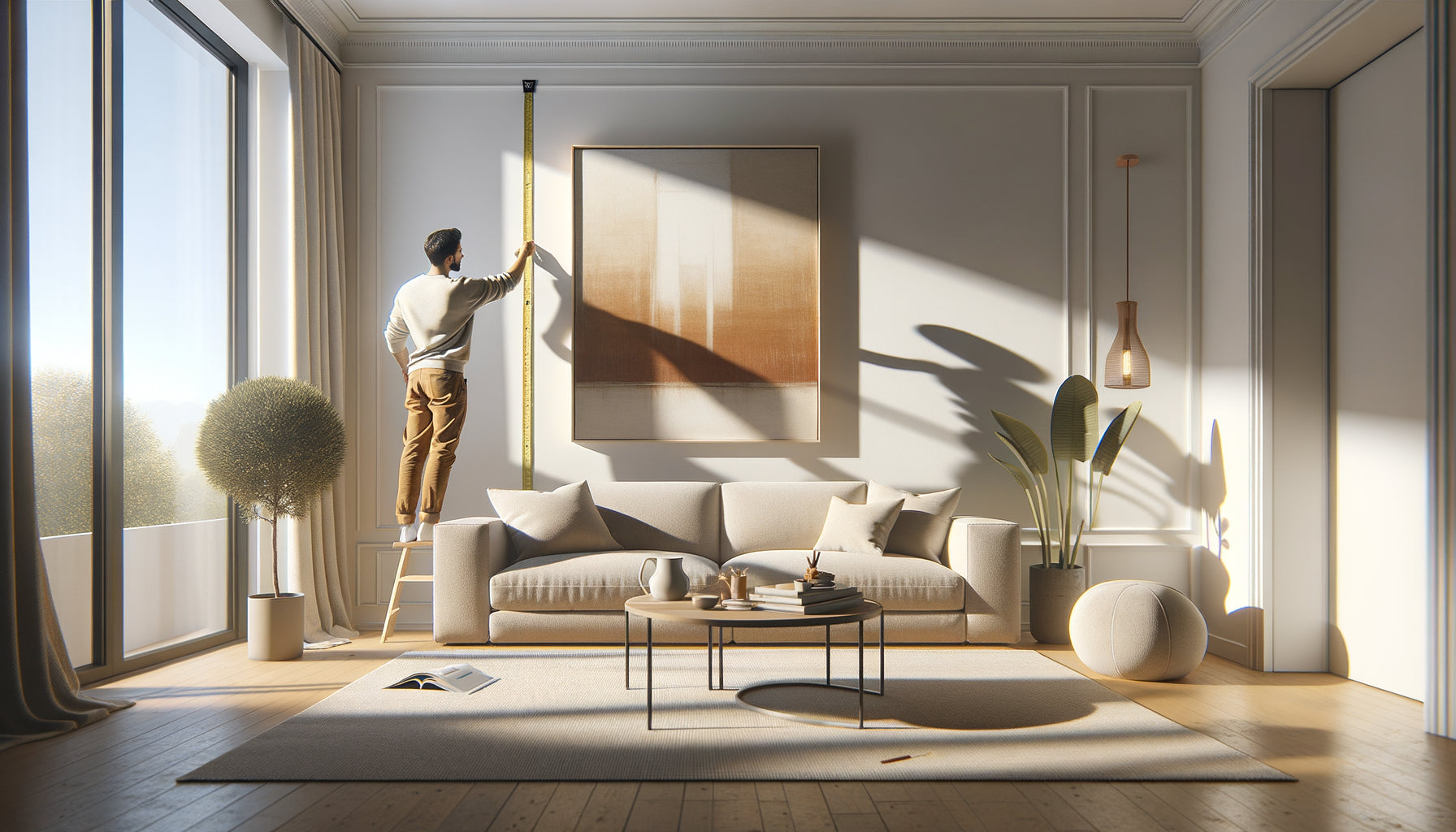
The universal rule that I have applied for fifteen years: **the center of the painting should be between 1.45 m and 1.55 m from the floor**, which corresponds to the eye level of an average-sized person. If your painting will mainly be viewed from the sofa, you can lower it slightly (center at 1.40 m) to compensate for the seated viewing angle. For multiple small paintings in a composition, apply this rule to the virtual center of the whole. Don't be afraid to test with masking tape before drilling: this preparation avoids regrets and multiple holes in your walls. The frequent mistake is to hang it too high, creating a disconnection between the painting and the rest of the space.
Can I mix different styles of paintings in a composition of small formats?
Absolutely, and that's what creates the most interesting compositions! The key lies in **establishing a visual connecting thread** that unifies the whole. This link can be chromatic (a recurring color in each work), stylistic (all in black and white, or all abstract), or material (similar frames). I have created magnificent galleries mixing vintage photography, contemporary watercolor and antique engraving – the unity came from raw wood frames and a palette of blues. Simply avoid the trap of « anything goes »: if you mix too many styles without coherence, you will get a cluttered effect rather than an eclectic collection. Limit yourself to a maximum of three styles in the same composition, and make sure that at least one element dialogues between all the pieces.
My living room is small (12 m²), will a large painting overwhelm it?
Counter-intuitively, a large painting can visually enlarge a small living room if it is well chosen. The trick: prioritize light shades, airy compositions, open perspectives (landscapes, fluid abstractions). A 100x80 cm format with pastel tones or a white background will create a visual window that breathes. On the other hand, avoid saturated dark colors and very busy subjects that will close off the space. If you are hesitant, opt for several small paintings (a maximum of three to five) in a horizontal linear composition: this will visually widen your wall. In a small living room, the golden rule is not to overload the walls – one wall with paintings is enough, the others remain clean to preserve the breathing space.