The other day, while preparing an exhibition for a multigenerational family in my Toulouse gallery, I observed a fascinating scene: little Chloé, age 4, was captivated by the same abstract work that also fascinated her 78-year-old grandfather. They weren't seeing the same thing – she saw “magic clouds” in it, he remembered the skies of his native Morocco – but they both felt the same emotion. This revelation confirmed what fifteen years of advising collectors and families has taught me: some paintings possess this rare ability to transcend generations.
Here's what an intergenerational painting brings: a shared emotional canvas that unites the family, a lasting investment that outlasts trends, and a visual conversation that evolves with each age of life.
The challenge? Too often, we choose paintings “for children” for bedrooms, or “adult” works for common areas. The result: your living room looks either like a daycare center or an intimidating museum where the youngest members don't dare to enter. Between infantilization and inaccessible sophistication, where do you set the cursor? This tension creates a muffled frustration: the feeling of having to choose between aesthetics and family conviviality.
Yet, choosing paintings that suit all ages requires neither artistic compromise nor creative censorship. It’s more about understanding this universal visual language that certain works naturally speak. In this article, I share the keys I have identified through my hundreds of consultations: how to select paintings that dialogue with each generation, creating this emotional thread that transforms a house into a shared home.
The rule of three levels of reading
When I advise families on choosing their paintings, I always apply this fundamental principle: an intergenerational work must offer three simultaneous levels of reading. The first level, immediately accessible to the youngest, is based on recognizable shapes or vibrant colors. A 3-year-old child should be able to point and say “a bird” or “blue.”
The second level addresses adolescents and young adults: a more complex symbolic, narrative, or emotional dimension. This same form of bird becomes a metaphor for freedom, blue evokes melancholy or infinity. It is at this age that one begins to question the why behind the what.
The third level speaks to adults and elders: technical subtlety, cultural references, resonance with lived experience. Here, you appreciate the brushstroke, you recognize the influence of an artistic movement, you project your own memories. These multi-layered paintings create conversations between generations: each shares what they see in it, enriching the perception of others.
Universal themes that transcend time
Some subjects possess that timeless quality I consistently observe during intergenerational installations. Natural landscapes top the list: forests, oceans, mountains speak to primal instinct, regardless of age. A canvas depicting a turquoise sea soothes a baby with its undulations, inspires a teenager dreaming of travel, and transports a retiree to their past vacations.
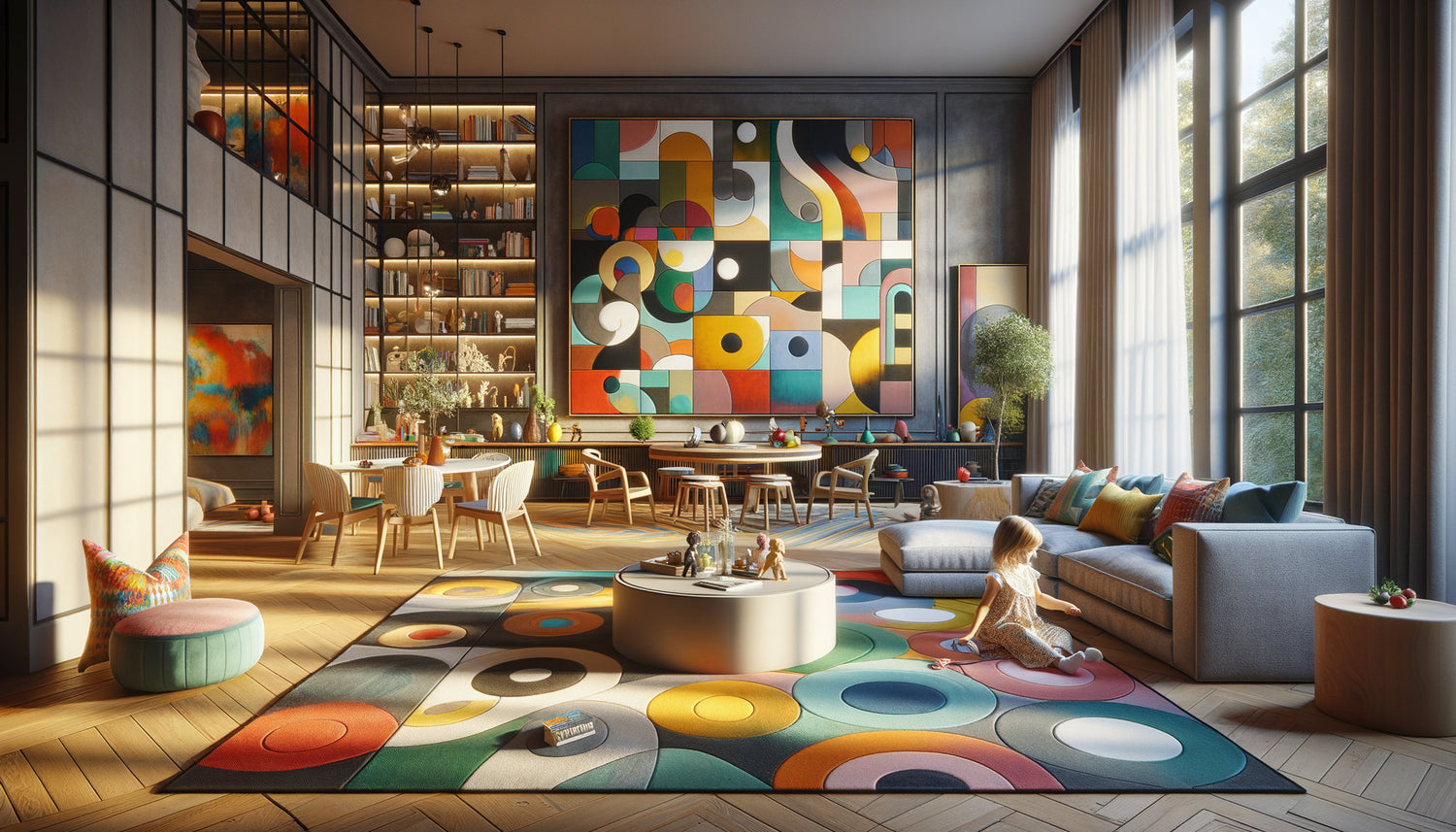
Abstract geometric compositions also work remarkably well. Contrary to popular belief, children adore abstract art: they haven't yet learned to look for « realism », they react instinctively to shapes and colors. Adults, on the other hand, find sophistication and modernity in them. I have sold countless minimalist works to parents surprised to see their children attach to them as much as they do.
Stylized animal representations constitute a third safe path. Attention: stylized, not childish. A graphically treated deer, a flock of birds in clean silhouettes, a leopard in an art deco style - these paintings avoid the trap of « cute » while remaining identifiable and fascinating for everyone.
The color palette that unites rather than divides
After fifteen years of observing reactions to artworks, I have developed a personal theory about intergenerational colors. Earthy tones enriched with vibrant accents create this perfect balance: soft enough to soothe, dynamic enough to stimulate. A painting dominated by ochres, beiges and olive greens, punctuated by touches of terracotta or duck blue, appeals as much to a toddler as to a seventy-year-old.
Avoid pure primary colors in large masses - they scream « children's room ». Opt for their sophisticated versions: a Klein blue rather than a royal blue, a burgundy red rather than a fire engine red. These nuances retain the visual impact while gaining elegance. Children react as much to rich colors as to basic ones; it is our adult conditioning that makes us believe otherwise.
Monochromatic harmonies with variations in textures offer a brilliant solution for choosing family paintings. A grayscale gradient with material effects, layered off-whites, graduated blues - these compositions create visual depth that fascinates young eyes while respecting contemporary aesthetic codes. In my gallery, these textured works systematically invite children to want to touch, a sign of authentic sensory engagement.

The format and strategic placement
The physical dimension of a painting radically influences its intergenerational perception. I have noticed that medium formats (60x80 to 90x120 cm) constitute the sweet spot: imposing enough to structure an adult wall, but not overwhelming for a child's visual field. Very large formats can sometimes intimidate younger children, who cannot embrace the work in a single glance.
Variable placement changes everything. Hang your paintings slightly lower than the standard museum height (center at 145 cm rather than 160 cm from the floor). This small difference makes the artwork accessible to the gaze of children without appearing poorly positioned for adults. In circulation areas such as hallways, create constellation-like hangings at different heights - each member of the family naturally finds their point of focus.
Strategic spaces to maximize impact
Certain areas of your interior are particularly well suited for intergenerational paintings. The dining room comes first: it is where families gather, converse, and share. A well-chosen painting becomes the silent fourth guest, a natural subject of discussion. I often guide my clients towards narrative works for this space - compositions that tell a story, inviting everyone to share their interpretation.
The living room, of course, but with a nuance: prefer the wall facing the sofa rather than behind it. Why? Because we look more at what is in our natural field of vision when sitting down. This painting then becomes a companion for movie nights, afternoon reading, and board games - anchored in daily family life.
Don't forget transition spaces: landings, staircases, entrances. These areas see the whole family pass by several times a day. Installing paintings that suit all ages creates repeated micro-moments of artistic connection, gradually familiarizing everyone with the artwork until it becomes part of the identity of the home.
When abstraction becomes common language
Here is a counterintuitive truth that I have observed hundreds of times: contemporary abstract works often work better in an intergenerational context than figurative representations. Why? Because they leave room for everyone's imagination without imposing a single reading.
Faced with a realistic portrait, a 6-year-old sees « a lady », end of story. Faced with colorful abstract swirls, he invents a story: « it’s a rainbow dragon flying in the storm ». The teenager projects his moods onto it, the adult finds an aesthetic soothing. Everyone has their painting within the painting. This freedom of interpretation generates a much stronger emotional appropriation than a literal work.
I particularly recommend organic abstractions - fluid forms inspired by nature, compositions evoking water, wind, plant growth. They possess that hypnotic quality that captures attention without exhausting the gaze. In my gallery, I regularly observe entire families absorbed in front of these paintings, each in their personal contemplation but together in the experience.

The art of evolving the collection with family
Choosing intergenerational paintings doesn't mean freezing your decor for twenty years. On the contrary, these works constitute stable anchors around which to evolve the environment. When my clients come back to see me after a few years, I suggest adding rather than replacing: a small complementary series, a diptych in dialogue with the initial work.
This evolutionary approach has considerable educational advantages. Children who grow up seeing the collection enrich develop a dynamic relationship with art: they intuitively understand that taste is built, that domestic aesthetics are not fixed but alive. I have seen teenagers actively participate in the choice of new pieces, thanks to their familiarity with existing works.
Also consider the light seasonal rotation: some paintings from reserve come out at different times, creating freshness without upheaval. This practice, common among discerning collectors, is perfectly suited to family homes. It subtly teaches younger people that art is experienced, rediscovered, and not consumed by a single glance.
Create your family's emotional red thread
Discover our exclusive collection of paintings for Waiting room that transcend generations and transform your spaces into places of authentic sharing.
Transform walls into collective memory
The magic happens when a painting ceases to be simply decorative to become a shared memorial marker. “Do you remember when you said it was a friendly monster?” asks the father to his now teenage son, in front of the abstraction that has adorned the living room for ten years. These works become family temporal markers, silent witnesses to everyone's evolution.
In my consultations, I always encourage photographing children in front of their favorite paintings at different ages. This visual archive creates a powerful emotion: you see the child grow up, but the painting remains, constant and benevolent. Some of my clients have created real rituals: on their birthday, a photo in front of "their" artwork. These practices anchor art into the emotional fabric of the family.
Choosing paintings that suit all ages is ultimately investing in a non-verbal common language. In a world where each generation seems to speak a different dialect, these works offer a visual meeting ground, a shared vocabulary made of colors, shapes and emotions. They remind us that despite our differences in age and experience, we remain capable of feeling together.
Imagine your living room in five years: your youngest daughter who is about to leave for her studies lingers in front of the painting that has accompanied all her adolescence, finding comfort and continuity there. Your eldest returning with his own child, pointing at the colorful shapes while murmuring: "I loved those birds too." This silent transmission, this reassuring permanence - that's what a truly intergenerational painting offers. Start today: look at your walls with fresh eyes, imagine which works could become these precious witnesses to your family history.
Frequently Asked Questions
Are abstract paintings too complicated for young children?
It's exactly the opposite of what I observe daily in my gallery! Children have a natural ease with abstraction that we, adults, have often lost. They don't seek to "understand" the work intellectually - they feel it directly. A 3-year-old instinctively reacts to bright colors, dynamic shapes, contrasts, without the analytical filter that sometimes makes us doubt. In reality, abstract paintings free their imagination rather than constrain it: where a figurative landscape imposes "this is a mountain," an abstract composition allows "it's what I want it to be." This freedom of interpretation paradoxically makes abstraction more accessible to the youngest. I have seen children spend twenty minutes fascinated by textured monochromatic canvases, discovering entire universes invisible to busy adults.
Should dark or melancholic themes be avoided in a house with children?
No, and that’s an important question you raise. Protecting children from complex emotions through art would be counterproductive – we would deprive them of an extraordinary tool for understanding the full palette of human feelings. Paintings with darker tones, contemplative or melancholic atmospheres absolutely have their place in a family home. They subtly teach that sadness, nostalgia, and introspection are part of the human experience, without words or lectures. Of course, I don’t recommend violent or distressing scenes, but a twilight landscape with deep blues, an abstract composition in stormy grays – these works bring depth and nuance. Children do not necessarily perceive them as “sad” either: what evokes adult melancholy can represent calm, mystery, the comforting night before sleep for them. The balance lies in variety: alternate bright and more introspective tones to reflect the emotional richness of life.
How to involve children in the choice without compromising adult aesthetics?
Excellent concern that reveals the heart of the intergenerational challenge! The key is to frame the options rather than opening up unlimited choice. Pre-select three or four paintings that already meet your adult aesthetic criteria, then ask your children which one they prefer. This approach gives them real decision-making power (their opinion really matters) while maintaining your decorative guideline. When I work with families in my gallery, I observe that consulted children develop a tenfold attachment to the chosen artwork – it becomes “their” painting even if it adorns the common living room. Another technique: involve them on specific criteria rather than global ones. “What color do you prefer?” or “What does this one make you think of?” rather than “Which one do you want?”. Their answers guide you towards the work that will resonate most strongly with them, among your already validated selection. This co-decision also educates their gaze: they gradually learn the subtleties of aesthetics by participating in family choices rather than experiencing incomprehensible decisions.