I spent twelve years designing care spaces: medical offices, private clinics, hospital services. Twelve years observing patients in waiting rooms, measuring the impact of each aesthetic decision on their emotional state. And among all interventions tested, one emerged with a disturbing consistency: landscapes paintings. Not just any artwork, not just any poster, but authentic representations of nature that literally transform the patient experience.
Here's what landscape paintings bring to care spaces: a measurable reduction in preoperative anxiety, a decrease in pain perception, and a shortening of recovery time. These benefits are not folklore decoration, but reproducible scientific results.
The problem? Medical environments often remain visual deserts. Aseptic white walls, aggressive lighting, total lack of connection with the outside world. Patients wait there, already weakened by worry, immersed in a decor that amplifies their tension rather than soothes it. This visual sterility is not neutral: it actively contributes to felt stress.
Yet, the solution exists and draws on decades of research in environmental psychology. Natural landscapes possess documented therapeutic properties, capable of modulating our autonomic nervous system. Integrating these images into care spaces is not an aesthetic luxury, but a clinical intervention in its own right.
In this article, I share the precise mechanisms by which landscape paintings act on patient stress, the most effective visual typologies, and how to concretely transform a medical space into a soothing sanctuary.
The science behind the calming effect of natural landscapes
It all starts with a study that has become legendary in the world of medical architecture. In 1984, Roger Ulrich published research that revolutionized our understanding of the care environment. His observation is simple but radical: patients hospitalized after cholecystectomy, whose window overlooked trees, needed less pain medication and were discharged sooner than those whose view was a brick wall.
This discovery triggered hundreds of studies confirming the therapeutic power of natural elements. Images of landscapes activate our parasympathetic nervous system, which induces relaxation. Heart rate slows down, blood pressure decreases, cortisol levels fall. These reactions are involuntary, almost automatic.
Neuroscience sheds light on this phenomenon: our brain has evolved for millennia in natural environments. Organic shapes, soft color variations, open horizons trigger soothing responses deeply ingrained within us. This is called biophilia, our innate attraction to living things.
In a medical context where anxiety can compromise the effectiveness of treatments, these natural landscape paintings become valuable clinical tools. They require no cognitive effort from the patient, unlike active relaxation techniques. Simply gazing at a misty forest or mountain lake is enough to trigger relaxation.
What landscapes truly soothe patients?
Not all natural landscapes are equal when it comes to stress relief. My field observations and scientific studies converge on precise typologies. Aquatic scenes come out on top: calm lakes, winding rivers, gentle waterfalls. Water has a documented hypnotic effect; it captures attention without capturing it, allowing the mind to wander without straying.
Temperate forests occupy second place. But caution is warranted: bright undergrowth, with inviting paths, works better than dense and dark forests. The patient must be able to mentally project themselves into the image, feel an invitation rather than a threat. Depth of field, the presence of a path, diffused light are essential.
Mountain landscapes also soothe, provided they evoke contemplation rather than physical challenge. An alpine valley in spring, distant snow-capped peaks under a clear sky, high-altitude meadows: these images inspire serenity and mental elevation.
Conversely, some natural scenes can paradoxically increase stress. Images of storms, sheer cliffs, chaotic landscapes should be avoided. Similarly, representations that are too abstract or stylized lose their therapeutic effectiveness. Realism counts: the brain needs to instantly recognize the natural environment to trigger its soothing response.
The colors that heal
The color palette plays a decisive role. Greens and blues dominate the most effective landscapes. These colors naturally slow heart rate and promote serotonin production. Greens bring stability and renewal, blues evoke trust and tranquility.
Touches of soft yellow and pale orange, present in dawn or dusk lights, add a comforting dimension without excitement. On the other hand, bright reds, aggressive contrasts, and excessive saturations are counterproductive in a care setting.

The Measurable Impact on Patient Experience
The benefits of nature landscape artworks in medical settings are precisely quantifiable. A 2019 meta-analysis compiling 43 studies shows an average reduction of 28% in preoperative anxiety in waiting rooms adorned with natural landscapes, compared to neutral spaces.
Even more impressive: patients exposed to these images before a procedure report less postoperative pain. Several American hospitals have documented a decrease of 20 to 30% in the consumption of analgesics among patients whose room features representations of nature.
Recovery time is also affected. This famous Ulrich study showed an average one-day earlier discharge. Other research has confirmed this phenomenon in different surgical contexts. The explanation? A less weakened immune system due to chronic stress, better sleep quality, a mental state more conducive to healing.
In waiting rooms, the effect is also measured on the perception of time. Patients facing landscape artworks estimate they have waited 15 to 20% less than those facing blank walls, even if the objective duration is identical. This temporal distortion considerably reduces frustration and impatience.
I have personally observed fascinating behavioral transformations: less agitation, fewer repeated consultations of the clock, fewer tense interactions with reception staff. The overall atmosphere of the space changes, creating a virtuous circle of collective appeasement.
Integrating Landscapes into Healthcare Spaces: Practical Recommendations
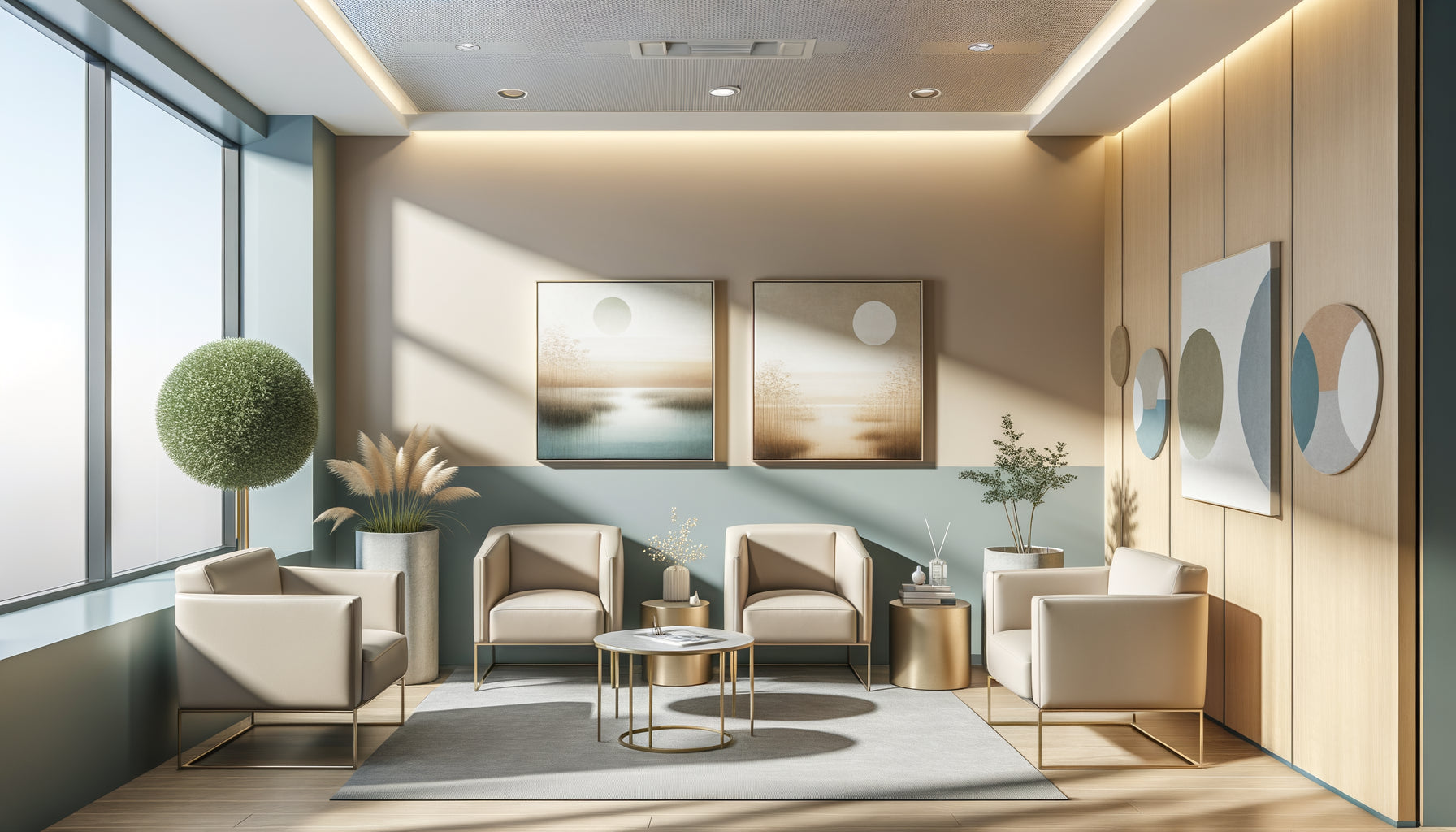
The therapeutic effectiveness of nature landscape artworks depends as much on their content as on their spatial integration. Placement is crucial. In a waiting room, position the artwork within the natural field of vision of seated patients, ideally facing the main seats. Avoid excessive heights that require looking up.
Size also counts. A painting too small gets lost in the space and loses its immersive power. For a standard waiting room, aim for formats of at least 90x60 cm, or even more ambitious wall compositions. The goal is to create a visual window to the outside, especially in spaces without natural light.
Lighting deserves special attention. A poorly lit artwork loses its impact, but aggressive lighting destroys its soothing effect. Prefer LED spotlights with warm color temperature (2700-3000K) positioned as discreet accent lighting.
Quality and Authenticity
Reproduction quality is decisive. Low-end prints, with faded colors and blurry details, not only fail to soothe but can even irritate. Invest in high definition prints on noble supports. The patient should be able to lose themselves in the nuances, discover details with each look.
The frame contributes to the effect. Simple frames, in natural wood or neutral tones, enhance the image without competing with it. Avoid baroque gilding or overly contemporary frames that create a conceptual distance from the subject.

Beyond aesthetics: a holistic care approach
Integrating natural landscape paintings into medical spaces signals something fundamental to patients: their emotional well-being matters. In a healthcare system often perceived as dehumanized, this attention to the visual environment communicates respect and kindness.
This symbolic dimension amplifies the direct physiological effect. Patients feel considered in their entirety, not just as bodies to be treated. This psychological recognition activates trust mechanisms that facilitate the therapeutic relationship and improve adherence.
Some establishments go even further by allowing patients to choose the images for their room from a selection of natural landscapes. This personalization, even minimal, reinforces the feeling of control in an environment where patients generally have very little. The results on satisfaction and stress markers are spectacular.
Healthcare providers themselves benefit from these calming environments. Several studies show a reduction in burnout and improved quality of interactions with patients in visually enriched spaces. The soothing effect of landscapes does not discriminate: it benefits all occupants of the space.
Transform your care space into a soothing sanctuary
Discover our exclusive collection of waiting room paintings that reduce stress and improve your patients' experience through scientifically selected natural landscapes.
Creating a visual refuge in the medical space
Imagine a waiting room where patients arrive tense, anxious, and leave with a feeling of having been welcomed into a space that respects their humanity. Natural landscape paintings are not just a decorative detail; they restructure the spatial and emotional experience of care.
Start small if necessary: a single, well-chosen piece, well placed, can transform a space. Observe patients’ reactions, collect their feedback. You will quickly see that these images do not decorate the medical space, they heal it.
The care environment can no longer be thought of independently of its psychological impact. Every visual element counts, contributing to anxiety or relaxation. By consciously choosing to integrate nature through landscape paintings, you are making a choice for truly holistic care.
Patients may not consciously remember the painting they contemplated in your waiting room. But their nervous system will remember that moment of calm in the storm of medical worry. And it is precisely this invisible soothing that makes all the difference between enduring a treatment journey and experiencing it with dignity.
Frequently asked questions about landscape paintings in a medical setting
Do all types of nature paintings have the same soothing effect?
No, effectiveness varies considerably depending on the type of landscape depicted. Calm aquatic scenes (lakes, tranquil rivers) and bright forests with visible paths are most effective in reducing stress. Images should encourage a relaxing mental projection: the patient should be able to imagine walking in this landscape, resting there. Conversely, dramatic landscapes, storm scenes or overly abstract representations lose their therapeutic power. The presence of water, greenery, open horizons and soft light constitute the most powerful visual ingredients. Colors also matter: prioritize green and blue hues which naturally slow heart rate, and avoid aggressive contrasts or excessive saturations that can paradoxically increase tension.
What size painting should be chosen for a waiting room?
The dimension of the painting is crucial for its therapeutic effectiveness. A format that is too modest gets lost in the space and does not offer the necessary immersion to trigger the soothing effect. For a standard waiting room accommodating 6 to 10 people, aim for a minimum size of 90x60 cm, ideally 120x80 cm or larger. The goal is to create a true visual window onto nature, especially in spaces without exterior openings. The more the painting occupies the patient's field of vision while seated, the more their brain integrates it as a real environment rather than just a decorative object. Position it at eye level for people sitting down, facing the main seats. In large spaces, don’t hesitate to create a mural composition with several coordinated landscapes, or opt for impressive panoramic formats that truly transform the atmosphere of the place.
Do reproductions work as well as original paintings?
Excellent question that comes up repeatedly. The good news is that for therapeutic effect, it's not artistic authenticity but image quality and its ability to immerse the gaze that matters. High-definition prints on quality supports produce the same measurable benefits on stress as original works, provided colors are faithful, details preserved and rendering realistic. The brain reacts to visual content, not to the creation technique. What destroys the effect is low-end printing with faded colors, visible pixels, mounted on cheap supports. Invest in professional reproductions with archival quality inks, on canvas or art paper, with a simple frame that enhances the image. A well-reproduced painting at 300 euros will be infinitely more effective than a mediocre original painting at 2000 euros. Always prioritize subject, composition and reproduction quality over originality status.