It’s a question that has long lingered with me during my consultations. A dental clinic director once confided in me: “My patients tell me they feel even more anxious in my waiting room.” The white walls, the health posters, the aseptic atmosphere... everything amplified their stress. Then she hung three abstract works in ocean tones. The change was spectacular: less agitation, fewer last-minute cancellations.
Here’s what choosing the right paintings brings to your waiting room: a measurable reduction in visitor anxiety, a positive perception of your professionalism, and an atmosphere that directly influences the customer experience. Three out of four clinics underestimate the psychological impact of their wall decor. They think “neutral” when their patients need “comforting.”
Are you hesitating between soothing works that calm and energetic creations that energize? This tension is legitimate. Every day, I advise healthcare professionals, office architects, and public space managers who ask themselves exactly the same question. The answer is never binary, but it follows precise psychological principles that I will share with you.
Invisible anxiety: what your visitors truly feel
Close your eyes for a moment. Imagine yourself in a medical waiting room. Your heart beats a little faster. Your hands search for composure. Your gaze scans the room, looking for a reassuring visual anchor. This neurological reflex is not insignificant: our brain automatically scans the environment to assess the level of safety.
Research in environmental psychology confirms it: a waiting room naturally generates cognitive tension. The wait itself activates our alert circuits. In this context, paintings are not just decorations. They become silent emotional regulators.
I observed this phenomenon in a pediatric clinic where colorful and stimulating works had been installed with the best intentions. Result? Children were overexcited, parents exhausted before even the consultation. Staff spoke to me of an “electric energy difficult to channel.” The mistake was not in the artistic quality, but in the mismatch between the visitors' emotional state and the visual message of the paintings.
Soothing paintings: the science of visual deceleration
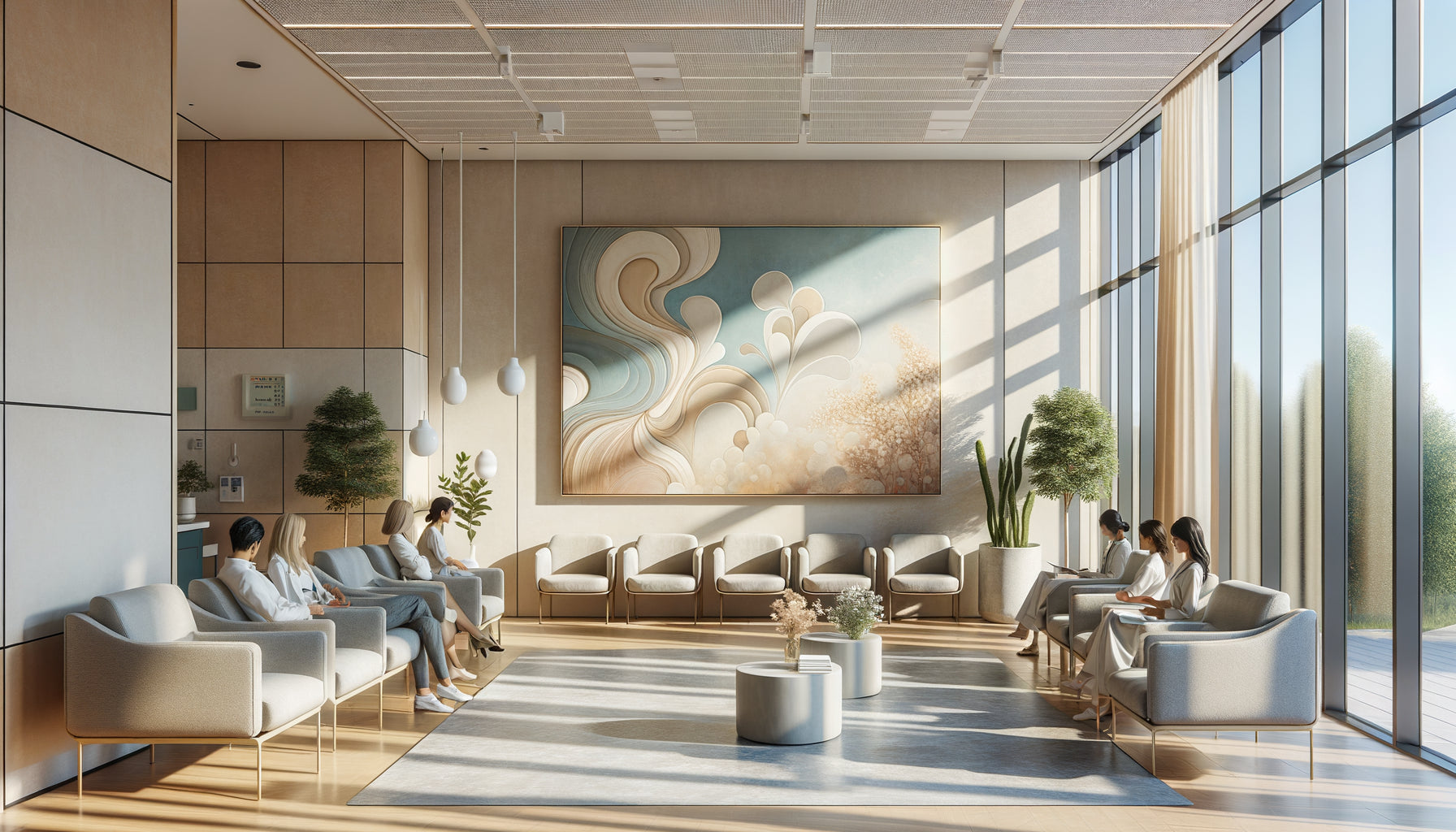
Soothing paintings work like visual lullabies. Their characteristics are scientifically documented: cool tones (blues, greens, pale lavenders), horizontal compositions that slow down the gaze, organic shapes rather than angular ones, soft contrast between elements.
In a radiology clinic where I worked, we installed a series of abstract aquatic landscapes. The perceived waiting time decreased by 23% according to the subsequent satisfaction survey. Patients described the room as “more spacious,” “brighter,” although no architectural changes had been made. It’s the magic of soothing works: they expand the perception of space and time.
When to Prioritize Visual Calm
Calming artworks are particularly suitable for medical and dental waiting rooms, where anxiety already exists. They are also appropriate for administrative spaces (banks, notaries) where visitors deal with serious matters. A law firm specializing in family law replaced its classic engravings with soft mineral abstractions: pre-consultation tensions visibly decreased.
Also favor this approach if your waiting room is already visually stimulating: high traffic, ambient noise, information screens. Calming artworks then create "islands of calm" where the eye can rest.

Stimulating Artworks: Positive Energy for the Experience
Conversely, some contexts call for positive stimulation. I recently advised a business incubator center. Their problem? A waiting room that exuded the energy of a teachers' lounge. Entrepreneurs seeking support and dynamism found themselves in a stifling atmosphere.
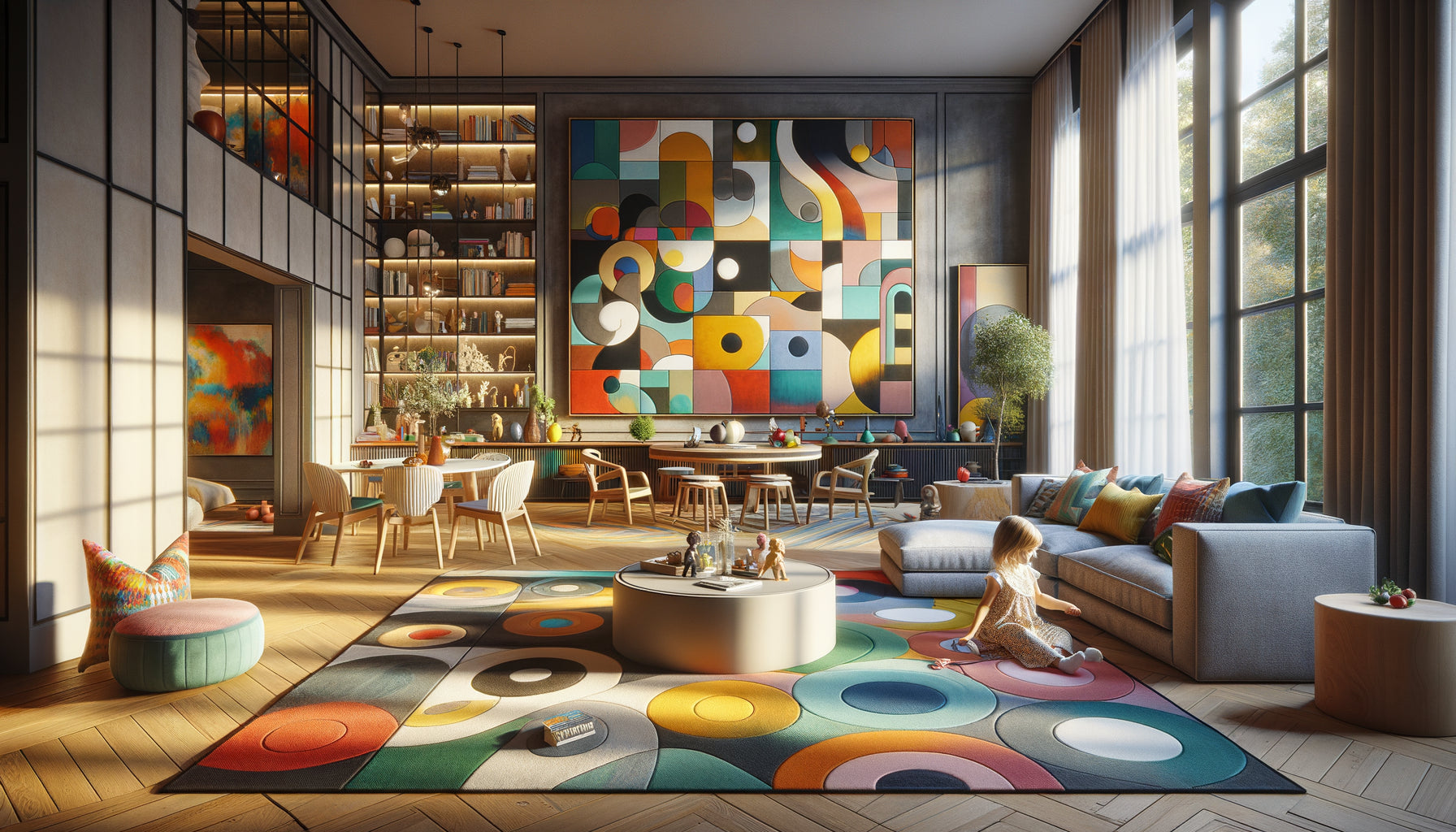
We opted for bold geometric works, energizing colors (oranges, golden yellows, nuanced reds), diagonal compositions that create movement. The feedback was unanimous: "You can feel something is happening here." Stimulating artworks had transformed the perception of the institution itself.
Where Visual Energy Becomes an Asset
Stimulating artworks find their place in creative agencies, coworking spaces, showrooms, waiting rooms of sports or wellness centers where people seek dynamism. A graphic design studio chose vibrant, colorful abstractions: they become a selling point in themselves, demonstrating the team's boldness.
However, be aware of the nuance: stimulating does not mean aggressive. A painting with garish colors or chaotic shapes generates tension, not inspiration. The balance lies in a joyful and controlled energy, like a good piece of upbeat music without being deafening.
The Third Way: The Intelligence of Combination
But here’s the secret few decorators reveal: you don’t have to choose a side. The most sophisticated solution often involves orchestrating an emotional progression through several artworks.
In a multidisciplinary medical center, I created a visual sequence: a large soothing artwork (abstract landscape in ocean tones) facing the entrance to “receive” patients, followed by more dynamic touches (colorful botanical compositions) in the circulation areas. This layering creates a rich sensory experience without contradiction.
The size of your waiting room also plays a role. A generous space allows for this diversity. A small room requires stricter consistency: it’s better to have two harmonious soothing artworks than a confused mix.
Common mistakes to absolutely avoid
Don’t fall into the trap of the “neutral” artwork. These lukewarm, personality-free works, supposedly designed to “please everyone,” please no one. They create an emotional void worse than a lack of decoration. I've seen banal photographic reproductions generate more indifference than bare walls.
Also avoid anxiety-inducing themes in medical settings: storm scenes, overly realistic representations of the human body, dark or melancholic works. A psychology practice had unfortunately hung a series on urban loneliness... The artistic intention was noble, but totally unsuitable for patients' experiences.

The decisive test: observe, listen, adjust
How do you know if you’ve made the right choice? Observe behaviors. Do visitors look up at your artworks? Do they stop for a few seconds in front of them? Or do they systematically turn their gaze to their phones?
A successful artwork in a waiting room naturally captures attention without forcing it. It offers a constructive distraction: the eye rests on it, returns, explores the details, comes back. This micro-contemplation reduces the perception of time and associated anxiety.
Also solicit direct feedback. A simple question to reception: “Have you noticed our new decoration?” The answers are often revealing. In a veterinary clinic where I had advised stylized and soothing animal artworks, owners spontaneously told me: “Even my dog seems calmer here.” The atmosphere had changed, and everyone felt it.
Your professional identity in every brushstroke
Beyond soothing or stimulation, your paintings tell your professional story. An osteopath who chooses organic, flowing works communicates their philosophy of the body in motion. An architecture firm that hangs clean geometries affirms its contemporary vision.
This narrative coherence transforms your waiting room into an extension of your expertise. Visitors subconsciously perceive this harmony. They think:
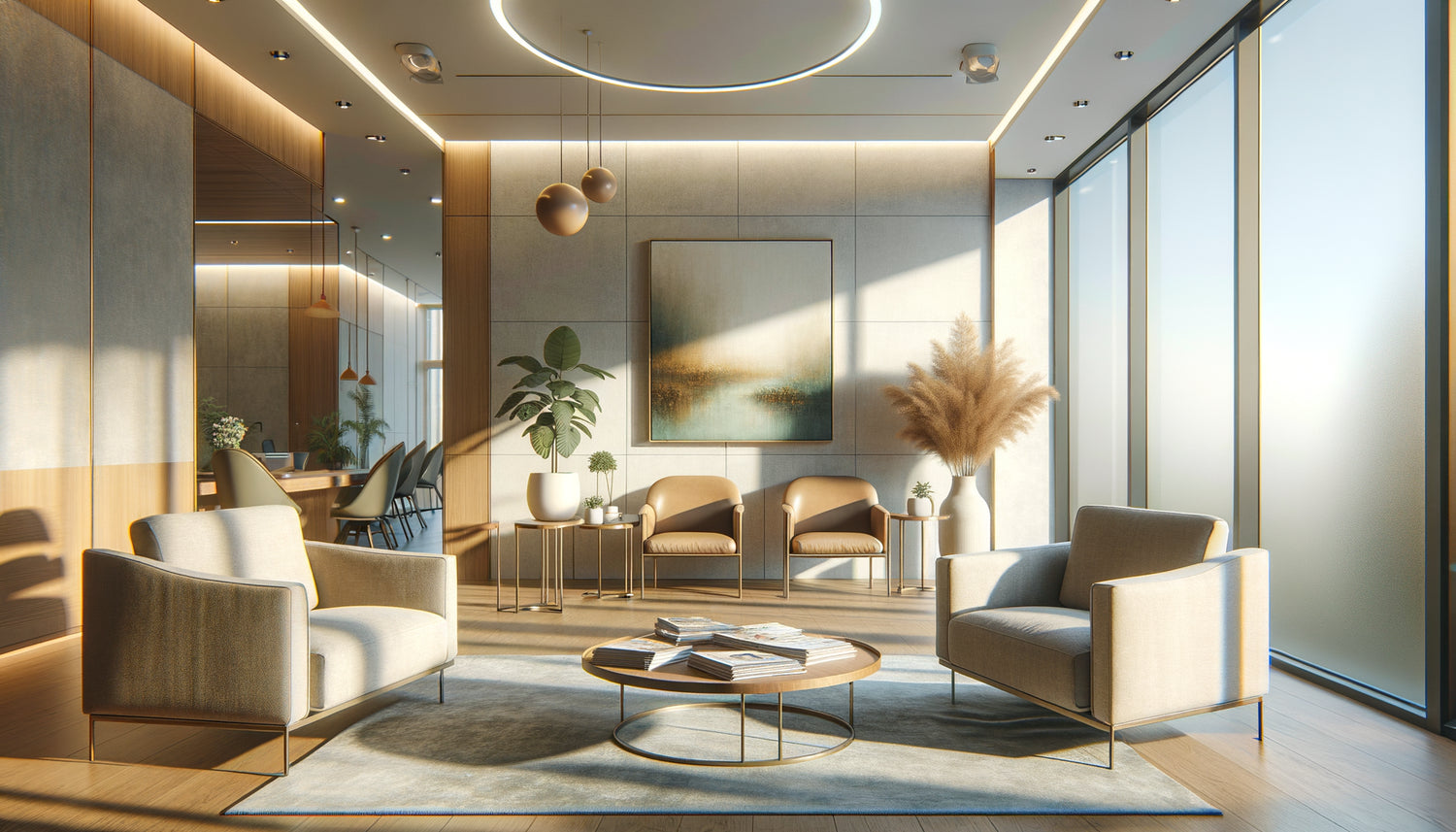
I accompanied a dermatologist who was hesitating between classic reproductions and contemporary photographs of natural textures (barks, minerals, droplets). She ultimately chose the latter option. Result? Her patients now associated her practice with a modern and detail-oriented approach. Her paintings had become silent ambassadors of her practice.
Transform your waiting room into a wellness space
Discover our exclusive collection of wall art for Waiting Room that combines visual soothing and professional elegance.
The art of creating a memorable experience
Now imagine your ideal waiting room. Visitors enter, their gaze naturally rests on a work that welcomes them. Their breathing becomes deeper. Their posture relaxes imperceptibly. Waiting becomes a parenthesis rather than an ordeal.
That's exactly what good paintings bring: a subtle but powerful transformation of the experience. Whether they are soothing or stimulating, their mission remains identical – to create a positive emotion that colors the entire visit.
Start by identifying the emotional state of your visitors upon arrival. Are they anxious? Rushed? Curious? Tired? This answer will naturally guide you towards the appropriate artistic register. Then choose works that also resonate with your professional values. This double coherence – emotional and identity – creates waiting areas that are not forgotten.
The best painting for your waiting room is not one that follows a decorative trend, but one that deeply understands who walks through your door and what they need. It is this perfect alignment between psychological function and aesthetic expression that transforms a simple waiting area into a true welcome experience.
Frequently Asked Questions
Can I mix soothing and stimulating paintings in the same waiting room?
Absolutely, provided a consistent spatial logic is respected. The most effective technique is to create a visual hierarchy: a calming artwork dominating (the largest, facing the entrance or in the main field of vision) accompanied by more dynamic accents on the sides or in passageways. This composition provides reassuring anchoring while avoiding monotony. In a medium-sized waiting room, I generally recommend a 70/30 ratio: 70% calming energy, 30% stimulating touches. Simply avoid abrupt contrasts that would create sensory confusion. The goal is a smooth progression, like a well-thought-out music playlist that varies the moods without dissonant breaks.
How to tell if my current artworks are suitable for my waiting room?
Three simple indicators reveal the effectiveness of your artworks. First test: visual engagement. Discreetly observe your visitors for a few days. Do they look at your works at least once during their wait, or do they remain glued to their phones? Second test: spontaneous feedback. How many people positively comment on your decor in one month? A well-chosen artwork naturally generates admiring remarks. Third test: your personal feeling. Are you still proud of your artworks after six months, or do they begin to seem invisible, dated or unsuitable? If you are unsure, photograph your waiting room and show it to three external people asking them for three adjectives to describe it. Their answers will instantly enlighten you on the atmosphere actually created.
What size artwork should I choose for a small waiting room?
Contrary to intuition, a small waiting room often benefits from a generous sized artwork rather than several small ones. A medium to large format (minimum 80x60 cm) creates a strong focal point that visually structures the space and gives an impression of grandeur. Multiple small frames fragment the gaze and visually shrink the room. For a room of 10-15m², I generally recommend a main artwork of 100x70 cm, possibly accompanied by a second smaller one (40x50 cm) to create a dialogue without clutter. Also prefer horizontal compositions that optically widen the space, and light tones that reflect the light. The frequent mistake is to undersize for fear of overloading: an artwork too small in a small room paradoxically accentuates the narrowness by highlighting the reduced proportions.