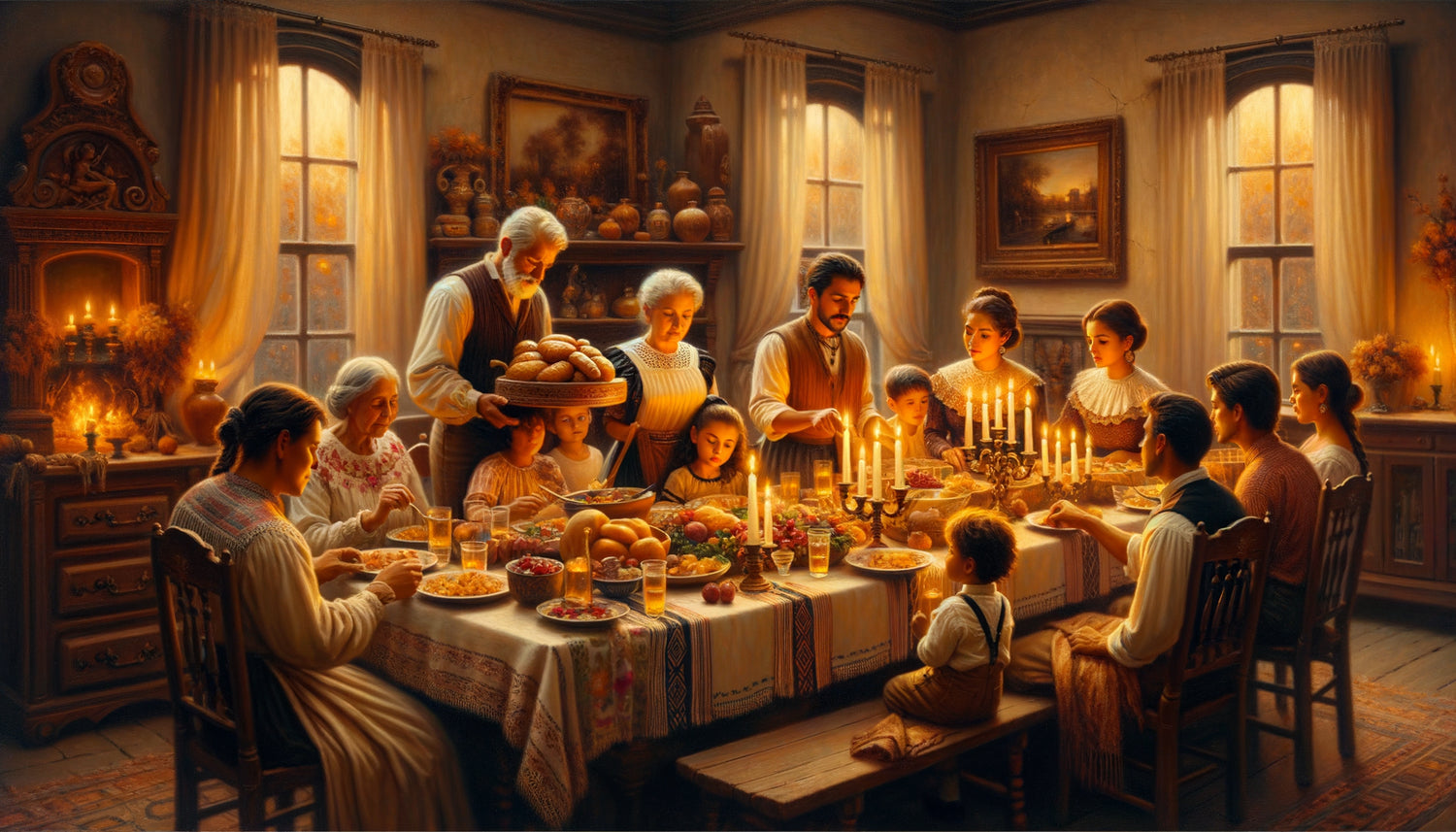
I will never forget that Sunday when, browsing a flea market near Toulouse, my gaze fell on a dusty canvas depicting a family Christmas scene. The anonymous faces around this set table immediately plunged me back into my own memories. This instant emotion, this visceral connection with strangers from another era, sums up in itself why these artistic representations go beyond simple decoration.
Here's what traditional family holiday paintings truly bring: they create a visual bridge between generations, anchor our sense of belonging and transform our spaces into guardians of collective memory. These works do not only tell the story of one family, they tell ours.
You may be feeling that impression of disconnection from your roots, that feeling that traditions are gradually fading away in our hypermodern world. Your walls remain neutral, anonymous, when they could tell a much deeper story.
Rest assured: reintroducing this cultural continuity into your interior does not require you to be a historian or possess ancestral works. It just takes understanding how these representations work as emotional and memorial catalysts.
In this article, I reveal the subtle mechanisms that make traditional family holiday paintings true guardians of our cultural heritage, and how to integrate them to create spaces full of meaning.
The set table: theater of transmission
Carefully observe a painting depicting a traditional festive meal. What immediately strikes you is the centrality of the table. In almost all cultures, from Leonardo da Vinci's Last Supper to 17th-century Flemish holiday scenes, the table constitutes the epicenter of the composition.
This artistic recurrence is not insignificant. The set table symbolizes the ritual gathering, that suspended moment where generations meet and codes are naturally transmitted. Children learn posture, service, respect for elders. Paintings immortalizing these moments freeze much more than a lunch: they capture the very process of cultural continuity.
By hanging such a work in your dining room or living room, you create a permanent visual reminder of these values of sharing. My clients regularly testify that these representations subtly change the atmosphere of their own meals, unconsciously encouraging them to slow down, savor, and converse more.
Objects as cultural clues
In these traditional family holiday paintings, scrutinize the details: the tableware, the embroidered tablecloths, the dishes served, the clothes. Each element is a cultural identity marker. A French king's cake differs from a British Christmas pudding, just as a kimono de fête stands out from a Breton costume.
These visual cues function as a cultural grammar that our brains decode instantly. They allow us to locate ourselves within a historical and geographical continuum. It is this recognition that generates that comforting feeling of belonging.
When gestures become heritage
Beyond objects, paintings of traditional family celebrations immortalize ritual gestures: the solemn carving of the roast, the serving of wine, the exchange of gifts, collective prayer. These codified actions vary according to cultures but all fulfill the same function: to create temporal and behavioral markers.
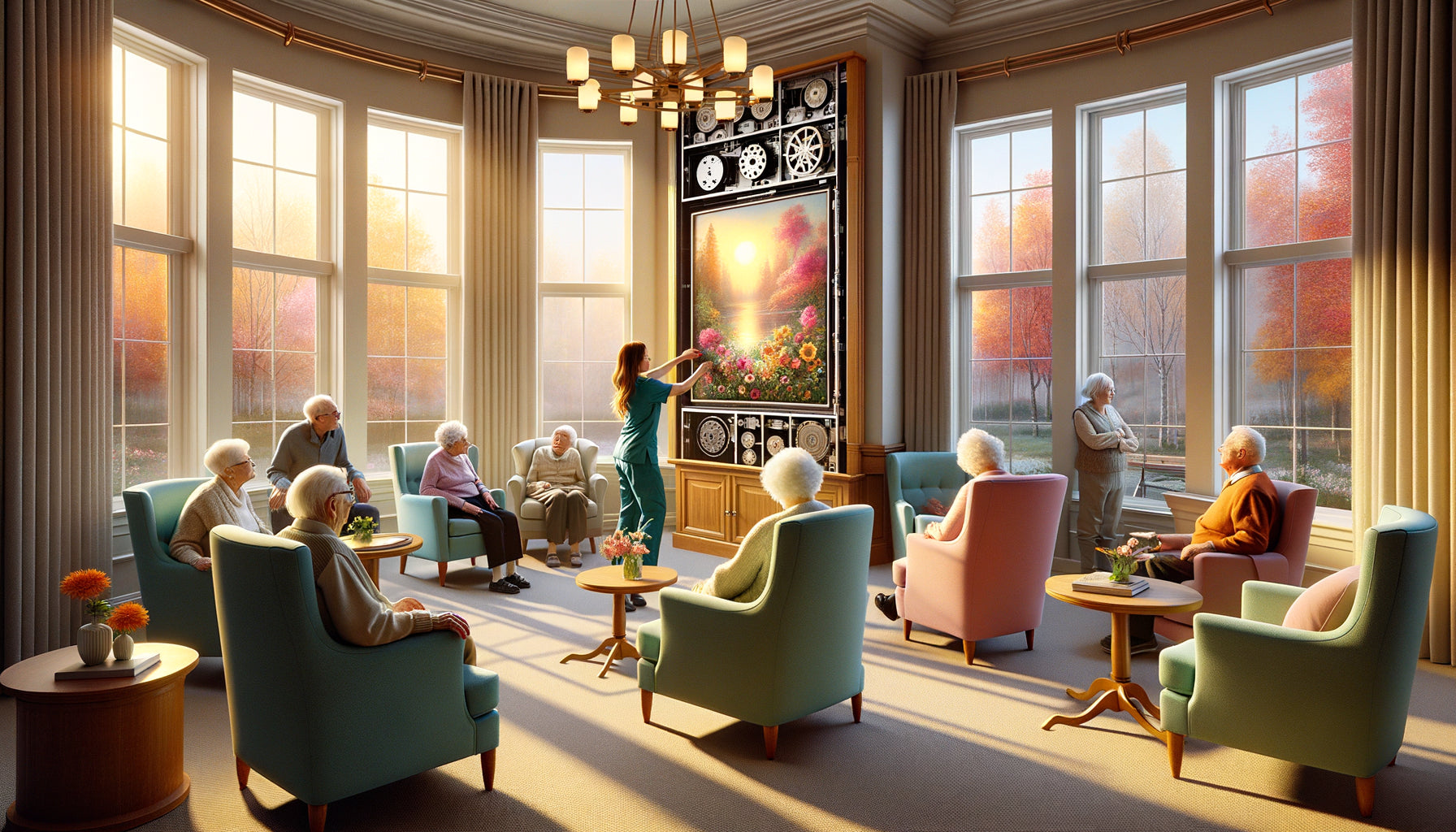
I recently advised a client who was looking to decorate the common area of a multi-generational residence. She hesitated between contemporary abstract art and more traditional scenes. We opted for a series of paintings representing different family celebrations across the decades. The result? Residents spontaneously began to share their own memories when observing these works, creating a new form of social connection.
This anecdote perfectly illustrates how these representations never remain passive. They activate memory and encourage oral transmission, this second pillar of cultural continuity.
The hidden sensory dimension
A fascinating aspect of paintings of traditional festivals lies in their ability to evoke multisensory experiences. When faced with a representation of a banquet, our brain does not just see images: it mentally reconstructs the smells of cooking, laughter, ambient warmth, the clinking of glasses.
This sensory activation explains why these works generate a deeper emotional connection than other artistic genres. They engage our affective memory, that reservoir where our most intimate cultural references nest.

Time frozen: antidote to modern acceleration
Our era is characterized by a vertiginous acceleration. Traditions adapt, simplify, sometimes disappear. In this context, paintings of traditional family celebrations play a stabilizing role. They testify that certain values transcend eras: family, sharing, collective celebration.
This visual permanence creates what anthropologists call a temporal anchor. When contemplating these scenes, we enroll ourselves in an unbroken chain of similar celebrations, sometimes stretching back centuries. It's not just your grandmother who did this, but dozens of generations before her.
I regularly observe this effect in people who integrate these works into their interior decoration. They describe a feeling of re-rooting, a reconnection with something greater than themselves. In a world where individualism dominates, these paintings remind us of our fundamentally collective dimension.
Universality in Specificity
Paradoxically, the more culturally specific a family celebration painting is, the more universal its message becomes. A scene of American Thanksgiving speaks as well as a Norman Christmas Eve or a Chinese New Year celebration. They all share this common narrative structure: loved ones gathered around a ritualized moment of joy.
This universality explains why these representations work even in multicultural spaces. They do not divide, they reveal our fundamental common points beyond differences in form.
How These Works Shape the Identity of Places
When you hang a traditional family celebration painting in a space, you are not simply decorating a wall: you symbolically qualify the place. You signal that this location values conviviality, memory, transmission.
This qualification is particularly powerful in collective spaces: common rooms of residences, family living rooms, reception areas. The painting becomes a visual totem that subtly influences behavior. People talk differently, behave with more consideration, as if the represented characters were watching us and reminding us of our best social codes.
In my work designing shared spaces, I have noticed that places adorned with traditional celebration paintings spontaneously generate more interactions between occupants. These works create conversation starters, pretexts for exchange: Does this remind you of your childhood Christmases? In our family, the tradition was different...
Nostalgia as Social Cement
These representations activate what psychologists call reflective nostalgia, different from simple melancholy. It is a positive look at the past that nourishes the present rather than fleeing it. Traditional family celebration paintings trigger this healthy form of nostalgia which strengthens our sense of identity while anchoring us in the moment.
This complex temporal dynamic – being present while connecting to the past – is precisely what we call cultural continuity. It is not static but living, constantly reactivated by these visual supports.

Transmitting without imposing: the silent pedagogy
One of the great advantages of traditional festive paintings lies in their non-verbal mode of transmission. Unlike moralizing speeches, they suggest rather than impose. They make certain values present without erecting them into obligations.
For younger generations often reluctant to traditional injunctions, these works function as visual invitations. They show without demonstrating, evoke without demanding. An adolescent may not read a book on family history, but he will unconsciously absorb the codes and values of a daily contemplated painting.
This indirect pedagogy proves remarkably effective. Cultural references are imprinted naturally, without psychological resistance, creating what educators call a hidden curriculum: learnings that take place outside any formal framework.
Children facing these images
I have often observed children stopping for a long time in front of family festive paintings, asking a thousand questions: Why are they dressed like that? What is on the table? What are they doing with their hands? These spontaneous interrogations open doors to transmission that adults might not otherwise have crossed.
Traditional festive paintings thus serve as supports for intergenerational dialogue, creating those precious moments where transmission takes place naturally, in curiosity rather than obligation.
Transform your spaces into guardians of living memory
Discover our exclusive collection of wall art for senior residences that celebrates the richness of family traditions and creates bridges between generations.
Towards a new appreciation of family scenes
We are currently experiencing a renewed interest in representations long considered outdated. After decades of minimalism and abstraction, the public is rediscovering the emotional power of narrative-rich figurative scenes.
This resurgence of traditional family celebration paintings is not simply a nostalgic trend. It responds to an authentic contemporary need: that of finding anchors in a rapidly changing world, of reclaiming a collective history in the face of individual fragmentation.
The most avant-garde interior designers are now integrating these works into resolutely modern contexts, creating fascinating temporal dialogues. A 19th-century banquet painting near a contemporary kitchen, a Victorian Christmas scene in an industrial loft: these juxtapositions generate a narrative depth that modern furniture alone cannot offer.
By choosing to hang these representations in your home or shared spaces, you are doing much more than making a decorative choice. You consciously decide to keep alive a memory, to enroll yourself in a continuity, to offer those who share these places a connection with something larger than the present moment.
Traditional family celebration paintings are not frozen relics but living organisms of cultural transmission. They evolve with our gaze, enrich themselves with our own experiences, and constantly create new resonances. That is why they will continue to adorn our walls for a long time and nourish our fundamental need for continuity.
Frequently Asked Questions
Do traditional celebration paintings suit modern interiors?
Absolutely, and it is this creative tension that makes them so interesting today. The mistake would be to believe that they only work in rustic or classic settings. On the contrary, a traditional family celebration painting in a contemporary environment creates a particularly eloquent temporal contrast. It humanizes the space, brings depth and warmth that modern furniture alone cannot offer. I simply recommend choosing a simple frame to facilitate this stylistic coexistence. The essential thing is that the work dialogues with your space rather than opposes it.
Should one choose scenes corresponding to their own culture?
Not necessarily, and that’s the beauty of these representations. Of course, a painting reflecting your own traditions will create an immediate personal resonance. But traditional family celebrations from other cultures can just as easily enrich your space. They broaden your perspective, spark conversations, and remind us that some values – togetherness, sharing, transmission – transcend borders. In multicultural spaces like shared residences, mixing different visual traditions even becomes a particularly relevant act of inclusion. The important thing is that the artwork speaks to you emotionally, that it evokes something authentic within you.
Where to place these paintings to maximize their impact ?
Communal living spaces are the natural locations: dining room, living room, open kitchen. These places where people gather create an obvious resonance with the subject of the painting. But don’t neglect passageways like hallways or entrance halls, where these works can create a symbolic transition between the outside and the intimacy of the home. In senior residences or shared spaces, prioritize common rest areas where residents have time to contemplate and exchange. Ensure appropriate lighting that highlights the artwork without creating reflections, because these paintings rich in detail deserve to be lingered over for a long time.