When Mrs. Dupont, 82 years old, arrived at the Les Érables residence, she immediately felt a difference. Not just in the furniture or colors, but in an indefinable atmosphere that instantly soothed her. What she perceived unconsciously was the effect of carefully orchestrated therapeutic decor, far beyond simple aesthetic considerations. Because in senior residences, every decorative choice can either simply embellish or truly heal.
Here's what the difference between therapeutic and aesthetic decoration brings concretely: a measurable improvement in cognitive and emotional well-being, a reduction in anxious and disoriented behaviors, and sensory stimulation adapted to the specific needs of older people. Three dimensions that radically transform the daily experience of residents.
Too often, families choose a residence for its elegant appearance, harmonious hallways, and beautifully decorated spaces. But a few weeks after moving in, they notice that their loved one seems disoriented, agitated, or conversely, strangely apathetic. Beauty alone is not enough. It can even, in some cases, become a source of confusion when it does not meet the specific neurological and sensory needs of old age.
Rest assured: understanding this distinction requires no medical training. In this article, I reveal the concrete criteria that separate these two decorative approaches, to allow you to objectively assess the environment offered to your loved ones. You will know exactly what elements to observe during your visits, and why some decorative choices go far beyond a simple question of taste.
Aesthetic decoration: when visuals are prioritized over function
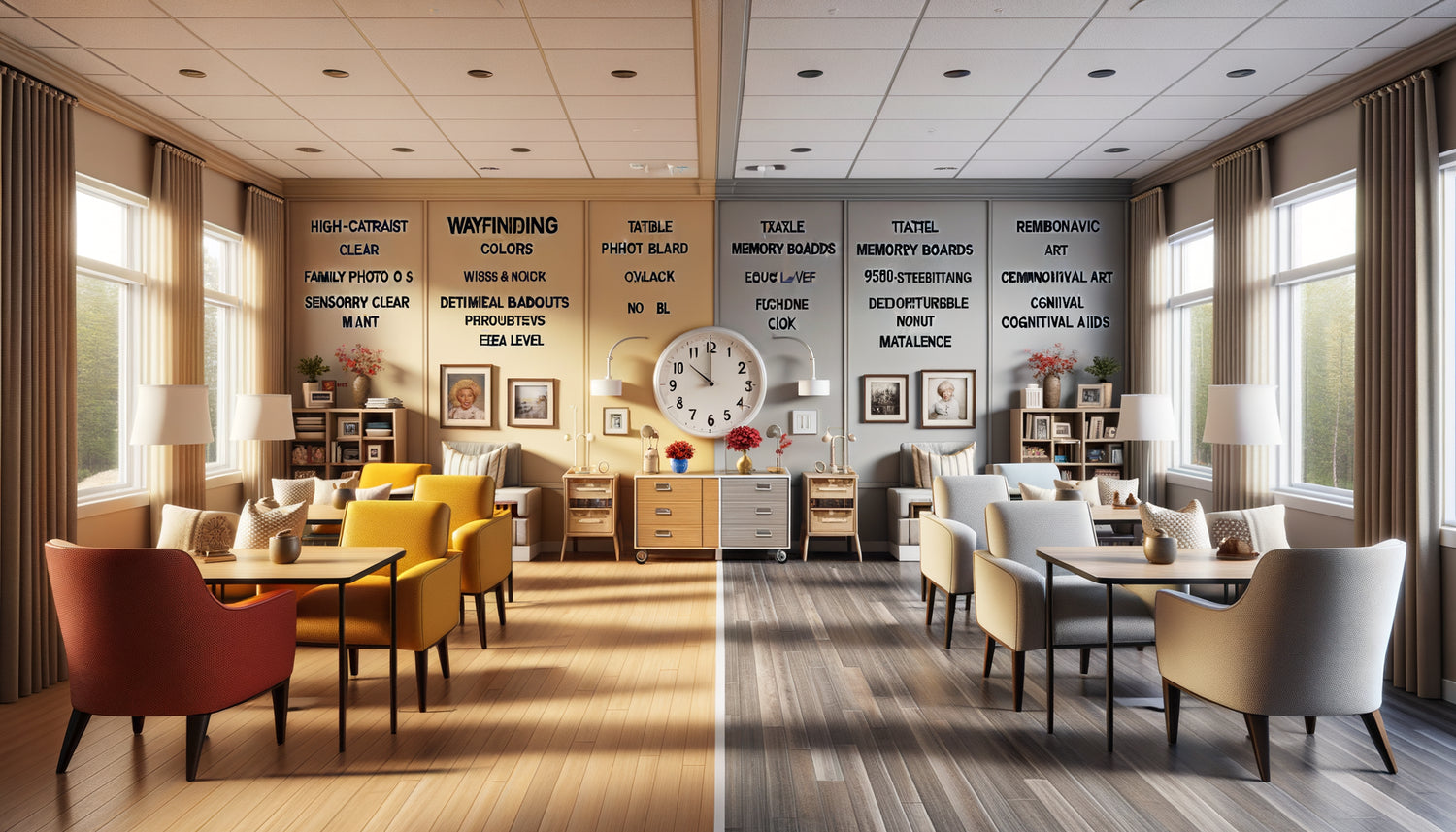
Aesthetic decoration in senior residences first responds to a commercial and visual logic. It aims to seduce families during visits, create an image of prestige, and reassure about the quality of the establishment. Choices naturally focus on trendy color harmonies, noble materials, and conventional works of art that could adorn any boutique hotel.
In this type of approach, you will find beige or pearl gray walls, abstract paintings in neutral tones, subdued ambient lighting, and uncluttered spaces that breathe modernity. Everything is impeccably coordinated, even Instagrammable. The entrance hall impresses, the dining room evokes a contemporary restaurant, the hallways recall the latest hotel trends.
But here's the problem: this aesthetic decoration completely ignores sensory alterations related to aging. With age, perception of contrasts decreases by 50%, sensitivity to cool colors weakens, and the ability to distinguish reliefs is considerably reduced. A staircase entirely gray becomes an invisible trap. A monochrome beige hallway becomes a disorienting tunnel without visual cues.
Therapeutic decoration: when every detail becomes care
Therapeutic wall decor in senior residences starts from a radically different philosophy: the environment is a care tool in its own right. Every color, every texture, every visual element is selected for its measurable effects on behavior, orientation and emotional well-being of residents.
Let's take colors as an example. Therapeutic decoration favors warm and saturated hues - soft oranges, bright yellows, natural greens - because neurological studies demonstrate their better visibility for older people. The doors of the rooms are painted in distinct colors, allowing residents with mild cognitive impairment to recognize their space without reading the numbers. This is called therapeutic chromatic wayfinding.
Contrasts become strategic: a step marked by a bright yellow band, a red door handle on a white leaf, a black switch on a cream wall. These choices are not random aesthetic but stem from a fine understanding of age-related visual impairments, including macular degeneration and cataracts.
Textures as cognitive stimulation
Where aesthetic decoration smooths and uniformizes, therapeutic decoration multiplies tactile stimulations. Various fabrics on armchairs, rough surfaces alternating with smooth areas, natural materials such as raw wood or wool. This sensory diversity keeps tactile curiosity active, slowing the decline of sensory abilities.
I have observed in several residences the installation of therapeutic sensory walls: wall panels integrating different textures to touch, ropes, fabrics, metal elements. These installations, which would seem out of place in a purely aesthetic approach, generate moments of spontaneous interaction, particularly beneficial for people suffering from anxiety or agitation.

Lighting: revealing the two philosophies
Nowhere else is the difference between therapeutic and aesthetic decoration more striking than in lighting. Aesthetic decoration favors ambiances, games of shadows, indirect lighting that creates a soft and intimate atmosphere. Very photogenic, certainly. But potentially dangerous.
Therapeutic wall decor in senior residences requires a minimum functional lighting of 500 lux in circulation areas, with maximum natural light. Shadowy areas are eliminated as they can be interpreted as obstacles by a person suffering from dementia. Variations in light intensity between two rooms are gradual to avoid glare or disorientation.
Even more subtle: the use of circadian lighting. Therapeutic decor integrates systems that modulate color temperature according to the time of day - stimulating blue light in the morning, soothing warm light in the evening - to naturally regulate sleep cycles often disrupted in seniors. No aesthetic consideration here, only neurobiological logic.
Artwork: from decorative to therapeutic narrative
In an approach to aesthetic decor, paintings and photographs are chosen for their formal beauty, their ability to harmonize with the establishment's color palette. Harmless abstract compositions, generic landscapes, reproductions of famous works.
Therapeutic decor radically transforms this function. The artworks become memory trigger supports, triggering memories and conversations. Photographs from bygone eras - scenes of life from the 1950s-1960s - that resonate with the youth of residents. Representations of old trades that encourage sharing experiences. Familiar regional landscapes that anchor in an emotional territory.
I have seen residences install rotating seasonal paintings: scenes of grape harvesting in autumn, Christmas markets in winter, fields of poppies in spring. This variation maintains temporal orientation, particularly valuable for people whose perception of time becomes blurred. Nothing aesthetically revolutionary, but a measurable cognitive impact.
Figurative subjects take precedence over abstraction because they generate less anxiety. A person suffering from Alzheimer's can become agitated by an abstract composition that they cannot interpret, whereas a clear rural scene immediately reassures them.
Transform your space into a truly therapeutic environment
Discover our exclusive collection of wall art for senior residences that combines authentic beauty and measurable cognitive benefits, specially designed to stimulate memory and soothe anxiety.

Signage: Where Utility Meets Therapy
The difference between aesthetic decoration and therapeutic decoration is beautifully crystallized in signage. The aesthetic approach minimizes signs, seeks discretion, favors elegant fonts but often too small or with insufficient contrast. The result is visually clean but functionally flawed.
Therapeutic decoration in senior residences embraces generous, legible, multimodal signage. Large sans-serif characters, universal pictograms, systematic color codes. But above all, it adds personalized biographical markers: Mrs. Martin's door is identified by a photo of her when she was young, a familiar object reproduced, a color that has meaning in her history.
This therapeutic personalization creates what occupational therapists call identity anchors, essential when spatial memory falters. It’s no longer just functional or aesthetic; it's deeply human.
How to Evaluate a Residence's Approach?
During your visit, ask specific questions that reveal the decorative philosophy. Ask why a particular color was chosen for the doors. Inquire about the criteria used to select paintings. Question about lighting levels and their daily variation. A residence practicing therapeutic decoration will have detailed answers supported by occupational therapy studies or recommendations.
Observe the residents' behavior in common areas. Do they seem oriented, active, engaged with their environment? Or do they appear passive, disconnected, lost despite the beauty of the place? Therapeutic decoration in senior residences generates observable behaviors: more spontaneous interactions, less anxious wandering, greater autonomy in movement.
Check for the presence of living natural elements. Accessible plants, aquariums, glass aviaries. Biophilia - our innate connection to life - is a pillar of therapeutic decoration, with proven effects on blood pressure and cortisol levels. Purely aesthetic decoration will settle for impeccable artificial flowers.
Visualize the Daily Transformation
Imagine your loved one in two different residences. In the first, everything is beautiful but uniform. She searches for her room every day, avoids the staircase she can't clearly distinguish, sleeps poorly due to inadequate lighting, and gets bored with paintings that don’t speak to her. Anxiety creeps in insidiously.
In the second, practicing therapeutic decoration, she recognizes her orange door at the end of the hallway. She takes the staircase with contrasting steps without hesitation. The vintage photographs in the common room spark conversations with other residents. In the evening, warm light naturally soothes her. She sleeps better, orients herself easily, and maintains independence for longer.
The difference between therapeutic decoration and aesthetic decoration in senior residences is not a matter of taste or budget. It's a question of care philosophy: is the environment considered as simple decor or as a tool for maintaining cognitive abilities and quality of life? Your next choice of residence should be based on this fundamental distinction.
Start today by creating an evaluation grid for your visits, listing the therapeutic criteria mentioned here. You will instantly see which establishments have truly thought beyond appearances, to create spaces that heal as much as they beautify.
Frequently Asked Questions about Decoration in Senior Residences
Can a residence be both aesthetic and therapeutic?
Absolutely, and that's even the ideal to seek. The best senior residences do not oppose these two approaches but intelligently merge them. Modern therapeutic decoration integrates contemporary aesthetic principles while respecting neurological and sensory imperatives. For example, bright colors can be used elegantly in harmonious compositions, varied textures can be integrated into designer furniture, and functional lighting can come from remarkable architectural luminaires. The key lies in the hierarchy of priorities: the therapeutic function guides the choices, then aesthetics enhance them. Look for establishments that clearly display this dual ambition and can explain how each decorative element simultaneously serves beauty and care.
Does therapeutic decoration necessarily cost more?
Unlike popular belief, therapeutic decor in senior residences doesn't necessarily involve costs higher than purely aesthetic high-end decoration. Budget differences lie elsewhere: less in the materials than in the expertise required. You need occupational therapists, psychologists specializing in gerontology, sometimes designers trained in care environments. The initial investment can be slightly higher in consulting, but the choices themselves are often more economical - standard quality paints rather than luxurious coatings, affordable photographic artworks rather than expensive works of art. Above all, the economic benefits in the medium term are significant: fewer falls and therefore less medical expenses, better autonomy for residents requiring less intervention from staff, reduction of disruptive behaviors limiting the use of anxiolytics. True therapeutic decor pays for itself through its effects.
How to convince a residence to adopt therapeutic principles?
If your loved one already resides in an establishment prioritizing pure aesthetics, you are not powerless. Start with modifications in the individual room, space where families generally have some leeway. Introduce elements of therapeutic decor on a small scale: framed and well-lit old personal photos, textiles with varied textures, color code to differentiate drawers or storage areas. Document the observed improvements - better orientation, reduced anxiety, improved sleep - and share these factual results with management. Propose scientific articles or feedback from other establishments. Group together with other families having the same concerns to create a collective demand. Some residences, faced with reasoned requests and compelling literature, accept to evolve gradually, especially as therapeutic decor becomes a differentiating commercial argument appreciated by new generations of families who are better informed.