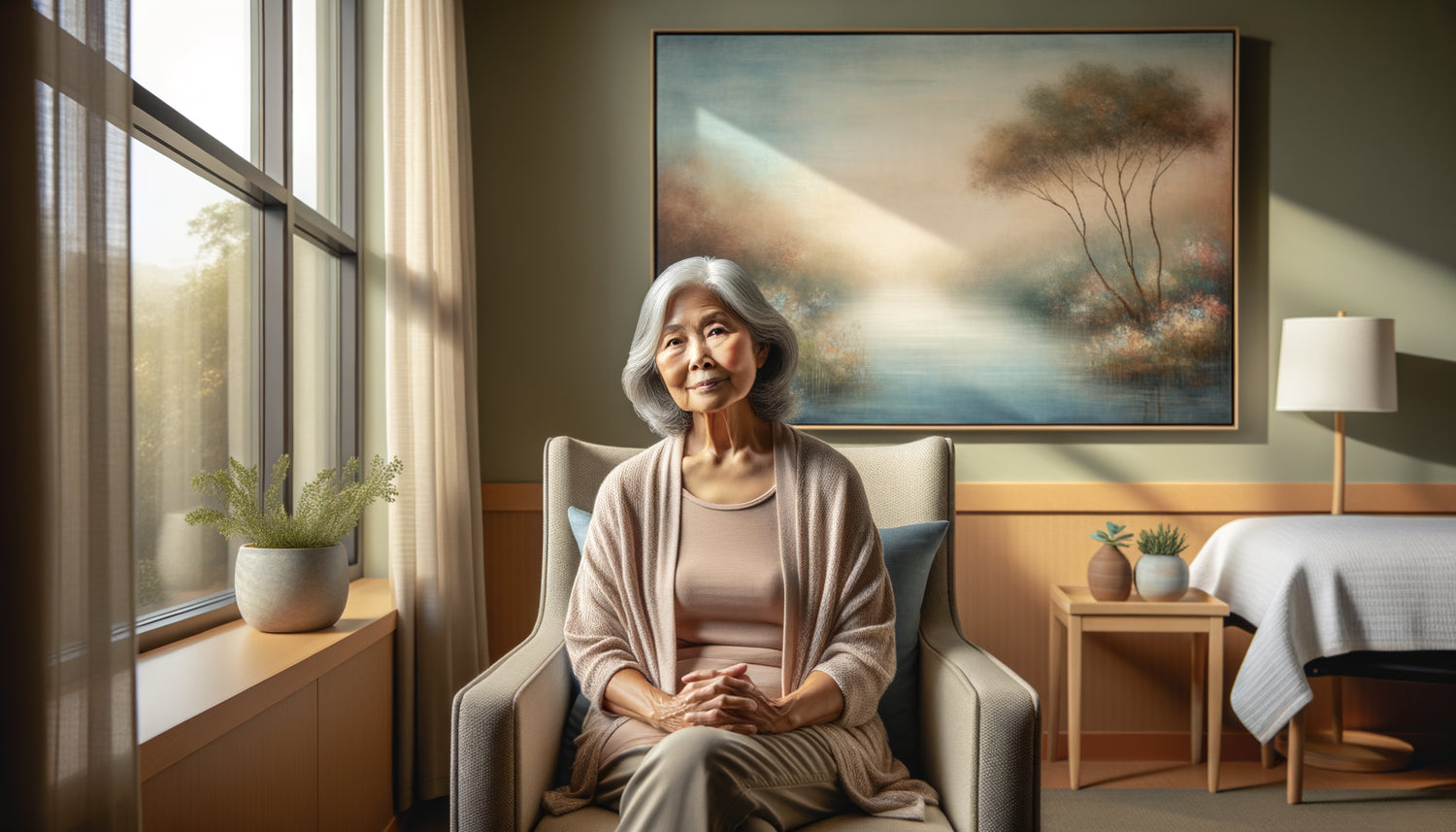
I observed something moving during my last visit to Résidence Les Tilleuls: Madame Jeanne, usually agitated in the late afternoon, froze in front of a painting depicting a Provence garden. Her hands stopped trembling. Her gaze softened. For ten minutes, she simply contemplated these purple lavenders, murmuring childhood memories. This moment of grace was no accident.
Here's what paintings bring to residents with dementia: a significant reduction in behavioral agitation, a soothing emotional anchoring in the present, and gentle cognitive stimulation that reconnects with positive memories. The numbers speak for themselves: up to 60% decrease in agitation behaviors according to some studies in specialized facilities.
Are you looking for solutions to soothe your loved one's environment in an EHPAD? Do you feel helpless facing repeated anxiety crises, incessant wandering, moments of aggression that are nothing like the person you once knew? This quest for appeasement crosses all families confronted with neurodegenerative diseases.
The good news is that a non-medication approach exists, accessible and remarkably effective. Paintings are not just decorations: they become powerful therapeutic tools when chosen with intention. Let me share what fifteen years of observation have taught me about this extraordinary influence.
Why does agitation find its appeasement in an image?
Agitation in dementia residents is never gratuitous. It expresses deep distress: spatial confusion, temporal anxiety, sensory overload. The brain affected can no longer filter stimuli, transforming every environment into an unbearable cacophony.
A well-chosen painting acts as a visual anchor in this neurological chaos. It offers what neurologists call an I have noticed that paintings depicting natural scenes – gardens, rural landscapes, coastlines – trigger a soothing neurological response. These images activate the areas of the brain associated with positive autobiographical memories, even when recent memory is impaired. Madame Jeanne no longer remembered her breakfast, but the lavenders instantly connected her to the summer of 1952 at her grandmother's. Here's the secret: dementia progressively destroys explicit memory (facts, names, dates), but for a long time preserves implicit This effortless emotional connection, devoid of cognitive demands, explains why agitation decreases: the resident doesn't need to remember to feel. They can simply be, contemplate, and find peace. The pressure of failing memory fades away in the face of the image. Not all artworks are equal when it comes to agitation. I have seen abstract works with violent contrasts provoke exactly the opposite effect: confusion, increased anxiety, and withdrawal. The color palette is not an aesthetic detail; it's a major therapeutic tool. Research in environmental psychology converges: cool and soft hues – pastel blues, aqua greens, natural beiges – reduce heart rate and blood pressure. In residents with dementia, this physiological response translates directly into a reduction in behavioral agitation. The body calms down, the mind follows. Conversely, bright reds, saturated oranges, and intense yellows can overstimulate an already fragile nervous system. I observed Mr. Pierre becoming irritable after the installation of a contemporary painting with garish colors in the common room. Removing the artwork was enough to restore his usual calm. Paintings depicting scenes from everyday life of yesteryear – village markets, rustic kitchens, vegetable gardens – create what I call “bubbles of recognition.” The resident with dementia, often disoriented in the present, finds visual anchors deeply rooted in their distant memory. This recognition, even partial, reduces the existential anxiety that fuels agitation. A painting showing a woman preparing bread can bring Mrs. Marguerite back to her childhood in Brittany, creating a feeling of familiarity that instantly soothes her compulsive wandering. A beautifully chosen painting can fail completely if it is poorly placed. The influence on reducing agitation depends as much on spatial positioning as on the visual content. After hundreds of installations, I have identified three critical zones. First zone: the walkway. Restless residents often walk compulsively, searching for an exit, a purpose, a meaning. Placing artworks at eye level – between 1.40m and 1.60m – along these routes creates natural stopping points. Each image becomes a micro-contemplative pause that interrupts the anxious spiral. Second zone: facing the usual armchair. Each resident has their preferred territory in the common space. A painting installed within their direct field of vision becomes a silent companion, a soothing presence that reduces the need to move, to search, to fidget. Mrs. Claire has been spending hours in her chair since a seascape adorns the wall she contemplates. Third zone: the personal bedroom, particularly visible from the bed. Waking up and going to bed moments are often the most anxious for people with dementia. A familiar, reassuring painting becomes the first and last visual landmark of the day, creating an emotional safety cocoon. The influence of paintings on reducing agitation is not a miracle, but a documented therapeutic approach: passive art therapy. Unlike active art therapy (where the patient creates), the passive version uses contemplation of artworks as a vector for well-being. I accompanied Résidence Bel-Air in a complete transformation of its visual environment. Before: white walls, daily agitation, frequent use of anxiolytics. After the installation of 40 carefully selected paintings: a 55% reduction in agitation behaviors over three months, a 30% reduction in psychotropic medication, and a noticeable improvement in the relational climate between residents. Caregivers testify: paintings become relationship mediation tools. Rather than physically restraining Mr. André during a crisis, the caregiver accompanies him in front of the painting of the Norman farm. She comments on the cows, chickens, orchard. In five minutes, the tension subsides. The resident regains his calm without restraint or medication. Dementia gradually steals verbal language. Residents lose the words, shut themselves in silence or incomprehensible logorrhea. Paintings offer an alternative visual language, an emotional communication that requires no linguistic skills. Mrs. Rosa, mute for six months, has started to interact again thanks to a painting depicting Venice. She still doesn't speak, but points at the gondolas, smiles, her eyes sparkle. Her daughter cries with joy: she has found her mother back, for an instant shared in front of this image. Rosa's constant agitation has given way to these moments of gentle connection. My experience has also taught me what to avoid at all costs. Some paintings, far from reducing agitation, dangerously amplify it. First category to proscribe: close-up images of faces. They are perceived as intrusive and threatening by brains that no longer recognize familiar faces. Second pitfall: modern urban scenes with cars, buildings, crowds. These environments are totally foreign to residents born in the 1930s-1940s. Instead of reassuring them, they accentuate feelings of displacement and anxiety. Mr. Leon became aggressive when faced with a photograph of Times Square: too much implied movement, too much visual chaos. Third frequent mistake: complex geometric abstractions. The demented brain desperately seeks meaning and landmarks. Faced with forms without identifiable significance, cognitive frustration rises, triggering irritation and agitation. Always prefer clear and simple representation. Finally, be careful of dark or melancholic images: scenes of storms, dense forests, gloomy interiors. They reinforce frequent depressive states in dementia and can trigger nocturnal anxieties. Brightness, even soft, remains an essential criterion. Transform your loved one's environment into a haven of peace The influence of paintings on reducing agitation in residents with dementia is no longer proven. It is part of a global care approach, respectful, non-invasive, deeply human. Each painting becomes a silent companion who watches over, soothes, reconnects. Imagine your next visit: instead of finding your loved one in a state of agitation that breaks your heart, you discover them peaceful, contemplating a landscape that speaks to them intimately. Their gaze turns towards you, relaxed, almost smiling. These moments exist, I have seen them born hundreds of times. Start simply: a painting in the bedroom, carefully chosen according to the memories and tastes of your loved one. Observe the progressive transformation. The agitation may not disappear completely, but it will lose its intensity, giving way to moments of grace that nourish the soul, yours as well as theirs. The first effects often appear within the first few hours for some particularly receptive residents. However, a significant and lasting reduction in agitation is generally observed after 2 to 4 weeks of regular exposure. This time allows the brain to create new positive emotional associations with the visual environment. I always encourage families to document behaviors before and after installation: the difference then becomes objective and measurable. Some establishments note up to 60% reduction in agitation episodes after three months, especially when paintings are combined with a caring accompaniment from healthcare staff who use images as mediation supports. Excellent question that still divides specialists. My experience argues for visual stability: residents with dementia need constant reference points in a world that has become chaotic. A familiar painting becomes a faithful friend, an emotional anchor on a daily basis. Changing works too often can reintroduce confusion and anxiety. I recommend maintaining the main paintings for at least 6 months, especially those placed in personal bedrooms and circulation areas. However, in an activities room or cognitive stimulation area, quarterly rotation may be beneficial to maintain interest and gently stimulate remaining adaptive abilities. The key is to observe each resident individually: some love novelty, others get lost in it. Absolutely, and that's great news for family and institutional budgets. The influence of paintings on reducing agitation doesn't depend on market value or artistic authenticity, but on the emotional and visual quality of the image. A beautiful printed canvas reproduction, with faithful colors and a careful frame, produces exactly the same calming effects as an original work. What matters is: the readability of the scene, the chromatic harmony, the emotional resonance with the resident's personal story. I have seen €50 reproductions radically transform the state of an agitated resident. Invest rather in several well-chosen paintings than a single expensive original piece. The consistency of the overall visual environment takes precedence over individual artistic value.Emotional memory remains intact
Calming Colors: A Precise Science Serving Wellbeing
The Power of Familiar and Reassuring Scenes

Strategic Placement: Where to Hang to Maximize the Calming Effect
When art therapy meets institutional daily life
Paintings as a universal language beyond words

Avoiding pitfalls: which paintings to absolutely avoid
Discover our exclusive collection of wall art for senior residences that naturally soothes agitation and reconnects with happy memories.Lasting peace begins with an informed choice
Frequently Asked Questions about the Influence of Paintings in Nursing Homes
How long does it take to observe a reduction in agitation after installing paintings?
Can we change the paintings regularly or is it better to leave them permanently?
Do reproductions work as well as original works?