In Georges' living room, a former captain at sea for thirty-two years, three monumental marine oils dominate the walls of his Brest apartment. When I ask him why he surrounds himself with these waves and tormented skies now that he has permanently left the sea, his response surprises me: "It’s precisely because I no longer set sail that I need them." This sentence summarizes the complexity of the link between seafarers and their artistic representation.
Here's what maritime paintings bring to former sailors and fishermen: a sense of identity that anchors them in their history, a paradoxical appeasement that transforms difficult memories into serene contemplation, and a visual language that only those who have sailed truly understand in its entirety.
Many think that a retired sailor would want to turn the page, forget the storms, sleepless nights, and constant worry. Why surround yourself with waves when you’ve finally gained solid ground? This misunderstanding often comes from loved ones who redecorate living spaces with mountain or countryside landscapes, believing they are doing well. Yet, it's not oblivion that these men and women need.
The truth is that the sea never truly leaves. It is inscribed in the body, in the gaze, in the way of reading the sky. And maritime paintings become a bridge between two lives: one before, active and demanding, and one after, calmer but needing meaning and continuity. Together, we will discover why these works play such a particular therapeutic role for this community.
The still sea: when the image soothes what reality exhausted
I have long accompanied residents in coastal retirement homes, and I have observed a fascinating phenomenon. Former fishermen react differently to maritime paintings according to one specific factor: the presence or absence of movement. A fishing boat at port at sunset provokes serene contemplation. A storm scene with spray generates endless stories but also a form of agitation.
What the painting brings is the mastery of time that the real sea never allows. Faced with a canvas depicting sailboats under a light breeze, the former sailor can finally control the experience. He chooses when to immerse his gaze in it; he can detach himself from it when the emotion becomes too strong. This regained autonomy transforms sometimes traumatic memories into contemplative material.
A former fishing boss from Guilvinec confided to me that his painting of boats stranded at low tide reminded him of moments of respite: "When I look at it, I remember the mornings we prepared the nets, not the nights we fought against the waves." The frozen maritime scene operates a natural memory selection, highlighting the meditative aspects of the trade rather than its constant dangers.
The paradox of maritime nostalgia
One might believe in a contradiction: how can a harsh, dangerous life, marked by family separations, generate such powerful nostalgia? The answer lies in what psychologists call "redemptive nostalgia." Maritime paintings allow for the reinterpretation of past experiences by extracting their identity substance while leaving aside immediate suffering.
An old merchant sailor explained to me that his large painting of a cargo ship crossing the Indian Ocean under the stars did not remind him of the six months away from his family, but of the pride in belonging to a community of experts, navigators capable of reading the world differently. The painting becomes the symbolic receptacle of this pride, freed from its emotional cost.
A visual language that only initiates truly decipher
When you place a maritime painting in front of different audiences, the reactions reveal totally distinct perceptual worlds. The average visitor will admire the colors, the composition, perhaps the romantic atmosphere of a lighthouse in the mist. The old sailor, on the other hand, technically reads the scene as one deciphers a musical score.
I witnessed a memorable scene in a Nantes gallery. In front of a 19th-century marine painting depicting a three-masted ship under full sail, an old captain of the merchant navy remained silent for fifteen minutes. Then he murmured: "The painter has never sailed. With this wind and this sail orientation, the boat would be lost." For him, the technical error broke any possibility of appeasement. The painting became a source of irritation rather than serenity.
This anecdote highlights a crucial point: the maritime authenticity of the works directly conditions their soothing effect on former seafaring professionals. A scene consistent with nautical realities – correct rigging, plausible weather conditions, faithful lighting – generates immediate recognition that allows relaxation. Conversely, an artistic approximation creates a cognitive dissonance that prevents immersion.
The details that speak to seafarers
Maritime paintings that particularly soothe former sailors share specific characteristics. The representation of maritime light comes first: this particular quality of the dawn at sea, when the horizon still blends with the sky, or those late afternoons when the sun makes each wave sparkle differently. Painters who have really sailed, like the Dutch masters of the 17th century or some contemporary artists from a nautical background, capture this luminosity with a precision that former sailors instinctively recognize.
The other trigger is the presence of human scale. A large, empty sailboat can seem majestic, but a tiny silhouette on the deck, a fisherman leaning over his crates, sailors furling a sail: these details reactivate the body memory of the trade. The former fisherman projects himself into these gestures that he has performed thousands of times, and this mental projection triggers a similar calming effect to that of meditation in motion.

The painting as a tool for transmission and conversation
In families of sailors, intergenerational communication often hits an invisible wall. How to tell thirty years at sea to grandchildren born in the digital age, who have never left the continent? Words always seem insufficient, anecdotes get lost in their too technical or too routine aspect.
Maritime paintings then become extraordinary narrative supports. René, a former bosun, has installed in his living room a reproduction of a port scene from the 1950s, the time when he first embarked. When his grandchildren visit, the painting serves as a trigger. “You see that guy on the dock? That was my job, securing the ropes.” Suddenly, the story takes shape, becomes visual, understandable.
This transmission function brings a calming effect of a different nature: that of feeling that one's experience will not be totally lost, that it will find an echo even tenuous in family memory. The maritime painting literally anchors the personal history in the domestic space, giving it a lasting materiality that simple stories cannot offer.
When the community recognizes itself in the image
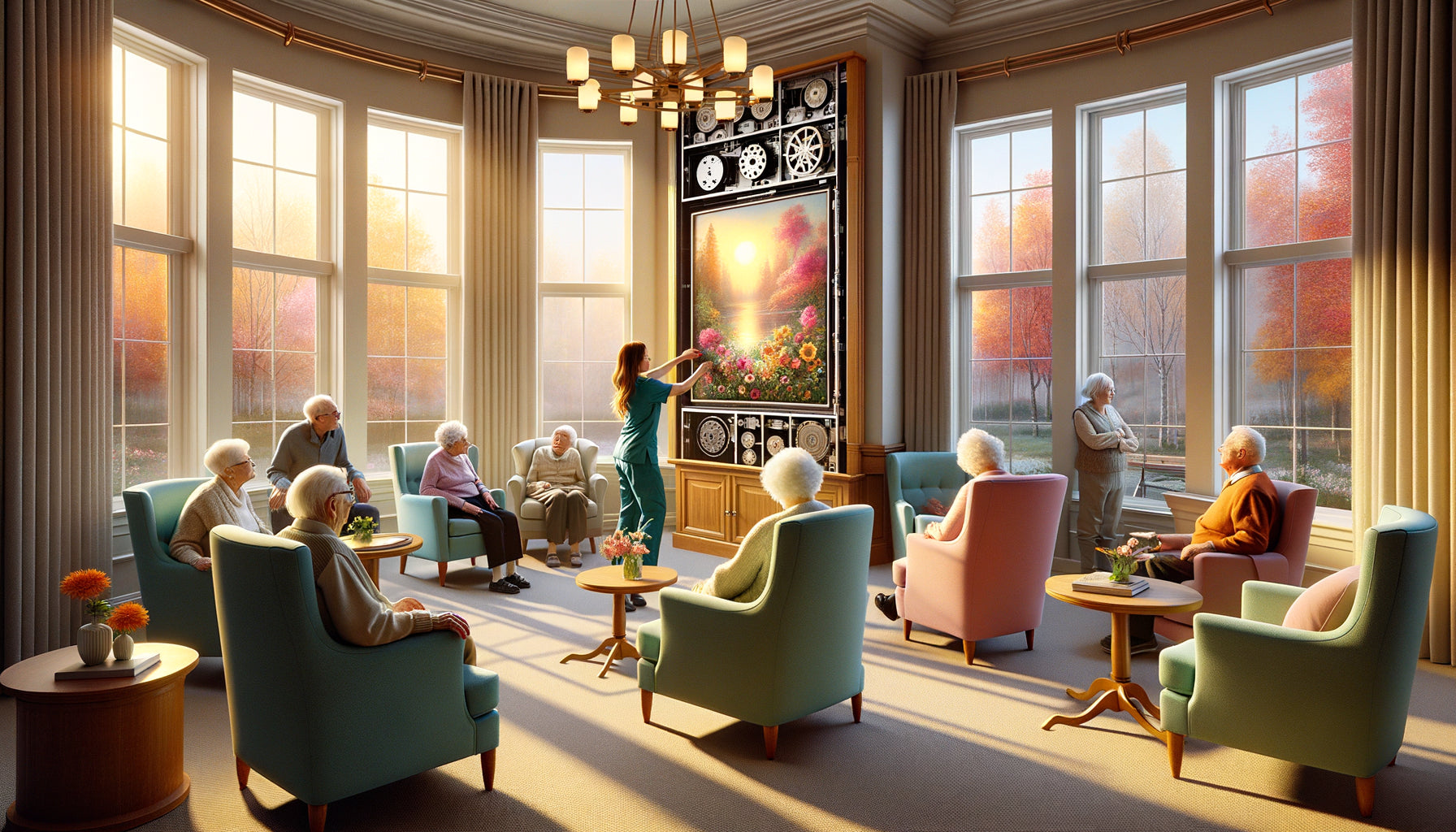
I noticed a touching phenomenon in coastal senior residences. Maritime paintings installed in common areas spontaneously create informal gathering points. Former sailors naturally meet there, comment on the details, correct each other's memories, laugh at the anecdotes that the work evokes.
This collective dynamic amplifies the individual calming effect. The painting becomes the catalyst for a microsociety that shares codes, a vocabulary, a common history. In a context where retirement can mean loss of status and social identity, these groupings around a maritime image reconstruct a therapeutic sense of belonging.
The calming scenes: emotional typology
Not all seascapes generate the same soothing effect. After dozens of conversations with former maritime professionals, a clear emotional typology emerges.
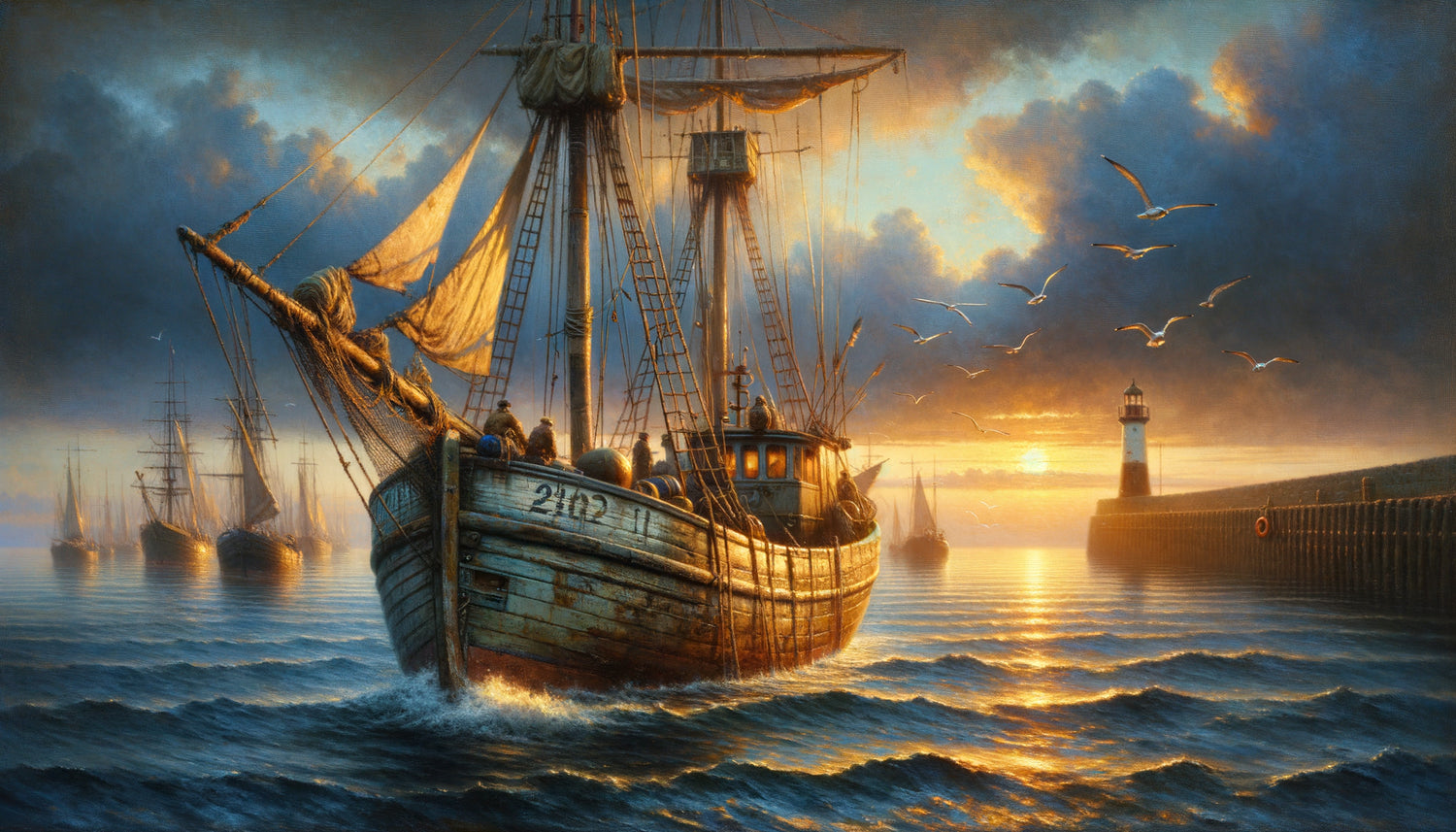
The scenes of resting harbors – boats moored at sunset, nets drying on quays, low tide revealing hulls – are by far the most popular. They evoke moments of respite, regained security, work accomplished. An old fisherman from Fécamp told me: "When I look at my painting of the harbor at dawn, I feel exactly what I felt after a difficult tide, when we finally passed through the breakwater: relief."
The vast seas under soft light – these views of endless horizons under peaceful skies, with no human presence or almost none – work differently. They engage the contemplative, almost mystical dimension that many sailors develop facing the oceanic immensity. These paintings invite inner silence, a form of meditation that does not need words.
Curiously, storm scenes also occupy a significant place, but for a specific reason: they allow revisiting moments of adrenaline and danger from the absolute safety of the present. It is appeasement by contrast: "I look at this huge wave submerging the deck, and I tell myself that I am well warm, and that I will never face that again." The fixed storm becomes tangible proof that this period is definitively closed.
The importance of format and placement
The size of maritime paintings directly influences their ability to soothe. Large formats – over one meter wide – create an immersive effect particularly sought after by former sailors. Faced with a monumental canvas, the visual field is sufficiently occupied to trigger this sensation of "diving back" into the marine environment.
Placement in the habitat also reveals fascinating unconscious strategies. Many former sailors install their main painting facing their usual armchair, creating a daily and ritualized face-to-face. Others prefer a perpendicular wall, visible in peripheral vision, a constant presence but not intrusive. This intimate geography of the work in domestic space modulates its therapeutic effect.

Beyond nostalgia: the sea as a psychic structure
To understand why nautical paintings particularly soothe former seafarers, one must go beyond the superficial explanation of nostalgia. What is at play is much deeper: it's the preservation of an entire psychic structure forged over decades at sea.
A man or woman who has spent their professional life sailing does not only develop technical skills. Their perception of space, time, risk, solitude, and community is built according to parameters radically different from those of land dwellers. The infinite horizon, the constant movement, the controlled unpredictability become components of their mental architecture.
When this person permanently leaves the sea, they do not simply change jobs: they lose their natural cognitive environment. Nautical paintings are not mere nostalgic decorations; they are perceptual prosthetics that keep active areas of the mind that would otherwise atrophy. Looking daily at a nautical scene is like continuing to operate the neural circuits of reading waves, weather anticipation, and presence in vastness.
This neuropsychological perspective explains why some former seafarers develop a true contemplative dependence on their paintings. It's not ordinary sentimental attachment; it’s a structural need to maintain consistent their deep identity facing the upheavals of life ashore.
Offer a maritime window that truly speaks to the souls of the sea
Discover our exclusive collection of paintings for senior residences that respect maritime authenticity and bring this particular soothing to former sailors.
Choosing the right painting: what former seafarers are really looking for
If you want to offer a nautical painting to a former sailor or fisherman, or if you yourself are concerned and looking for the work that will truly speak to you, certain criteria deserve particular attention.
First, prioritize artists who have sailed or who have immersed themselves extensively in maritime communities. Their gaze carries the right technical skill and understanding of atmospheres that former professionals immediately recognize. Official Marine painters, artists residing in ports, some documentary photographers offer this valuable authenticity.
Beware of overly romantic or idealized scenes that erase the laborious dimension of the trade. A former fisherman confided to me his annoyance at “salon marines” where sailors have clean hands and impeccable oilskins. It’s not about brutal realism, but about truth in details: a body posture that testifies to effort, equipment consistent with the era and type of fishing, credible weather.
Finally, don't hesitate to involve the person concerned in the choice. Contrary to popular belief, revealing the surprise doesn't spoil anything: the selection process, the discussion about different artworks, the memories they evoke already constitute a therapeutic experience in themselves. Many former sailors find it difficult to verbalize their decorating needs; guiding them with kindness towards the artwork that truly speaks to them is perhaps a more valuable gift than the object itself.
Mistakes to absolutely avoid
Some well-intentioned blunders can turn a gift into a source of discomfort. Avoid scenes of shipwrecks or maritime disasters, especially if the person has experienced dramas at sea. What may seem "impressive" or "powerful" artistically can sometimes reactivate buried traumas.
Also be wary of overly contemporary representations if the person sailed in the 1960s-1980s. A former merchant sailor confronted with a giant container ship might feel a sense of dispossession: "This is no longer my sea, this is no longer my job." Prioritize periods that correspond to their lived experience, or timeless scenes that transcend eras.
Finally, never neglect the geographical dimension. A sailor who has spent his life in the Mediterranean will not necessarily recognize themselves in Breton seascapes, and vice versa. The light, the color of the water, the type of coastline carry a maritime regional identity as distinct as wine terroirs. This geographical consistency conditions the ability to identify with it and therefore the soothing effect.
When words fail, images soothe
Many former sailors and fishermen share a common characteristic: a certain difficulty in verbalizing their emotions, a consequence of a professional culture that valued restraint and discretion. Maritime paintings then become silent emotional regulation tools, particularly valuable during difficult transition periods such as retirement and aging.
Facing their canvas, these men and women can feel, remember, sometimes cry, without having to name what is happening. The painting offers a personal projection space that words cannot always create. This non-verbal cathartic function explains why some former sailors develop daily contemplative rituals: a few minutes each morning in front of their maritime artwork, a moment of centering before facing a day ashore that still feels foreign to them.
Imagine your living space enriched with a permanent window onto the universe that shaped your existence. Imagine being able, with just one glance, to reactivate that part of yourself that earthly life no longer engages. The right nautical painting is not a decorative accessory: it's a daily companion that maintains dialogue with the person you were, the person you remain deep down, even far from sea spray and tides. Start by identifying scenes that truly resonate with your personal maritime experience, look for artists who have managed to capture this truth of the sea, and give yourself this visual continuity that will transform your interior into a space of reconciliation between all parts of your story.
Frequently Asked Questions about Nautical Paintings and Former Sailors
Do former sailors prefer nautical paintings or photographs?
This question often comes up, and the answer is not unequivocal. Nautical paintings, particularly those executed in a realistic or impressionistic style, offer a timeless and poetic dimension that allows for a certain emotional distance. Artistic interpretation filters reality in a way that can be more soothing than raw photographic reproduction. On the other hand, some former sailors specifically seek the documentary accuracy that only photography can provide, especially if they want to rediscover specific types of boats, particular ports or defined eras. I have found that sailors with a more contemplative sensibility tend towards painting, while those who have retained a more technical relationship with the sea often prefer photography. Ideally, it is sometimes best to mix the two approaches in different rooms, creating multiple levels of interaction with the nautical universe according to moments and emotional needs.
Can a painting of a storm really be calming or could it instead generate anxiety?
This is a matter of individual sensitivity and personal history. For some former sailors, scenes of storms reactivate a form of positive adrenaline: they recall moments when their skills were maximally challenged, when they felt fully alive and useful. Contemplating a storm from the safety of your living room can provide what psychologists call “the satisfaction of danger overcome.” This is particularly true for those who sailed on large ships and retain a valorizing memory of their ability to face the elements. On the other hand, for fishermen who have experienced traumatic situations – capsizing, man overboard, loss of colleagues – these images can indeed generate residual anxiety. The golden rule is personal listening: if you feel that a scene makes you uncomfortable rather than revitalizes you, prioritize more serene atmospheres. True appeasement always comes from a positive resonance with the work, never from forced confrontation.
Should we prioritize artworks depicting exactly the type of navigation we have practiced?
This question touches on the heart of maritime identity. Intuitively, one might think that a former trawler captain would only want fishing scenes, and a merchant marine officer only cargo ships or ocean liners. In practice, it's more nuanced. Many former sailors appreciate the diversity of maritime representations, including those that do not exactly correspond to their experience. What matters most is the authenticity of the overall maritime atmosphere: the accuracy of the light, the credibility of the sea, and respect for nautical codes. I met a former fisherman who owned a superb collection of classic sailing ships, which he had never sailed himself. He explained to me that these sails filled with wind captured the very essence of what he loved about navigation: the dialogue with the elements, the elegance of movement, the fragility of human beings facing immensity. That said, having at least one work that accurately represents his professional world remains important for many, as it anchors personal history in a very concrete way. The ideal balance probably combines biographical specificity and openness to the diversity of maritime expressions.