A few weeks ago, during an installation at a client's home, an octogenarian, I hung a painting depicting children playing marbles in a schoolyard. She froze in front of the artwork, her eyes shining, and spontaneously told me about her summer 1952 in the Dordogne region. This moment confirmed what I have observed for fifteen years: paintings of children playing possess a unique emotional power, particularly with older people.
Here's what paintings of children playing actually bring: they reactivate happy childhood memories, create an atmosphere of calm that combats melancholy, and establish an emotional bridge between generations. These works do not simply decorate a wall: they transform a space into a refuge of bright memories.
You may be looking to create a warm environment in a senior bedroom, stimulate the memory of a loved one with cognitive impairments, or simply bring joy into a living space? Many think that a simple decorative frame will suffice, but the reality is much more subtle.
Rest assured: choosing a painting of children playing does not require expertise in art therapy. What matters is understanding how these representations dialogue with our emotional memory and buried emotions. I'll show you why these childhood scenes possess this unique ability to brighten everyday life.
When nostalgia becomes an emotional refuge
In my practice with senior residences, I have noticed that paintings of children playing consistently trigger positive emotional reactions. This phenomenon can be explained by what neuroscientists call 'restorative nostalgia': these images reactivate memories from a time when life seemed simpler and more joyful.
A painting depicting children running in a field or playing hide-and-seek works as a visual Proust's madeleine. It is not a sad melancholy, but a reconnection with fundamental emotions: carefree joy, spontaneity, wonder. These scenes recall a time when time stretched differently, when each game was an adventure.
I have observed that residents often spend several minutes in front of these paintings of children playing, smiling on their faces. Some begin to recount their own memories: games of marbles, street games, endless summers. The artwork becomes a catalyst for stories, a trigger for valuable intergenerational conversations.
The psychology of colors and movement
Paintings of children playing generally have a particular color palette: bright, luminous colors, often dominated by warm tones. These shades naturally stimulate the production of serotonin, the well-being hormone. The movement captured in these scenes – a child running, jumping, laughing – transmits a vital energy that positively contrasts with the sometimes excessive tranquility of senior spaces.
This dynamic visual is essential. It recalls that life is movement, that youth is not only a bygone period but an energy still accessible through memory. In environments where the pace naturally slows down, these artworks inject a valuable dose of emotional vitality.
How these works stimulate affective memory
Neuroscience has demonstrated that images of children playing activate specific brain areas linked to autobiographical memory and empathy. During a collaboration with an EHPAD (residential care home for the elderly), I installed a series of paintings depicting children playing in the common area. The care team quickly noted improved social interactions and a decrease in anxious manifestations at the end of the afternoon.
This phenomenon can be explained by several mechanisms. First, universal childhood scenes – playing ball, building sandcastles, running through grass – transcend generations and cultures. Everyone finds a personal echo in them. Secondly, these representations act as positive memory anchors: they do not require cognitive effort to be understood, and spontaneously trigger happy associations.
The temporal mirror effect
A fascinating aspect of paintings depicting children playing lies in their ability to create what I call a temporal mirror effect. When faced with these works, the senior viewer sees themselves simultaneously as they were and as they are. This dual perspective generates a reassuring narrative continuity: I am still myself, despite the passage of time.
This recognition of self across generations is profoundly soothing. Paintings depicting children playing do not show a lost paradise inaccessible, but rather a living part of our identity. They affirm that the joy of childhood has not disappeared: it has simply transformed, enriched by experience.

Choosing the right artwork to maximize emotional impact
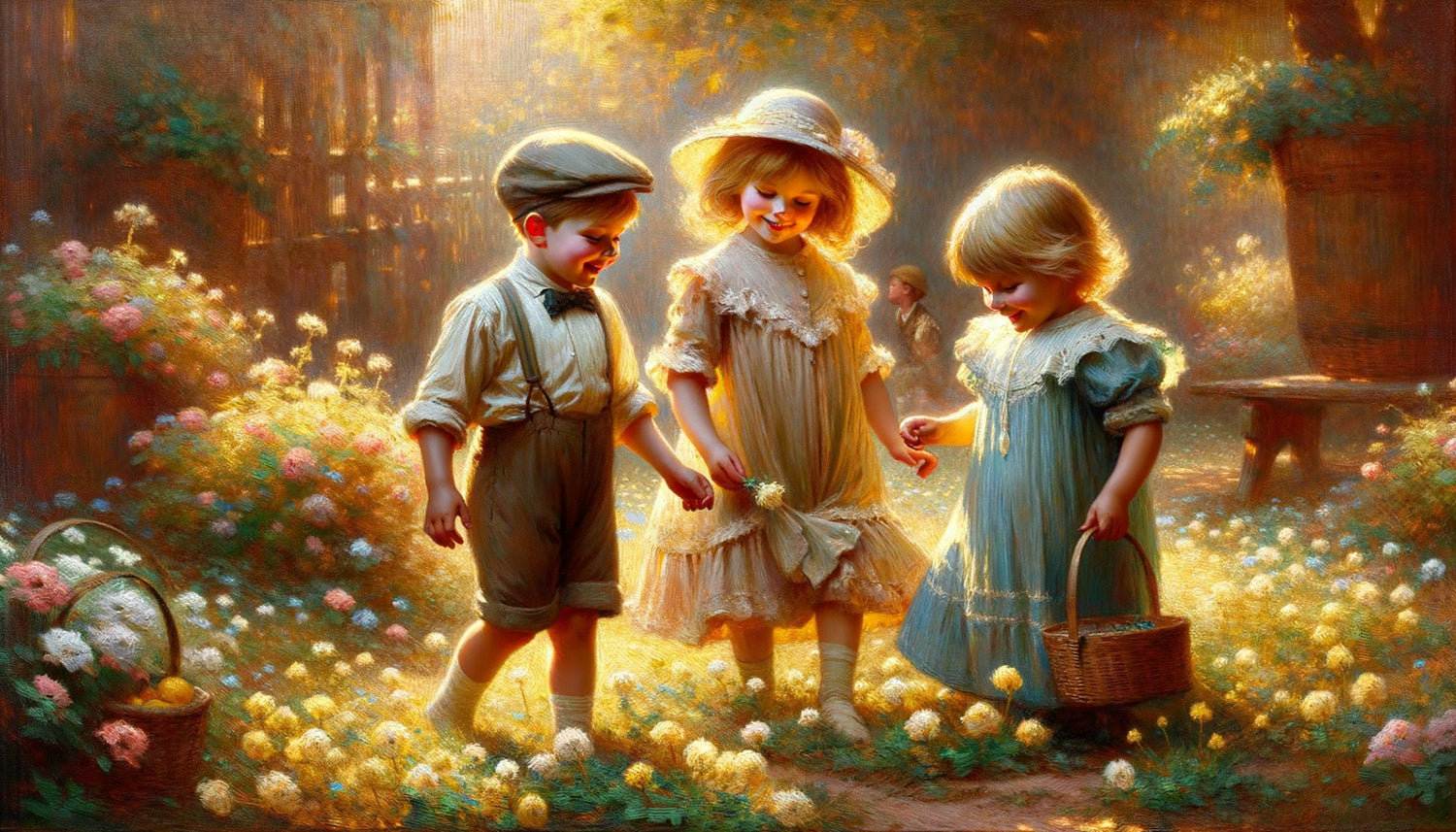
Not all paintings depicting children playing produce the same effect. In my recommendations, I prioritize specific criteria. Outdoor scenes in full light work better than dark interiors: they evoke freedom, space, breathing. Paintings showing group games stimulate more than solitary portraits, because they recall social connection and community belonging.
The painting technique also matters. Works with realistic or impressionistic renderings generally create more emotional connection than abstraction, as they allow for immediate identification. Details count: a red ball, a flowered dress, worn-out shoes – these specific elements trigger precise and personal memories.
I systematically avoid overly idealized or saccharine representations. The best paintings of children playing capture an authenticity: dust on the knees, tousled hair, intense concentration on a simple game. This visual truth resonates more than artificial perfection.
The importance of cultural and temporal context
For maximum effectiveness, I recommend choosing paintings of children playing whose era roughly corresponds to the viewer's youth. For people born in the 1930s-1950s, rural or street scenes work wonderfully: traditional games, farmyards, village squares. These generational visual markers amplify emotional resonance.
A painting of children playing jacks or hopscotch will speak differently to an octogenarian than a contemporary scene of a plastic playground. This temporal concordance is not nostalgic in the past tense: it validates lived experience, affirms that this era had value and deserves to be celebrated.
Beyond decoration: spontaneous art therapy
Paintings of children playing have a function that goes far beyond aesthetics. In care spaces, they become informal therapeutic tools. I have collaborated with psychologists who use these works as conversation starters: 'What was your favorite game?' 'Where did you play with your friends?' These simple questions, triggered by the image, open up valuable spaces for speech.
For people with mild cognitive impairments, these paintings act as non-invasive memory stimulants. Unlike formal cognitive exercises that can generate anxiety, observing a painting of children playing remains an enjoyable activity, without performance pressure. Memory reactivates naturally, without pressure.
Several families have reported to me that their usually taciturn parent spontaneously begins to recount childhood anecdotes in front of these works. These precious moments of communication create or recreate intergenerational bonds. Grandchildren discover a grandparent they didn't know: the one who climbed trees, invented games, lived daily adventures.

The effect on the overall atmosphere of a space
An often underestimated element: children playing wall art transforms the collective atmosphere of a place. In a senior residence where I oversaw the decoration, we installed several of these works in common areas. The overall ambiance became noticeably more cheerful, more conversational.
These images act as emotional permissions. They allow for smiles, lightness, and sharing happy memories. In contexts where concerns about health and discussions about limitations sometimes predominate, children playing wall art reaffirms that another dimension of existence deserves our attention: that of simple joy, spontaneous creativity, play.
Visitors also notice this difference. A director of an EHPAD (Establishment for Dependent Elderly) confided in me that several families had spontaneously commented on the atmosphere 'less institutional, more lively' after the installation of children playing wall art in the hallways. These works humanize the space, personalize it, and fill it with positive emotions.
Transform your space into a haven of bright memories
Discover our exclusive collection of wall art for senior residences that naturally stimulates joy and positive emotional connections.
Creating bridges between generations
A particularly touching aspect of children playing wall art: they facilitate intergenerational exchanges. During a family visit, a child recognizes in the work games that he practices himself, but in a different form. The conversation starts naturally: 'Did you used to play that too, grandma?' These temporal bridges are precious.
Children playing wall art remind us that some fundamental human experiences remain constant. The joy of running, laughing with friends, inventing stories – these pleasures cross the ages. This reassuring universality creates common ground between generations who may sometimes feel very distant.
In my practice, I encourage families to use these works as vehicles for transmission. The painting becomes a pretext for telling how things were 'before', what games we invented without electronics, how we had fun with next to nothing. These stories are not simple anecdotes: they convey values, a worldview, a part of the family history.
Now imagine this space where you enter and your gaze is immediately drawn to a painting of children playing. You involuntarily smile. For a few seconds, you find yourself in that schoolyard, that garden, that beach from your childhood. You feel that almost forgotten lightness. It's exactly this transformation that these works offer every day.
Start simply: choose a painting that resonates with your own memory, or the person for whom the space is intended. Place it in a passageway, at eye level, where natural light can play with the colors. Then observe. Listen to the stories that emerge. Paintings of children playing are not just decorations: they are permanent invitations to revisit our fundamental joys..
Frequently Asked Questions about Paintings of Children Playing
Do paintings of children playing really suit elderly people with dementia?
Absolutely, and it's even one of their most beneficial applications. Paintings of children playing work particularly well with people suffering from cognitive disorders because they stimulate long-term memory, which is generally better preserved than recent memory. Childhood scenes often remain accessible even in advanced stages of dementia. These clear, emotionally charged images offer reassuring visual cues without requiring complex cognitive effort. I have observed usually agitated residents calming down in front of these paintings, sometimes even sketching a smile or trying to recount a memory, even fragmentary. The key is to choose simple, bright scenes with easily identifiable subjects: children in a park, by the sea, in a farmyard. These universal representations cross the barriers of failing memory.
What style of painting of children playing should I choose: realistic, impressionistic or contemporary?
To maximize the positive emotional impact, I systematically recommend the realistic or impressionistic style rather than contemporary abstraction. The reason is simple: these paintings should trigger immediate recognition and spontaneous emotional connection. Realistic works allow for direct identification: 'I see children playing marbles, I remember doing the same'. Impressionism also works wonderfully because it captures the movement, light, and atmosphere of a happy moment without falling into cold hyperrealism. Its touches of color and brightness create a dreamy ambiance that amplifies the positive nostalgic dimension. On the other hand, overly stylized or abstract representations require an interpretive effort that can create confusion rather than pleasure, especially for older people or those with cognitive impairments. Favor readable, warm scenes bathed in natural light.
Where is the ideal place to put a painting of children playing in a senior bedroom?
The placement of your painting of children playing is crucial for maximizing its emotional impact. I recommend positioning it within the natural field of vision, ideally facing the bed or main armchair, at a height that allows you to contemplate it comfortably without raising your head. Avoid locations that require turning around: the work should naturally offer itself to the gaze, becoming a daily visual companion. Favor a wall benefiting from indirect natural light – never in full sun which would degrade the colors – because daylight amplifies the warm tones of paintings of children playing and reinforces their invigorating effect. In common areas, install them at seated eye level, near conversation areas: these works then become catalysts for exchanges. One last tip: leave visual space around the painting, do not overload it with other elements. It deserves to be contemplated in a certain quietness to fully deploy its evocative power.