This feeling is familiar: you wake up every morning facing that wall, too white, too empty, desperately lacking character. It's not the desire to hang something on it that's missing, but the certainty of making the right choice. A painting that's too imposing will overwhelm the space, while one that's too small will disappear into the background. Between these two extremes, how do you find the ideal size for your bedroom?
Here's what a well-chosen picture size brings to a bedroom: a soothing visual balance that promotes rest, an authentic personality that transforms the room into a true sanctuary, and spatial harmony that enhances every square centimeter. You hesitate between several dimensions, fearing a failed art gallery effect or a tiny frame lost on a large wall? This uncertainty is legitimate. The bedroom is not just a passageway: it's the place where each day begins and ends, where the eye naturally rests before sleep.
In the lines that follow, you will discover how to choose the perfect size according to your wall dimensions, understand the proportions that really work, and compose arrangements that transform your bedroom into a visual sanctuary.
The rule of thirds: your dimensional compass
Forget complicated formulas. To determine the ideal picture size, measure the width of your available wall and multiply by 0.66. This magic number – two-thirds – gives you the maximum width that your artwork should occupy. On a 240 cm wall above your bed, aim for a painting approximately 160 cm wide.
This proportion is not arbitrary. It respects the natural balance that our brain subconsciously seeks in a resting space. A picture occupying less than half of the wall will seem shy, floating in the void. Beyond 75%, it will overwhelm the space and create a visual tension that is not conducive to sleep.
For standard-sized bedrooms (12 to 15 m²), horizontal rectangular formats from 80x60 cm to 120x80 cm are the perfect sweet spot. They offer enough presence without dominating the room, creating what I call soft visual anchoring: your gaze finds a soothing focal point without being captured or distracted.
The exception of high ceilings
In bedrooms with ceilings of 3 meters or more, the rule of thirds applies differently. The verticality of the space calls for square (80x80 cm, 100x100 cm) or even vertical formats, which will naturally guide the eye upwards and enhance this beautiful ceiling height without overwhelming it.
Portrait, landscape or square formats: decoding their emotional language
Each picture orientation speaks a different spatial language. Horizontal (landscape) formats visually widen the space, create a feeling of openness and invite calm. This is why they naturally dominate bedrooms: they extend the horizontal line of the bed and reinforce the idea of rest.
Vertical (portrait) formats, on the other hand, energize the space, draw the eye upwards and create a sense of height. In a bedroom, use them sparingly: they are perfect on a side wall, near a door or in a narrow space like an alcove. A 50x70 cm or 60x80 cm format in portrait orientation animates a reading corner without overwhelming it.
Square (square) formats offer a unique visual stability. Neither horizontal rest nor vertical momentum: just a perfect balance that works wonderfully in modern and minimalist bedrooms. An 80x80 cm square painting creates a meditative focal point, particularly effective with abstract or geometric compositions.

When multiple compositions outperform a single painting
Here's a truth I discovered after hundreds of room setups: sometimes, three small paintings create more impact than one large one. The magic lies in the wall composition, that way of orchestrating several works into a coherent ensemble.
For an individual bedroom, the horizontal triptych remains a safe bet: three identical 40x50 cm formats spaced 5 to 8 cm apart create a soothing visual narrative above the bed. The eye naturally moves from left to right, like in a reading, creating a fluid movement that relaxes rather than activates.
The gallery wall composition works beautifully on a side wall, the one you see from the bed. Mix 4 to 6 frames of varying sizes (30x40 cm, 40x50 cm, 50x70 cm) while maintaining a constant spacing of 6 cm. The trick: arrange them on the floor until you find the perfect balance before drilling any holes.
The invisible alignment rule
In any multiple composition, create an invisible guideline: align either the top edges, the bottom edges, or the centers of your paintings. This invisible consistency structures the whole and avoids the cluttered effect that would disturb your rest.
Adapting the format to the function of the wall
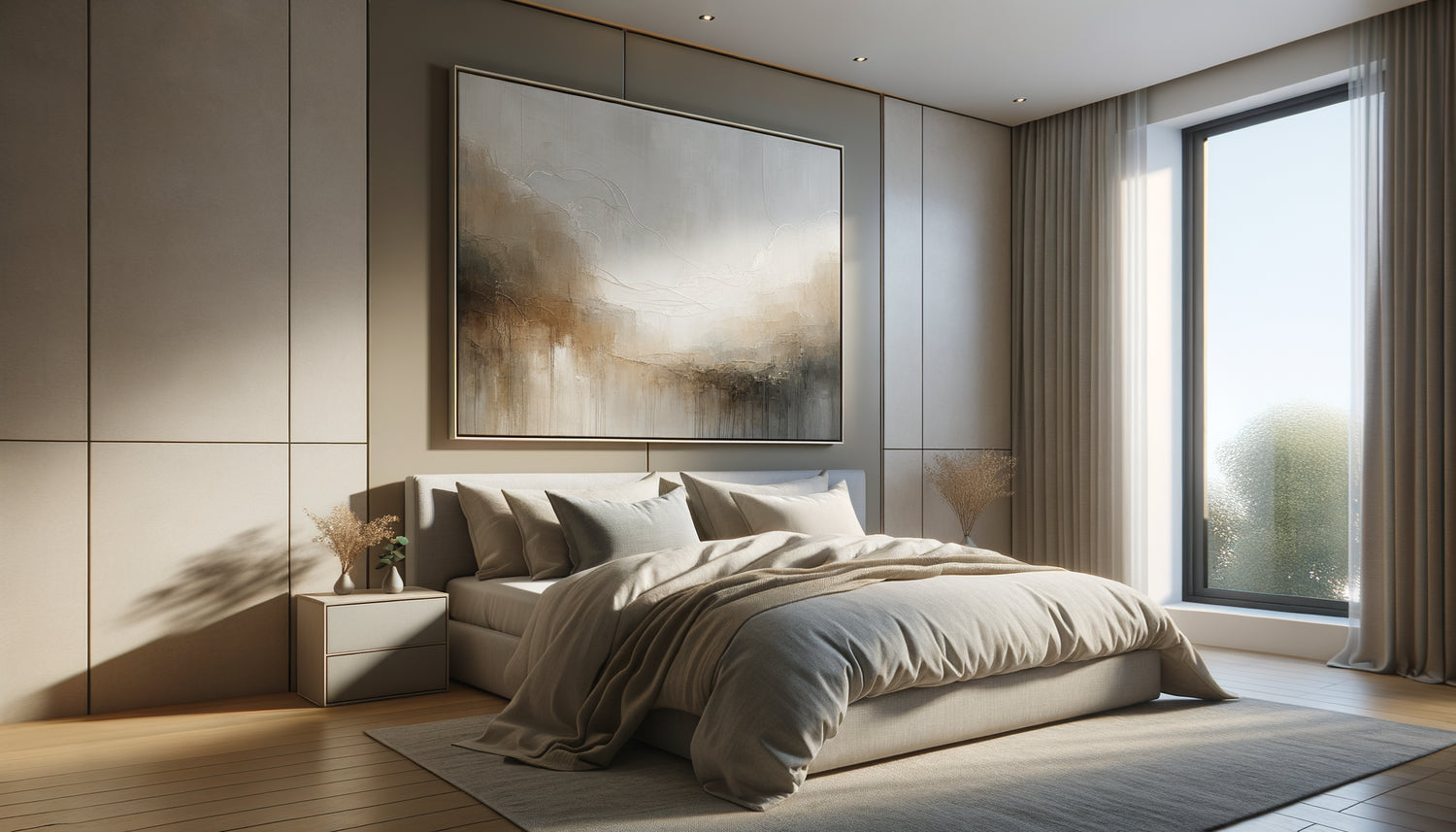
Not all walls in a bedroom are equal. The headboard wall tolerates and even demands the largest formats: it's your main scene, the one that defines the atmosphere of the entire room. Dare to use a 120x80 cm or even a 140x100 cm if your dimensions allow.
The wall opposite the bed, the one you gaze at before falling asleep, deserves special attention. Opt for medium formats (70x90 cm, 80x60 cm) with soothing compositions: soft landscapes, fluid abstractions, minimalist scenes. It's the last image your brain records before sleep.
The side walls perfectly accommodate more modest vertical formats (40x60 cm, 50x70 cm) or compositions in height. They create secondary points of interest without competing with your main staging.
As for the wall facing the door, often neglected, it offers a nice opportunity for a medium format (60x80 cm) that visually welcomes you when entering the room. It's your first spatial impression: exploit it.

XXL formats: daring the large format in a bedroom
Contrary to a persistent preconceived notion, large formats are not reserved for living rooms. In a spacious bedroom (more than 18 m²), a large-format painting of 150x100 cm or even 180x120 cm creates a spectacular architectural presence that transforms the wall into an emotional window.
The key: compensate for visual power with the softness of the subject. A large format works in a bedroom when it represents soothing elements – skies, oceans, snowy landscapes, monochrome abstractions. Immersion then becomes meditative rather than stimulating.
However, pay attention to the suspension height: a large painting hung too high will overwhelm the room. The center of the work should be between 145 and 155 cm from the floor, that is at eye level when standing. Above a bed, leave 20 to 30 cm between the top of the mattress and the bottom of the frame.
Small spaces: the medium format strategy
In a compact bedroom (less than 10 m²), resist the temptation of very small paintings. Paradoxically, medium formats work better than miniatures that get lost and accentuate narrowness.
A format of 60x80 cm or 70x90 cm well chosen brings structure and depth to a small space. Favor compositions with perspective, vanishing lines or gradients that create the illusion of openness. A horizontal marine landscape of 80x60 cm will make a cramped bedroom wall breathe better than three small 30x40 cm frames.
The trick for narrow bedrooms: exploit verticality with a single portrait format (60x90 cm) on the shortest wall. You balance the proportions and divert attention from the excessive length of the room.
Your bedroom deserves more than a blank wall
Discover our exclusive collection of wall art for senior residences that transforms each room into a true soothing sanctuary.
Visualize before you invest
Imagine the moment: you wake up naturally, your gaze drifts to that perfectly sized artwork that visually anchors your space. Neither too imposing nor shy. Just this balanced presence that tells you: here, this is my home.
The ideal format does not exist in absolute terms; it exists for your bedroom, your walls, your eye. Before any purchase, cut out a paper template to the dimensions considered, stick it to the wall and live with it for a few days. Your instinct will quickly tell you whether the format breathes or suffocates.
Start by measuring, apply the rule of thirds, then adjust according to your feeling. The bedroom is your sanctuary: only your visual comfort really matters.
Frequently asked questions about wall art formats in bedrooms
What is the minimum size for a painting above the bed?
To create a significant visual impact above a bed, aim for a minimum width of 80 cm. Below that, the painting may seem lost and unbalance the composition. For a standard double bed (140 cm), a format of 100x70 cm or 120x80 cm offers the ideal presence. If your budget or constraints limit you to smaller formats, opt for a composition of three 40x50 cm paintings spaced regularly: the cumulative effect will create the necessary width while bringing visual rhythm.
Can we mix horizontal and vertical formats in the same bedroom?
Absolutely, and it is even desirable to create visual dynamism. The key lies in hierarchy: establish a dominant format (usually horizontal above the bed) that defines the main atmosphere, then add vertical formats on the side walls as visual counterpoints. For example, a 100x70 cm horizontal painting behind the headboard can harmoniously dialogue with a 50x70 cm vertical format on the adjacent wall. However, maintain consistency in styles and colors to unify the whole despite the diversity of orientations.
How to choose between a large painting and several small ones?
This decision depends on your decorative personality and your wall. A large single artwork creates a strong, clean and contemporary impact: it suits minimalist spaces and lovers of bold visual statements. Several small artworks offer flexibility, storytelling and the possibility of evolution: you can add, rearrange, create evolving visual stories. In practical terms, prioritize a single artwork if your wall is less than 3 meters wide and you are looking for simplicity. Opt for multiple compositions if you like to collect, if your style often evolves, or if you want to create a progressive personal gallery. If in doubt, start with a medium-sized single piece: you can always add companions later.