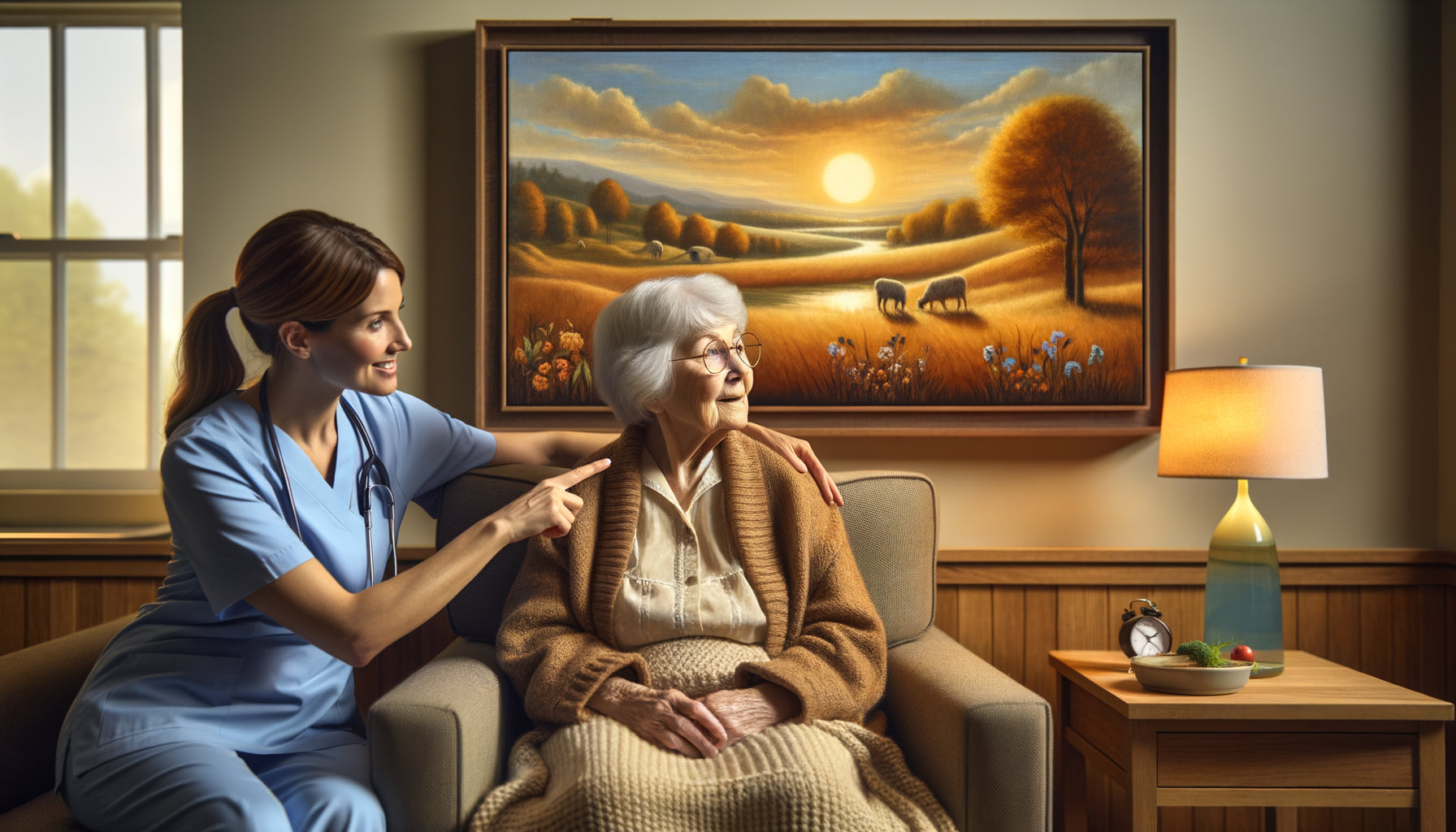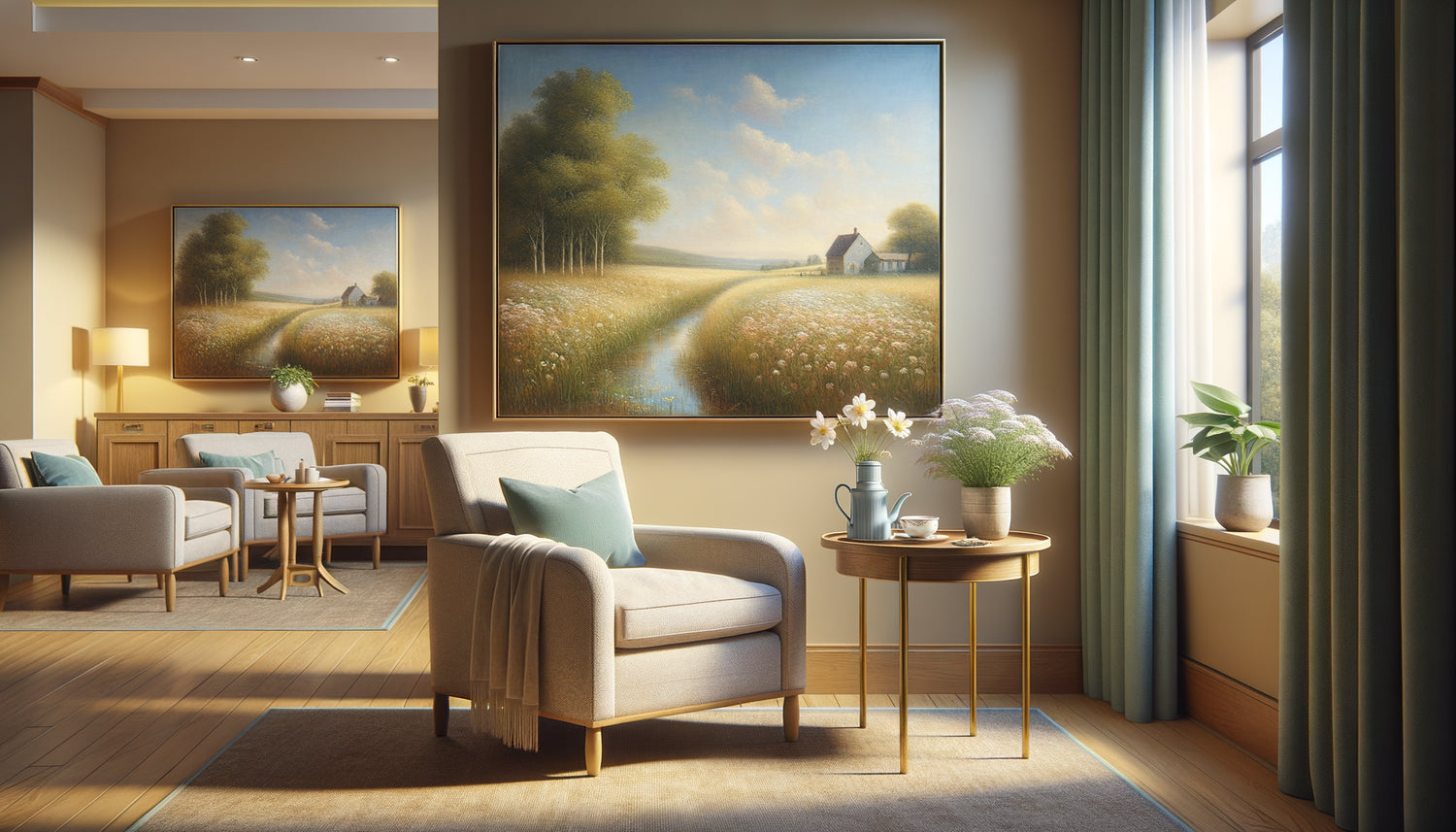
When Marie-Claude moved into her assisted living facility in Bordeaux, she immediately noticed the difference. It wasn't just the well-designed architecture or the comfortable furniture. It was these paintings in the reading room, near the library, that transformed a simple functional space into a true haven of peace. From Provençal landscapes with soothing colors to elegant still lifes inviting contemplation. She now spent every afternoon there, book in hand, soothed by this particular atmosphere.
Here's what carefully chosen paintings in rest areas of senior residences bring: a measurable reduction in stress thanks to harmonious visuals, gentle stimulation of cognitive abilities through artistic contemplation, and the creation of a warm atmosphere that combats the feeling of institutional isolation.
Many directors still think any reproduction will do. They install impersonal works, too abstract or with aggressive colors, without understanding why residents don't frequent these spaces designed for them. The furniture is perfect, the lighting studied, but something is missing. That human warmth, that invitation to calm which makes all the difference.
The good news? Choosing paintings suitable for rest areas in senior residences doesn't require a degree in art therapy. It just takes understanding a few essential principles about seniors' visual perception and the psychological impact of artworks in these particular living spaces.
I am going to share with you the codes I have discovered through my collaborations with residences that have transformed their common areas into true oases of serenity.
The emotional palette: when colors become allies of well-being
In the rest area of Les Glycines residence, the change was spectacular. By replacing paintings with bright and contrasting tones with works in soft and harmonious shades, the team observed a 40% increase in reading room attendance. Residents stayed longer, exchanged more.
Soothing blues evoke the serenity of marine and celestial landscapes. They naturally slow heart rate and promote deep relaxation. A painting depicting a summer sky or a peaceful lake becomes a window to tranquility, particularly valuable in rest areas where seeking calm is a priority.
Tender greens recall the regenerative nature: spring meadows, luminous undergrowth, French gardens. This color stimulates gently without exciting, perfect for those moments of pause when one wants to read, converse or simply contemplate.
Earthy and sand tones – beiges, light ochres, powdered pinks – create an enveloping atmosphere. They recall familiar interiors, childhood homes, these reassuring landmarks that are sometimes lacking in a new environment. In a senior residence, these shades warm the space without weighing it down.
Beware of intense reds, vibrant oranges, or dominant blacks in relaxation areas. These stimulating colors have their place in activity zones, but can generate subconscious tension where one seeks precisely to recharge.
These subjects that speak to the heart: the art of visual recognition
Jacques, a former 78-year-old agronomy engineer, stops every morning in front of the painting of the blossoming orchard in the relaxation room. 'It reminds me of my parents' property in Normandy,' he confides. This emotional connection is not insignificant: it transforms a simple decoration into a trigger for happy memories.
Familiar natural landscapes work wonderfully well. French countryside with its fields of lavender or wheat, roads bordered by poppies, perched villages, Breton or Mediterranean coasts. These scenes speak to the collective memory and offer reassuring visual reference points.
Elegant still lifes – wildflower bouquets, seasonal fruits, floral compositions – bring a welcome presence of greenery, especially in relaxation areas without an exterior view. They evoke sweet life, simple pleasures, without complex interpretation.
Scenes of everyday life from the past – Provençal markets, Parisian café terraces from the 1950s, rural scenes – create bridges with the experiences of residents. These paintings become catalysts for conversation, facilitating exchanges between residents around shared memories.
Absolutely avoid complex abstract works that require an interpretive effort, anxiety-inducing scenes (storms, ruins, marked solitude), or representations that are too contemporary which can create a generational distance. In a senior residence, visual familiarity is a major asset.

Readability above all: adapting art to visual capabilities
Here is a reality that too many establishments ignore: with age, visual perception changes. Sensitivity to contrasts decreases, distinguishing fine details becomes more difficult, eye fatigue arrives more quickly. Choosing paintings for relaxation areas in senior residences therefore requires thinking about visual accessibility.
Prioritize clear and structured compositions where the eye immediately identifies the main subject. A path through a field, a centuries-old tree in the foreground, a house in the distance: these organizing elements guide the gaze without exhausting it.
Gentle yet present contrasts facilitate visual reading. A clear sky over a darker sea, colorful flowers against a neutral background, a white village on a green hill. These differentiations allow the artwork to be appreciated without straining your eyes.
The size of the paintings is enormously important in a relaxation space. Too small, they become invisible from armchairs and sofas. Too large, they overwhelm the space and generate visual fatigue. For a residential living room, aim for formats between 60x80 cm and 90x120 cm, visible at a distance but not intimidating.
The hanging height at seated eye level is crucial: the center of the painting should be located between 120 and 140 cm from the floor, slightly lower than in a traditional gallery. Your residents spend a lot of time sitting, so their comfortable field of vision is different.
Lighting: the detail that changes everything
A magnificent painting poorly lit loses 80% of its impact. In relaxation areas in senior residences, prioritize indirect and adjustable lighting that avoids reflections on glazed surfaces. Lamps with a warm color temperature (2700-3000K) enhance natural tones without irritating sensitive eyes.
The intelligence of rotation: renewing without disrupting
At Les Marronniers residence, the cultural animator established a simple principle: rotate one painting out of three every quarter. No complete revolution that disorients, but enough novelty to stimulate interest and conversations.
This gentle rotation has several advantages in a relaxation space in a residence. It maintains a certain visual freshness that combats institutional monotony. It offers renewed discussion topics among residents. It allows you to adapt the paintings to the seasons: flowering landscapes in spring, bright summer scenes, warm autumnal atmospheres, winter softness.
Always keep a few favorite artworks, those around which residents like to gather. Mr. Durand and his Norman landscape, Mrs. Lefèvre and her wisteria in bloom. These visual landmarks become reassuring rituals, anchors in the daily life of the senior residence.
Think about creating discreet labels mentioning the title, the place represented, possibly a small anecdote. This information facilitates appropriation of the works and launches exchanges: 'Oh, do you know this region? I used to go there every summer...'

Beyond Decoration: Art as a Wellbeing Tool
In some particularly innovative senior residences, the artwork in rest areas becomes a true therapeutic tool. No complex protocol is needed: simply allow art to fulfill its natural functions of comfort and stimulation.
Regular contemplation of soothing works measurably reduces cortisol levels, the stress hormone. In a well-designed rest area, fifteen minutes in front of a harmonious landscape is equivalent to a real relaxation session.
Figurative paintings gently stimulate episodic memory. Facing a harvesting scene, Robert remembers his family farm. Facing a fishing port, Germaine revisits her coastal childhood. These connections preserve cognitive functions without conscious effort.
The social aspect is just as important: a beautiful artwork in a rest area naturally becomes a gathering point. We meet 'in front of the lavender painting', we comment together on a new work, we share our impressions. Art facilitates these precious links against isolation.
Some establishments even organize contemplative breaks: a weekly moment where an animator simply invites residents to observe a work together, share their feelings and memories. These gentle workshops, without performance or judgment, greatly enrich the experience of the senior residence.
Composing a Harmonious Collection for Your Space
You now have the keys to select each artwork individually. What remains is to think about the overall coherence of your rest area, because it is the global harmony that will create this particular atmosphere.
Establish a dominant palette for the entire space: rather cool tones (blues-greens) or warm tones (ochres-pinks)? This guiding line does not prevent variety, but creates a reassuring visual unity. Within the same senior residence, the rest area can have its own chromatic identity.
Vary the subjects while maintaining a common thread: if you choose nature as the main theme, alternate landscapes, gardens, floral compositions and rural scenes. This diversity in coherence maintains interest without creating visual cacophony.
Think about format balance: a large artwork as a focal point (above the fireplace or on the main wall), a few medium-sized pieces on secondary walls, possibly small works in reading nooks. This hierarchy of sizes visually structures the relaxation space.
Respect visual breathing room: no clutter. It's better to have three beautiful artworks well spaced than an accumulation that fatigues the eye. In senior residences, elegant sobriety always outweighs abundance.
Transform your relaxation spaces into true havens of serenity
Discover our exclusive collection of art for senior residences that combines timeless beauty and soothing benefits for your residents.
When art meets care: towards truly human spaces
Installing artwork in relaxation areas in senior residences is never just a decorative gesture. It's recognizing that our elders deserve beauty, that aesthetics participates in care, that the visual environment profoundly influences daily well-being.
Imagine your residents tomorrow morning. Mrs. Rousseau settling down with her knitting in front of the Provence landscape, soothed by these colors that speak to her. Mr. Lefort commenting with his neighbor on the new artwork of a perched village, recalling their past vacations. These small moments of connection, comfort, gentle stimulation: this is what well-chosen works offer your establishment.
Start simply: identify your main relaxation space, observe its natural light, note the circulation areas and preferred seating corners. Then select three artworks according to the principles we have explored: soothing colors, familiar subjects, maximum readability. Install them at an appropriate height, observe reactions, adjust.
Art is not reserved for museums or private interiors. It has its place in these collective living spaces, where it may fulfill its most beautiful function: create connections, soothe hearts, revive happy memories. Your residents don't ask for perfection. They aspire to accessible beauty, visual harmony, those small windows of serenity that well-chosen artworks can offer them every day.
Frequently Asked Questions
How many artworks to install in a relaxation area of a senior residence?
The golden rule is harmonious moderation: count one artwork for 15-20m² of space, never exceeding four works in the same room. For a typical 40m² living room, three well-placed artworks will be more than sufficient. Prioritize a large format as the main focal point (above the sofa or fireplace) and two medium formats on secondary walls. This restraint allows each work to be truly seen and appreciated, without creating visual fatigue. Remember that your residents spend a lot of time in these spaces: a clean environment will always be more relaxing than an accumulation, however beautiful it may be. White or neutral walls between artworks are not empty space; they are necessary breaths for visual comfort.
Should reproductions or original artworks be preferred for senior residences?
High-quality reproductions are the best choice for relaxation areas in senior residences, for several pragmatic reasons. They offer excellent value for money, allowing you to invest in multiple works rather than a single expensive original. They can be easily replaced if damaged or to renew the decor. Above all, they give access to universally appreciated masterpieces: Monet, Renoir, Provence landscape painters, without the stress of preserving originals. The essential thing is not authenticity but the emotional and aesthetic impact. Simply ensure you choose high-quality prints (giclée on canvas or art paper), with good frames. Your residents are not art experts but people seeking beauty and comfort: a beautiful reproduction perfectly fulfills this mission.
How to involve residents in the choice of artworks for their relaxation space?
Involving residents completely transforms their appropriation of the place. Organize a simple visual consultation: present three or four options for each location (via printed reproductions or on tablet) and collect preferences during a friendly coffee meeting. Create a small committee of volunteer resident artists who will give their opinion on new acquisitions, without it becoming an administrative constraint. You can also establish a democratic rotation system: twice a year, a show of hands decides which artwork to keep and which to replace. This active participation generates a rare sense of control and respect in institutions. Some residents may have personal works that they would be willing to lend temporarily to the common area. This collaborative approach tells your residents: 'This is your home, your opinion matters', a message infinitely more powerful than the most beautiful imposed artwork.