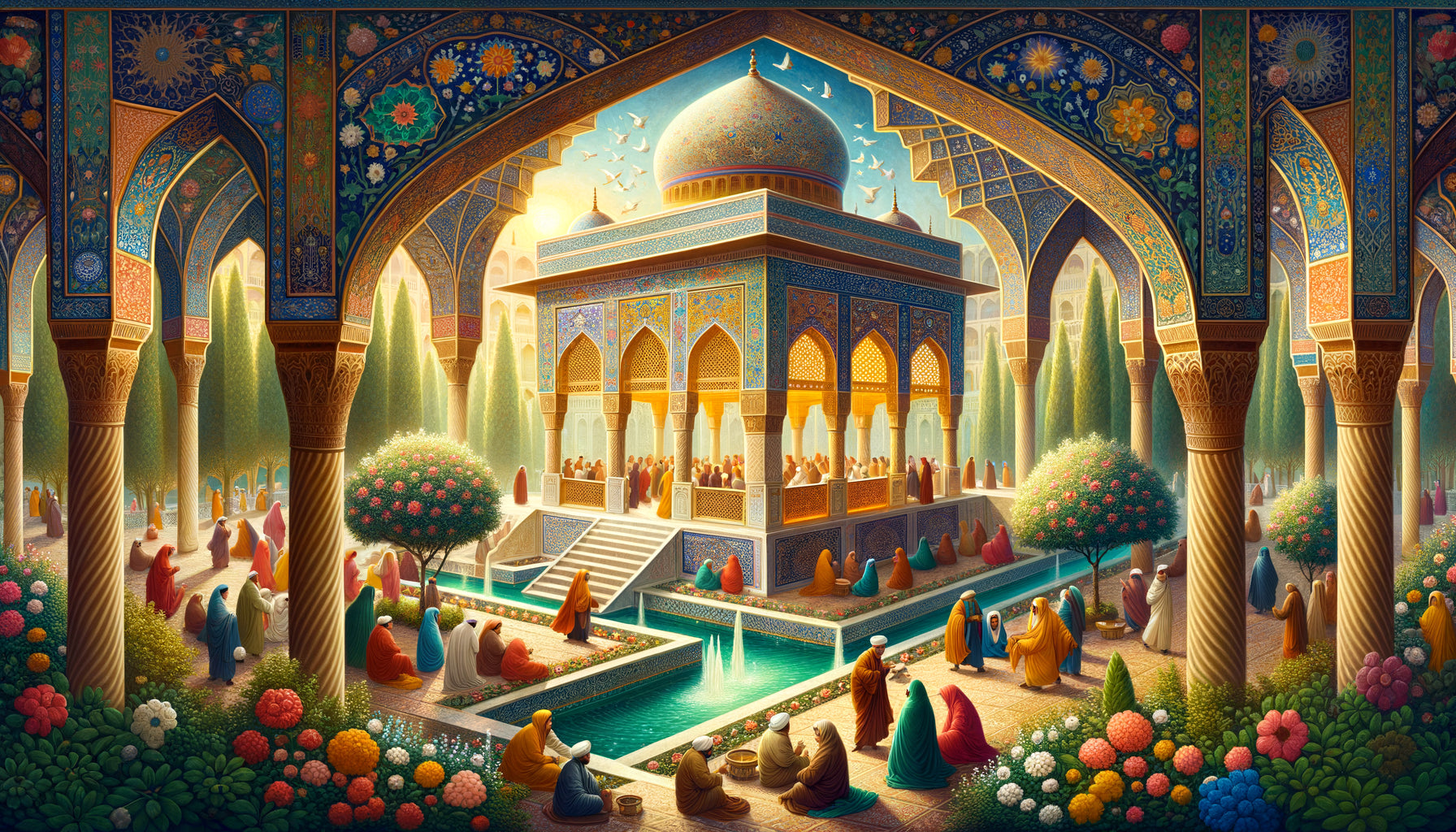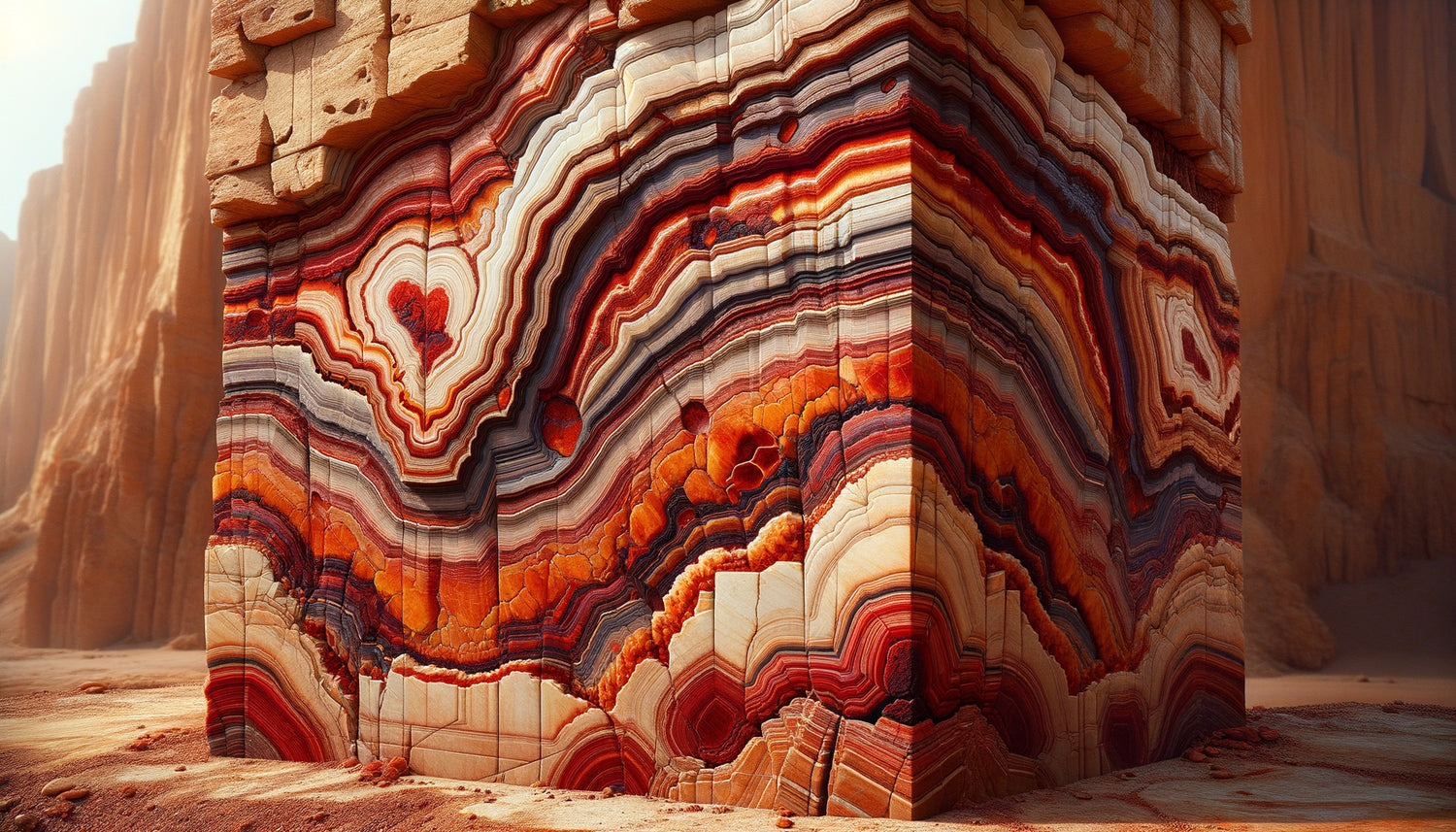
Imagine standing in the courtyard of a Khiva madrasah, Uzbekistan, your gaze lifted to these shimmering frescoes where a deep earth red dances, almost alive under the desert's raking light. This red is not an ordinary pigment: it is red ochre, this mineral substance that traverses centuries without ever losing its intensity. But where does this hypnotic color come from that permeates the walls of this legendary city? The answer lies in the bowels of the earth, in a fascinating geological process that transforms iron into chromatic poetry.
Here's what Khiva’s red ochre reveals: a millennial connection between geology and art, a history of mineral transformations that defy time, and an inexhaustible source of inspiration for our contemporary interiors seeking authenticity.
You may admire these ochre colors in architecture books or travel photos, but you wonder how these particular shades have resisted the assaults of the extreme continental climate of Central Asia. How did Uzbek artisans discover these pigments? And above all, what is the true origin of this exceptional raw material?
Rest assured: understanding the geological provenance of red ochre does not require a doctorate in mineralogy. It's an accessible, captivating story that connects the formation of rocks to the ancestral gestures of Persian and Uzbek decorators. Together, we will go back in time geologically to discover how the desert and iron conspired to create one of the most durable palettes in the history of decorative art.
In this article, I take you to the heart of the rock formations surrounding Khiva, into the secrets of iron oxides that give birth to ochre, and into the traditional techniques that transform rock into color. You will discover how this knowledge can enrich your own vision of decoration and wall art.
The geological foundations of Khorezm: cradle of red ochre
Khiva is located in the region of Khorezm, a historic oasis nestled between two merciless deserts: the Karakum to the south and the Kyzylkum to the north. This geographical location is not insignificant. The soil and subsoil of this region tell a story millions of years old, when the Aral Sea was much larger and tectonic movements shaped Central Asia.
The sedimentary formations surrounding Khiva contain significant concentrations of iron ore. Over geological eras, the alternation of wet and dry periods has favored the oxidation of iron contained in the rocks. It is precisely this process of oxidation that creates hematite (Fe₂O₃), the chemical compound responsible for the characteristic red hue of ochre.
In the rocky outcrops surrounding the city, one finds ferruginous clays and sandstones rich in iron oxides. These rocks, exposed to the cycles of drought and humidity characteristic of the continental climate, undergo weathering that gradually releases pigments. Local artisans have learned to identify these natural deposits, these colored veins that sometimes emerge directly from the desert floor.
Hematite: The Star Mineral Behind Khiva's Red
At the heart of the red ochre is hematite, an iron oxide whose name comes from the Greek haima, meaning “blood.” This etymological connection is not accidental: hematite has this remarkable ability to produce deep reds, ranging from brick red to dark purple, depending on its concentration and fineness of grinding.
In the geological formations around Khiva, hematite forms through slow oxidation of the iron contained in sedimentary rocks. Unlike other regions where ochre comes from volcanic or metamorphic deposits, here it is the sedimentary process that dominates. Ancient alluvial deposits, rich in ferruginous particles, have been gradually consolidated and then weathered by the combined action of residual groundwater and atmospheric oxygen.
The exceptional quality of Khiva's red ochre lies in its relative purity and the natural fineness of hematite particles. Artisans only had to extract these colored clays, dry them in the relentless desert sun, then grind them to obtain a powder with remarkable color stability. This color permanence explains why frescoes from several centuries still retain their vibrancy today.
Variations in Shades Depending on Local Deposits
Not all red ochres are the same. Around Khiva, there are subtle variations ranging from orange-red to reddish-brown, depending on the concentration of hematite and the presence of other minerals such as goethite (a yellow iron oxide) or kaolin clays. Master decorators knew precisely where to find one shade or another, thus creating a sophisticated palette from distinct but nearby geological sources.

Silk Road and Circulation of Pigments: A Geological Exchange
Khiva was a strategic point on the Silk Road, and this position influenced not only the trade of spices and fabrics, but also that of mineral pigments. While local red ochre was abundant, artisans supplemented their palette with materials from geologically different regions: lapis lazuli from Afghanistan for blues, Sienna earths from Italy, or yellow ochres from Persia.
However, for red, the local deposits were more than sufficient. Ochre quarries in the surrounding desert hills provided a quality raw material, easy to access and economical. This local availability explains the prevalence of red in the decorative architecture of Khiva, far beyond a simple aesthetic preference: it was also a matter of geological pragmatism.
Historical archives and accounts by Persian and Arab travelers mention the existence of these "red earths" in the Khorezm region. It is known that pigment miners and collectors formed a specific corporation, passing down from generation to generation knowledge of the best deposits and extraction techniques. This tradition has continued until modern times, even though industrial methods have gradually replaced ancestral practices.
From rock to fresco: the artisanal transformation of ochre
Understanding the geological origin of red ochre also means grasping the process that transforms a raw rock into a noble pigment capable of lasting for centuries. In Khiva, artisans followed a precise protocol, inherited from centuries of experimentation and refinement.
First step: extraction. Collectors identified outcrops rich in hematite, often indicated by the characteristic red coloration of the soil. They extracted colored blocks or clays using simple tools, prioritizing the purest and most homogeneous layers.
Second step: drying. The pieces of ochre were spread out in the sun for several days, sometimes weeks. This natural drying allowed to eliminate residual moisture and facilitate subsequent grinding. In the arid climate of Khorezm, this stage posed no logistical problems.
Third step: grinding and levigation. The dried ochre was ground in stone or bronze mortars, then sometimes washed to remove the coarsest impurities and obtain a powder of exceptional fineness. This powder could then be mixed with different binders: lime, casein, gum arabic, or egg, depending on the application and support.
Fourth step: application. On the walls of adobe or raw brick of Khiva's madrasahs and palaces, red ochre was applied in several layers, often combined with other pigments to create complex geometric patterns and monumental calligraphy. The chemical compatibility between the lime binder and hematite ensured perfect adhesion and exceptional resistance to thermal variations.

Why does Khiva ochre resist time so well?
The legendary durability of the frescoes in Khiva is due to several converging geological and chemical factors. First, hematite is an extremely stable chemical compound. Unlike organic pigments that degrade under UV light or humidity, the mineral red ochre is practically unchanged under normal conditions.
Secondly, the dry climate of the Khorezm region plays a crucial protective role. The absence of prolonged humidity prevents the development of mold and limits chemical reactions that could alter the pigments or binders. Significant temperature differences between day and night, far from weakening the frescoes, seem to have contributed to their gradual consolidation.
Finally, the quality of traditional preparation should not be underestimated. The fine grinding of ochre, the rigorous selection of raw materials, and application in successive layers created a pictorial structure that was both flexible and resistant, capable of absorbing micro-movements of the support without flaking.
This unique combination of geological, climatic and technical factors makes Khiva's red ochre a model of durability for anyone interested in natural materials in contemporary decoration. At a time when we are looking for sustainable alternatives to synthetic paints, the example of Khiva reminds us that the most effective solutions are often the oldest.
Red ochre as a marker of architectural identity
In Khiva, the omnipresence of red ochre is not a stylistic coincidence but the result of a perfect match between local geological resources and aesthetic needs. This color has become an identifying marker, to the point that one instantly recognizes the architecture of the Khorezm region by this warm, earthy tone that contrasts so powerfully with the bright blue of enameled ceramics.
This lesson remains relevant today: working with local materials and their intrinsic properties is creating a deep and lasting aesthetic coherence. It is also honoring the genius of the place, that geological and historical dimension which makes up the soul of spaces.
Be inspired by the millennial colors of the desert
Discover our exclusive collection of landscape paintings that capture the essence of ochre lands and the magic of Eastern horizons. Bring home this mineral warmth that crosses centuries.
The ochre of Khiva in your interior: a contemporary inspiration
Understanding the geological origin of the red ochre from Khiva is not only satisfying intellectual curiosity. It's also tapping into an inexhaustible source of decorative inspiration for our modern interiors. These earthy, deep and warm reds bring a timeless dimension to any space.
Unlike ephemeral trends, ochre tones possess the rare quality of seeming both ancestral and perfectly contemporary. In a contemporary living room, a wall painted in red ochre instantly evokes the warmth of the desert, the patina of time, and that discreet sophistication typical of refined Central Asian civilizations.
You can integrate these tones in multiple ways: wall paint of course, but also textiles (cushions, rugs, curtains), ceramics, or works of art. The important thing is to respect the spirit of these colors: their naturalness, their depth, their lack of harshness. Red ochre never shouts; it asserts itself with a quiet confidence.
For those who want to go further, there are now suppliers of natural pigments that offer authentic ochres, extracted from deposits similar to those in the Khorezm region. Working these raw materials, mixing them yourself with natural binders, is reconnecting with an ancestral gesture and creating truly unique finishes, impossible to reproduce industrially.
The geological history of the red ochre from Khiva teaches us a fundamental truth: the most beautiful colors are not invented, they are discovered in the earth. They carry within them the memory of rocks, climates, and civilizations that have known how to recognize and sublimate them. By choosing these shades for your interior, you are not simply decorating a space: you are inscribing it in a millennial continuum, giving it a depth that transcends fleeting fashions.
Conclusion: when geology meets the art of living
The red ochre of Khiva is not just a color: it's the result of a millennial dialogue between earth and man. It comes from sedimentary formations rich in iron, patiently oxidized by the climatic cycles of Central Asia, then transformed by artisans who knew how to recognize in these colored rocks an invaluable aesthetic treasure.
This geological story reminds us that lasting beauty always arises from a harmony with the territory, a deep understanding of materials and their intrinsic properties. In a world saturated with synthesis and ephemerality, the example of Khiva invites us to return to the sources, to seek in the earth itself the colors that will inhabit our living spaces.
Now that you know the secrets of this exceptional mineral material, let yourself be guided by its example: choose authentic materials, prioritize quality over quantity, and create interiors that, like the frescoes of Khiva, will stand the test of time without losing their soul. Red ochre awaits you, loaded with millions of years of geological history and centuries of human craftsmanship. It is up to you to write the next chapter in this beautiful story.
FAQ : Everything You Need To Know About Khiva's Red Ochre
Can We Still Find Ochre From The Khiva Region?
Yes, but with some nuances. Deposits of ochre in the Khorezm region still exist, and some local artisans continue to extract these pigments traditionally for the restoration of historical monuments. However, for the general international public, it is easier to obtain ocres of similar geological composition from specialized suppliers of natural pigments. The important thing is not so much the exact geographical origin as the mineralogical nature of the pigment: look for naturally ground hematite from sedimentary formations. This will give you shades very close to those of the frescoes of Khiva, with the same stability and chromatic depth. Some European suppliers offer excellent red ochres extracted from deposits in France, Italy or Spain, whose geological composition is comparable to that of Central Asian ochres.
Is Natural Red Ochre Really More Durable Than Modern Paints?
Under appropriate conditions, absolutely. Hematite, the main component of red ochre, is chemically extremely stable and practically does not degrade under the effects of light, oxygen or temperature variations. The frescoes of Khiva, centuries old, are a striking proof of this. On the other hand, this exceptional durability also depends on the quality of the binder used and the conditions of application. With a good-quality lime binder and proper preparation of the support, natural ochre will far surpass modern acrylic or vinyl paints, which can yellow, fade or flake off in just a few decades. The other major advantage of natural ochre is its total absence of toxicity: unlike many synthetic pigments, it does not release any volatile organic compounds and can be handled without special precautions. For a durable and healthy decorative project, natural red ochre remains an excellent choice, provided that traditional application techniques are respected.
How to incorporate the red ochre hues of Khiva into a contemporary interior?
Red ochre has this rare quality of harmonizing as well with traditional atmospheres as resolutely modern ones. In a contemporary interior, favor an approach by touches rather than complete saturation: a single wall painted in red ochre will create a warm focal point without weighing down the space. Combine these earthy tones with natural materials such as raw wood, unbleached linen, or polished concrete for a sophisticated mineral effect. Red ochre pairs beautifully with cool neutrals (pearl gray, off-white) which enhance its warmth, but also with deep greens that recall the oases of the desert. For the most daring, a combination of red ochre and deep blue will directly evoke the aesthetics of Khiva ceramics. Don't forget textiles: an ochre-toned rug, silk cushions dyed naturally, or wall hangings will bring this tactile and warm dimension characteristic of Central Asian interiors. Finally, lighting plays a crucial role: favor warm light sources (2700-3000K) that will make the nuances of red ochre vibrate and create an enveloping atmosphere, particularly appreciated in the evening.