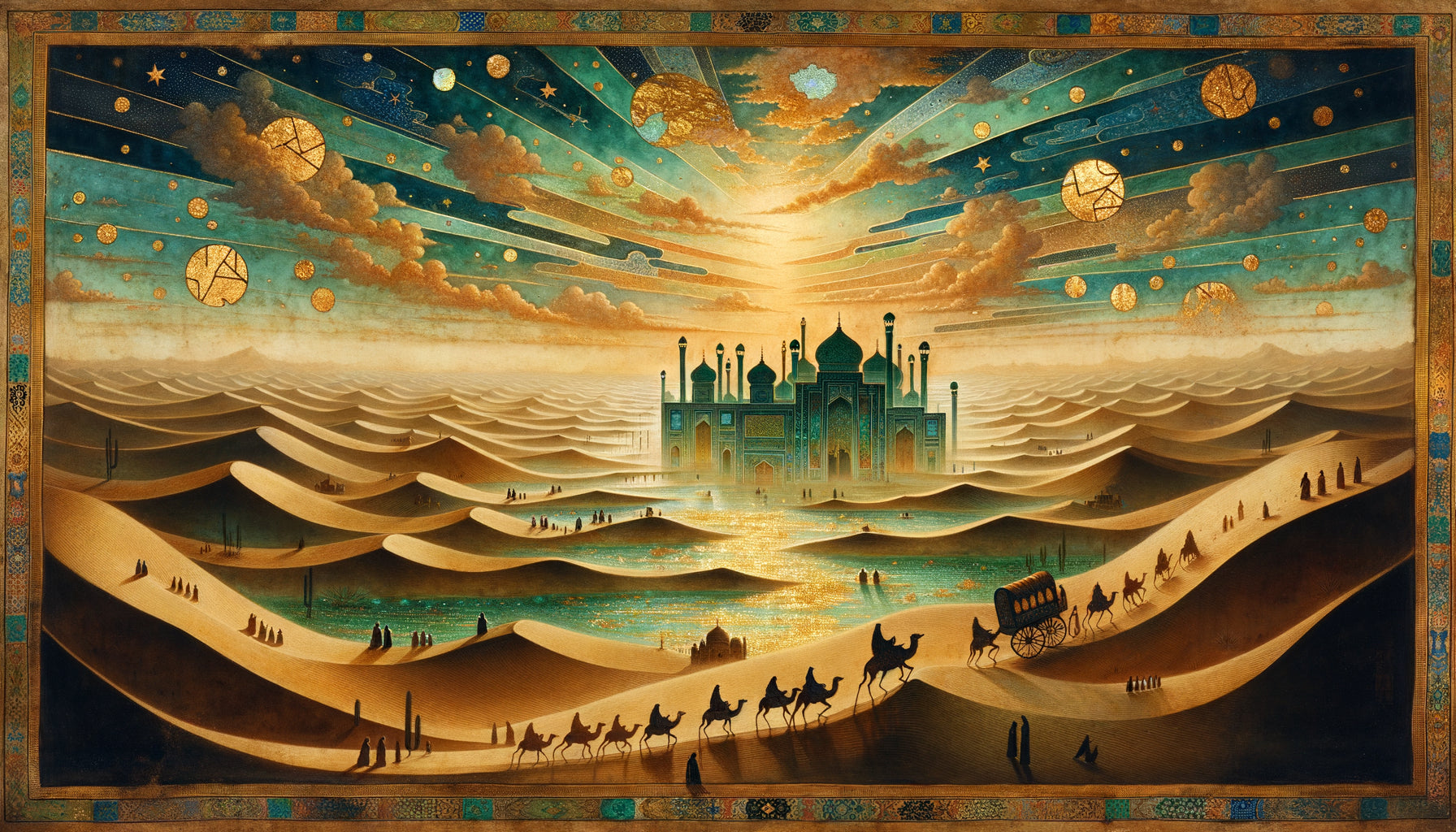
When contemplating Persian miniatures from the 13th century or the illuminations of medieval Arabic manuscripts, one detail immediately strikes: these sumptuous landscapes, populated with lush gardens and opulent palaces, completely ignore caves and caverns. Where medieval Christian iconography multiplied representations of hermit saints in their rocky retreats, medieval Islamic art developed a radically different worldview. This absence is not a technical accident or an artistic oversight, but a reflection of a profound cosmology that continues to influence our perception of natural and architectural spaces.
Here's what this absence reveals: a spatial philosophy that favors light over darkness, values cultivated gardens over wild nature, and inscribes human harmony in open spaces rather than underground retreats. Understanding this vision transforms the way we consider landscapes and contemporary design.
Today we admire Islamic gardens, their fountains and geometric perspectives, without truly grasping the underlying philosophy. Why has this artistic tradition so deliberately excluded natural geological formations from its representations? This question sheds light not only on art history but also on our current relationship with interior and exterior spaces.
The earthly paradise: a horizontal vision of bliss
In medieval Islamic cosmology, the garden represents an anticipation of paradise. Persian and Arabic miniatures display spaces where running water, ordered vegetation, and sunlight compose an ideal of perfection. The Arabic word jannah, which denotes paradise, literally means “garden.” This conception profoundly influences landscape representations: the cave, a confined and dark space, radically opposes this celestial vision.
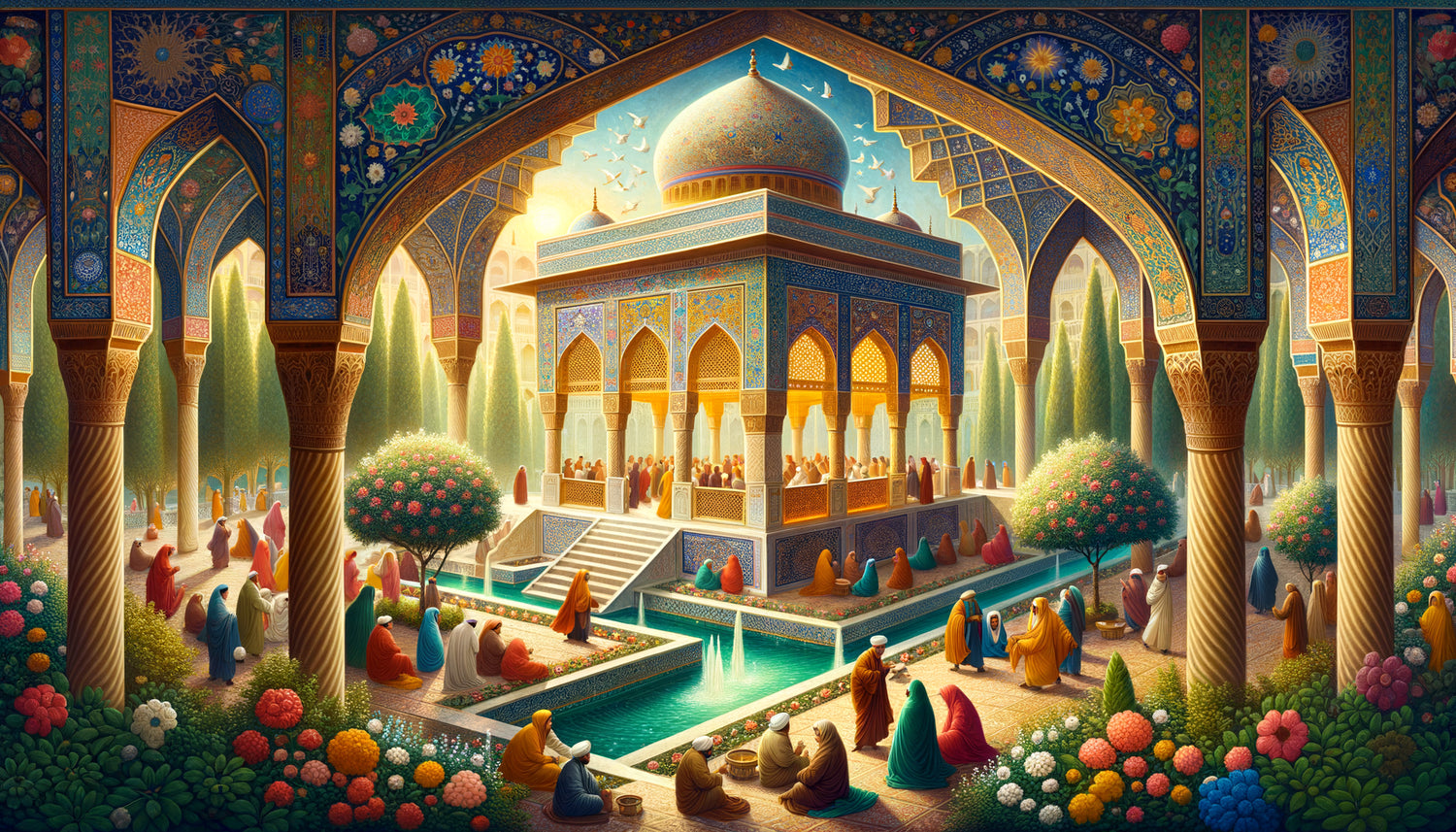
The manuscripts of the Khamsa of Nizami or the Shahnameh illustrate this constant preference. Princes and heroes evolve in enclosed gardens (chahār bāgh), structured by irrigation canals that divide the space into four quadrants. This geometry is never interrupted by geological accidents. Medieval Islamic landscape is constructed, mastered, humanized – the opposite of the natural and untamed cave.
This spatial philosophy can be found even in architecture: moucharabiehs filter light without ever banishing it completely, interior courtyards create private gardens bathed in brightness. The very idea of sinking into the earth, seeking spirituality in underground darkness, remains foreign to this tradition.
The Christian hermitage versus the Islamic community
The Christian eremitic tradition has profoundly marked Western medieval iconography. Saint Jerome in his cave, Mary Magdalene in the Sainte-Baume, the Desert Fathers in their rocky refuges: the cavern symbolizes spiritual retreat and penance in the Christian imagination. Caves and caverns become places of inner transformation, combat against demons, proximity to the divine through asceticism.
Medieval Islam develops a different spirituality, centered on the community and social life. While spiritual retreat (khalwa) exists in Sufism, it does not take the form of permanent cave isolation. Muslim mystics meditate in khanqah (Sufi convents) or ribat (spiritual fortresses), always connected to a community.
This theological difference explains the absence of caves in medieval Islamic landscapes. Representing a cave would have meant valuing radical isolation, a concept foreign to a religion that prescribes collective prayer, values trade, and encourages urban life. Miniatures show dervishes meditating, but always in gardens or bright architectural spaces.
Light as Divine Manifestation
The Verse of Light (Quran, surah 24, verse 35) profoundly structures Islamic aesthetics: “God is the Light of the heavens and the earth.” This central metaphor influences all spatial representation. Light is not simply a divine attribute; it is the manifestation of its presence. Caves and caverns, by their intrinsic darkness, oppose this luminous theology.
Medieval Islamic architecture multiplies devices to capture, filter, and diffuse light: pierced domes, openwork latticework, reflecting water mirrors. In miniatures, this search translates into vibrant color palettes, gold backgrounds, lapis lazuli skies. Introducing a dark cave into these compositions would have created a theological and aesthetic dissonance.

The Symbolic Geography of Persian Manuscripts
Medieval illuminators from Herat, Tabriz or Shiraz did not paint naturalistic landscapes but symbolic geographies. Each element carried a precise meaning: the cypress evoked eternity, the nightingale mystical love, the source divine generosity. In this codified system, caves and caverns had no place because they conveyed no positive value in Persian or Arabic culture.
Rocks sometimes appear, but always as external outcroppings, never as penetrable cavities. In Nizami’s Khamsa, hunting scenes show princes pursuing game across rugged terrain, but these rock formations remain on the surface, decorative, without unsettling depth.
This convention persisted from the 13th to the 16th century, from the school of Baghdad to the Safavid workshops. Even when artists depict pre-Islamic narratives such as the Shahnameh (Book of Kings), where some heroes might logically seek refuge in caves, they prefer royal tents or hunting pavilions – temporary structures but open to the sky.
When architecture imitates the ideal landscape
This absence of caves in iconography reveals a unique conception of the relationship between architecture and nature. Rather than adapting natural caves (a common practice in Buddhist or Eastern Christian traditions), Islamic architecture recreates the paradise garden through construction. The Alhambra of Granada, with its successive courtyards and water features, embodies exactly what Persian miniatures show.
The iwans (vaulted porches) of mosques and palaces create semi-open transition spaces, never completely closed. Even the sabils (public fountains), which could theoretically adopt a cavernous form, remain architecturally open. This consistency between pictorial representation and architectural realization confirms a unitary worldview.
The tiered gardens of Samarkand or the Mughal bagh in India extend this philosophy: transforming nature through human art rather than seeking spirituality in its geological accidents. The ideal medieval Islamic landscape is always the product of a harmonious collaboration between man and divine creation, never a return to raw, subterranean nature.
Influence on contemporary design
This aesthetic tradition strangely resonates with some current interior design trends. The contemporary Mediterranean style, which favors bright spaces, interior patios, and fluid transitions between inside and outside, unconsciously inherits this philosophy. Architects who work with natural light as a primary material rediscover this medieval Islamic approach.
The landscape paintings inspired by Eastern aesthetics capture the same quest: open perspectives, luminous horizons, absence of disturbing depths. They create in our modern interiors that feeling of controlled and harmonious space sought by Persian miniaturists. This aesthetic continuity crosses the centuries without us always being aware of it.
Transform your interior into a garden of light
Discover our exclusive collection of landscape paintings that captures this philosophy of open and bright spaces, to create in your home the harmony of medieval Persian gardens.

The rare exceptions that confirm the rule
Some late manuscripts, influenced by contacts with Chinese art under the Mongol dynasties, timidly introduce more pronounced rock formations. Fifteenth-century Herat school miniatures sometimes show steep mountains with rocky overhangs, a concession to the Sino-Mongol aesthetic which appreciated tormented landscapes.
But even in these cases, it is never about real habitable caves. The rocks remain surface decorative elements, treated with the same bright colors as the rest of the composition. No character enters them, no narrative action takes place there. This resistance testifies to the strength of the Islamic aesthetic convention.
This consistency over several centuries and in different regions (from the Maghreb to Mughal India) proves that it is not a simple artistic trend but a deep mental structure. Caves and caverns remain absent because they are conceptually incompatible with the worldview conveyed by these landscapes.
Reinventing our spaces in the light of this tradition
Understanding why medieval Islamic landscapes excluded caves invites us to rethink our own relationship with dark and confined spaces. In our contemporary interiors, we sometimes unconsciously reproduce this pattern: valued spaces are bright, open, connected to the outside. Cellars and basements remain utilitarian places, never privileged living spaces.
This tradition also teaches us the art of filtered light rather than total darkness. Where caves impose absolute blackness, mashrabiya and latticework create a precious twilight, which softens without obscuring. This nuance finds endless applications in contemporary design: curtains, openwork partitions, skylights.
Finally, the idea that the ideal landscape is a constructed garden rather than raw nature resonates with current ecological concerns. It is not about conquering wild nature or getting lost in it, but about establishing a harmonious and reciprocal relationship with it. Medieval Islamic landscapes already offered this third way between domination and submission.
The absence of caves and caverns in these representations is not a limitation but an expression of a coherent and sophisticated vision of space, light, and the place of humans in creation. Integrating this understanding into our current decorative choices means embracing a millennial aesthetic tradition that favors clarity over shadow, community over isolation, and cultivated harmony over natural chaos. Each time we choose a bright landscape painting rather than a dark scene, we unconsciously perpetuate this philosophy. Recognizing this lineage allows us to enrich and reinvent it for our contemporary spaces.
Frequently Asked Questions About Landscapes in Medieval Islamic Art
Why did medieval Islamic art favor gardens in its representations?
The garden (jannah in Arabic) literally represents paradise in the Islamic cosmology. Medieval artists were not seeking to reproduce naturalist landscapes but to evoke a paradisiacal ideal: flowing water, lush vegetation, perfect geometric organization, and omnipresent light. This aesthetic convention reflects a theology where humanized and cultivated nature surpasses wild nature. Persian and Arab miniatures systematically show ordered gardens, with their cross-shaped irrigation canals (chahār bāgh), their cypresses symbolizing eternity, and their architectural pavilions. This preference is rooted in a vision where divine harmony manifests through order and controlled beauty, a concept incompatible with caves and caverns that evoke geological chaos and darkness. Adopting this philosophy in our modern interiors means favoring bright spaces, carefully arranged plants, and open perspectives.
Are there mountains in medieval Islamic miniatures?
Yes, mountains appear frequently in Persian and Arab miniatures, but are treated in a very specific way. They are represented as external rock formations, often colored blue, green or ochre, with rounded or stylized contours. Unlike contemporary Chinese landscapes that explored geological depths, medieval Islamic mountains remain decorative surfaces without penetrable cavities. In the Shahnameh or manuscripts of the Khamsa, these reliefs serve as a backdrop for hunting or battle scenes, but never as places of habitation or spiritual retreat. This approach reflects the same philosophy that excludes caves and caverns: to value what is visible, bright, and accessible rather than what is hidden, dark, and underground. Illuminators thus created landscapes that were both recognizable and idealized, where each element carried a positive symbolic meaning.
How does this tradition influence contemporary interior design?
The aesthetics of medieval Islamic landscapes influence contemporary design in many ways, often unconsciously. The modern Mediterranean style, with its bright patios, fountains and fluid transitions between indoors and outdoors, directly inherits this spatial philosophy. Contemporary architects working on filtered natural light rediscover the principles of medieval moucharabiehs. In the choice of decorative works, this tradition is manifested by a preference for open and luminous landscape paintings, avoiding dark or confined scenes. Bright colors, unobstructed perspectives and the absence of disturbing depths create in our interiors that feeling of harmony sought by Persian miniaturists. Even current trends towards indoor gardens and living walls perpetuate this millennial idea: to bring cultivated nature into the living space rather than seeking inspiration from raw natural formations such as caves and caverns.