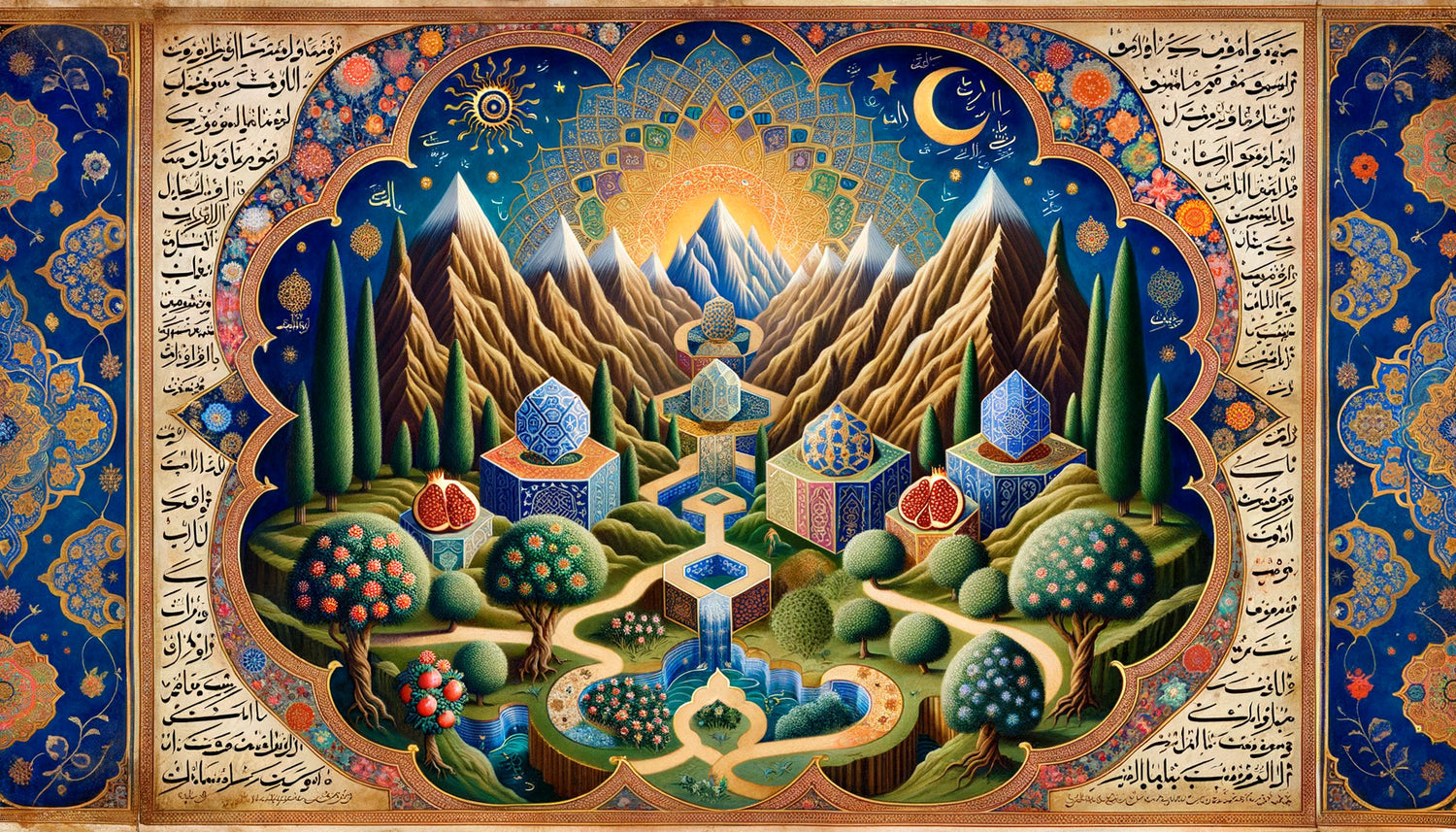
In the dimness of a study room in Istanbul, I discovered a 14th-century Sufi manuscript whose landscapes literally mesmerized me. These blue mountains, these impossible gardens, these rivers that wind like calligraphy… Nothing was there by chance. Every plant element, every topographic curve, every nuance of pigment carried a coded message that only initiates could decipher.
Here's what the landscapes of Sufi manuscripts reveal: a sophisticated visual language where nature becomes a spiritual map, colors transmit mystical states, and geometric compositions guide towards inner enlightenment. Far beyond simple decorations, these landscape representations constituted a veritable secret system of symbolic coding.
Faced with an ancient Sufi manuscript, one often feels helpless. These images seem beautiful but hermetic, their visual poetry escapes us. How to distinguish a simple ornamental landscape from a true initiatory map? How to decipher what the Sufi masters were transmitting visually to their disciples through these representations of nature?
Rest assured: understanding the symbolic coding of Sufi landscapes does not require twenty years of theological studies. It is enough to know the main reading keys, observe recurrences carefully, and let yourself be guided by the symbolic logic that structures these compositions. In this article, I reveal the secret codes that I have learned to decipher over the years through my research on Islamic mystical iconography.
The garden as topography of the soul
In Persian and Ottoman Sufi manuscripts, the paradise garden is much more than an enchanting decor. Its very structure encodes the spiritual journey. The four rivers that flow from a central source symbolize the four stages of the mystical path: Sharia (law), Tariqa (path), Haqiqah (truth) and Marifa (knowledge). When you observe a manuscript landscape with this aquatic grid, you are literally contemplating a map of the initiatory journey.
Sufi artists strategically positioned each plant element. The slender cypress represents the soul aspiring to the divine, while the weeping willow embodies the humility necessary for the spiritual seeker. Red roses encode mystical passion, white flowers purity of intention. In a Mantiq al-Tayr manuscript, I counted exactly seven types of trees corresponding to the seven spiritual valleys described by Attar.
This symbolic topography transforms each landscape into an esoteric diagram. The spatial arrangement is never random: it guides the eye and mind according to a precise initiatory journey, from the profane to the sacred, from the peripheral to the center.
The superimposed levels of reality
Sufi landscapes frequently employ a inverted perspective where distant elements appear larger. This technical 'error' is intentional: it signals that the spiritual world (in the background) possesses more reality than the material world (in the foreground). The oversized mountains in the distance represent metaphysical realities that loom over our ordinary existence.
The chromatic grammar of mystical states
Each color in Sufi manuscript landscapes corresponds to a codified spiritual state. Ultramarine blue, a precious pigment extracted from lapis lazuli, systematically encodes transcendence and divine infinity. When a landscape bathes in these azure tones, it signals a higher level of reality, a vision from the state of fana (ego extinction).
The emerald green, par excellence the prophetic color, marks zones of revelation and illuminative knowledge. The green meadows in manuscripts do not simply represent springtime nature, but spiritual stations (maqamat) where the mystic receives divine intuitions. I have observed that these green areas often contain hidden details: a face in the foliage, a calligraphic inscription formed by the branches.
Gold, omnipresent in celestial landscapes, codes for the unmanifested divine presence. The golden skies of Sufi manuscripts do not seek realism: they assert that behind the veil of the visible lies uncreated light. Some manuscripts even use a technique of gold leaf layering to create different intensities of luminosity corresponding to degrees of divine proximity.

When mountains become spiritual waves
Mountain representations in Sufi manuscripts present undulating, almost liquid forms that defy any realistic geology. This stylization reveals a precise morphological code: wave-mountains symbolize the obstacles and trials of the mystical path which succeed like the flows of an ocean.
In the manuscript of the Miraj Nameh (account of the Prophet's celestial ascent), the seven superimposed mountains encode the seven heavens to be traversed. Their crescent shape deliberately recalls the lunar symbol, associated with the world of the soul (nafs) which must be purified. The colors progress from earthy brown to celestial blue, literally mapping the spiritual ascent.
Some Sufi landscapes feature mountains pierced with caves illuminated. This recurring motif encodes the concept of khalwa, spiritual retreat in darkness from which inner light springs. The cave becomes a matrix of spiritual rebirth, a place of inward transformation.
The invisible but present paths
Look carefully: Sufi landscapes rarely contain explicit routes. Yet, spiritual paths are encoded in the composition itself. The alignment of trees, streams, sequences of architectural portals create lines of force that guide the gaze according to a precise course. These invisible paths represent the tariqa, the mystical path which appears only to those who know how to see.
The hidden cosmic architecture in the landscape
Sufi manuscripts frequently integrate architectural elements within natural landscapes: domes emerge from hills, minarets blend with cypresses, portals open in rocks. This fusion encodes a fundamental teaching: the entire universe is the divine temple, every natural element possesses a sacred dimension.
The octagonal pavilions that punctuate some landscapes are not mere garden kiosks. The octagon represents the transition between the square earth (the four elements, the four directions) and the celestial circle (divine unity). Their presence in the landscape signals places of passage between worlds, initiatory thresholds.
I discovered that some manuscripts use a invisible sacred geometry structuring the entire landscape composition. By tracing the diagonals and medians of the image, one reveals golden proportions, pentagrams, traditional Islamic geometric motifs. The entire landscape becomes mandala, support for meditation and spiritual concentration.

The hidden creatures and their symbolic language
The landscapes of Sufi manuscripts harbor encoded animal presences. The bird that crosses the sky is never trivial: the hudhud (hoopoe) represents the spiritual guide, the simurgh the divine essence, the nightingale the loving soul. Their position, their direction of flight, their color refine the message.
Some landscapes conceal fantastic composite creatures formed by the assembly of natural elements: a face appears in the rock, a dragon is drawn in the clouds. These optional illusions, visible only during prolonged observation, represent the spiritual realities hidden behind material appearances. They test the observer's insight.
Absences are as significant as presences. A Sufi landscape without human presence suggests mystical extinction (fana), while a solitary figure at the center encodes the spiritual master or the seeker who has attained union. The relative size of the characters compared to the landscape indicates their degree of spiritual realization.
Be inspired by these ancestral codes
Discover our exclusive collection of landscape paintings that captures this symbolic and spiritual dimension of nature, transforming your space into an invitation to contemplation.
Decipher to better contemplate
Understanding the symbolic coding of Sufi landscapes does not kill their magic: it multiplies it. Each manuscript becomes an open book on a millennial wisdom, each stylized mountain reveals a teaching, each color combination transmits a spiritual state. These images work on several simultaneous levels: aesthetic for everyone, symbolic for initiates, transformative for practitioners.
The next time you contemplate a Sufi manuscript landscape, observe the recurrences: how many vertical levels structure the composition? Which colors dominate and what can they encode? What invisible paths does your gaze naturally follow? These simple questions open the doors to a sophisticated visual language that has transmitted mystical knowledge for centuries.
The legacy of this symbolic coding continues to inspire contemporary artists fascinated by the spiritual dimension of landscape. It reminds us that nature is never just decorative: it can become sacred alphabet, initiatory map, mirror of the soul. Sufi masters understood that transforming your gaze on the landscape transforms your gaze on yourself.
FAQ : Understanding Sufi landscapes
How to recognize a Sufi landscape from an ordinary Persian landscape?
Sufi manuscript landscapes are distinguished by their intentional symbolic density. Look for the following clues: underlying geometric structures (often based on the number seven or four), the presence of invisible paths created by the alignment of elements, coded use of colors (transcendent blue, revealing green, divine gold), and above all a composition that guides the gaze according to a precise route from bottom to top or from outside to center. Persian decorative landscapes prioritize aesthetic harmony and ornamental richness, while Sufi landscapes always subordinate aesthetics to didactic and spiritual function. Also observe the perspective: Sufi landscapes frequently use intentional 'errors' (inverted perspective, impossible proportions) which signal that one is not looking at the ordinary world but a spiritual reality.
Were these symbolic codes really secret or simply cultural?
The distinction is subtle but important. Some symbols belonged to the shared visual culture of the medieval Islamic world: everyone knew that the cypress evokes spiritual elevation or that the quadripartite garden recalls paradise. But Sufi manuscripts added layers of esoteric codification reserved for initiates of the brotherhood. For example, the exact arrangement of seven trees according to a precise geometric pattern, or the use of specific mathematical proportions corresponding to metaphysical concepts taught orally. Sufi masters used these manuscripts as teaching aids during instruction sessions where they progressively revealed levels of reading. Without this oral transmission, even a cultivated contemporary could only access the first level of meaning. The 'secret' character therefore did not stem from a desire for concealment but from a graduated pedagogy of initiation.
Can these symbolic principles be applied in contemporary decoration?
Absolutely, and it’s even a fascinating approach to creating spaces full of meaning. You can integrate Sufi chromatic symbolism by using blue for meditation and elevation areas (bedrooms, reading corners), green for knowledge and creativity zones (offices, libraries), gold sparingly to signal transcendence. The structure of the quadripartite garden with central fountain wonderfully inspires the layout of patios or terraces. The principles of invisible path – guiding the gaze and movement through strategic alignment of decorative elements – create a fluid and intentional circulation within the habitat. You can arrange paintings, plants, and furniture according to subtle geometric axes that unconsciously structure the experience of space. The essential thing is to find the original intention: transform the environment into a support for contemplation, make each decorative element a silent reminder of deeper dimensions of existence.