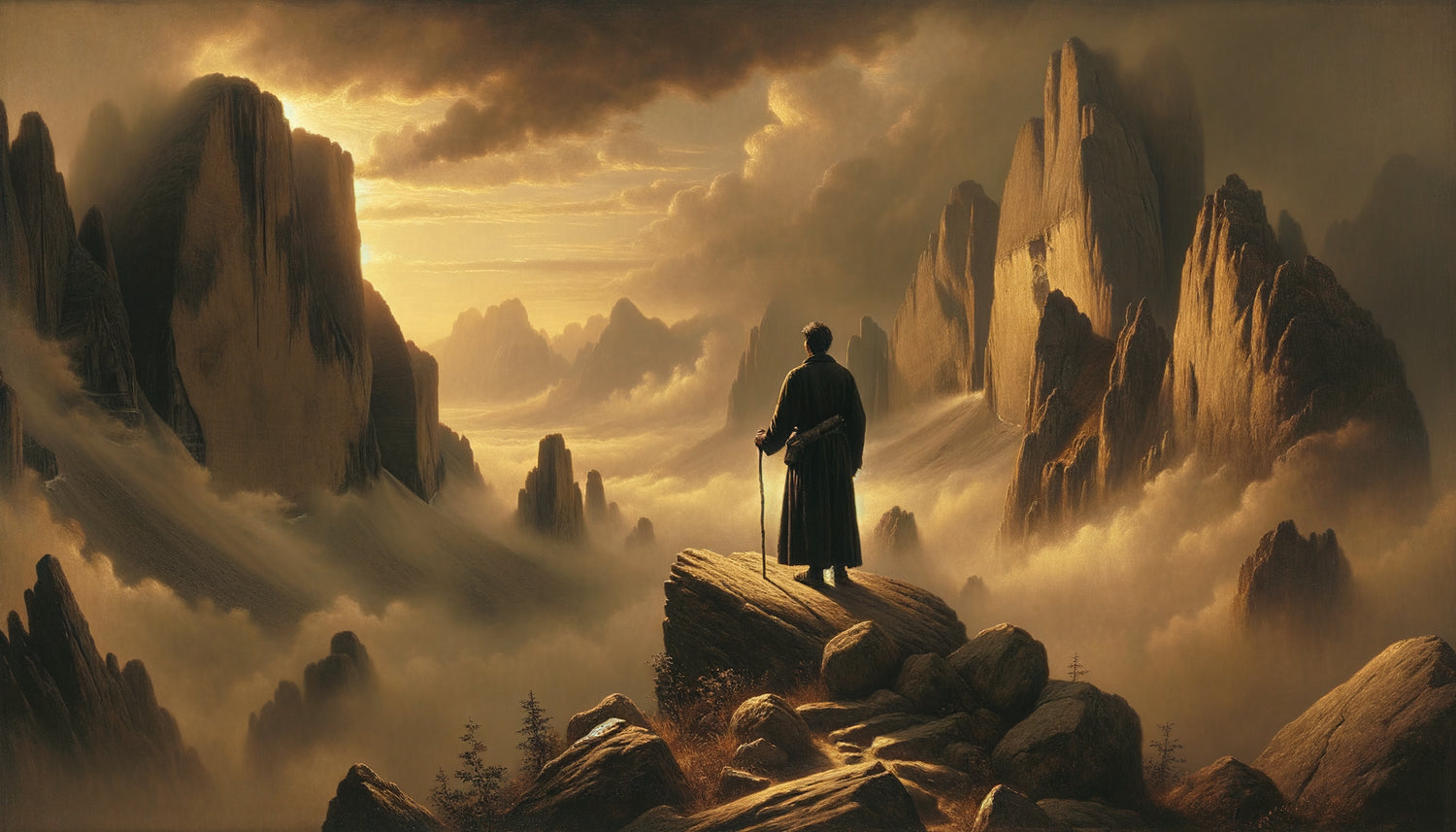
Imagine standing atop a misty mountain, your gaze lost in the immensity of a landscape that seems to merge with the sky. This solitary silhouette, seen from behind, contemplating the infinite horizon... You may have already encountered it in a museum, on a reproduction, or even on the walls of a contemporary interior. This mysterious figure of the traveler contemplating nature is not accidental: it embodies the very soul of romanticism.
Here's what this pictorial representation reveals to us: an invitation to inner meditation, a celebration of the intimate relationship between man and nature, and a visual manifesto of the quest for transcendence that defined a whole artistic era.
Today we live surrounded by images, saturated with visual stimuli, yet something escapes us. Why do these romantic paintings, over two centuries old, continue to fascinate us? Why does this contemplative figure still resonate so deeply within us? The answer lies in the way Romantic painters transformed landscapes into philosophical spaces.
Rest assured: understanding this artistic approach requires no particular scholarship. Simply let yourself be carried away by the emotion these works evoke and accept that art can be a mirror of our own inner selves.
I invite you to discover together the profound reasons that led these visionary artists to repeatedly place this solitary traveler facing the immensity of nature, and how this pictorial composition continues to influence our relationship with space and contemporary decoration.
The Traveler as a Mirror of the Romantic Soul
At the turn of the 19th century, a silent revolution shook European art. Romantic painters no longer seek to faithfully reproduce reality as their classical predecessors did. They want to express something more elusive: pure emotion, feeling towards nature, the subjective experience of the world.
The traveler contemplating the landscape becomes their signature visual. Caspar David Friedrich, the German master of romanticism, painted his most iconic work in 1818: The Traveler Contemplating a Sea of Clouds. This male figure, seen from behind, standing on a rocky outcrop, perfectly embodies this new sensibility. He does not dominate nature – he surrenders to it, he gets lost in it, he seeks something invisible within it.
This representation is not anecdotal. The traveler's back creates an immediate identification with the viewer. We do not see his face, his features remain mysterious. We can therefore project ourselves into his place, becoming ourselves this contemplator facing immensity. It is a direct invitation: 'Look with my eyes, feel with my heart'.
The Revolution of Perspective
Romantic painters orchestrate a radical reversal in the hierarchy of artistic genres. Landscape, once considered a minor genre, becomes the primary subject. But more than that, they transform the way it is viewed. The traveler is no longer a decorative element: he becomes the mediator between the work and us, the spiritual guide of our aesthetic experience.
Nature as cathedral: when landscape becomes spiritual
To understand the obsession of Romantic painters with these contemplative scenes, one must grasp their particular relationship to the divine. At a time when religious certainties waver, when the Industrial Revolution brutally transforms societies, nature becomes a new temple.
The travelers contemplating the landscape in Romantic paintings are not sightseeing – they are undertaking a spiritual quest. Faced with mountains, oceans, and misty forests, they seek to touch something absolute, infinite, transcendent. The landscape becomes the place of personal revelation.
Friedrich, once again, declared: 'The divine is everywhere, even in a grain of sand.' His solitary travelers embody this mystical search. They stand on the threshold of the visible world, where mist dissolves contours, where the sky merges with the earth. These blurred areas, these indistinct passages fascinate Romantics because they suggest the existence of a reality beyond the visible.
This spiritual dimension explains why so many Romantic paintings depict moments of transition: dawn, dusk, morning mist. These fragile, ephemeral instants, where light transforms the landscape into an almost unreal vision, become metaphors for mystical experience.

Man facing his own smallness
Another essential dimension emerges from these compositions: the relationship of scale. Romantic painters love to represent tiny human silhouettes against titanic landscapes.
The concept of 'sublime', theorized by Edmund Burke and Emmanuel Kant, obsesses Romantic artists. The sublime, unlike mere beauty, provokes a paradoxical mixture: terror and fascination, insignificance and elevation. Faced with a dizzying mountain or an ocean storm, we simultaneously experience our fragility and our ability to conceive the immense.
The traveler contemplating the landscape embodies precisely this tension. Their small silhouette emphasizes the immensity surrounding them, but their posture – standing, dignified, contemplative – affirms humanity's ability to embrace this vastness with a gaze, to think it, to feel it. It is an ambiguous celebration of the human condition: fragile yet conscious, ephemeral yet capable of eternity through thought.
An aesthetic of melancholy
This acute awareness of our smallness in the face of the cosmos engenders a particular emotion that the Romantics cultivate: melancholy. Not depressive sadness, but a gentle contemplative melancholy, tinged with admiration and acceptance. The solitary traveler in the landscape expresses this fundamental solitude of human beings, but also the poignant beauty of this isolation facing infinity.
The inner journey: when the landscape becomes a metaphor
If Romantic painters depict travelers, it is because the journey itself becomes a central metaphor for their worldview. But be careful: it is not about physical travel, tourism, anecdotal events. It is about the inner journey, exploring oneself through nature.
The romantic landscape functions as a projection of the human soul. A steep mountain evokes the obstacles of existence, a winding path symbolizes the course of life, a stormy ocean reflects tumultuous passions, a peaceful lake suggests regained serenity. Romantic painters thus create an emotional geography where each natural element resonates with a psychological state.
Travelers contemplating the landscape are therefore not simply looking outwards – they are also looking inwards. This double perspective, external and internal, fascinates Romantic artists. It makes it possible to make the invisible visible, to give pictorial form to the most intimate feelings.
This approach still influences our way of understanding landscape art today. When we choose a work for our interior, we do not simply select a pleasant view – we opt for an emotional atmosphere, a state of mind, an invitation to daydream.

The creative solitude: a modernity ahead of its time
There is something profoundly modern about these solitary figures contemplating the landscape. The Romantic painters, in the early 19th century, anticipate our own contemporary experience of individuality and the quest for meaning.
The romantic traveler deliberately chooses solitude. They are not isolated by accident – they actively seek this face-to-face with nature, a moment of disconnection from society. Isn't that exactly what we seek today when we dream of mountain getaways, ocean retreats, moments of silence facing the immensity?
This modernity explains why these images continue to speak to us. In a hyperconnected world, saturated with solicitations, the figure of the traveler silently contemplating the landscape becomes almost subversive. It celebrates slowness, meditation, the ability to simply be present before the beauty of the world.
The lasting influence on interior decoration
This romantic aesthetic still deeply permeates our decorative choices. Paintings depicting contemplative landscapes instantly create an atmosphere of serenity and depth in a space. They invite slowing down, reflection, transforming a simple wall into a window open onto infinity.
Transform your space into a contemplative sanctuary
Discover our exclusive collection of landscape paintings that capture this romantic essence and invite daily reverie.
The living legacy of an artistic vision
Two centuries after Friedrich and his contemporaries, why do we continue to be fascinated by these travelers contemplating the landscape? Because their message remains as relevant as ever.
These works remind us that slowing down is not a weakness but a necessity. That there is immense richness in simple contemplation. That nature remains a refuge for the soul, a space of psychic regeneration. That we need moments when we can simply be, without purpose, without performance, facing something that surpasses us.
The romantic aesthetic of the traveler contemplating the landscape also teaches us a lesson in visual composition applicable to our interiors. It shows us the power of contrasts – between the intimate and the immense, man and nature, detail and panorama. It reveals how to create depth, how to suggest infinity in a finite space, how to transform a place into an emotional experience.
Contemporary creators continue to draw from this repertoire. Photographers, designers, interior architects constantly reinterpret this contemplative relationship with natural space. Large bay windows opening onto landscapes, meditative spaces integrating framed views of nature, works of art evoking immensity – all inherit this romantic vision.
Imagine yourself now in your own space, with this new awareness. This landscape painting that you contemplate daily is no longer just a decoration – it's a window to infinity, a daily invitation to inner travel, a reminder of your own ability to feel the sublime. Consciously choose the images that inhabit your walls, because they subtly shape your state of mind, your relationship with the world, your ability to marvel. Romantic painters bequeathed us much more than paintings: they offered us a way of looking, feeling, existing in the face of the immensity of the world.
Frequently Asked Questions
What is the most famous painting depicting a traveler contemplating a landscape?
The most iconic painting is undoubtedly The Traveler Contemplating a Sea of Clouds (1818) by Caspar David Friedrich. This iconic work depicts a man seen from behind, standing on a rocky promontory, contemplating a mountainous landscape shrouded in mist. It perfectly summarizes the romantic aesthetic: meditative solitude, sublime nature, an invitation to viewer projection. This composition has been reproduced and reinterpreted countless times, permanently influencing Western visual imagination. It works wonderfully in a contemporary interior because it combines mystery, depth and timelessness.
Why did Romantic painters often depict characters from behind?
This pictorial technique, called Rückenfigur in German, served several artistic and philosophical purposes. First, it creates an immediate identification: by not seeing the character's face, the viewer can easily project themselves into their place and share their contemplative experience. Second, it transforms the character into a mediator between the work and us, guiding our gaze towards the landscape while inviting us to share their emotion. Finally, this approach emphasizes that the essential is not in individual traits but in the universal experience of the sublime facing nature. It's a technique that still works remarkably well today to create a meditative atmosphere in a space.
How can I integrate the romantic spirit into my current decor?
Incorporating romantic aesthetics doesn’t mean creating a dark or dated interior. On the contrary, the romantic spirit translates to the celebration of contemplation and connection to nature. Choose artworks depicting landscapes that invite inner journeys – misty mountains, oceans at dawn, mysterious forests. Prioritize compositions with depth and mystery over overly literal images. Create visual pause spaces where the eye can wander. Play with scale contrasts to suggest immensity. And above all, select images that resonate with your own sensitivity, as emotional authenticity was at the heart of the romantic approach.