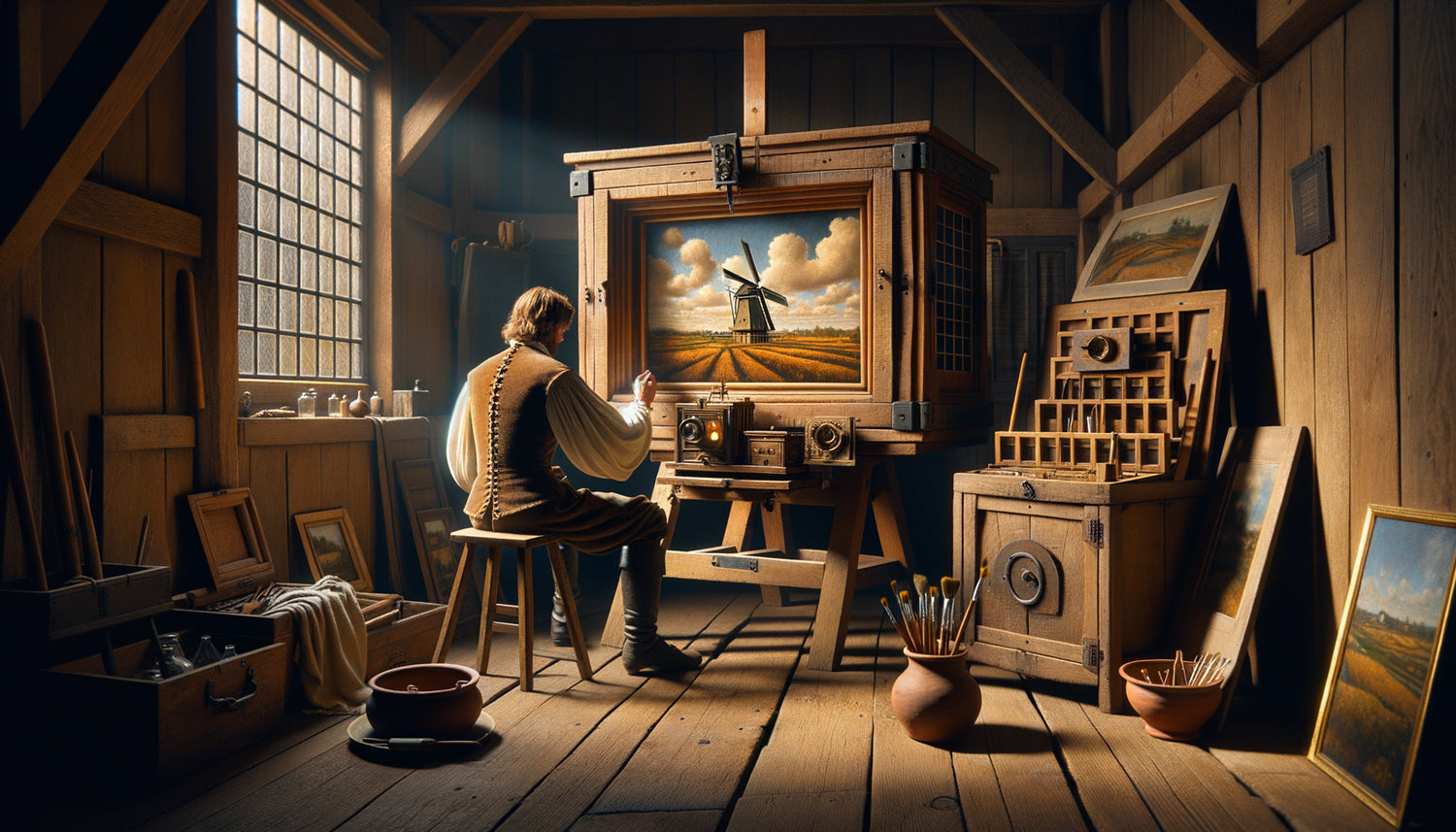
In the silent workshop of a 17th-century Dutch master, a wavering image forms on a white canvas: windmills are drawn with astonishing clarity, canals reflect light with mathematical precision, clouds swell in a perfect gradient. This is neither a dream nor a spell, but the optical magic of the camera obscura, this revolutionary instrument that transformed the way Dutch landscape artists captured reality.
Here's what the camera obscura brought to Dutch landscape masters: an infallible geometric perspective that transcended the human eye, a revolutionary understanding of light and its subtle gradations, and a speed of execution that allowed for capturing the fleeting moment. These three advantages enabled Dutch painters to create works of striking realism that continue to fascinate four centuries later.
Do you admire these Dutch landscapes with dizzying perspectives, infinite skies where each cloud seems to pulsate with life? Do you wonder how these artists achieved such accuracy, this unsettling feeling of looking through a window rather than a painting? The frustration of never understanding their technical secret can prevent you from accessing an invaluable source of inspiration for your own relationship with images and decoration.
Rest assured: understanding the role of the camera obscura in the practice of Dutch landscape artists requires no knowledge of art history. It is a fascinating story of innovation, observation, and the quest for beauty that will illuminate your view of the works you choose to adorn your walls. I invite you on a journey into the workshops of the Dutch Golden Age, where science and art merged to create the extraordinary.
The Magic Box That Revolutionized Vision
The camera obscura – literally "dark room" in Latin – is an optical device whose principle dates back to antiquity but reached its peak during the 17th century in Holland. Imagine a completely dark room, or a simple closed box, pierced with a tiny hole. Exterior light passes through this hole and projects an inverted image of the landscape onto the opposite wall.
For Dutch landscapists, this instrument represented much more than a scientific curiosity. It was a window into a transformed reality, where proportions were organized according to the relentless laws of optics. Painters installed their camera obscura facing the endless polders, the lively ports of Amsterdam or Delft, the dunes battered by the winds of the North Sea.
The projected image revealed subtleties invisible to the naked eye: how light diffracts on the water of canals, how distances naturally progress according to a geometric progression, where to place precisely the horizon line to respect observed reality. Landscapists thus discovered the secrets of atmospheric perspective, this gradual decrease in contrast and saturation with distance.
Vermeer, Canaletto and the Masters of Luminous Illusion
Johannes Vermeer, although famous for his intimate interiors, likely used a camera obscura to compose his celebrated views of Delft. His painting « View of Delft » manifests this particular quality of light captured by the instrument: points of light that sparkle with an almost photographic intensity, a characteristic blur in certain places, a disturbing atmospheric accuracy.
Art historians have long debated the actual use of the camera obscura by Dutch landscape painters. Some paintings present perspective anomalies consistent with optical projection: slight distortion at the edges, variable depth of field, particular brightness. These technical clues betray the passage through the mechanical eye of the instrument.
Canaletto, Venetian painter who follows this Dutch tradition, openly used his portable camera obscura. He carried it through the alleys of Venice, capturing the play of light and shadow on the palaces with astonishing accuracy. His commercial success proved that collectors were precisely looking for this quasi-photographic quality, this impression of reality captured rather than reconstructed.

Between geometric precision and artistic freedom
It would be wrong to believe that the camera obscura turned Dutch landscape painters into mere mechanical copyists. The instrument served as a guide, not an absolute master. Painters took considerable liberties with the projected image, moving buildings, modifying the proportions of clouds, intensifying certain contrasts.
Jacob van Ruisdael, undisputed master of dramatic landscapes, likely used the camera obscura to establish his basic compositions, then greatly amplified atmospheric effects. His tormented skies, monumental waterfalls, heroic windmills transcend simple optical observation. The instrument provided him with a solid geometric framework on which to build his grandiose visions.
This tension between scientific precision and creative imagination characterizes the entire production of landscape painters of this era. The camera obscura offered them a thorough understanding of linear and atmospheric perspective, then their talent transformed this knowledge into visual poetry. The optical device shaped their gaze, sharpened their perception, but never replaced their artistic sensitivity.
The mobile studio: capturing the fleeting moment
Dutch landscape artists developed portable versions of the camera obscura, veritable mobile workshops that revolutionized their practice. These boxes equipped with lenses and mirrors allowed the projection of an image onto a horizontal surface, facilitating drawing and sketching work. The artist could thus quickly trace the main lines of a composition before the light changed.
This mobility transformed the painter's relationship to the landscape. Rather than reconstructing from memory a scene observed, the landscape artist captured the present moment with remarkable fidelity. Moving clouds, sails filled by the wind, changing reflections on the water – all these ephemeral elements could be quickly fixed thanks to the portable camera obscura.
The sketchbooks of many Dutch artists show drawings of geometric precision incompatible with a simple observational drawing. These quick tracings, notes on light and values, are tangible evidence of the intensive use of the optical instrument. The landscape artist worked in two stages: optical capture in the field, then pictorial elaboration in the workshop.

The visual legacy in our contemporary interiors
Why should this technical history interest you today, as you choose artworks for your living room or office? Because paintings inspired by this Dutch tradition possess a particular quality that transforms the space. This feeling of infinite depth, this natural light that seems to emanate from the canvas, this balanced composition that rests the eye – all these attributes stem directly from the optical mastery acquired thanks to the camera obscura.
When you hang a reproduction of a Dutch landscape or a contemporary work inspired by this aesthetic, you introduce into your interior this particular window onto the world. The rooms seem to expand, the walls recede, the eye travels into the depths of the composition. This is the direct legacy of these artists who intuitively understood the laws of optics and perception.
Contemporary creators are also rediscovering these principles. Some current photographers and painters experiment with handmade camera obscuras, seeking to rediscover this unique luminous quality, this poetic blur, this softness of tonal transitions. They testify to the timeless relevance of the visual discoveries of the Dutch Golden Age.
The secrets of composition revealed by the instrument
The camera obscura taught Dutch landscape artists compositional principles that became standards of landscape painting. The lower rule of thirds for the horizon, for example, directly derives from observing the optical projections of vast Dutch skies. The instrument naturally showed how to balance earth and sky to create a harmonious composition.
Framing effects, now familiar in photography, were already being explored by these painters thanks to the camera obscura. The instrument imposes a rectangle of vision, eliminating the superfluous, focusing attention on the essential. Landscape artists thus learned to compose by subtraction, to eliminate distracting elements, to build purified and powerful images.
This discipline of framing is found in the most beautiful Dutch landscapes: an off-center but perfectly balanced composition, a foreground that guides the eye into the depth, a subtle focal point that retains attention without forcing it. These principles, discovered empirically thanks to the camera obscura, still form the basis of all visual education today.
Transform your interior with the magic of landscapes
Discover our exclusive collection of landscape paintings that capture this depth and light inherited from the Dutch masters, to create in your home this feeling of infinite space and contemplative serenity.
Look differently: the lesson of the Dutch Masters
The history of the camera obscura in the practice of Dutch landscape artists teaches us a valuable lesson: the greatest artists were not afraid to use available technology to refine their vision. Far from being a « cheat », the optical instrument was a learning tool, a way to educate the eye to perceive what the brain usually filters.
Today, we can apply this same philosophy to our relationship with images that inhabit our spaces. Rather than choosing works at random, we can consciously seek these qualities of depth, light, balanced composition that Dutch tradition has brought to perfection. Each painting then becomes a carefully calibrated window, an opening onto elsewhere that enriches our daily lives.
Dutch landscape artists have bequeathed us more than just beautiful paintings. They passed down to us a way of looking at the world, an attention to luminous nuances, a sensitivity to geometric structures hidden in the apparent chaos of nature. The camera obscura was their silent teacher, and their works continue to teach those who know how to observe them attentively.
Conclusion: the augmented eye of the Golden Age
The camera obscura therefore played a fundamental role in the practice of Dutch landscape artists: perspective guide, revealer of light, sensor of fleeting moments. It embodied this perfect alliance between art and science that characterizes the Dutch Golden Age. Far from mechanizing creation, it refined the gaze, educated perception, offered a solid foundation on which to erect poetic visions.
Now imagine yourself in front of an authentic Dutch landscape or a contemporary work that inherits its spirit. You no longer see simply a decorative painting, but the fruit of an optical revolution, a testament to a quest for visual truth, a window carefully constructed according to the laws of light. Your interior is enriched by this historical and aesthetic depth.
Start today to observe differently the landscapes around you, whether they are real or painted. Look for the horizon line, analyze the progression of planes, follow the path of light. You thus activate the legacy of Dutch masters, you see with their eyes augmented by the camera obscura, and your visual sensitivity transforms forever.
FAQ : Your questions about the camera obscura and Dutch landscape artists
Was the camera obscura considered cheating by artists of the time?
Absolutely not, and that's where the beauty of this story lies. In 17th century Holland, the use of scientific instruments was seen as a mark of intelligence and modernity, not as cheating. The Netherlands was then the European center of optical innovation – it was there that microscopes and telescopes were perfected. Landscape artists who used the camera obscura were seen as erudite artists, capable of combining scientific knowledge and pictorial talent. The instrument served as a guide for composition and perspective, but artistic genius remained essential to translate this optical image into a work of art charged with emotion. Think of it like an architect using measuring tools: technology does not replace creativity, it serves it. Indeed, many artistic treatises of the time explicitly recommended the use of the camera obscura as an essential pedagogical tool for training young painters' gazes.
How to recognize that a Dutch painting was made with a camera obscura?
Several visual clues betray the likely use of the camera obscura by Dutch landscape artists. First, look for a geometrically perfect perspective, with vanishing lines that converge precisely – an accuracy difficult to achieve with the naked eye. Then observe the quality of the light: the camera obscura produces characteristic bright spots, almost pearlescent, particularly visible on water reflections or shiny surfaces. You may sometimes notice a slight blur at the edges of the composition or variable depth of field, just like in a photograph. The proportions between near and far elements are also an indication: they follow a natural optical progression rather than the usual distortions of human perception. Finally, some paintings exhibit a subtle spherical distortion, especially in the corners – a typical effect of lenses from that era. These characteristics do not diminish the artistic value of the work; they simply testify to a sophisticated working methodology that will fascinate your informed gaze.
Why is this technique particularly associated with the Netherlands rather than other countries?
The 17th century Netherlands brought together unique conditions that explain the massive adoption of the camera obscura by landscape artists. First, a geographical reason: the perfectly flat Dutch topography, with its infinite horizons, posed complex perspective challenges that the instrument helped to solve. Next, an exceptional scientific context: the United Provinces were the world center for optical innovation, with artisans like Leeuwenhoek perfecting lenses. The Dutch Protestant culture also valued precise observation of nature as a manifestation of the divine, encouraging a quasi-scientific approach to painting. Economically, prosperity created massive demand for realistic landscapes to decorate bourgeois homes – the camera obscura allowed faster production without sacrificing quality. Finally, the Dutch pictorial tradition favored descriptive accuracy over Italian idealization, making the optical tool particularly relevant. This convergence of geographical, technical, cultural and economic factors made the Netherlands the ideal laboratory where landscape artists and camera obscura merged to create a revolutionary art whose fascinating accuracy we still admire today.