I discovered my first Hiroshige in a small Kyoto shop, on a rainy afternoon. It was a print of the Kanbara station under snow, from his series of Fifty-three Stations of the Tōkaidō. The snowflakes seemed still to be falling on the yellowed paper, and the travelers bent forward as if I could hear the crunching of their sandals. That day, I understood: Hiroshige was not just an artist, he was a poet-geographer, a visionary documentarian who had captured the soul of 19th century Japan.
Here's what Hiroshige’s prints bring to our understanding of Edo period Japan: they document with topographical precision the famous sites of the country, immortalize the pilgrimage and commercial routes that shaped Japanese life, and reveal the daily atmosphere of each place through the seasons and weather conditions.
Many admire Japanese prints for their aesthetic beauty, without realizing that they constitute veritable visual archives. They are hung on walls as simple decorations, ignoring the fact that they tell geographical, social, and cultural stories of incredible richness.
Yet, understanding how Hiroshige documented Japan’s famous sites completely transforms our view of these works. Each print becomes a window onto a vanished world, a precious testimony that combines art and documentation with an unparalleled genius.
In this article, I take you on the roads of Edo period Japan, to discover Hiroshige's documentary techniques and the cartographic legacy he left us through his prints of famous sites.
The Tōkaidō: The road that changed landscape art
In 1832, Hiroshige undertook a journey that would revolutionize Japanese printmaking. He travels the Tōkaidō, this legendary 514-kilometer route linking Edo (Tokyo) to Kyoto, the vital artery of feudal Japan. But unlike his predecessors, Hiroshige travels with the eye of a visual chronicler.
His series of Fifty-three Stations of the Tōkaidō does not just represent pretty landscapes. Each print documents with precision one of the fifty-three relay posts where travelers were required to stop to rest, change horses or spend the night. Hiroshige notes everything: the topography of the places, the local architecture, the economic activities, the regional costumes.
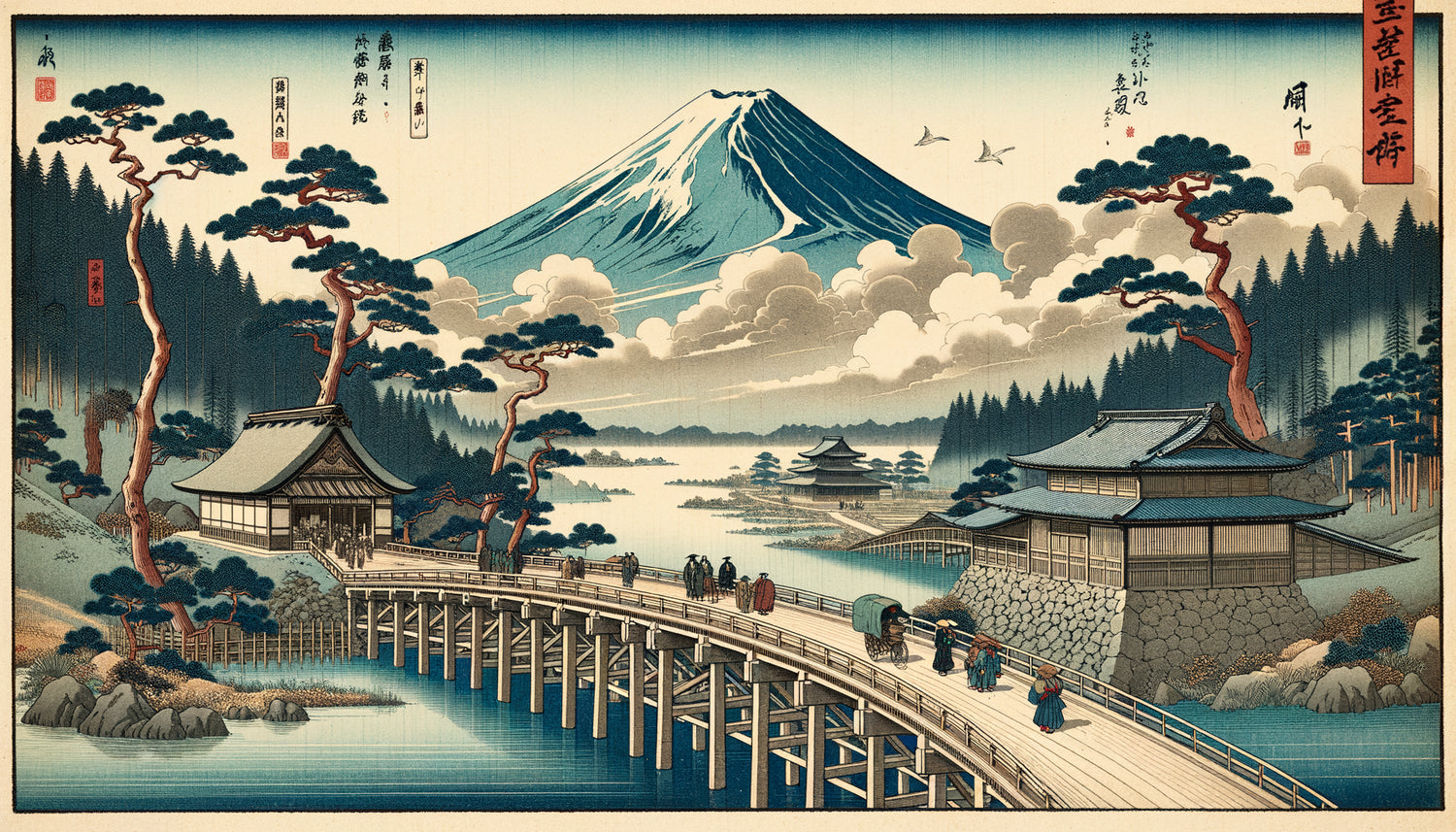
Take the print of Nihonbashi, the starting point in Edo. We see the famous bridge with its exact structure, the shops that line it, the procession of a daimyo (feudal lord) with his entourage – a crucial detail because these processions punctuated life on the Tōkaidō. Or that of Okazaki, where Hiroshige captures the Yahagi bridge and its forty-seven spans, giving precise architectural information while creating a harmonious composition.
What makes these prints exceptional as documents is their topographical fidelity combined with a unique atmospheric sensitivity. Hiroshige shows how the same place changes according to the time of day, the season, the weather – thus creating multidimensional documentation of famous sites.
The Hundred Views of Edo: Mapping a Capital
Between 1856 and 1858, Hiroshige created his ultimate masterpiece: the Hundred Views of Edo. This series constitutes a true poetic cartography of Tokyo before its transformation into a modern metropolis. Each print documents a specific location in the capital with its implicit geographical coordinates.
Hiroshige's documentary approach reaches remarkable sophistication here. He employs innovative viewpoints – dizzying perspectives, tight framing, bold close-ups – not through mere artistic fancy, but to provide precise spatial information. The print of the Kinryūzan Shrine in Asakusa shows the exact location of the temple, its orientation, and the surrounding neighborhoods visible in the background.
These prints have become irreplaceable historical documents. When earthquakes, fires, and bombings destroyed much of old Tokyo, the Hundred Views became references for historians seeking to understand the urban organization, architecture, and daily life of the Edo period.
Hiroshige also documents famous seasonal sites: the cherry blossoms of Ueno, the fireworks of Ryōgoku in summer, the maple leaves of autumn at Kaianji. He thus creates a visual calendar of meisho (famous places) and their moments of excellence – crucial information in a culture where visiting sites at the right season was an art of living.

The Documentary Method of an Observant Master
How did Hiroshige transform his observations into documentary prints? His method reveals a true visual documentation protocol ahead of its time.
First, Hiroshige actually traveled. Unlike some artists who worked from descriptions or other images, he went to the spot with his sketchbooks. He noted topographical details: curves of rivers, silhouettes of mountains, arrangement of buildings. These notebooks, some of which survive, show precise annotations on colors, distances, and place names.
Next, he integrated local identity markers. Each region of Japan had its specialties: Hiroshige documents the particular fishing boats of Shinagawa, the palanquin bearers of Hakone, the paper makers of Oiso. These details transform his prints into visual ethnographies of the regions traversed.
He also used atmospheric perspective to document the actual weather conditions of each location. The mist of Mishima, the torrential rains of Shōno, the deep snow of Kanbara – these meteorological phenomena were not decorative effects but information about the regional climate that travelers needed to know.
The role of cartouches and inscriptions
Each Hiroshige print bears a cartouche indicating precisely the name of the place depicted. These inscriptions transform the work of art into a geographical document. He often added additional information: distance from Edo, relay number, name of the shrine or bridge.
These texts were not trivial. In Edo Japan, where travel was regulated, Hiroshige's prints served as visual guides for those planning a trip or dreaming of distant destinations. They were the equivalent of our travel documentaries, but in art form.
When the print becomes an archive: documentary value today
Today, Hiroshige's prints are studied by historians, urban planners and geographers as true primary sources. They document a Japan in transition, just before the Meiji opening that would transform everything.
Researchers use these prints to reconstruct Edo's urban layout, trace old roads, identify disappeared buildings. The Edo-Tokyo Museum has an entire room where the One Hundred Views serve as the basis for models reconstructing the city of the 19th century. Without Hiroshige, part of this urban memory would be lost.
The prints also document social practices: how a river was crossed (on foot, by boat, on the shoulders of carriers), how people were dressed according to social classes, what professions existed. Each silhouette, each gesture captured by Hiroshige provides information about daily life in Edo Japan.
For ecologists and climatologists, these works even offer data on historical environment: vegetation cover, water level, presence of animal species. A print showing Mount Fuji with a certain snow line indirectly documents the climate of the time.

The influence on modern visual documentation
Hiroshige’s documentary approach influenced far beyond Japan. When his prints arrived in Europe in the 1860s, they revolutionized how Western artists conceived of documentary landscape.
Van Gogh directly copied Hiroshige's prints, fascinated by his ability to combine precise observation and artistic expression. French Impressionists drew inspiration from his bold compositions and attention to atmospheric conditions – elements that Hiroshige used to faithfully document places.
Modern landscape photography also owes much to Hiroshige. This idea of thematic series systematically documenting locations (think of Ansel Adams’s work on American national parks) finds a precedent in the Fifty-three Stations or the One Hundred Views.
Today, some Japanese photographers undertake to recreate Hiroshige’s journey, photographing the same sites 180 years later. These projects reveal how accurate his documentation was: one can identify exactly where he stood, which direction he was looking, creating a fascinating dialogue between past and present.
Integrating Hiroshige’s documentary spirit into your interior
Collecting or displaying reproductions of Hiroshige's prints is not only inviting art but also documented history into your home. Each image tells a geography, bears witness to a moment, preserves a memory.
For an interior that values this documentary dimension, create a thematic wall: a series from the Tōkaidō that tells a journey, or several seasons of the same place from the One Hundred Views. Discreetly add an old map of Japan to geographically contextualize the places represented.
Hiroshige's prints fit particularly well into reflective spaces: office, library, reading corner. Their documentary nature makes them more than decorations – they are windows onto a world to explore, invitations to intellectual travel.
Prioritize reproductions that preserve the original cartouches with Japanese inscriptions. These texts are an integral part of the work’s documentary dimension. Even if you don't read Japanese, their presence recalls that each print is as much a geographical document as it is an artistic creation.
Transform your walls into a documented journey
Discover our exclusive collection of landscape paintings that capture the spirit of great documentary masters and bring historical depth and timeless beauty to your interior.
A lesson in looking for our image-saturated era
In an era where we produce billions of photos daily, Hiroshige teaches us something valuable: the difference between photographing and documenting, between capturing and understanding.
His prints remind us that a successful documentary image requires patient observation, knowledge of the subject, and clear intention. He didn't photograph everything impulsively – he selected the most representative views, the most significant moments, the most revealing details.
In our relationship with the places we visit, Hiroshige’s approach suggests an alternative to superficial tourism: look truly, note the particularities, understand the context. His prints of famous Japanese sites are so enduring precisely because they go beyond the surface to capture the essence of a place.
This philosophy of looking can enrich our own way of traveling, photographing, inhabiting spaces. Hiroshige invites us to be documentarists of our own lives, attentive to the details that tell a larger story.
The next time you observe a Hiroshige print, don't just see an elegant Japanese landscape. Look at it for what it truly is: a revolutionary act of documentation, a way to preserve the world before cameras existed, a testament that an artist could be a geographer, a historian, and a visual archivist.
Start simply: choose a Hiroshige print that attracts you. Find the place it represents on a map of Japan. Read about its history. Discover how this site appears today. You will transform a work of art into a portal to deeper exploration – exactly what Hiroshige wanted his prints to be for travelers of his time.
Famous Japanese sites continue to exist, transformed but recognizable. And thanks to Hiroshige’s documentary genius, we possess an incomparable visual archive of their state almost two centuries ago – a temporal bridge stretched between two worlds by the simple power of attentive observation and artistic talent.