1891. Paul Gauguin, age 43, leaves Marseille with a one-way ticket to Tahiti. In his hold are tubes of paint, blank canvases and an intuition: that the West has exhausted its palette. What awaits him there will forever change his way of seeing, feeling and painting landscapes. No longer as a backdrop to be reproduced, but as a total experience to reinvent.
Here's what Gauguin’s departure for Tahiti brought to his vision of landscape: a radical liberation of pure color, a composition freed from academic perspective, and a spiritual fusion between man and nature that transforms each canvas into an inhabited, almost sacred landscape. Three revolutions that changed the history of modern art.
Do you admire the great post-impressionist masters without always understanding what makes their work so powerful? Are you fascinated by this transition between European impressionism and modern boldness, but explanations remain abstract, too technical? Rest assured: understanding Gauguin’s metamorphosis of landscape is delving into a human, sensitive, almost romantic story. It's seeing how an artist in search of authenticity dared to give up everything to reinvent his way of capturing the world. And that changes everything about your appreciation of art.
The break with Europe: when the Breton landscape is no longer enough
Before Tahiti, Gauguin paints in Brittany. Pont-Aven, Le Pouldu: landscapes of moors, chapels, grey skies. He already develops cloisonnism, these blocks of color outlined in black, inspired by stained glass and Japanese prints. But something frustrates him. Europe seems cramped to him, academic, prisoner of its conventions. The Breton landscape remains figurative, recognizable, almost documentary.
Gauguin wants something else. He dreams of a primitive landscape, of nature untouched by industrial modernity. He reads Pierre Loti, is fired up by exotic tales, idealizes a lost paradise. His departure for Tahiti is not just an expatriation: it's a philosophical quest. He seeks to rediscover an original purity, a direct and instinctive relationship with nature, far from Parisian salons and condescending critics.
The chromatic explosion: color as inner truth
In Tahiti, Gauguin discovers harsh, violent, saturated light. Nothing to do with the subtle nuances of Brittany or Monet's aquatic reflections. Here, the sun overwhelms everything, intensifies every shade. And Gauguin does not seek to reproduce this light realistically. On the contrary: he transforms it.
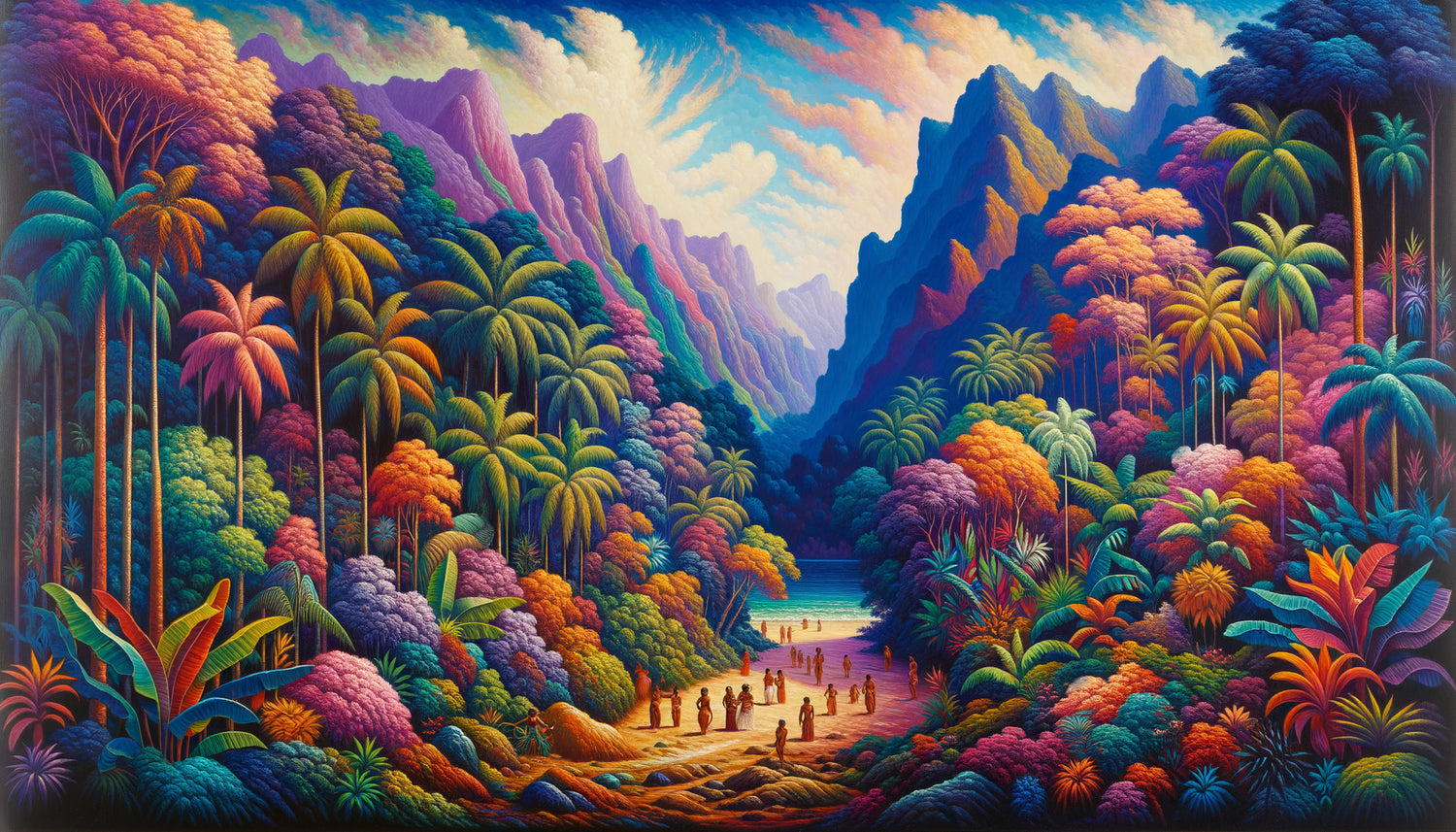
His Tahitian landscapes become symphonies of fuchsia pink, cadmium yellow, emerald green, deep violet. Colors that do not really exist in observed nature, but which express an emotional, spiritual truth. The landscape is no longer a faithful copy: it becomes a projection of the artist's soul.
In Fatata te Miti (1892), the ocean is not turquoise blue as expected: it undulates in horizontal bands of mauve, pale green, and golden yellow. The trees are not green: they explode in brick red, burnt ochre. Gauguin invents a mental landscape, hallucinatory, where sensation takes precedence over description. It is this chromatic audacity that will inspire the Fauves, Matisse among them, twenty years later.

The end of perspective: flattened, decorative, totemic landscapes
Another fundamental break: Gauguin abandons the linear perspective inherited from the Renaissance. His Tahitian landscapes no longer seek to create an illusion of depth. The planes overlap like decorative layers, almost like cut-out papers.
Look at Arearea (1892): the foreground with the red dog and the two women, the middle ground with the Polynesian idol, the background with the trees and mountains... everything is juxtaposed without logical transition. No atmospheric perspective, no vanishing lines. The landscape becomes tapestry, ornamental surface where each element coexists in a poetic space rather than a geometric one.
This radical simplification transforms the landscape into a symbol. The Tahitian mountains, omnipresent in his paintings, are no longer geographical reliefs: they become mystical presences, almost silent deities watching over human scenes. The landscape acquires a sacred, mythological dimension.
The influence of Oceanic arts on his composition
Gauguin collects sculptures, tikis, Maori motifs. He observes how Polynesian artists integrate the landscape into their creations: not as a backdrop, but as an element woven into a whole. This holistic approach overturns his practice. His landscapes are no longer backgrounds in front of which scenes play out: they become total environments where human figures, vegetation, mountains, sky merge in the same breath.
The inhabited landscape: nature as an extension of the human soul
Unlike the Impressionists who often paint deserted, contemplative landscapes, Gauguin systematically populates his Tahitian scenes. But these human figures are not accessories: they become one with the landscape. The bodies of Tahitian women embrace the curves of the hills, their golden skin dialogues with the ochres of the earth, their languid postures respond to the horizontality of the ocean.
In Nafea Faa Ipoipo (When Will You Marry?, 1892), the two young women are not posed in front of a landscape: they emerge from it, as if the lush vegetation, the vibrant flowers and the warm tones were merely extensions of their presence. The landscape becomes a portrait, and the portrait becomes a landscape.
This fusion reflects the Polynesian cosmogony that Gauguin attempts to absorb: the idea that humans are not separated from nature, but participate in a living continuum. His Tahitian landscapes breathe this lost unity, this original harmony that the West has fractured.

Between fantasy and reality: the reinvented landscape
But let's be honest: Gauguin’s Tahiti is partly a mental construct. When he arrives in 1891, the island is already deeply colonized. Papeete looks like a small French town, with Catholic missions, administration, shops. The pristine paradise he hoped for no longer exists, or perhaps never existed.
Nevertheless: Gauguin reinvents the Tahitian landscape. He erases signs of modernity, idealizes village scenes, mixes Maori myths and personal imagination. His canvases do not document Tahiti: they create a parallel Tahiti, dreamed of, poetic, where the landscape becomes a pictorial utopia.
This tension between observation and invention is precisely what makes his landscapes so powerful. They are neither realistic nor totally abstract: they inhabit a fascinating in-between space where true sensation mixes with projected fantasy. A territory that modern art will relentlessly explore after him.
The legacy: from symbolism to fauvism
The transformation of the landscape in Gauguin after Tahiti irrigates all of 20th century painting. Matisse will retain absolute chromatic freedom. Picasso will draw inspiration from this fusion between primitivism and modernity. German expressionists will adopt this idea of the landscape as a psychic projection. Even lyrical abstraction owes something to this audacity: to paint not what one sees, but what one feels.
Let yourself be inspired by this revolution of the gaze
Discover our exclusive collection of landscape paintings that capture the same intense emotion and chromatic freedom inherited from the great post-impressionist masters.
Seeing differently: Gauguin's timeless lesson
Gauguin’s transformation of landscape after Tahiti is not just a stylistic evolution. It is a philosophical revolution: daring to reject conventions, listening to one’s inner vision, accepting to leave everything behind to remain faithful to one’s artistic quest. His Tahitian landscapes remind us that art does not reproduce the world: it reinvents it, colors it with our emotions, loads it with our dreams.
Even today, these vibrant canvases invite us to see differently. To see in a simple landscape not a backdrop, but a total experience, sensory, spiritual. To understand that beauty is not in fidelity to reality, but in the authenticity of the gaze.
So next time you contemplate a landscape, whether it be on canvas or outside your window, ask yourself the question that Gauguin asked himself in Tahiti: What is my inner truth facing this scene? What colors would my soul see? That's where the real transformation of the gaze begins.
Frequently Asked Questions
Why did Gauguin choose Tahiti rather than another exotic destination?
Gauguin was looking for a place far enough from Europe to escape its artistic conventions, but also a place idealized by the literature of the time, particularly Pierre Loti’s accounts of Polynesia. Tahiti represented for him this pristine paradise where to rediscover a lost authenticity, a direct relationship with nature without the filter of modernity. He hoped to live there simply, at low cost, while finding new subjects and a new light. Although his Tahiti was partly fantasized, this radical quest for elsewhere was sincere: he wanted to completely reinvent his art, and only total geographical uprooting seemed to allow him this metamorphosis. This extreme choice has indeed freed his palette and vision of the landscape irreversibly.
How to recognize a Tahitian landscape by Gauguin compared to his Breton works?
The difference is immediately apparent. His Breton landscapes use colors that are still relatively naturalistic, even stylized: deep greens, earthy ochres, bluish grays. The composition remains quite readable, with a simplified but present perspective. In Tahiti, everything explodes: the colors become unnatural, almost hallucinatory (fuchsia pink, bright yellow, deep violet). Perspective disappears in favor of superimposed planes like theater sets. Tahitian landscapes systematically integrate human figures that merge with the environment, whereas in Brittany, landscapes and characters remain more distinct. Finally, the atmosphere changes radically: Breton canvases retain a certain Nordic melancholy, while Tahitian works radiate a lush, almost dreamlike sensuality. It's truly a before and after.
Can we appreciate Gauguin's landscapes without knowing his biography?
Absolutely! Gauguin's Tahitian landscapes first function through their immediate visual power: these vibrant colors, this bold composition, this captivating atmosphere touch the sensitivity directly, without requiring context. You can be moved by the chromatic intensity or the poetry of a scene without knowing anything about the man who painted it. However, knowing his journey considerably enriches the experience: understanding that he left everything for this quest, that he dared to reject academic conventions, that he reinvented landscape through intimate conviction adds a fascinating human dimension. His canvases then become testaments to an existential transformation, not just stylistic exercises. But even without this knowledge, the raw beauty of his landscapes is enough to captivate. True art always works on these two levels: immediate emotion and depth revealed by knowledge.