







Why Do Reflections in Water Fascinate Impressionist Artists So Much?
December 16, 2025 · 8 min read · by Walensky
On a misty morning by the Seine, the water transforms into a trembling mirror. The poplars are reflected in it, fragmented by the current, their forms dancing between reality and abstraction. It is this luminous instability that shook 19th-century painting. Impressionist artists did not paint water: they captured its perpetual movement, its unique ability to decompose light into a thousand changing glimmers.
Here's what reflections in the water brought to Impressionists: a revolution of visual perception, transforming the liquid surface into a laboratory for studying light; unprecedented technical freedom, where fragmented touches found their natural justification; and modern poetry, where the ephemeral became the main subject, more fascinating than the landscape itself.
In front of a Monet or Renoir, many wonder why these artists spent hours observing basins, rivers or seascapes. This obsession with reflections may seem strange, almost manic. Yet, this fascination hides a much deeper quest than a simple decorative exercise.
Rest assured: understanding the appeal of Impressionists for water reflections requires no academic knowledge. Just observe how light plays on the water during your next walk. This reading will reveal the optical, emotional and technical secrets that made reflections the perfect subject to revolutionize Western painting.
Water as a natural prism: the decomposition of light
For Impressionists, water was not a decorative element but a living optical phenomenon. Claude Monet understood this while observing the Seine in Argenteuil: each ripple, each wave transformed the reflected colors radically. The blue of the sky mixed with the green of the banks, creating impossible shades to name, fleeting violets, fugitive roses.
This moving surface offered what no other subject could give: the perfect justification for fragmenting the pictorial touch. Where a conservative critic would have reproached Monet for his visible brushstrokes on a portrait, no one could contest that water in motion required this jerky technique. Reflections in the water became the technical alibi of an aesthetic revolution.
Berthe Morisot, in her scenes in the Bois de Boulogne, used reflections to create a delicious spatial ambiguity. Where does the bank begin? Where does the reflection end? This voluntary confusion invited the gaze to navigate between the planes, creating paradoxical depth. Reflecting water became a pictorial space where all freedoms were allowed.
Captured movement: painting the elusive
Unlike static landscapes, reflections in the water embodied time itself. Every second changed their appearance. This temporality fascinated Impressionists who were seeking to capture the moment, that fleeting impression that academicism ignored in favor of timeless and frozen compositions.
Look at Monet’s series on water lilies: the reflections gradually become the main subject, relegating the flowers to the background. The artist was painting less aquatic plants than the breath of the surface, that perpetual trembling where sky and garden mingled in a liquid dance. This radical approach foreshadowed 20th-century abstraction.
Renoir, in his boating trips at Chatou, used reflections to translate the joy of movement. The oars disturb the water, the reflections break into colorful splinters, the whole scene vibrates with a contagious energy. The reflective water was not contemplative but dynamic, carrying that vibrant modernity that the Impressionists wanted to celebrate.
The technique of separate touches
Reflections justified a major innovation: the juxtaposition of pure colors not mixed on the palette. A reflection of sky in water is never uniformly blue. It contains fragments of yellow, pink, gray, which the brain synthesizes at a distance. The Impressionists reproduced this optical process directly onto the canvas.
This technique, revolutionary at the time, finds its perfection in aquatic scenes. Pissarro applied this method to the reflections of the Seine in Rouen, creating shimmering surfaces of unprecedented chromatic complexity. Each touch remained visible but contributed to the overall harmony, just as the ripples of water fragment a reflection without destroying it.

The fascination with the ephemeral and the elusive
Beyond technique, reflections in water represented a philosophy of the present moment. In an era of rapid industrialization, where photography captured reality with mechanical precision, Impressionists chose the most fleeting subject: trembling light on water.
This quest for the ephemeral directly opposed academic values. Where the School of Fine Arts demanded eternal compositions inspired by mythology, Impressionists painted a reflection that would not exist again in five minutes. This radical modernity destabilized as much as it fascinated.
Sisley, in his landscapes of Ile-de-France, made reflections the emotional heart of his compositions. A bridge reflected in the river doubled its presence, creating an imperfect symmetry full of melancholy. Water became a mirror of the soul, a sensitive surface where the moods of the sky and the painter were projected.
— Our selection


The influence of Japanese prints on reflections
The arrival of Japanese prints in Europe in the 1860s profoundly changed the Western view of reflections. Hokusai and Hiroshige treated water with a bold stylization: reflections became decorative motifs, almost abstract, freed from the obligation of realism.
This influence is masterfully evident in Monet, a passionate collector of prints. In his views of the basin with water lilies, the horizon line often disappears, leaving the surface of the water to occupy the entire canvas. This radical composition, borrowed from Japanese masters, abolishes traditional perspective in favor of a unified space where reflections and reality merge.
The Impressionists understood that reflections allowed for total formal liberation. There was no longer a need to model volumes or respect Alberti's perspective: water justified all chromatic and compositional daring. What academics would have called errors became perfectly legitimate in an aquatic scene.
The reversal of the pictorial hierarchy
Traditionally, a reflection was secondary, an accessory to the main subject. Impressionists reversed this hierarchy. In Monet's work, particularly in his later works, the reflection often becomes more elaborate and vibrant than the reflected object. This subtle subversion overturned centuries-old conventions.

— You may also like


Why these reflections still touch us today
More than a century after their creation, Impressionist reflections continue to move us. Why? Because they capture a universal experience: that suspended moment when one observes water and the world seems to double, offering an alternative reality, softer, brighter.
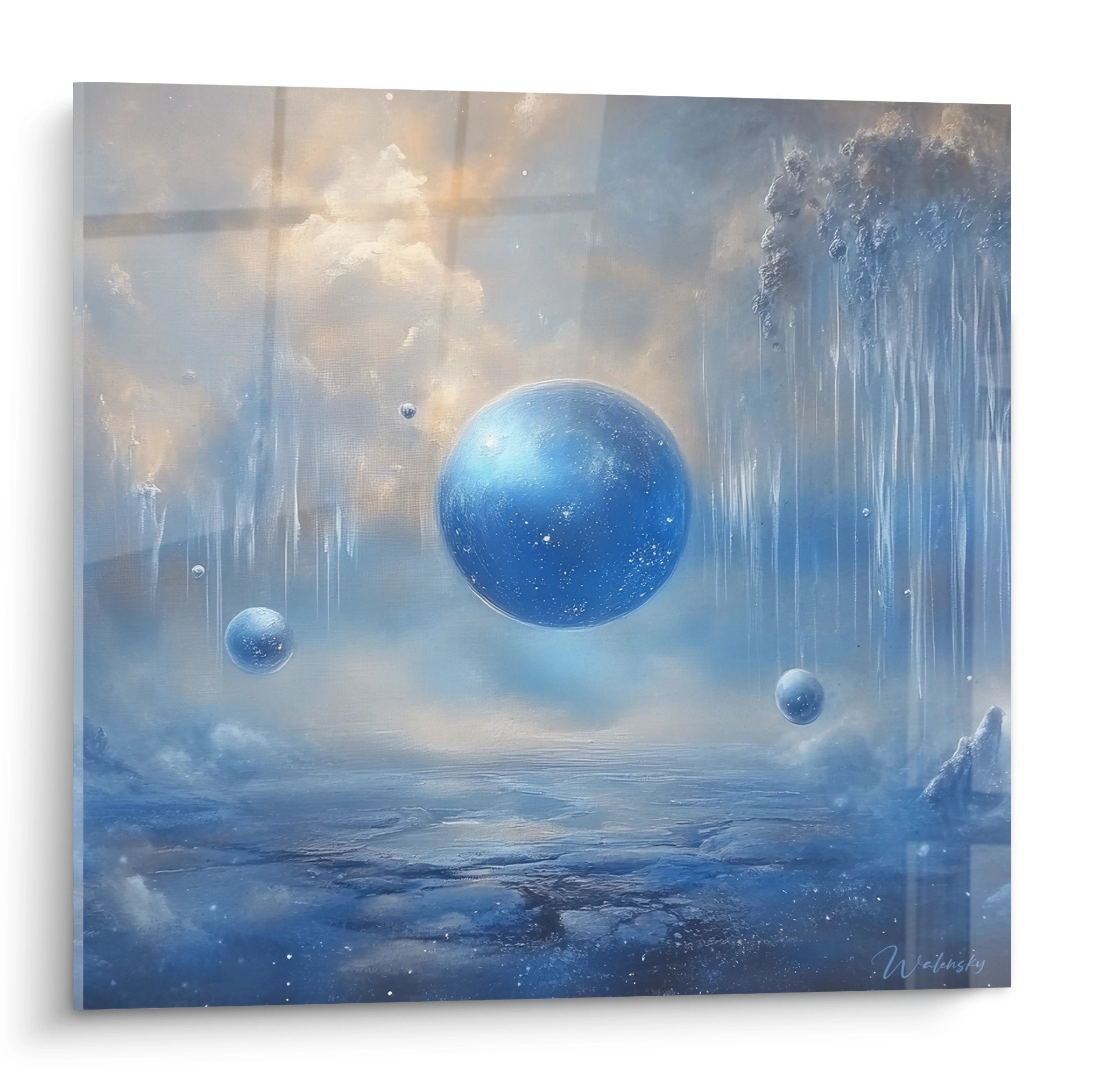
These paintings invite us to slow down, to observe what our utilitarian vision usually neglects. In our contemporary interiors, a work inspired by Impressionist reflections brings this contemplative breath, this fragment of nature that dialogues with the changing light of our living spaces.
The profound lesson of the Impressionists remains relevant: the most mundane can become extraordinary depending on the quality of our attention. An ordinary basin becomes a cathedral of light if one takes the time to observe how reflections transform its surface. This philosophy of attentive observation resonates particularly in our era saturated with superficial images.
Let the poetry of reflections into your daily life
Discover our exclusive collection of landscape paintings that capture this luminous magic of aquatic reflections, to transform your walls into contemplative windows.

The legacy of impressionistic reflections in modern decoration
Today, integrating a work inspired by impressionistic reflections into one's interior creates a fascinating dialogue with natural light. Like Monet’s canvases changed appearance according to the time of day, these aquatic compositions reveal different nuances over the hours, creating a living decor.
The tones of reflections - these deep blues mixed with emerald greens, these twilight purples crossed by gold - naturally harmonize with contemporary palettes. A reflection painting brings depth without weighing down, creating a valuable visual opening in urban spaces where nature is often lacking.
Beyond aesthetics, these works carry an ongoing invitation to contemplation. In a living room, bedroom or office, they create a soothing anchor point, a daily reminder that beauty lies in the patient observation of simple phenomena - like light dancing on water.
The Impressionists bequeathed us much more than just a pictorial style. Through their fascination with reflections in water, they taught us to see differently: to prioritize impression over description, the ephemeral over the permanent, luminous sensation over precise drawing. Each reflection was for them an invitation to celebrate the present moment, this fleetingness that gives all the flavor of existence.
This revolution of gaze remains strikingly modern. In your daily life, take the time to observe reflections - in a puddle after the rain, in your morning cup of coffee, on the window of a building. You will then understand why Monet could spend years painting the same basin: because reflecting water never ceases to offer us a new spectacle, a lesson in presence and beauty accessible to those who know how to look.
Frequently asked questions about reflections in Impressionist art
Why did Monet paint so many aquatic scenes with reflections?
Monet was fascinated by the water’s ability to constantly transform light and colors. Reflections offered him a subject in perpetual mutation, perfect for his quest to capture the visual impression of a precise moment. His garden at Giverny, with its pond filled with water lilies, became his personal laboratory where he could daily observe how reflections changed according to the time, season, and weather. This obsession was not manic but deeply consistent with his artistic project: to prove that painting could capture what the eye truly perceives, in all its luminous and chromatic complexity, rather than what the mind rationally reconstructs.
Were reflections in water a new subject in painting?
No, reflections existed in painting long before the Impressionists. Dutch Masters of the 17th century, for example, already painted canals with their reflections. The Impressionist revolution was not about the subject but about the treatment. Where academics considered the reflection as a technical detail to be executed precisely to demonstrate their virtuosity, the Impressionists made it the heart of their research on visual perception. They did not seek to paint a perfect and frozen reflection, but to capture its instability, its vibrations, its ephemeral character. This radically different approach transformed a conventional motif into a ground for revolutionary experimentation.
How to integrate the spirit of Impressionist reflections into my decoration?
Start by choosing a work – reproduction or contemporary creation – that favors the aquatic tones and fragmented light characteristic of Impressionist reflections. Place it where natural light varies throughout the day: near a window or facing a changing light source. The Impressionists worked with living light, and your painting will reveal different nuances depending on the time. Harmonize your decorative palette with the colors of the painting: deep blues, watery greens, touches of crepuscular pink or violet. Finally, create reflective surfaces in your space - mirrors, glass, lacquered surfaces - that will dialogue with the theme of reflections, creating a poetic continuity between the work and your interior.
Explore our collections


