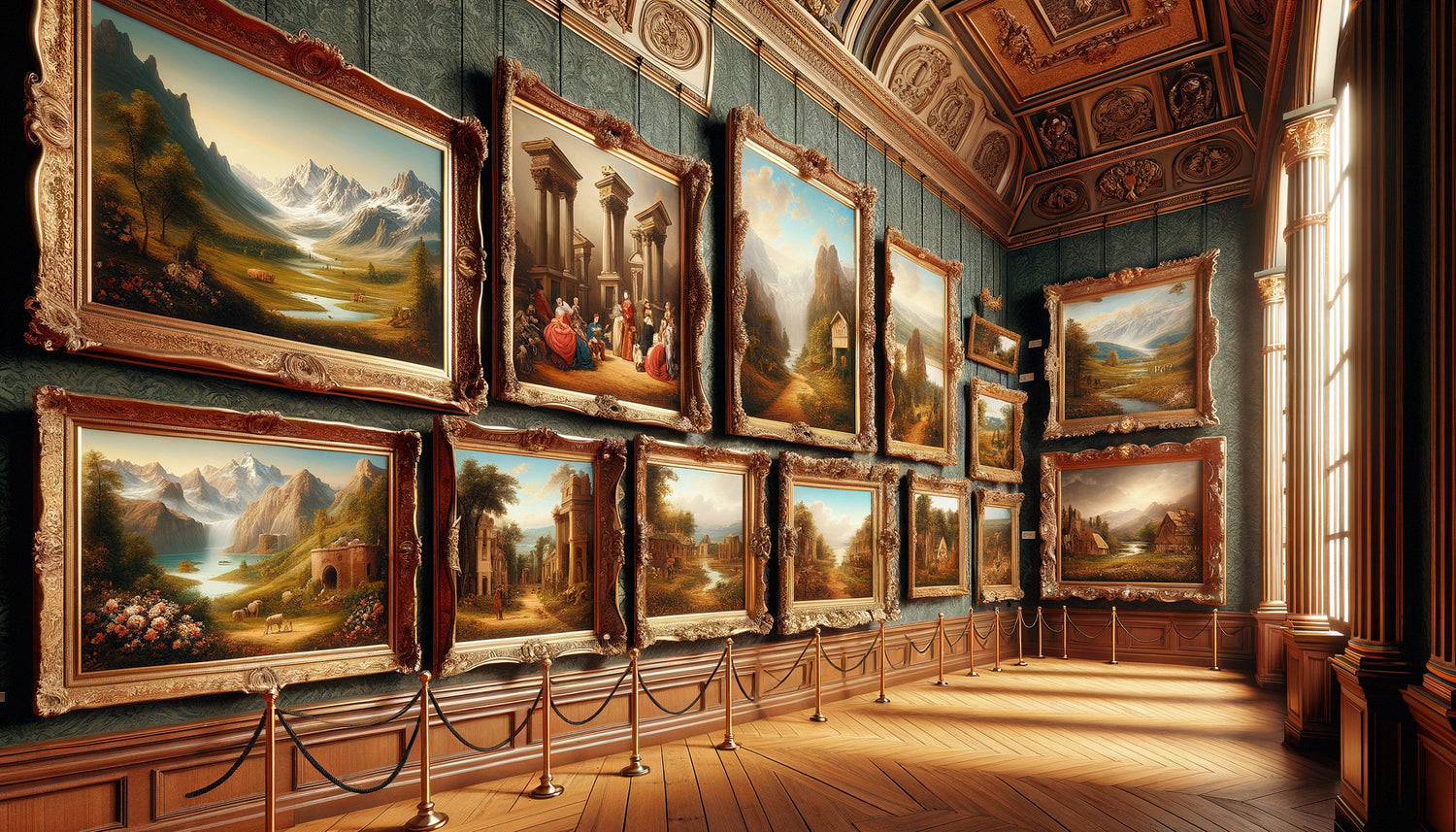
Imagine a moment in the vast plains of the Serengeti at sunset, the undulating dunes of the Sahara under golden light, or the Ethiopian mountains shrouded in mist. These breathtaking landscapes were practically absent from European art galleries before 1900. In classic museums, you can find hundreds of Alpine views, Dutch seascapes, Italian countryside... but where are the African horizons?
Here's what this absence reveals: an artistic system centered on its own references, limited geographical accessibility, and a utilitarian vision that reduced Africa to its resources rather than its beauty. This scarcity is as much a testament to the logistical constraints of the time as it is to the cultural filters that determined what was worth painting.
Have you ever wondered why your favorite gallery is full of Provence landscapes but completely ignores African panoramas? This question is not trivial for those who want to understand how our relationship with landscape art has been built. Rest assured: understanding these historical mechanisms allows us today to rediscover these neglected visual territories and significantly enrich your decorative universe.
In this article, we will explore together the fascinating reasons for this absence, decipher the artistic dynamics that caused it, and discover how the 20th century finally opened the doors to these landscapes long invisible.
The journey to Africa: an adventure out of reach for most artists
Before the 20th century, traveling to Africa represented a titanic undertaking. For a Parisian or London painter in the 18th century, reaching African landscapes required several months of perilous navigation, considerable investments, and major health risks. Malaria, yellow fever, and other tropical diseases decimated non-immunized Europeans.
Artists naturally preferred accessible destinations: the Swiss Alps just a few days' drive away, the Tuscan countryside easily reachable from Rome, or the Norman coast within reach of a coach. William Turner traveled through Europe in a few weeks; reaching Kilimanjaro would have taken him more than six months round trip.
This logistical constraint created a vicious circle: without an established pictorial tradition on African landscapes, no patron invested in such expeditions. And without funding, artists could not develop this visual repertoire. The few painters who ventured to Africa generally did so within a military or colonial context, with documentary rather than aesthetic goals.
When landscape reflects European cultural identity
Western landscape art was built around references deeply rooted in the European imagination. Roman ruins, medieval castles, Gothic churches: these architectural elements structured compositions and gave them a narrative dimension immediately understandable to audiences.
African landscapes, lacking these familiar cultural markers, seemed strangely empty to Western artists. A baobab did not carry the symbolic weight of a centuries-old European oak. A traditional hut did not have the romantic prestige of a Provençal farm. This Eurocentric reading grid literally filtered what deserved to be represented.
The tradition of the Grand Tour, this initiatory journey for European elites, focused exclusively on Italy, Greece and sometimes the Mediterranean Orient. Artists formed their gaze on Venice, Florence and Rome, not on Timbuktu or Zanzibar. This standardized visual education perpetuated the invisibility of African landscapes in Western artistic production.
The weight of academies in the hierarchy of subjects
European fine arts academies imposed a strict hierarchy of pictorial genres. At the top was historical painting, followed by portraiture, then landscape with its subdivisions. Classical landscapes inspired by Greco-Roman antiquity received honors, while exotic scenes were relegated to the rank of curiosities.
An ambitious artist seeking academic recognition would be far more interested in painting idealized views of the Roman countryside than African panoramas without institutional prestige. This orientation of artistic careers powerfully contributed to keeping Africa outside the legitimate landscape field.

Orientalism: when North Africa eclipses sub-Saharan Africa
There is a crucial nuance: North Africa was not entirely absent from Western art. The 19th century Orientalist movement produced countless representations of the Maghreb, Egypt and the Middle East. Delacroix, Fromentin, Gérôme painted Moroccan and Algerian scenes with fascination.
But this Orientalism precisely reveals the Western bias: these regions were perceived as an exotic extension of the classical Mediterranean, heirs to admired ancient civilizations. Sub-Saharan Africa, on the other hand, remained terra incognita, lacking in the European imagination those valued cultural connections.
Orientalist landscapes themselves were often fantasized, reconstructed in workshops from a few sketches and a lot of imagination. They served more as backdrops for scenes considered picturesque than they were studied for their intrinsic landscape value. The desert became a setting for caravans and genre scenes, rarely the main subject of contemplation.
The colonial vision: to document rather than celebrate
When Western artists finally began to represent African landscapes in the 19th century, it was mostly within a colonial and documentary context. Scientific, military or commercial expeditions sometimes hired draughtsmen to map territories, illustrate flora and fauna, inventory resources.
These utilitarian representations differed radically from romantic contemplative landscape. The aim was to document, classify, inventory—not to convey an aesthetic emotion or a poetic vision. Watercolors from these missions often remained in scientific archives rather than accessing the walls of Parisian living rooms.
This extractive approach extended to the gaze directed at territories: Africa was interesting for its mining, agricultural and strategic resources, rarely for the intrinsic beauty of its landscapes. The colonial gaze functioned as a filter that transformed ecosystems into inventories of economic potential.
The lack of a market for African landscapes
The art market operated according to the law of supply and demand. European collectors bought what they knew, what resonated with their experience and culture. A landscape of Normandy evoked memories, familiar sensations; an African Rift Valley landscape remained abstract, lacking that emotional connection.
Artists, dependent on these sales for a living, naturally adapted their production to the tastes of the market. Why invest months in an expensive trip to Africa to produce works that no one would buy, when Breton seascapes or Fontainebleau undergrowth were immediately snapped up?

The Turn of the 20th Century: New Mobilities, New Perspectives
Everything changes with the 20th century. Advances in maritime and then air transport make Africa accessible. Medical treatments reduce health risks. Above all, European artistic avant-gardes deliberately seek to break with academic conventions.
Modern artists value authenticity, the primitive, elsewhere. Africa becomes a legitimate source of inspiration, no longer as an exotic backdrop but as a subject in its own right. Fauvism, Expressionism, and then Abstraction find new resonances in African forms and colors.
Parallel to this, African artists trained in Western techniques begin to represent their own landscapes with an endogenous gaze. This twofold movement — Western artists opening up to Africa and African artists appropriating landscape codes — gradually transforms the place of African landscapes in art history.
Photography also plays a decisive role. Lighter and faster, it allows documenting and disseminating African views to a wider audience. These photographic images prepare the ground for a different reception of pictorial representations.
Reinvent Your Interior with Unexplored Horizons
Discover our exclusive collection of landscape paintings that celebrate the diversity of global natural beauties, from African savannas to contemporary horizons.
Understanding This Absence to Better Appreciate Current Diversity
This historical scarcity of African landscapes in Western art teaches us a lot about cultural valuation mechanisms. It reveals how geographical accessibility, institutional structures, market dynamics and cultural filters determine what becomes visible or invisible in artistic production.
Understanding these mechanisms now allows us to adopt a more conscious and open perspective. When decorating your interior, choosing an African landscape contemporary becomes a gesture that breaks with centuries of invisibility. It is affirming that beauty transcends borders established by 18th century academies.
This historical awareness also enriches your appreciation of artworks. A painting depicting Kilimanjaro or the Okavango Delta carries within it this history of absence, this long silence broken. It fits into a progressive rewriting of what deserves our contemplation and our walls.
Contemporary spaces gain considerably by integrating this landscape diversity long neglected. A living room that dialogues with varied horizons — European, African, Asian, American — reflects a cultural openness and curiosity that transcends inherited limitations from the past.
Transform your space with historical awareness
Now that you understand the reasons for this historical absence, you can make more informed and meaningful decorative choices. Integrating an African landscape into your interior is no longer just a matter of personal taste: it's participating in a historical correction, expanding the collective visual repertoire.
Imagine your living room transformed by a majestic view of the Ethiopian highlands, your office inspired by the serenity of a sunset over Lake Malawi, or your bedroom soothed by the gentle curves of the Namibian dunes. These landscapes bring a distinct visual energy, unique color palettes — ochres, burnt earths, deep greens — that completely renew the atmosphere of a space.
This approach is part of a broader contemporary trend: conscious decoration, which considers the cultural provenance and symbolic load of decorative elements. It's creating interiors that tell stories, that testify to an openness to the world and a reflection on the visual legacies we perpetuate or question.
Frequently Asked Questions about African Landscapes in Western Art
Did no Western artist paint Africa before 1900?
Indeed, some artists have depicted African landscapes before the 20th century, but they remain exceptional. Orientalist painters like Eugène Delacroix visited North Africa in the 1830s, producing a few views of Morocco and Algeria. Artists accompanying scientific expeditions, such as Thomas Baines during Livingstone's explorations in the 1850s, documented Southern Africa. However, these works represent a tiny proportion compared to the thousands of European landscapes produced at the same period. Most remained within documentary or ethnographic contexts rather than the classic art circuit. What is striking is precisely this rarity in a century (the 19th) which saw an explosion of European landscape production with Impressionism, the Barbizon school, Dutch marine paintings... Africa remained a massive blind spot.
How to integrate African landscapes into a classic decor without creating a stylistic break?
Successful integration relies on chromatic and compositional harmonies rather than geographical origin. An African landscape with ochre and earth tones blends perfectly with an interior featuring natural hues and raw materials. Look for representations that share formal qualities with your existing decor: if you like clean and minimalist compositions, prioritize views of deserts or savannas with soothing horizontal lines. For a richer and more textured interior, opt for scenes of tropical forests or colorful markets. The frame also plays a crucial role: a classic gilded frame can create continuity with traditional European works, while a simple contemporary frame affirms a more modern approach. Don't hesitate to create a visual dialogue by placing an African landscape next to works from other origins: this conversation between different geographical cultures enriches the space rather than fragmenting it.
Where to find authentic representations of African landscapes today?
Several options are available to you depending on your budget and aesthetic preferences. Galleries specializing in African contemporary art regularly showcase artists from the continent who revisit the landscape genre with fascinating contemporary perspectives. Online platforms like Artsy, Saatchi Art or specialized stores offer museum-quality reproductions of African historical and contemporary landscapes. Also look for works by African photographers who have beautifully documented their territories: names like Malick Sidibé, Seydou Keïta, or more recently Fabrice Monteiro. For an accessible and immediate approach, online collections of art reproductions now offer diverse selections including African views. The important thing is to prioritize representations that escape colonial clichés—avoid overly smooth postcard visions—and which carry an authentic gaze, whether it comes from African artists or artists who have developed a true sensitive knowledge of the continent.