The first time I discovered a canvas depicting Mount Taranaki in an Auckland gallery, I felt something indescribable. It wasn't simply a volcanic landscape – it was an almost living presence, a telluric force captured within the pictorial matter. New Zealand painters don’t just reproduce their volcanoes: they transcribe an ancestral relationship between the earth and the spirit, a millennial conversation with sleeping giants.
Here is what the representation of New Zealand volcanic landscapes brings to your interior: a visceral connection with the primitive forces of nature, a dramatic aesthetic that transforms any space, and a cultural bridge to Maori spirituality. Many believe that landscape art is limited to pretty postcard views, wise and reassuring compositions. But in New Zealand, the volcanic landscape carries an urgency, a burning memory. I understand your hesitation: how to integrate this raw power into a harmonious interior? Let me show you how these artists have transformed geological fury into visual poetry, and why their works resonate today in contemporary spaces around the world.
The breathing earth: when the volcano becomes pictorial subject
In New Zealand, the volcanic landscape is not an inert backdrop. It's a daily presence, sometimes threatening, always majestic. New Zealand painters have developed a unique approach to capture this duality. Unlike European landscapists who celebrate domesticated nature, artists from the North and South Islands work with living geological matter.
Mount Ruapehu, Mount Ngauruhoe, the mythical White Island – these active volcanoes permeate the Kiwi collective consciousness. Artists like Colin McCahon understood very early on that painting a New Zealand volcano required a specific pictorial language. No Turner-esque romanticism, no Friedrich’s horrified sublime. No, something more direct, more primitive.
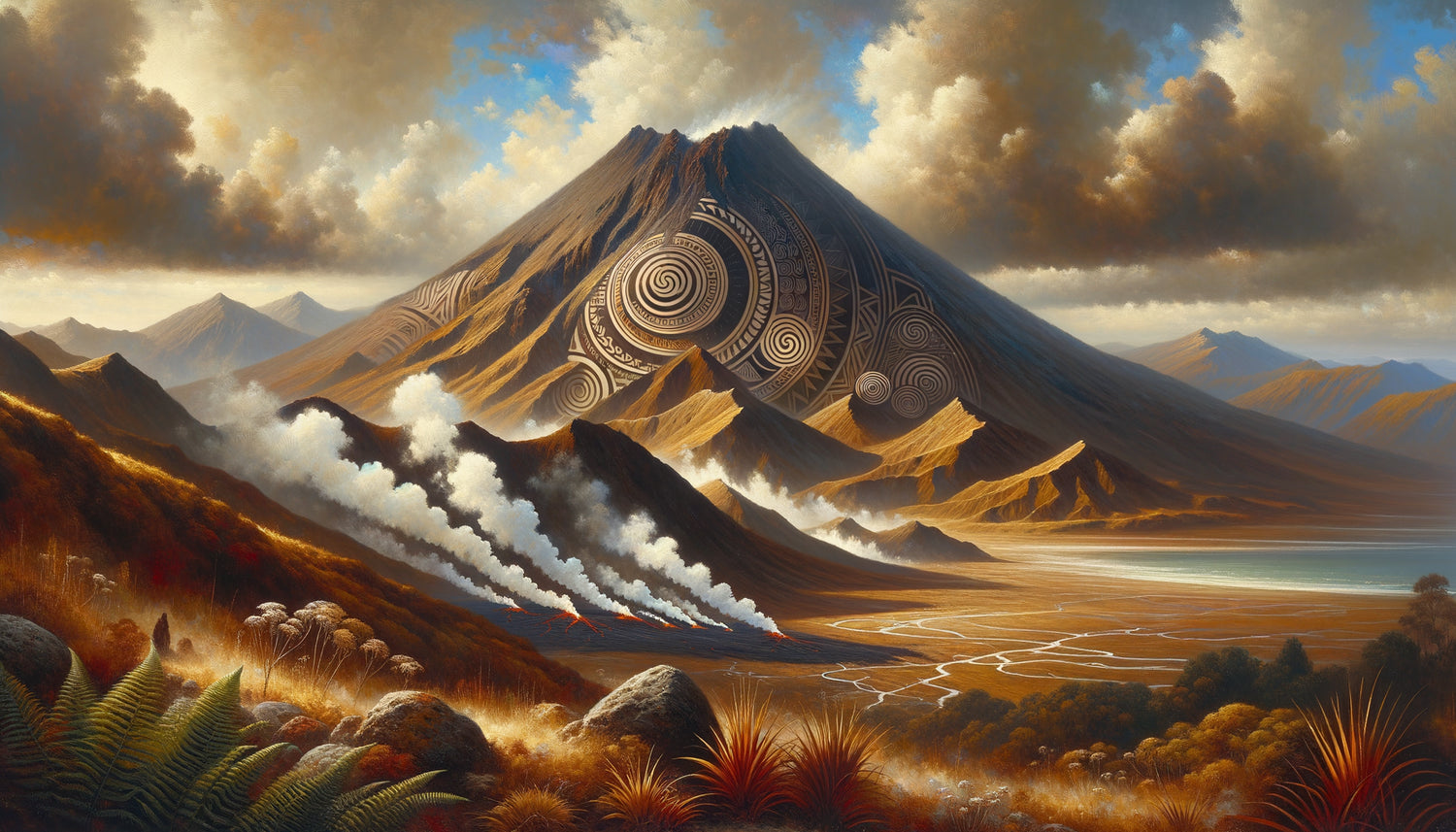
This approach translates into bold compositions where the mountain often occupies the entire visual field. Contemporary painters use thick impastos, rough textures that evoke cooled lava, ashes, earth ravaged by eruptions. The color palette oscillates between incandescent reds, the deep blacks of basaltic rock, and those acidic greens of the vegetation courageously colonizing the flanks of the giant.
The Maori influence in volcanic representation
It's impossible to talk about New Zealand’s volcanic landscapes without mentioning Māori cosmology. For the tangata whenua, the people of the land, volcanoes are not simply geological formations. They are petrified ancestors, spiritual entities with their own stories, their tragic loves, their legendary angers.
Contemporary Māori artists like Robyn Kahukiwa or Shane Cotton incorporate this mythological dimension into their representations of the volcanic landscape. Their paintings overlay strata: geological, historical, spiritual. We find traditional motifs – spirals of koru, lines of kowhaiwhai – that dialogue with the massive silhouette of the volcano. This fusion between tradition and modernity creates works of extraordinary symbolic richness.
Painting techniques at the service of geology
How to translate the texture of a millennial lava flow into painting? How to capture the sulphurous steam that escapes from the fumaroles? New Zealand painters have developed innovative techniques specifically adapted to their subject.
Some artists like Grahame Sydney favor tempered hyperrealism, this almost photographic precision that does justice to the geological details of the volcanic landscape. Each streak of ash, each accident of relief is meticulously documented. This approach creates works of hypnotic presence, where you can almost feel the residual heat of the ground.
Others, like Ralph Hotere, opt for lyrical abstraction. The volcano becomes a pretext for an exploration of forces, tensions, and energetic dynamics. Forms are simplified to the essential: a powerful vertical, a dark mass against an incandescent sky. These abstract landscapes work wonderfully in contemporary interiors, where they bring visual strength without imposing too literal representation.
Color as a volcanic language
The palette of New Zealand painters working on the volcanic theme deserves particular attention. Far from the clichés of red lava, they explore sophisticated chromatic harmonies. The deep black of obsidian, these silvery grays of the fumaroles, sulfur yellow of geothermal areas, emerald green of the tree fern forests that border craters.
This vibrant color palette makes New Zealand volcanic landscape paintings exceptional masterpieces for interior decoration. They blend seamlessly into minimalist settings – where their visual power creates a dramatic focal point – as well as into more eclectic interiors, where they dialogue with natural materials such as raw wood, stone, and linen.

From centerpiece to your living room: integrating volcanic power
I have often accompanied collectors in their quest for the perfect volcanic landscape painting. The question invariably arises: how to tame this telluric energy in a domestic space? The key lies in understanding scale and spatial context.
A large format representing Mount Tongariro in all its majesty requires a generous wall, ideally in a reception area where it can deploy its monumental presence. These imposing works literally transform the atmosphere of a room, creating an effect of window onto infinity, an opening to the primordial forces of nature.
For more intimate spaces, detailed volcanic studies work remarkably well. A close-up on lava formations, a composition centered on mineral textures, an abstract evocation of geothermal vapors. These more contemplative approaches to the volcanic landscape integrate perfectly into a bedroom, office, or meditation space.
Creating a dialogue between the artwork and the space
Installing a New Zealand volcanic landscape painting is not something to be taken lightly. I have learned that these works require a clean environment that allows them to breathe. Avoid decorative clutter: the volcano must reign supreme. Pair it with raw materials – polished concrete, driftwood, patinated metal – which echo its mineral authenticity.
Lighting plays a crucial role. Directional lighting reveals the reliefs of the pictorial matter, creating shadows that accentuate the tactile dimension of the work. For brighter representations, prioritize indirect natural light that makes the colors vibrate without creating parasitic reflections.
Masters of the Volcanic Landscape
The New Zealand art scene is brimming with talent that perpetuates and renews the tradition of volcanic landscape. Artists like Peter Peryer, although a photographer, significantly influences contemporary painters through his documentary and poetic vision of volcanic sites.
Michael Smither deserves special mention for his series dedicated to Mount Taranaki. His canvases capture the volcano in all its moods, from the imposing serenity of clear days to the subtle threat of stormy skies. This serial approach recalls Monet’s Haystacks, but with a distinctly New Zealand dramatic intensity.
Emerging young artists like Sarah Munro or Karl Maughan reinterpret the volcanic landscape through contemporary prisms. Their works integrate environmental concerns, questioning our relationship to these fragile ecosystems, threatened by climate change and tourist pressure.

When Geology Inspires Modern Decoration
Beyond hanging a canvas, the New Zealand volcanic landscape now inspires an entire decorative aesthetic. Interior designers draw on this imagery to create powerful and soothing atmospheres – a paradox that perfectly reflects the dual nature of the volcano.
This influence is reflected in the choice of color palettes: these shades of anthracite gray, punctuated by touches of rust and deep green. In the textures as well: rough surfaces, seemingly raw materials but sophisticated in their implementation, recalling the harsh beauty of lava fields.
Decorative objects are inspired by volcanic forms: vases with conical silhouettes, luminaires evoking incandescent lava, textiles with abstract geological patterns. This global approach allows to create a coherent universe where the volcanic landscape painting becomes the centerpiece of a broader decorative narrative.
Let the power of volcanoes transform your interior
Discover our exclusive collection of landscape paintings that capture the dramatic and poetic essence of telluric forces, for a space that vibrates with natural energy.
The future of volcanic landscapes in New Zealand art
As environmental challenges become increasingly prominent in public debate, New Zealand painters are reinventing their approach to volcanic landscapes. Their works are no longer just celebrations of natural beauty, but also valuable testimonies of threatened ecosystems, poetic alerts about the fragility of these extraordinary environments.
This testimonial dimension gives contemporary paintings an added value. Acquiring a work representing a New Zealand volcanic landscape is preserving a visual memory, participating in the cultural conservation of a unique natural heritage. It is also, very concretely, supporting a dynamic artistic scene that deserves international recognition.
European galleries are finally beginning to take a serious interest in these artists from the edge of the world. Informed collectors understand: New Zealand painters offer a vision of landscape radically different from Western tradition, a vision that resonates deeply with our contemporary aspirations to reconnect with the authentic forces of nature.
Imagine your living room transformed by the silent presence of a New Zealand volcano. This mountain which has seen legends born, which still breathes beneath its carapace of rock and snow. Every morning, contemplating it, you reconnect with something larger than your daily life, with this geological memory that reminds us of our humble place in the immensity of time. Start by exploring the contemporary artists who perpetuate this tradition. Let yourself be guided by your emotions rather than conventions. The perfect volcanic landscape awaits you somewhere, ready to infuse its telluric energy into your living space.
Frequently asked questions about New Zealand volcanic landscapes
Do volcanic landscape paintings suit all decorating styles?
Absolutely, and that's where their extraordinary strength lies. A neo-zealand volcanic landscape possesses a visual universality that transcends decorative trends. In a minimalist interior, it brings that touch of raw nature which warms the austerity of clean lines. In a bohemian space, it naturally dialogues with organic materials and ethnic textiles. Even in a classic interior, a contemporary representation of a volcano creates a stimulating contrast that energizes the whole. The key is to choose the pictorial style: hyperrealistic for sophisticated atmospheres, abstract for more contemporary spaces, expressionistic for bold interiors. I always recommend considering the overall energy of your space before choosing. A peaceful volcano under a serene sky suits bedrooms and relaxation areas, while a more dramatic composition magnifies a living room or office.
How to recognize an authentic neo-zealand volcanic landscape painting?
Authenticity is read in several revealing details. First, the geological signature: neo-zealand volcanoes have characteristic profiles that local artists know intimately. Mount Taranaki with its almost perfect symmetry, Mount Ruapehu with its suspended glaciers, the colored craters of Tongariro. Then observe the vegetation: the tree ferns, the tussocks, this unique flora that often frames compositions. The light also betrays the origin: this particular quality of southern light, more raw, more contrasted than European light. Finally, the cultural approach: many neo-zealand artists subtly integrate maori references, whether in the composition, symbolism or even in the title of the work. For absolute guarantee, prefer specialized galleries that provide complete documentation on provenance and artist. A certificate of authenticity becomes essential for valuable works.
What budget to plan for a quality neo-zealand volcanic landscape painting?
The market for neo-zealand volcanic landscapes offers a wide range that suits all budgets. For a museum-quality art reproduction, expect to pay between 200 and 600 euros depending on the format and printing technique. These reproductions allow access to works by renowned masters while respecting a reasonable budget. For an original work by an emerging artist, prices generally start around 800 to 2000 euros for a medium size. Established artists with national recognition offer artworks between 3000 and 15000 euros. As for internationally recognized contemporary masters, their pieces can reach several tens of thousands of euros. My advice: start by defining your budget, then explore what is accessible within that range. Remember that the emotional investment counts as much as the financial investment. A more modest work that transports you daily is worth infinitely more than a prestigious piece that leaves you indifferent. Serious galleries often offer payment facilities for significant acquisitions, making art accessible without compromising quality.