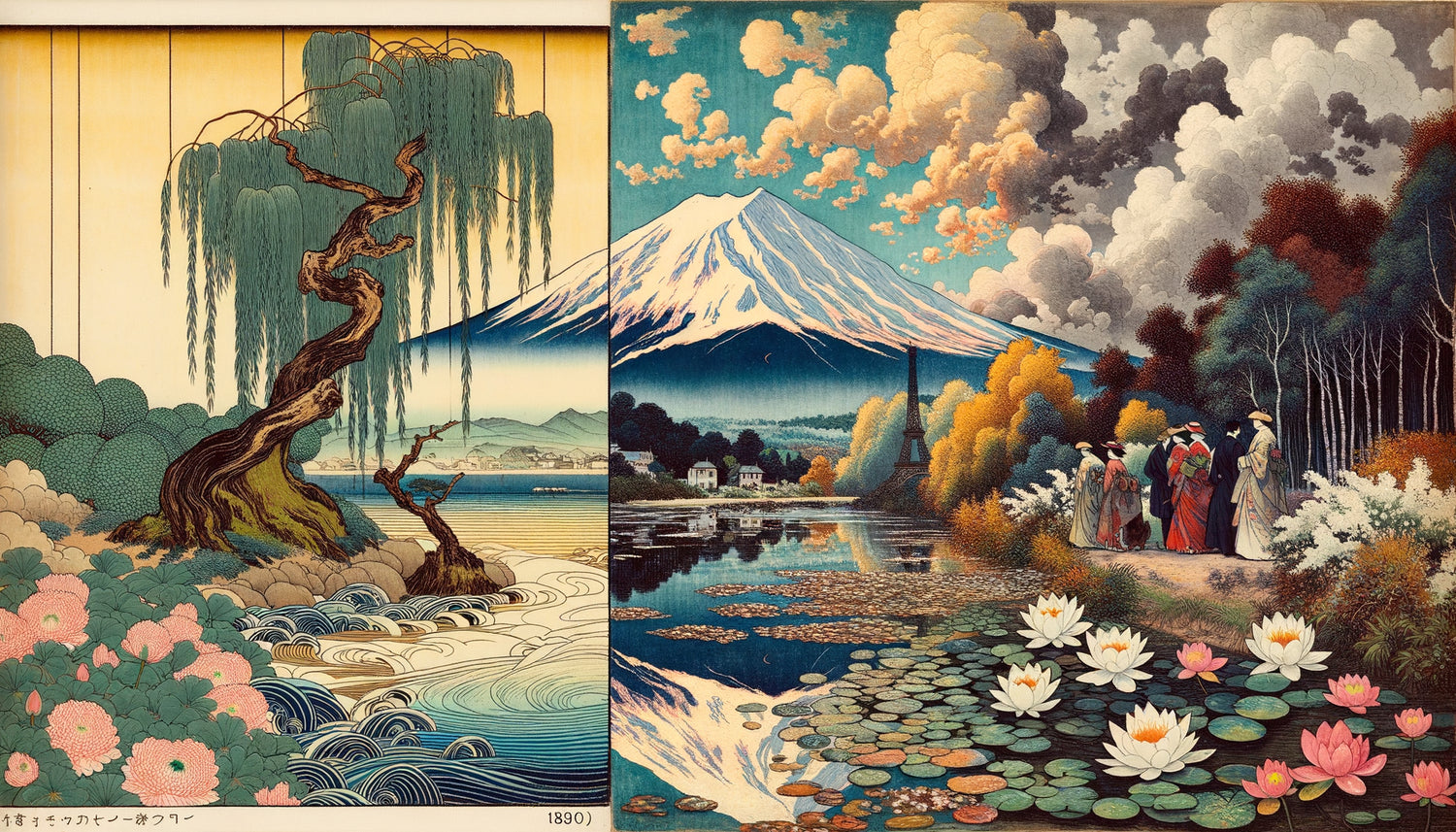
Paris, 1867. The Universal Exhibition opens on the Chaillot hill. Among the gleaming pavilions, a simple fan adorned with a stylized Mount Fuji is about to change everything. Claude Monet stops, fascinated. These clean lines, this impossible perspective, this deep blue that dialogues with emptiness… Something has shifted in his gaze. In a few decades, Japanese prints would revolutionize the way European painters perceived and represented landscapes.
Here's what the influence of Japanese prints brought to European Impressionist landscape: a radical liberation of composition, an unprecedented chromatic boldness, and an intimate connection with nature that transcended academic conventions.
For centuries, European landscapists had obeyed the same rules: mathematical perspective, hierarchy of planes, noble subject in the center. The result? Magnificent but predictable canvases, where nature seemed corseted within a rigid mental framework. Artists were seeking something else, without knowing exactly what.
Then came the shock of Japonism. These prints arrived in the luggage of merchants offering a radically different vision of the world. No rules, just sensitive truth. And suddenly, everything became possible.
I invite you on this visual revolution that continues to irrigate our way of looking – and inhabiting – landscapes today.
When the West Discovers Japanese Landscape Masters
The story begins with a commercial accident. Around 1856, Japanese porcelains arrived in Europe, wrapped in scrap paper: ukiyo-e prints considered worthless in Japan. The engraver Félix Bracquemond discovered one depicting crabs. He shows it to his painter friends. The news spreads like wildfire through Parisian workshops.
What Monet, Pissarro, Van Gogh and their contemporaries discover surpasses everything they have learned at the Fine Arts school. Hokusai's and Hiroshige’s prints present a living, breathing nature, captured in the instant. The famous The Great Wave off Kanagawa becomes an obsession for a whole generation. Not for its exoticism, but for its lightning-fast modernity.
European artists frantically collect these works. Monet owns more than two hundred in his Giverny house. Van Gogh methodically copies Hiroshige’s prints. Mary Cassatt integrates their lessons into her intimate scenes. This fascination is not a simple craze: it's a re-education of the gaze.
The Revolution of Composition: Daring to Decenter
The first lesson from Japanese prints concerns composition. In European academic art, the main subject occupies the center, surrounded by hierarchical secondary elements. Ukiyo-e pulverizes this dogma.
Look at Hiroshige’s prints: a bridge occupies the extreme left edge, a plum branch invades the foreground and cuts the image diagonally, the horizon is placed very high or very low. The void becomes as eloquent as the full. This bold asymmetry liberates the pictorial space.
Impressionists embraced this freedom with delight. Monet paints his water lilies without a horizon, without traditional spatial markers. Degas frames his dancers as if he were seizing them in flight, cropping bodies at the edges of the canvas. Pissarro composes his Parisian boulevards with dizzying perspectives that owe everything to Edo views.
This influence of Japanese composition transforms the viewer into an active participant. The eye must reconstruct, imagine, extend. The Impressionist landscape becomes an experience rather than a representation.
The power of close framing
Japanese masters dared to use impossible framings: a giant iris occupying all the space, a waterfall seen from so close that its scale is lost. This radical intimacy with nature directly inspires Monet's series. His Haystacks, his Poplars, his Cathedrals adopt this principle of obsessive proximity. A single motif, repeated, explored in all lights. Japanese prints had taught that a fragment could contain the universal.

Liberated color: bold blocks and contrasts
The second revolution concerns color. Ukiyo-e prints use blocks of pure colors, juxtaposed without modeling or gradation. A deep Prussian blue dialogues directly with a vibrant orange. No gray shadows, no subtle transition: color asserts its raw presence.
This chromatic frankness electrifies the Impressionists. Van Gogh writes to his brother Theo that Japan taught him to see color differently. He copies Hiroshige's Plum Blossoms print, absorbing this economy of means where three colors suffice to create a world.
Gauguin pushes this lesson to Brittany, then to Polynesia. His landscapes adopt the frank contrasts and the dark outlines of prints. Bernard, Sérusier and the Nabis theorize cloisonnism, directly inspired by Japanese printmaking techniques.
This chromatic influence of prints on the Impressionist landscape is not limited to imitation. It opens a path towards pure expressiveness, where color translates emotion rather than optical reality. The landscape becomes a musical score.
The moment and the series: capturing the ephemeral
Japanese woodblock prints capture precise moments: a sudden rain shower on the Atake bridge, a full moon over the canal, snow at dawn. This attention to fleeting moments and atmospheric variations resonates deeply with the Impressionist project.
Hokusai and Hiroshige create series: Thirty-six Views of Mount Fuji, Fifty-three Stations of the Tōkaidō. The same motif traversed by seasons, hours, weather conditions. This serial approach directly inspires Monet who paints his haystacks in summer, in winter, at dawn, at dusk. Each canvas captures a state of mind of the landscape.
The Japanese print had taught that nature is perpetual movement. The European Impressionist landscape abandons the idea of a definitive image to embrace this fluidity. Painting becomes a metaphor for the passage of time.
Nature as a state of mind
Beyond the technique, prints convey a philosophy. In Japanese art, the landscape is not a backdrop but a state of consciousness. A few strokes suffice to evoke the solitude of a traveler in the rain, the serenity of a temple in the mist. This contemplative dimension infuses Impressionist landscapes, which become meditations on light, time, being-in-the-world.

The garden as a total work of art: from Giverny to contemporary interiors
The ultimate influence of Japanese prints is manifested in the very conception of inhabited landscape. Monet does not simply paint nature: he creates his own Japanizing universe at Giverny. The Japanese bridge, the wisteria, the water lilies… His garden becomes a living work of art, an extension of his canvases.
This fusion between art and daily life, inherited from Japanese aesthetic philosophy, permeates our relationship with the domestic landscape today. The idea that a corner of a garden, a view framed by a window, a plant arrangement on a wall can embody all the beauty of the world comes directly from this encounter between East and West at the end of the 19th century.
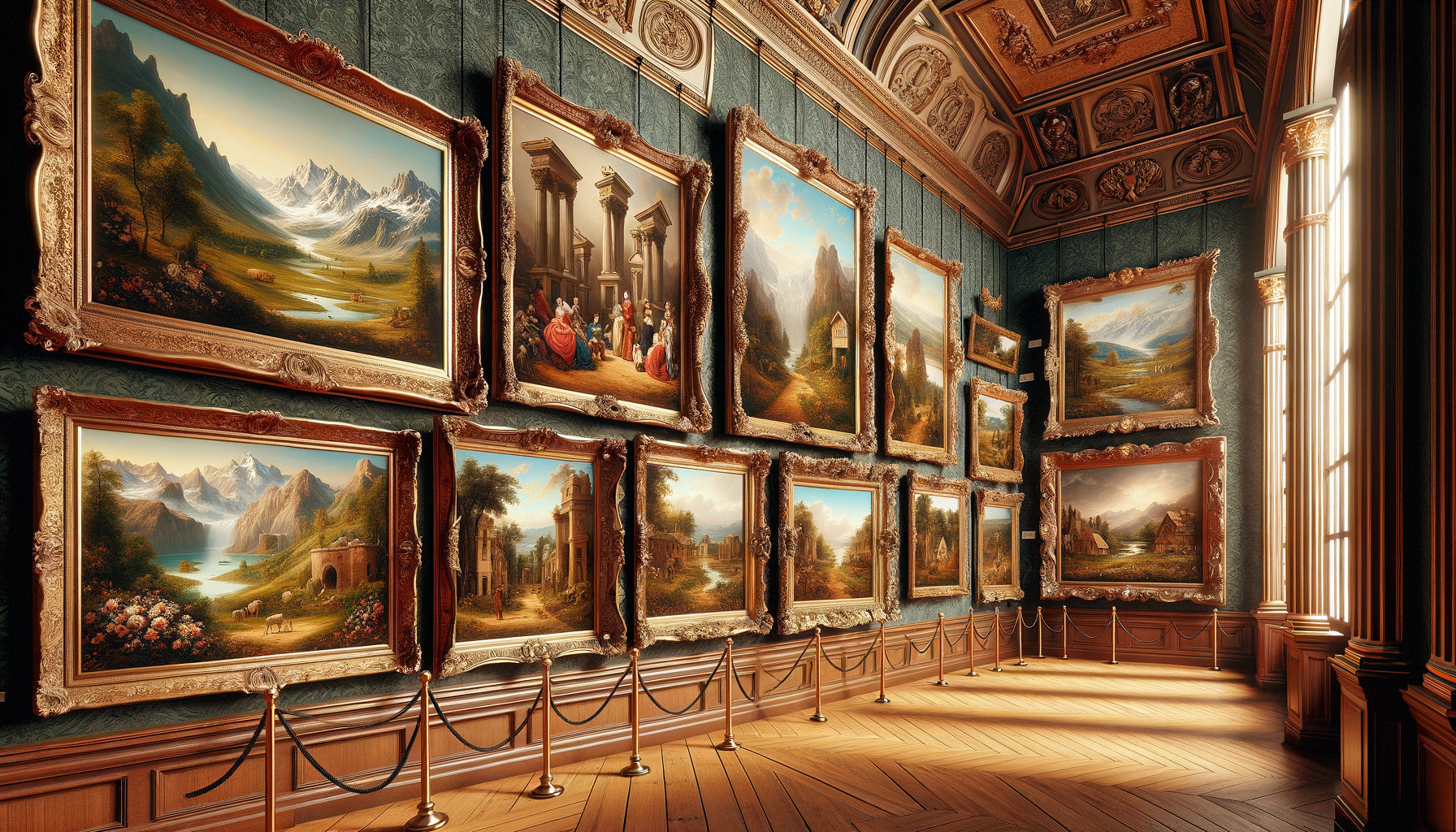
Impressionist landscapes are no longer confined to museums. They inhabit our interiors through reproductions that perpetuate this poetic vision of nature. Every time we hang a painting depicting a French garden bathed in soft light, we prolong this century-old conversation between Paris and Edo.
Let the poetry of Impressionist landscapes into your home
Discover our exclusive collection of landscape paintings that capture this unique alchemy between Impressionist light and Japanese composition, to transform your interior into a haven of contemplation.
Living legacies: how this revolution still inspires us
More than a century after this cultural clash, the influence of Japanese prints on the European Impressionist landscape continues to shape our gaze. Contemporary photographers use these asymmetrical framing techniques, these games of empty and full space. Interior designers compose their atmospheres according to these principles of dynamic balance.
When you choose a reproduction by Monet or Pissarro for your living room, you are not just hanging a beautiful image. You are inviting into your home the fruit of this extraordinary encounter between two visions of the world. You perpetuate this silent conversation between French Impressionism and Japanese ukiyo-e.
This double influence is evident in the way these works dialogue with contemporary space. Their offbeat composition creates movement on a wall. Their bold yet harmonious colors soothe without boring. Their suggestion rather than their description leaves room for reverie.
Japanese prints offered European Impressionists much more than a repertoire of forms: permission. Permission to dare, to experiment, to trust sensation over rule. This conquered freedom transcends time and continues to inspire all those who seek to capture the fleeting beauty of the world.
Conclusion: A transformed gaze for eternity
The influence of Japanese prints on the European Impressionist landscape goes far beyond the history of art. It has transformed our way of seeing, framing, and experiencing the landscapes that surround us. From Hokusai's Great Wave to Monet's Water Lilies, a dialogue has been established whose heirs we are.
Whenever you stop in front of an Impressionist landscape – in a museum or on the wall of your home – remember this improbable encounter between Paris and Edo. These works carry within them two reconciled wisdoms: the vibrant light of the West and the purified contemplation of the East.
Today, inviting an Impressionist landscape into your home is welcoming this double breath. It is choosing a gaze that knows how to see the extraordinary in the ordinary, the monumental in the intimate, the eternal in the instant. Start by truly observing your living space. Which wall calls for this poetry? What light deserves to be celebrated by a landscape that carries so many stories?
FAQ : Japanese Prints and European Impressionism
Why were the Impressionists so interested in Japanese prints?
The Impressionists sought to escape the academic conventions that stifled their creativity. Japanese prints offered them exactly what they were looking for: a radical alternative to European perspective and composition rules. These works proposed bold framing, pure colors in blocks, and an intimacy with nature that perfectly matched their desire to capture the moment and sensation. It wasn't just a taste for exoticism, but a true artistic recognition. Monet, Van Gogh, Degas and so many others saw in ukiyo-e a validation of their own intuitions and a springboard towards greater creative freedom. This encounter transformed their way of seeing and painting the world.
What concrete elements of Japanese prints can be found in Impressionist landscapes?
Several characteristics stand out when comparing these two artistic universes. First, the asymmetrical compositions: the Impressionists adopt off-center framing where the main subject can occupy a corner of the canvas, just like in Hiroshige's prints. Then, the use of elements in the foreground that frame the scene – a branch, a bridge, a curtain of trees – a very Japanese technique. Color blocks and sharp contrasts gradually replace subtle modeling. The horizon placed very high or very low, plunging perspectives, the importance given to emptiness and the unpainted… All these techniques come directly from the Japanese influence. Even the practice of thematic series – Monet painting his haystacks or his cathedral under different lights – is inspired by the series of Hokusai and Hiroshige.
How to integrate a Japanese-inspired Impressionist landscape into my decor?
The advantage of Impressionist landscapes nourished by Japanese aesthetics is that they adapt wonderfully to contemporary interiors. Their often asymmetrical composition creates dynamism without overwhelming the eye. To highlight them, prefer a clean wall where the work can breathe – just as prints valued the empty space around the motif. A Monet landscape with its water lilies finds its place in a neutral-toned living room, bringing a touch of color and poetry without overloading it. Scenes of riverbanks or Japanese gardens work wonderfully in spaces bathed in natural light. The trick? Leave some empty space around the painting, don't squeeze it between other frames. This visual breathing honors the Japanese heritage of these works and allows their magic to fully operate.