I spent fifteen years collecting Persian manuscripts in the souks of Tehran and Parisian auction houses. One day, facing a 16th-century miniature, I realized something extraordinary: what I took for simple decor was actually a sophisticated visual language. The lush gardens, stylized mountains, winding streams did not only serve to embellish the scene – they told a story, revealed the emotions of the characters, created a mystical atmosphere.
Here's what Persian art in miniatures brings: a vision of landscape as poetic space where every natural element carries symbolic meaning, a vertical composition technique that transforms our perception of space, and a vibrant color palette that makes the natural decor a protagonist in its own right.
Perhaps you admire these works in books or museums, but you wonder how these artists managed to create such rich universes in such small formats. How do they manage to suggest the immensity of a paradise garden in just a few square centimeters? Why do these landscapes seem both realistic and totally dreamlike?
The beauty of Persian art lies precisely in its ability to condense infinity into the miniature. The court painters of the Safavid or Mughal dynasties developed extraordinarily sophisticated visual conventions to integrate landscape as a central narrative element.
I invite you to discover the secrets of this masterful integration of landscape in Persian miniatures – these millennial techniques that continue to inspire contemporary designers and decorators.
The Persian garden: more than a decor, an earthly paradise
In the Persian imagination, the landscape always begins with the garden. The Persian word pardis has indeed given our word "paradise." Persian miniatures systematically represent lush gardens as a metaphor for happiness, love and divine perfection.
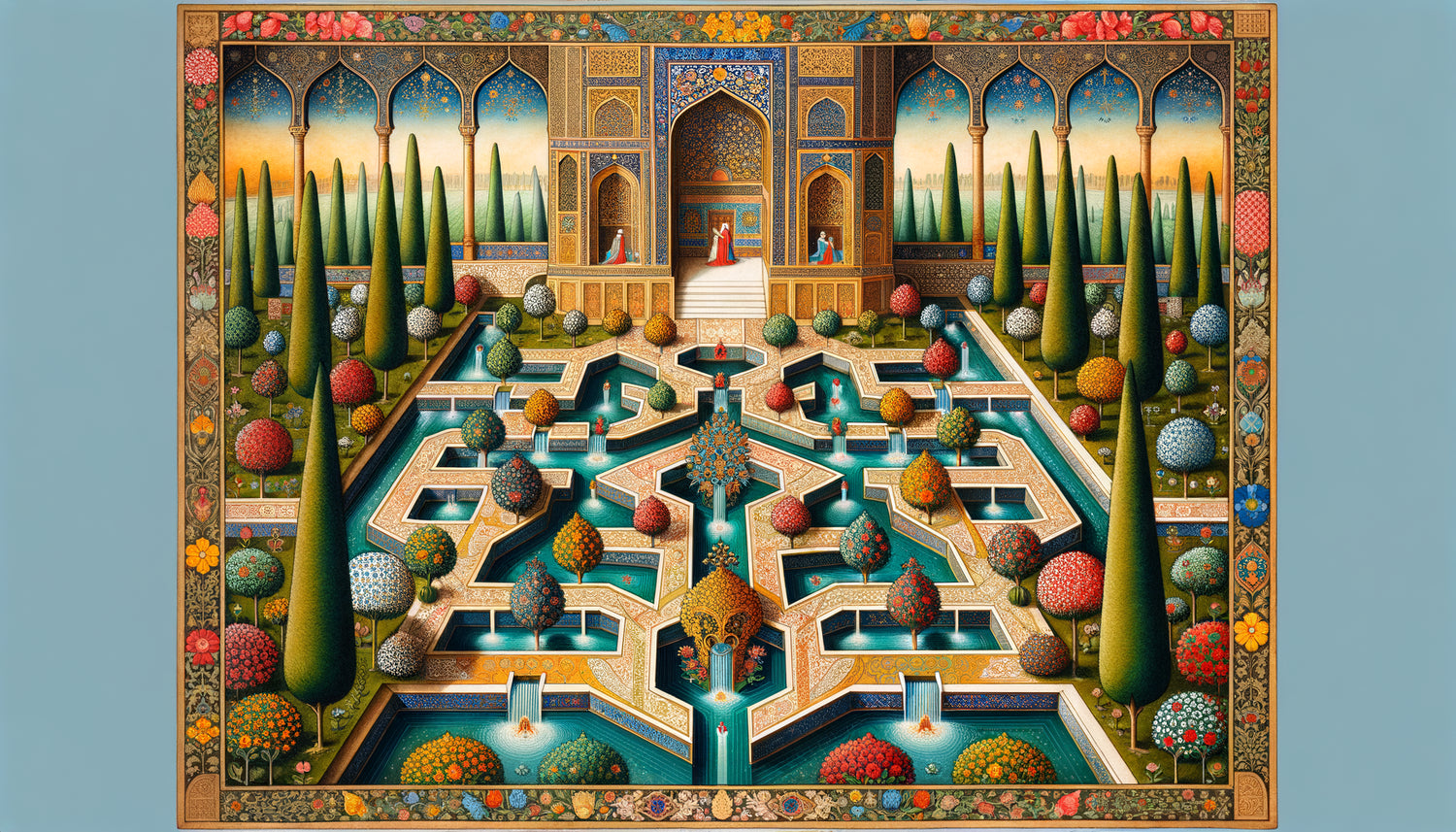
What is fascinating about these representations is their geometric organization. Gardens are structured according to the principle of the chahar bagh, the garden divided into four parts by water channels. This quadripartite organization symbolizes the four rivers of the Koranic paradise. Miniaturists reproduce this sacred geometry with architectural precision.
I noticed that trees – slender cypresses, pomegranate blossoms, almond trees – are never arranged randomly. Each plant species has its meaning: the cypress evokes eternity and spiritual verticality, the pomegranate symbolizes fertility, the weeping willow represents amorous melancholy.
Water as a narrative thread
In Persian miniatures, water always structures the landscape composition. Winding streams, rectangular pools, and fountains create guidelines that direct the viewer's eye. Artists use blue lapis lazuli or turquoise pigments to render this water almost supernatural.
These waterways never reflect the sky or the figures – a deliberate stylistic convention that keeps the landscape in a timeless, almost abstract dimension.
The inverted perspective: when the distance becomes close
This is perhaps the most confusing aspect for a Western eye: Persian miniatures completely reject linear perspective invented by the Italians during the Renaissance. Instead, they use what I call a “poetic perspective.”
Landscape elements are superimposed vertically rather than diminished according to distance. A distant mountain occupies the top of the composition, represented with as much detail as a bush in the foreground. This vertical arrangement creates a sense of spiritual elevation rather than an illusion of depth.
I have spent hours analyzing miniatures by Behzad or Reza Abbasi. Their genius lies in this ability to stack landscape planes like strata of reality. The ground becomes a horizontal band decorated with meticulous flowers, then comes a dense vegetation area, then rocky hills, and finally a golden sky or a stylized horizon.
Mountains as visual punctuation
Mountains in Persian art deserve special attention. They appear as rock formations with sinuous and organic contours, often tinted pink, ochre or purple. These stylized reliefs frame the scenes, create separations between different narrative moments, or symbolize obstacles on the path of lovers.
Artists use a fascinating technique: they paint the rocks with subtle gradations and add touches of gold to suggest the divine light that permeates creation.

A color palette that transcends naturalism
If you look closely at the landscapes of Persian miniatures, you will notice that colors never seek to faithfully imitate nature. Meadows can be turquoise, skies golden, rocks pink or lavender. This chromatic freedom is not naivete, but a deliberate aesthetic choice.
The pigments used – Afghan lapis-lazuli, cinnabar vermilion, beaten gold, saffron – cost a fortune. Their brilliance was meant to evoke the richness of paradise, not reproduce the banality of the visible world. I had the chance to see miniatures never exposed to light: their colors possess an almost hallucinatory intensity.
The sky, in particular, becomes a true symbolic space. Often treated as a solid gold plane or dotted with stylized clouds shaped like Chinese volutes (influence of the Silk Road), it transforms each scene into a moment suspended outside of time.
When the landscape tells the emotion of the characters
This is what I took years to understand: in Persian miniatures, the landscape functions as an emotional mirror. Artists use natural elements to amplify the feelings of the protagonists.
In the love scenes from Nizami's Khamsé, lush gardens, nightingales perched on flowering branches, babbling streams create an atmosphere of paradisiacal sensuality. Conversely, in battle or exile scenes, the landscape becomes barren, rocky, traversed by turbulent torrents.
I particularly studied the representations of Majnun in the desert, this poet driven mad with love for Layla. The miniaturists show him surrounded by wild animals in a landscape of bare hills. Even there, touches of delicate vegetation persist – a symbol of love that survives despite madness.
Flora as a codified language
Each flower has its meaning in the Persian visual vocabulary. Roses evoke beauty and mystical love, irises symbolize divine messages, tulips represent perfect love. Miniaturists scatter these botanical elements throughout the landscape like a poet scatters metaphors.
This floral richness even transforms the most dramatic scenes into visual celebrations. The landscape never serves as a simple neutral background – it actively participates in the storytelling.

Architectural influence: pavilions and terraces inhabit the landscape
A fascinating aspect of landscape integration in Persian miniatures concerns the constant interweaving of architecture and nature. Scenes rarely take place in purely natural or completely built-up spaces.
Artists depict open pavilions, terraces overlooking gardens, and balconies from which characters contemplate the landscape. This porosity between interior and exterior reflects the Persian architectural ideal where the garden extends the dwelling.
The carpets that cover these terraces often echo the motifs of the surrounding garden – a geometric representation of nature that dialogues with real nature. I have always found this dizzying mise en abyme: the landscape becomes decor, the decor becomes landscape.
Frames within frames
Miniaturists frequently use architectural elements – arches, doors, windows – to create visual windows onto different portions of the landscape. This technique allows for multiple viewpoints and enriches the composition.
One can simultaneously see a garden in the foreground, a mountainous landscape through an arcade, and a starry sky above. This layering creates narrative depth rather than spatial depth.
Contemporary legacy: miniatures for your interior
What fascinates me today is seeing how these millennial principles inspire contemporary design. The saturated colors of Persian miniatures are found in current decorative palettes. Their vertical organization inspires modern wall compositions.
In an interior, integrating reproductions of Persian miniatures or works inspired by this tradition instantly creates an atmosphere that is both sophisticated and poetic. These images function as windows to a world where the landscape is never banal, always carrying profound meanings.
I have advised many collectors seeking to create interiors that tell stories. Persian miniatures, with their rich landscapes, offer an unparalleled narrative density in a compact format – perfect for contemporary spaces where every centimeter counts.
Transform your space into a contemporary Persian garden
Discover our exclusive collection of landscape paintings that capture the same visual poetry where nature becomes narrative and emotion.
Conclusion: landscape as a window to infinity
Persian art does not represent the landscape – it transforms it. Each garden becomes paradise, each mountain becomes metaphor, each flower becomes symbol. This approach radically changes our view of nature and space.
Persian miniaturists understood that the landscape was not merely a backdrop but a complete visual language, capable of translating emotions, structuring narratives, and evoking the divine. Their genius lies in their ability to condense immensity into the intimacy of the miniature format.
Even today, these principles inspire us to create spaces where the landscape – whether real or represented – becomes protagonist rather than background. Begin by carefully observing a Persian miniature. Let your gaze travel vertically from the flowering foreground to the golden sky. You will then understand that the true journey is not measured in distance, but in depth of vision.