Imagine yourself before a monumental canvas where titanic mountains pierce the clouds, where virgin forests stretch as far as the eye can see, where divine light seems to bless every rock, every waterfall. This is not simply a landscape. It's an artistic declaration of independence, a quest for national identity, a mystical celebration of American nature. 19th-century painters did not merely represent wild landscapes: they invented the visual soul of a nation under construction.
Here's what this glorification of wilderness brought to American artists: a distinct cultural identity from Europe, a spiritual expression without a church, and visible proof of an exceptional national destiny.
You may admire landscape works today without understanding why they resonate so deeply within you. Why do these mountains, valleys, endless horizons speak to your soul? The answer lies in this founding era when visionary artists transformed wilderness into natural cathedrals. Let me tell you this fascinating story that will forever change your view of wild landscapes.
The quest for an American artistic identity
At the beginning of the 19th century, America suffered from a major cultural complex. Parisian and London salons dominated the art world. American collectors bought European masters. Local artists imitated the techniques of the Old Continent. But how could one compete with centuries of tradition, with Roman ruins, medieval castles, landscapes cultivated for millennia?
The answer was right before their eyes: the wild landscapes that Europe no longer possessed. The Catskills, the Rockies, Niagara Falls, Yosemite Valley represented a unique visual treasure. These virgin territories offered what European landscapes had lost: primeval grandeur, monumental scale, the sensation of original discovery.
Thomas Cole, founder of the Hudson River School, perfectly understood this. In 1836, he wrote that American nature possessed characteristics that no European landscape could match. This wilderness was becoming America's distinct cultural heritage, its artistic equivalent to Gothic cathedrals or Greek temples.
Manifest Destiny painted on canvas
These wild landscapes carried a powerful political and philosophical message. The concept of Manifest Destiny proclaimed that the United States had a divine destiny for continental expansion. Painters became the visual prophets of this ideology. Every majestic mountain painting, every representation of fertile, unexplored valley suggested infinite possibilities.
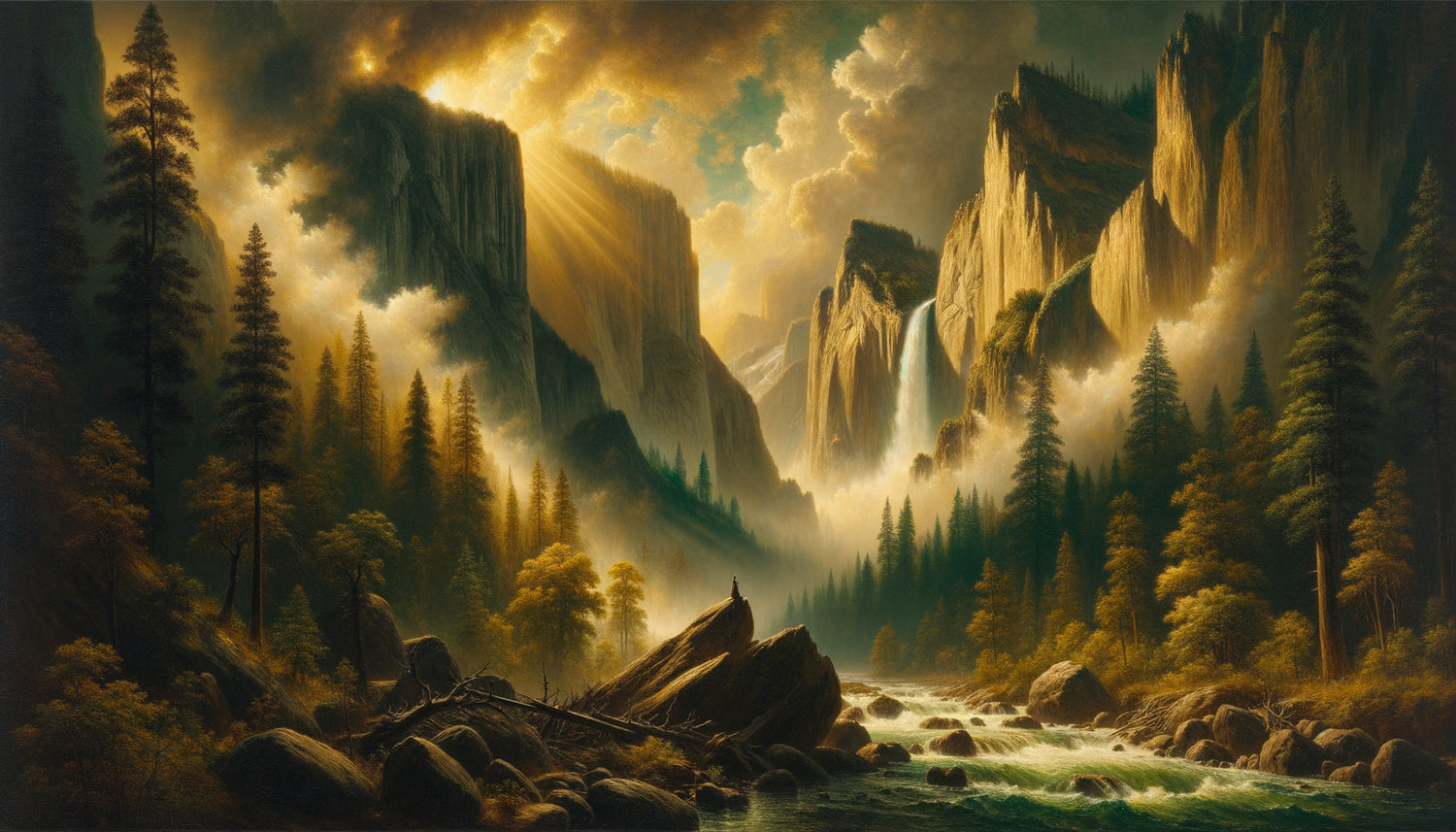
Albert Bierstadt perfectly embodied this vision. His monumental panoramas of the Rockies, often in exceptional formats exceeding two meters, transformed wild landscapes into territorial promises. The dramatic light that illuminated these scenes was not merely a pictorial effect: it was divine blessing on American expansion.
Frederic Edwin Church went even further. His spectacular compositions, such as 'Heart of the Andes,' attracted entire crowds, exhibited like quasi-religious events. Spectators paid to see these visions of pristine nature in darkened rooms, creating a quasi-mystical experience. The wilderness became a mobile sanctuary.

When nature replaces the cathedral
19th-century America was experiencing a fascinating spiritual transformation. Emerson and Thoreau's transcendentalism proposed a religion of nature. Ralph Waldo Emerson wrote that in the woods, man regains his reason and his faith. Painters translated this philosophy visually.
Wild landscapes became sacred spaces, places of spiritual revelation without institutional dogma. Look at the canvases of Asher Durand: light filters through the trees as through vegetable stained glass windows. His primary forests are natural naves where man, minuscule, contemplates infinity.
This spiritual dimension explains the almost devotional attention paid to botanical and geological details. Each leaf, each stone, each reflection of water testified to the perfection of nature's design. Painting faithfully the wilderness was honoring creation itself. These artists were not simply landscape painters, but witnesses to divine grandeur manifested in American wilderness.
The sublime as an aesthetic experience
European theorists like Edmund Burke had defined the concept of the sublime: that sensation mixing terror and admiration for immeasurable natural forces. American landscapes offered this sublime on an unparalleled scale. The waterfalls, the dizzying canyons, the mountain storms, the millennial sequoias exceeded European imagination.
Thomas Moran, painting the Grand Canyon of Yellowstone, created compositions where human scale disappears in the face of geological immensity. His almost unreal colors – these pinks, these golds, these purples – were not exaggerations but attempts to translate the sublime experience itself. How to render the ineffable if not by intensifying the chromatic palette?
This search for the sublime also explains the obsession with dramatic atmospheric phenomena. Stormy skies, twilight lights, morning mists did not only serve the pictorial effect. They captured that moment when the wilderness reveals its transcendent power, where the viewer feels simultaneously threatened and amazed.

The paradox of preservation through image
Fascinating irony of history: by glorifying wild landscapes, these painters accelerated their disappearance. Their canvases attracted settlers, tourists, developers to these virgin territories. But paradoxically, they also created American environmental awareness.
Moran's paintings and William Henry Jackson's photographs of Yellowstone directly influenced Congress's decision to create the first national park in 1872. Images of wild landscapes became conservation arguments. If this nature deserved to be painted with such devotion, shouldn't it also be protected?
This tension between celebration and preservation still resonates today. Each wilderness painting from the 19th century documents a world disappearing. Primary forests fell under axes, indigenous nations were displaced, the railroad fragmented territories. These paintings became simultaneously celebrations and elegies, hymns to natural grandeur and testimonies of an irreversible loss.
The legacy in our contemporary interiors
This tradition from the 19th century profoundly influences our contemporary relationship with wild landscapes. Why do we hang representations of mountains, forests, endless horizons in our living spaces? We unconsciously perpetuate this quest for connection with the wilderness, this search for the sublime, this need to contemplate immensity.
Wild landscapes in our interiors are not mere decorations. They function as windows onto infinity, reminders of something larger than our urban daily life. They carry this legacy from the 19th century: the idea that wild nature nourishes the soul, elevates the spirit, reconnects to the essential.
This aesthetic also explains the persistent popularity of landscape style in contemporary wall art. Even stylized, abstract, photographic, these landscapes activate within us this deep cultural memory. We seek in our walls what Bierstadt and Church offered their contemporaries: escape, inspiration, domesticated sublimity.
Invite the grandeur of wild landscapes into your everyday life
Discover our exclusive collection of landscape paintings that capture the spirit of these infinite horizons and transform your walls into windows onto natural immensity.
Your own connection to the wild
Now that you understand why these painters glorified wild landscapes, look differently at the natural representations around you. Each painted mountain carries this story of national identity, spiritual quest, sublime sought. Each forest depicted resonates with this transcendentalist desire for divine connection through nature.
You don't need to visit Yellowstone or Yosemite to access this experience. The genius of these 19th-century artists was precisely to make the sublime accessible, to transform immensity into domestic contemplation. By consciously choosing representations of wild landscapes for your spaces, you participate in a centuries-old tradition that affirms that wilderness nourishes something essential within us.
Let these infinite horizons enter your everyday life. Let these mountains, valleys, dramatic skies remind you that beyond urban walls there is always this primal grandeur. This is exactly what Cole, Bierstadt, Church and their contemporaries wanted: for American wilderness to continue inspiring, elevating, transcending generations.
Frequently Asked Questions
Who were the main American wilderness painters in the 19th century?
Major figures include Thomas Cole, considered the founder of the Hudson River School, the first great American art movement. Albert Bierstadt specialized in monumental panoramas of the Rockies with a characteristic dramatic light. Frederic Edwin Church created spectacular compositions inspired by his travels in South America. Thomas Moran documented the geological wonders of the West, including Yellowstone and the Grand Canyon. Asher Durand excelled in intimate forest scenes imbued with transcendentalism. These artists shared a common vision: to transform American wilderness landscapes into artistic and spiritual statements, proving that America possessed a natural heritage equal to European cultural treasures.
How to integrate the spirit of 19th-century wilderness landscapes into a modern interior?
The essence of this aesthetic rests on three timeless principles. First, prioritize representations that create visual depth: distant horizons, aerial perspectives, successive planes that open up space. Second, seek out works capturing dramatic light – stormy skies, twilight glows, luminous contrasts – which bring this sublime dimension. Third, choose generous formats that assert the presence of the landscape as a contemplative window, not merely a decorative accessory. In a clean contemporary interior, a large wild landscape creates this fascinating contrast between human minimalism and natural lushness. Combine it with natural materials – raw wood, stone, linen – to reinforce this connection to the wilderness celebrated by 19th-century masters.
Why do wild landscapes remain popular in current decor?
This enduring popularity reveals a fundamental human need that transcends eras. As our lives become more urban, digital and fragmented, representations of wild nature act as visual antidotes. They offer what 19th-century painters already promised: mental escape, spiritual connection, reminder of something larger than daily life. Neurologically, contemplating natural landscapes reduces stress and promotes attentional restoration – effects documented by contemporary research. Culturally, we inherit this transcendentalist American tradition that sacralizes virgin nature. Aesthetically, wild landscapes bring movement, depth and visual complexity into interiors often geometric. They create points of contemplation, essential visual breaths in our living spaces saturated with information and solicitations.