Twilight occupies a unique place in the romantic imagination of the 19th century. This ambiguous hour, suspended between day and night, becomes for Romantic artists much more than a simple pictorial motif: it embodies a true visual metaphor for the human soul. The landscape paintings of twilight in Romantic art translate a profound spiritual quest, where the declining light symbolizes the transitional states of existence. From incandescent red to melancholic violet, each twilight hue carries an emotional charge that Romantic painters exploit to express the inexpressible. This fascination with evening lights reveals as much the sensibility of an era as the desire of artists to capture the ephemeral and give form to the torments of the modern soul.
Twilight as a metaphor for transition and finitude
In Romantic symbolism, twilight represents above all a moment of existential transition. Artists see in it the reflection of the human condition, torn between hope and despair, life and death. Caspar David Friedrich, a major figure of German Romanticism, systematically uses these declining lights to evoke the fragility of existence. His characters often contemplate twilight horizons, their backs to the viewer, inviting meditation on finitude. This symbolism of passage is part of the Romantic philosophy that celebrates the fleeting moment, the impossibility of holding back time. The dying sun then becomes an allegory of human destiny, while the last rays of daylight symbolize the fragile hope that persists in the face of impending darkness. Landscape paintings of this period bear witness to this obsession with intermediate states, those moments when nature itself seems to hesitate before plunging into night.
The colors of twilight: a codified emotional language
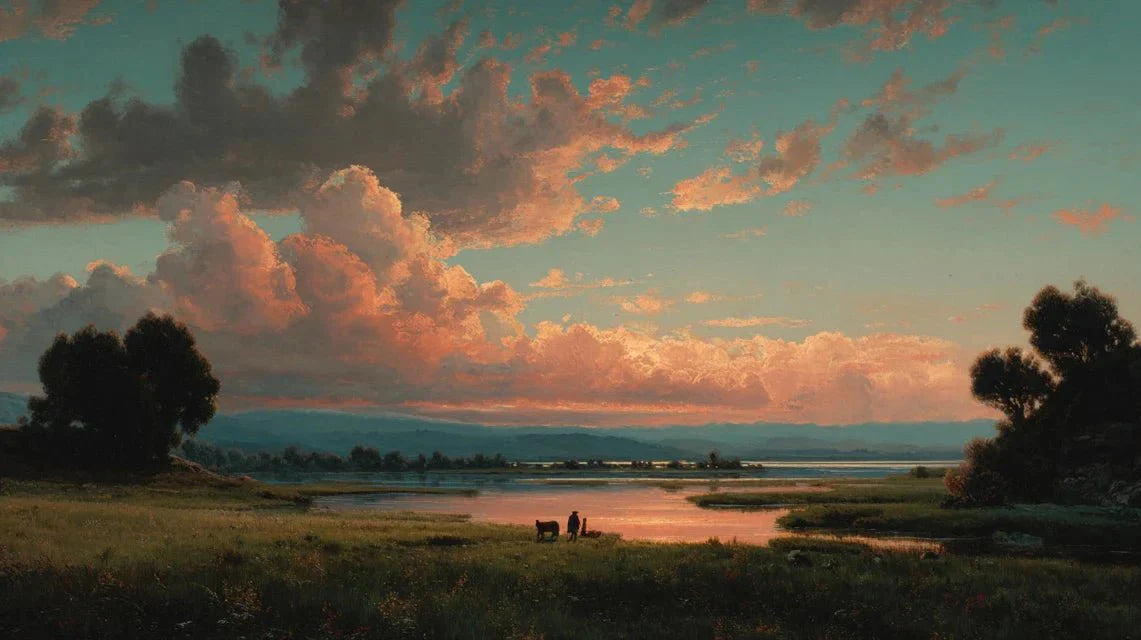
Romantic painters develop a true chromatic vocabulary around twilight, where each shade conveys a specific emotion. Blazing red evokes passion and dramatic intensity, while violets and mauves suggest melancholy and introspection. J.M.W. Turner, undisputed master of luminous atmospheres, pushes this symbolism of colors to its paroxysm in his fiery landscapes where the sky and sea merge into chromatic blazes. These pictorial choices are not simply realism: they translate complex psychological states. Artists use the subtle gradations of twilight to express:
- Nostalgia through soft oranges and pale pinks
- Existential anguish via leaden skies and dark reds
- Spiritual transcendence thanks to golden lights piercing the clouds
- The terrible sublime with violent contrasts between light and darkness
This emotional palette transforms the twilight landscape into a true mirror of romantic introspection.
Sublime Nature and Solitary Contemplation at Twilight
The representation of twilight in Romantic art is consistently accompanied by a sublime dimension, that mixed feeling of fascination and dread towards the power of nature. Romantic artists often place tiny human figures against the immensity of fiery skies, highlighting the disproportion between man and the cosmos. This aesthetics of the sublime, theorized by Edmund Burke, finds its most accomplished expression in twilight landscapes. American painters of the Hudson River School, such as Frederic Edwin Church, masterfully exploit these effects by depicting grandiose panoramas bathed in apocalyptic twilight lights. The solitude of the contemplator then becomes a key element of the composition: this solitary figure facing the twilight embodies the romantic individual seeking meaning, confronted with his own insignificance but also with his unique ability to perceive and feel the tragic beauty of the world.
Twilight as a Threshold Between Visible and Invisible Worlds
Beyond its psychological dimension, twilight in Romantic art carries a spiritual and mystical significance. This indecisive hour when outlines fade is perceived as a privileged moment when the veil between the material world and the beyond becomes thinner. Artists exploit this ambiguity to suggest immaterial presences, hidden dimensions of reality. Twilight mists, indistinct silhouettes, inexplicable lights become signs of a transcendent reality. John Atkinson Grimshaw, with his urban and rural landscapes shrouded in ghostly twilight lights, creates atmospheres charged with mystery where the everyday tips over into the strange. This esoteric dimension of twilight is part of the romantic fascination for the occult, dreams and the irrational. The moment when the sun disappears symbolically marks the entry into another mode of perception, where imagination takes precedence over reason and where the invisible becomes accessible to the sensitive soul.
Legacy and Contemporary Resonance of Twilight Symbolism
The symbolism of twilight landscapes developed by the Romantics continues to permeate contemporary artistic creation. Photographers, filmmakers, and painters today regularly reactivate these visual codes to evoke melancholy, uncertainty, or transformation. This persistence is a testament to the universal power of Romantic archetypes: twilight remains a readily recognizable symbol of transition and emotional ambivalence. Contemporary artists inherit this tradition while updating it, using evening lights to question our relationship with nature in a worrying ecological context, or to express the anxieties of an era marked by uncertainty. The persistence of these Romantic motifs in the collective imagination proves that the sensibility developed in the 19th century has lost nothing of its relevance: our twilights remain charged with the same existential questions about time, finitude and the meaning of our presence in the world.
The twilight landscapes in Romantic art are more than just a pictorial genre: they embody a worldview where nature becomes the theater of human emotions. This fusion between external landscape and inner landscape, between observation and projection, defines the very essence of Romantic sensibility. Even today, these images of setting suns and fiery skies continue to touch us deeply, proving that the Romantic quest for the absolute and beauty transcends eras and speaks to our timeless human condition.
Frequently Asked Questions
Why does twilight fascinate artists so much?
For Romantics, twilight embodies a symbolic moment of transition between light and darkness, life and death. This ambiguous hour allows for the visual expression of complex states of mind, melancholy, and spiritual quest characteristic of Romanticism. Artists see it as a perfect metaphor for the human condition and its ephemerality.
What is the significance of twilight colors in Romantic paintings?
Each twilight hue carries a codified emotional charge: fiery reds evoke dramatic passion, purples suggest melancholy, soft oranges translate nostalgia, while golden lights symbolize spiritual transcendence. These chromatic choices transform the landscape into a mirror of Romantic interiority.
Who are the main Romantic painters of twilight landscapes?
Caspar David Friedrich explores the spiritual and existential dimension of twilight, J.M.W. Turner creates spectacular luminous atmospheres, Frederic Edwin Church paints grandiose American panoramas, and John Atkinson Grimshaw develops mysterious urban and rural atmospheres. Each uses twilight to express his romantic vision of the world.