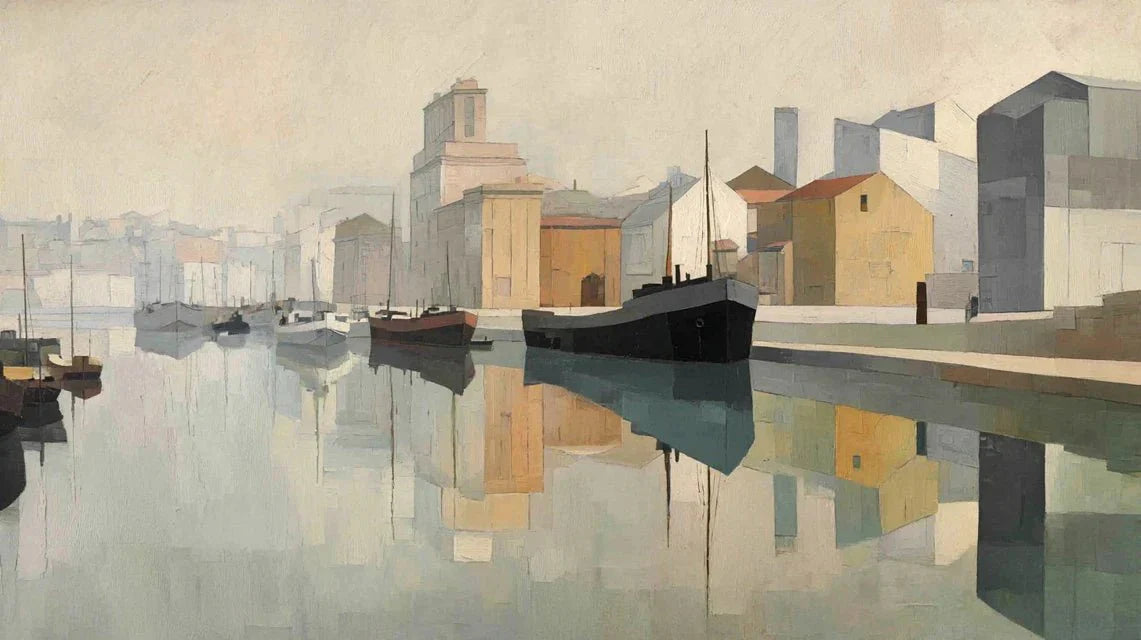
When Albert Marquet, an indefatigable traveling painter, sets up his easel in front of a port, he makes a radical selection. This Bordeaux native born in 1875 doesn't waste time on details. A silhouette? A simple dark spot. A boat? Its hull and mast, end of story. This direct approach marks all his harbor views. Marquet refuses exhaustive description. He seeks the essence, not an inventory.
He learns painting at the École des Beaux-Arts in Paris in Gustave Moreau's studio but quickly breaks away from it. From 1903 to 1937, he travels through Normandy – Le Havre, Fécamp, Rouen, Dieppe. With each journey, his vision becomes clearer. He paints from his hotel window, a bird's-eye view of the port, and captures the essentials in a few hours with his rapid touch. Colored masses replace details. Buildings become geometric blocks surrounded by a clear black line. This economy of means is immediately striking: you understand the port at a glance. The viewer needs no explanation. The structure speaks for itself.
The harbor synthesis: technique of reducing forms
This pictorial simplification doesn't happen by chance. Marquet develops a true technique over the years. He observes the port landscape for a long time, mentally notes the structuring elements, then keeps only the essentials on his canvas.
Characteristics of his method:
- Black outline defining each architectural form
- Systematic aerial view from a hotel window
- Restricted palette of grays, ochres and pink beiges
- Clearly hierarchical successive planes
- Figures reduced to simple silhouettes
A quay becomes a powerful diagonal that runs through the painting. Warehouses transform into ochre or beige rectangles. Factory chimneys rise in dark verticals piercing the sky. Simple? Absolutely not. This method requires a sharp understanding of composition and an eye trained to distinguish the accessory from the fundamental.
Marquet builds his landscapes like an architect constructs a building. Each line of force has its function in the overall balance. The successive planes overlap clearly without ever blending together. Foreground: the quay or bank that firmly anchors the scene in reality. Background: port activity with boats, cranes, figures reduced to a few signs. Background: the sketched horizon that suggests infinity without detailing it. This rigorous construction creates a striking modernity. His paintings seem painted yesterday rather than a century ago. This approach still inspires contemporary landscape paintings that seek the same strength in sobriety.
Marquet's port landscapes: composition and framing
The framing naturally extends this search for synthesis. Marquet always paints from a downward angle, from his hotel window several floors above the port. Facing the Bassin du Havre, the Pont Boieldieu in Rouen, or the docks of Fécamp, he dominates the scene. This elevated viewpoint radically changes the perception of the port landscape. The oblique lines of the quay, the diagonals of the bridges, the parallels of the basins organize space with a rigorous geometry that strongly structures the composition.
This view allows several activity zones to be embraced simultaneously: passersby on the quayside in the foreground, boats moored in the basin in the second plane, factories and warehouses beyond, and finally the sky above. Marquet creates depth without resorting to traditional perspective with its classic vanishing point. His composition remains deliberately flat, almost abstract in its organization, but the space works perfectly. The eye naturally circulates from one plane to another.
The balance of masses is immediately striking. Water generally occupies the lower half of the painting, creating a stable base. The sky and buildings share equally the upper part. This harmonious distribution creates profoundly soothing images, despite the industrial activity represented with its smoke, cranes, and incessant comings and goings. The port becomes a place of contemplation.
Chromatic simplification in Marquet's maritime landscapes
The colors follow exactly the same logic of simplification. After 1907, Marquet gradually abandons the bright hues of his Fauve period. No more intense reds, arbitrary blues from 1905-1906. Instead, a strict but infinitely nuanced chromatic range: grays, ochres, pink beiges. This restriction fully contributes to the general purification of his style. Fewer different colors, but an infinite richness in variations.
These nuanced tones perfectly translate the changing atmospheres of Norman ports. Marquet masterfully captures the mist that envelops the basins at dawn, the rain that wets the quays and makes the paving shine, heavy and cloudy skies that weigh on the roofs. His grays are never dull or monotonous. They vibrate with subtle variations – bluish grays for shaded areas, greenish grays for reflections on water, purplish grays for stormy skies. An extraordinary richness in this apparent sobriety which requires a real technical mastery of color mixing.
His pictorial matter remains remarkably fluid, almost watercolor-like in its lightness. Marquet considerably dilutes his oil colors, creating matte surfaces that gently absorb light rather than reflecting it violently. This particular texture powerfully reinforces the impression of calm, suspended time that characterizes his landscapes. Reflections on the water? A few quick touches are enough to suggest them. The water then becomes a large uniform colored plane that firmly maintains the surface plan without creating an illusion of excessive depth.
The synthesis of port elements: water, sky and architecture
Everything ultimately converges towards a perfect visual unity. Water literally obsesses Marquet in every maritime motif he approaches. This liquid element, always present, fully justifies his deep love of ports. Water brings movement with its ripples, changing reflections with the light, atmospheric variations according to the weather. It visually and symbolically connects the different parts of the painting, creating continuity between the foreground land and the distant horizon.
The sky plays an absolutely strategic role in this balance. Never dramatic clouds or flamboyant sunsets with Marquet. His skies remain uniform, slightly cloudy, creating a diffuse light that illuminates the scene without violent contrast. This equal and soft luminosity helps to maintain the perfect clarity of the composition. Sky and water constantly dialogue through similar tones, creating a chromatic unity that reinforces the cohesion of the whole.
Port architecture finally provides the indispensable geometric structure: massive warehouses, metal cranes, smoking chimneys, arched bridges. These vertical and horizontal elements strongly contrast with the fluid surfaces of water and sky. Marquet systematically treats them as defined color masses with clear outlines. No meticulously detailed windows, no brick or stone textures. Just pure volumes that exist in space like essential geometric forms.
This masterful synthesis of the three fundamental elements produces port landscapes of absolute coherence. Nothing too much, nothing too little. Each component plays precisely its role in the overall balance. Result: paintings that brilliantly capture the very essence of the port, its particular atmosphere, its unique character, without any superfluous anecdote that would distract the eye.
FAQ: Understanding Marquet's Landscapes
Why did Marquet always paint from a high window?
This bird's-eye view allowed Marquet to embrace the entire port landscape in a single glance. This elevated position naturally creates oblique and diagonal lines that powerfully structure the composition. It also offers some distance from the bustle of the port, favoring calm observation and visual synthesis.
How did Marquet obtain his nuanced grays?
Marquet perfectly mastered color mixing. His grays are never obtained by a simple black-and-white mix, but by the subtle combination of complementary colors – blues and ochres, purples and yellows – which create vibrant grays, sometimes warm, sometimes cold, depending on the light and atmosphere he wanted to render.
What is the difference between Marquet and the Impressionists in their port landscapes?
Unlike the Impressionists who fragment the touch to capture variations in light, Marquet simplifies and synthesizes. He uses blocks of color, sharp geometric shapes, and eliminates details. Where Monet multiplies colored touches, Marquet reduces to the essential with unified masses.