Ernest Chamaillard remains a discreet but essential figure in French rural realism of the late 19th century. His landscapes capture with rare sensitivity the essence of the French countryside, far from the romantic or idealized representations of his time. Originally from Anjou, this naturalist painter devoted his career to immortalizing cultivated lands, country lanes and modest horizons of inland France. His work bears witness to a sincere commitment to the truth of peasant life, where each canvas becomes a visual document of agricultural life. Through his sober and luminous compositions, Chamaillard offers an authentic look at a rural France in full mutation, between secular traditions and the first upheavals of modernity.
A realism rooted in French terroirs
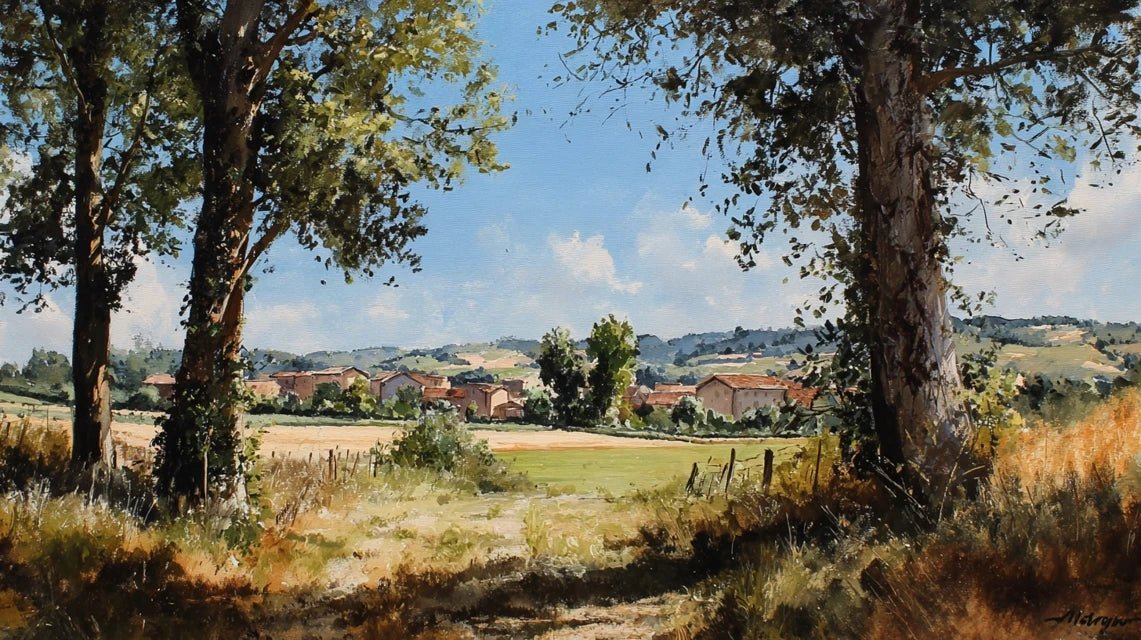
Chamaillard’s landscapes are distinguished by their topographical fidelity and rejection of theatricality. Unlike romantic landscape painters who magnified nature, Chamaillard adopts a documentary, almost ethnographic approach. His French countryside appears in its daily truth: plowed fields under a gray sky, muddy paths bordered by hedges, villages asleep at dusk. This realistic aesthetic is in line with the Barbizon School, but with particular attention paid to the regions of western France, notably Anjou and Touraine. The painter favors medium formats that allow for careful observation without grandiloquence. His palette, dominated by ochres, deep greens and subtle grays, restores the atmospheric nuances specific to the Loire region. For lovers of rural art seeking to enrich their collection, landscape paintings are a valuable source of inspiration to understand this French pictorial tradition.
Light as a signature of the countryside
In Chamaillard’s landscapes, light plays a fundamental narrative role. The painter remarkably masters the atmospheric variations of the French countryside: the misty dawn over meadows, the setting sun that lengthens the shadows of poplars, or those stormy skies announcing storms above the harvests. This luminosity reveals a patient observation of nature and its cycles. Chamaillard often works outdoors, directly confronted with the elements, which gives his paintings a striking immediacy. Backlighting effects, transparency games in foliage, silvery reflections in ponds create a discreet but deeply rooted poetry. This attention to luminous phenomena brings his work closer to the Impressionists, although he retains a more structured construction and a more affirmed drawing, faithful to the principles of rural realism.
Compositions and recurring motifs of the peasant world
Chamaillard's work is characterized by recurring rural motifs that structure his visual vocabulary. His landscapes feature a restrained compositional architecture, organized around horizontal lines that emphasize the extent of cultivated land. The following elements constitute his preferred repertoire:
- Rural paths winding between hedgerows and leading the eye to the horizon
- Isolated trees (oaks, poplars) serving as vertical anchor points in the composition
- Haystacks arranged in fields after harvest, witnesses of agricultural work
- Peasant silhouettes discreetly integrated, never idealized but present as an integral part of the landscape
- Rural architectures: barns, mills, village steeples punctuating the horizon
These French countryside motifs are never treated in a trivial manner but participate in a global vision where man and earth form an inseparable whole. Chamaillard avoids easy picturesque scenes to favor a stripped-down authenticity.
A color palette at the service of realism
Chamaillard's palette visually translates his attachment to rural realism. His landscapes banish garish colors in favor of a harmony of muted and natural tones. Cultivated lands are expressed in warm browns and ochres, meadows in deep greens nuanced with yellows, while skies display a range of bluish grays and creamy whites. This chromatic restraint never engenders monotony thanks to the subtlety of tonal transitions. The painter works in successive layers, creating a rich pictorial texture that captures light in a complex way. The touches are precise but not smoothed, preserving a liveliness of execution that testifies to his direct observation. This colored approach definitively anchors his French landscapes within a specific temporality, that of a pre-industrial agricultural France where natural rhythms still dictate collective existence.
Legacy and posterity of Chamaillard's gaze
Although less celebrated than his contemporaries Millet or Breton, Chamaillard bequeathed an authentic vision of the French rural landscapes that still influences our perception of the 19th-century countryside today. His rejection of spectacle and his attention to daily details make his paintings precious historical documents on the spatial organization of terroirs, agricultural practices, and rural planning of his time. Collectors and art historians are gradually rediscovering the importance of his work in the development of French realism. His landscapes resonate particularly well in our era when ecological issues and the valorization of rural heritage regain a burning relevance. The sincerity of his gaze, devoid of nostalgia as much as explicit social criticism, offers a sober testimony to a world in transition. This poetry of rural daily life, captured with accuracy and sensitivity, constitutes Chamaillard's essential contribution to the history of French landscape painting.
Conclusion
Chamaillard’s landscapes embody a sincere and rigorous approach to rural realism, far from spectacular effects. His patient gaze at the French countryside has produced a coherent body of work where each painting bears witness to attentive observation and accomplished technical mastery. Between documentation and poetry, his compositions offer privileged access to agricultural France at the turn of the century, capturing with accuracy the light, colors, and atmosphere of terroirs transformed today. Chamaillard thus remains an essential passer-on of this landscape memory.
Questions frequentes
Who was Ernest Chamaillard ?
Ernest Chamaillard (1862-1930) was a French painter specializing in rural landscapes. Originally from Anjou, he devoted his work to the realistic representation of the French countryside, particularly that of the West. His style is rooted in the naturalist tradition, favoring direct observation and topographical fidelity to daily agricultural scenes.
What characterizes Chamaillard’s rural realism ?
Chamaillard's rural realism is characterized by its rejection of idealization and its attention to the daily details of the countryside. He favors a subdued palette, structured horizontal compositions, and naturalistic light. His landscapes faithfully document the organization of terroirs, agricultural practices, and rural architecture of 19th-century France, without excessive picturesque qualities.
Where can one see Chamaillard’s works today ?
Chamaillard's works are mainly preserved in regional museums in Western France, particularly in Anjou and Touraine. Some paintings also appear in private collections and during specialized auctions of 19th-century painting. His gradual rediscovery is the subject of thematic exhibitions dedicated to French rural realism.