Albert Lebourg embodies a unique vision of French Impressionism, far from the Parisian crowds and riverside cafes. This Rouen painter dedicated his life to capturing the changing light of the Norman estuaries, these spaces where the river meets the sea in a perpetual dance of reflections and mists. His canvases breathe with authentic Normandy, that of fluvial ports, misty banks, and shifting skies. Between 1870 and 1920, Lebourg developed a unique pictorial language, made up of delicate touches and subtle tones, transforming the landscapes of the Seine estuary into veritable visual poems. His work bears witness to a deep fascination for these amphibious territories where nature reveals its most fleeting beauty.
Lebourg's Norman Impressionism: A Regional Artistic Identity
Albert Lebourg is part of this tradition of 'Norman Impressionism' which is distinguished by its attachment to local landscapes and their particular atmosphere. Born in Montfort-sur-Risle in 1849, he grew up in direct contact with the Seine and its tributaries. Unlike Parisian Impressionists who sought modern leisure activities, Lebourg favors the natural scenes of the estuaries, these transition zones where freshwater mixes with saltwater. His canvases capture the infinite variations of Norman light, this particular clarity that filters through low clouds. The landscapes of Lebourg are characterized by a color palette dominated by grays, silvery blues and delicate pinks. His light brushstrokes create a vaporous texture that perfectly evokes the ambient humidity of the Seine banks. This sensitive approach makes him an undisputed master of representing estuarine atmospheres, a pictorial territory he explored with remarkable constancy throughout his career.
The Estuaries in Lebourg's Work: Geography of a Passion
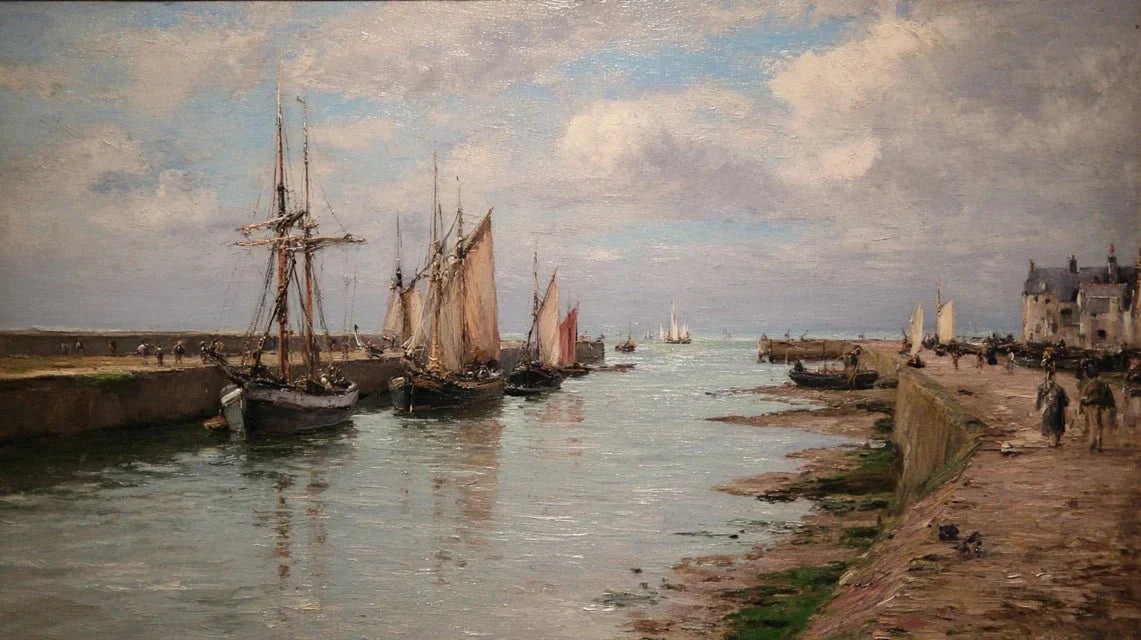
The Seine estuary constitutes Albert Lebourg's favorite terrain, a motif that he revisits tirelessly under all its facets. From Rouen to Honfleur, passing through La Bouille and Duclair, the painter travels these shores to grasp their multiple expressions. His compositions show an intimate understanding of these estuarine landscapes: the progressive widening of the river, the islands that emerge at low tide, the anchored boats gently swaying. For lovers of these aquatic atmospheres, landscape paintings allow to explore this impressionistic vision of fluvial territories. Lebourg excels particularly in representing morning mist effects, when outlines dissolve and only ghostly silhouettes of sailboats and poplars remain. His views of the estuary bear witness to a meticulous observation of natural phenomena: the reflection of light on the water, the shifting reflections of clouds, the chromatic transitions from sky to dusk. This pictorial geography reveals an artist deeply rooted in his territory, capable of transforming the most familiar places into scenes of ethereal beauty.
Technique and palette: the luminous signature of Lebourg
Albert Lebourg's pictorial technique reveals an exceptional mastery of color and light applied to Norman landscapes. His approach is distinguished by several essential characteristics that define his Impressionistic estuaries. His chromatic palette favors cool, silvery tones, perfectly suited to the humid atmosphere of Normandy. Soft greens, delicate mauves dominate his compositions, creating this recognizable vaporous ambiance. Lebourg uses divided touches but less systematically than Monet or Pissarro, preferring a more fluid application that suggests the movement of water and wind. His Seine estuary landscapes often feature a marked horizontal construction, with parallel bands that structure space: the sky, the distant hills, the river, the bank. The key elements of his technique include:
- Subtle chromatic transitions that create atmospheric depth without brutal contrast
- A light and transparent touch which sometimes reveals the canvas, reinforcing the impression of luminosity
- Aquatic reflections treated with delicacy, where forms dissolve into colored undulations
- A balanced spatial construction that guides the eye from the foreground to the distant horizon
This technical approach makes Lebourg a subtle colorist, capable of rendering the infinite nuances of Norman light on the moving waters of estuaries.
Recurring motifs: architecture of estuarine landscapes
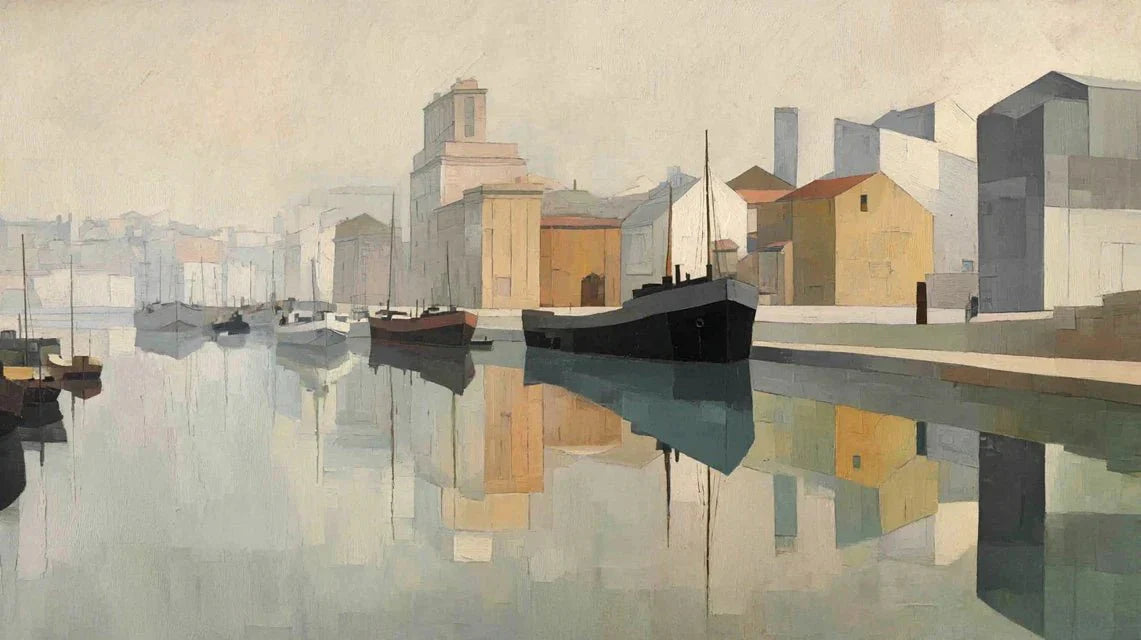
Lebourg's landscapes revolve around recurring motifs that constitute his personal visual vocabulary. Sailboats and fishing boats appear frequently, their slender masts creating verticals that counterbalance the horizontality of the compositions. These vessels are never anecdotal: they embody human activity in harmony with nature. Bridges are another major element, notably the Rouen bridge which he paints many times, a symbol of industrial modernity integrated into the Norman landscape. The aligned poplars along the banks offer characteristic vertical rhythms, while the vegetated islets of the river create essential intermediate planes for spatial depth. Urban architecture sometimes appears in the background – steeples, houses along the Seine – but always subordinate to the dominant natural element. This recurrence of motifs never leads to monotony: each estuary view offers a unique atmospheric variation, depending on the time, season and weather conditions. Lebourg thus demonstrates that a limited territory can offer an infinity of pictorial subjects, provided one knows how to observe the perpetual transformations of light.
Lebourg's legacy in landscape painting
Albert Lebourg’s influence on Impressionist landscape painting extends far beyond the borders of Normandy. His sensitive approach to estuaries opened a path for painters attached to regional territories, proving that one could develop an authentic pictorial language without necessarily joining Parisian circles. His ability to capture fleeting atmospheres still inspires contemporary artists working on river and maritime landscapes. Lebourg also contributed to artistically valuing Normandy beyond the cliffs of Étretat and the beaches of Deauville, revealing the discreet beauty of often-neglected estuarine areas. His work bears witness to a certain modernity in his gradual abstraction of forms, foreshadowing the research of the early 20th century. Collectors and institutions now recognize the exceptional quality of his Norman landscapes, which offer a poetic and authentic vision of a territory in transformation. This late but solid recognition confirms that Lebourg fully deserves his place among the masters of French Impressionism, as a discreet poet of estuaries and an incomparable observer of light reflections on water.
Lebourg’s landscapes constitute an artistic corpus of remarkable coherence, entirely dedicated to celebrating Norman estuaries. His singular Impressionism, made of subtle chromaticism and atmospheric sensitivity, continues to fascinate by its ability to transform familiar scenes into moments of pure visual poetry. Albert Lebourg reminds us that the greatness of an artist is not measured by the diversity of his subjects, but by the depth of his gaze on a beloved territory constantly reinvented by light.
Frequently Asked Questions
What are Lebourg’s preferred locations in his estuary landscapes?
Albert Lebourg mainly paints the Seine estuary, from Rouen to Honfleur. His favorite places include La Bouille, Duclair, the quays of Rouen and the banks between the city and the mouth. He particularly likes areas where the river gradually widens, offering these characteristic atmospheric perspectives in his work.
How can you recognize a Lebourg landscape among other Impressionists?
Lebourg’s landscapes are distinguished by their silvery palette dominated by bluish grays, delicate pinks and soft greens. His touch is more fluid than Monet's, creating a characteristic vaporous atmosphere. The composition favors horizontal formats with clearly defined successive planes and a marked presence of the aquatic element.
Why is Lebourg considered a master of Norman Impressionism?
Lebourg embodies Norman Impressionism through his exclusive attachment to regional landscapes, particularly the estuaries of the Seine. Unlike Parisian Impressionists, he developed a pictorial language specific to the Norman light and the humid atmospheres of the riverbanks, thus creating an artistic identity deeply rooted in his territory of origin.