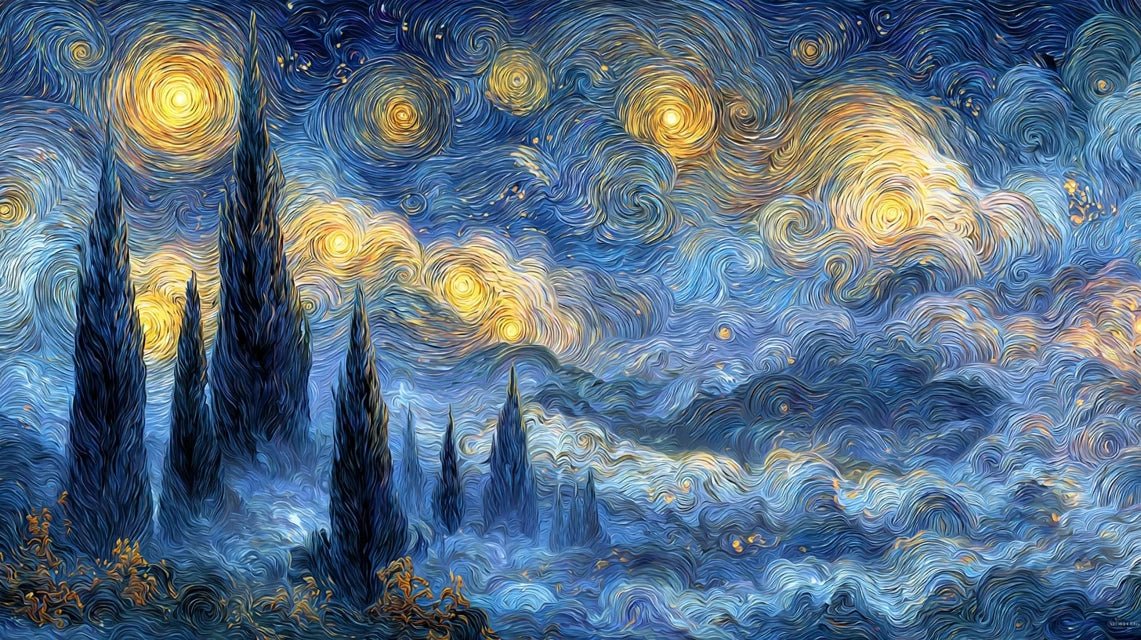
Imagine yourself standing before a Van Gogh painting. You see a sky swirling, stars dancing like living flames. It's not just a landscape; it’s a painted prayer. In the history of Western art, nature has always been much more than just a backdrop. The mystical landscapes of Christian art embody this spiritual quest where each tree, each ray of light becomes a sacred language, a gateway to the invisible. This sacred dimension transforms religious painting into a space of contemplation accessible to all.
Mystical landscapes in Christian art: nature and transcendence
Vincent van Gogh dreamed of becoming a pastor before taking up his brushes. This spiritual vocation never left him; it simply transformed. His swirling skies and cypress trees reaching for the stars tell this quest: to connect earth to sky, to make the landscape a bridge between humanity and the divine. The artist created what he called a "new religion" where nature consoles, soothes, elevates, offering a true mystical experience through painting.
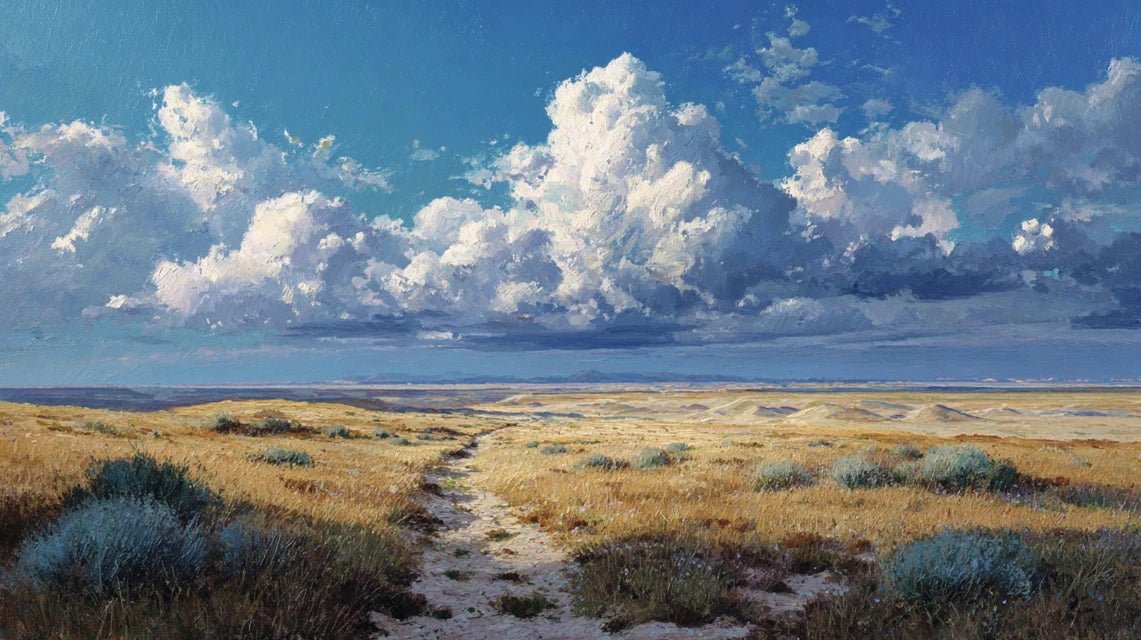
Other painters followed this mystical path. Lawren S. Harris and Emily Carr transformed the vast landscapes of Canada into spaces of silent contemplation. Harris simply expressed it: "When one is moved by beauty, it is the soul that is awakened." Paul Gauguin integrated Christian symbols into the Breton countryside, transforming an ordinary village into a theater of divine revelation. These artists shared a conviction: the landscape is never just a landscape; it’s always an authentic spiritual experience.
Symbolism of nature in Christian landscapes
Take a cypress tree in a Van Gogh painting. It's not just a tree. It's a cosmic pillar connecting our earthly world to the infinite sky. Baudelaire understood it: nature is a temple where man walks through a forest of symbols. In Christian art, every natural element speaks a coded language that traditional iconography allows us to decipher.
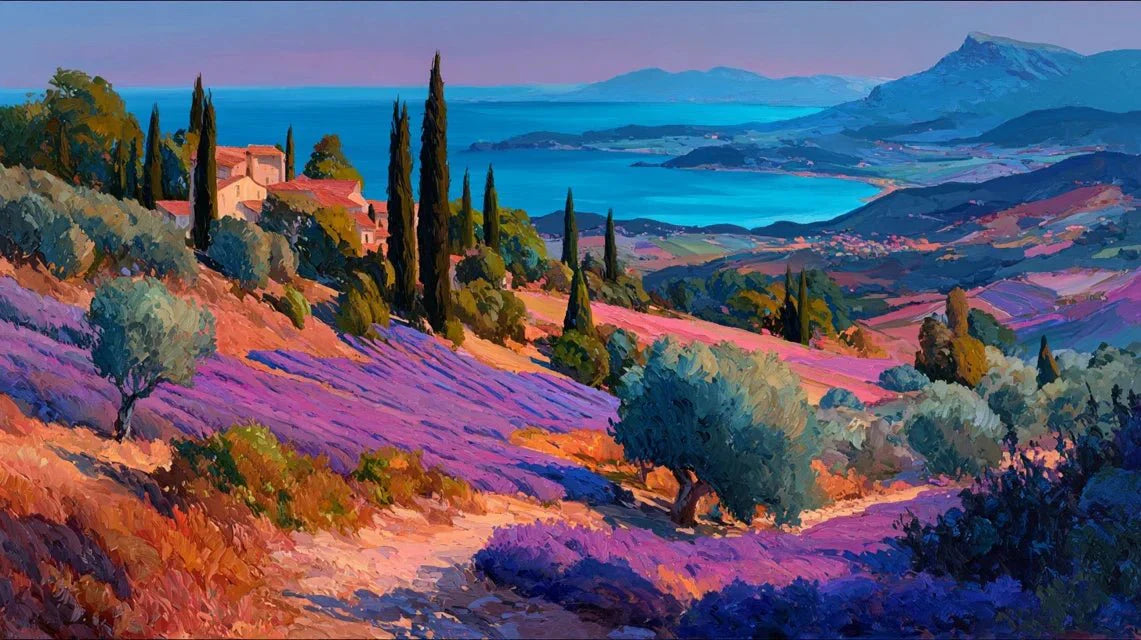
Symbolists like Alphonse Osbert perfected this art of Christian symbolism. In their works, a simple luminous horizon evokes the beyond. A winding path tells the journey of the soul towards perfection. Light itself becomes divine, as in starry nights where each star symbolizes infinity and the perfection of God.
These landscapes use a recurring visual vocabulary:
- The sacred trees that rise vertically towards the sky
- The luminous horizons that promise infinity
- The turbulent skies where the Spirit blows
- The winding paths that invite inner pilgrimage
To discover how these traditions are perpetuated today, explore the landscape paintings that keep this sacred dimension alive.
Techniques for representing Christian mystical landscapes
How to paint the invisible? Artists of religious painting invented techniques to meet this challenge. Giovanni Segantini and Giuseppe Pellizza da Volpedo used divisionism: thousands of colored points that, seen from afar, create a luminous vibration almost supernatural. Their nature seems to breathe, palpitate with an inner life conducive to contemplation.
Van Gogh went even further. He wrote to his brother: "I have a terrible need for religion so I go out at night to paint stars." His thick impastos, his screaming colors transform each brushstroke into an act of faith. Look at his paintings: the painting is so thick that it almost sculpts light. It's an immersive technique designed to give the viewer the same mystical experience as the artist experienced in front of the subject.
Russian iconography offered another solution with its reversed perspective. Instead of fleeing towards a distant point, lines converge towards you, spectator. You no longer observe the landscape from the outside; you are invited to enter it, to meditate on it in a space where Christian symbolism takes full measure.
Mystical landscapes: divine light in Christian nature
Light is the star of Christian mystical landscapes. Claude Monet understood this when he tirelessly painted his haystacks at different hours of the day. Each variation of light revealed a different aspect of the sacred, inviting contemplation of natural phenomena.
Think of the stained glass windows of Gothic cathedrals. Sunlight streams through the colored panes and suddenly, the stone interior becomes a celestial kingdom. Painters sought to recreate this magic on their canvases. In Van Gogh's "The Sower," the huge yellow sun resembles a giant halo that sanctifies the work of the peasant. The everyday becomes sacred under this golden light, perfectly embodying the sacred dimension of religious painting.
Charles-Marie Dulac pushed this exploration towards the universal. His starry nights and galactic visions transcend the borders of a particular religion. They lead us to a spiritually expressive cosmos, giving the keys to see beyond appearances.
Nature and spirituality: the mystical elements of Christian landscapes
Stars, the cosmos, the immensity of nature... In Christian mystical landscapes, these elements are not mere decorations. They are transcendent forces that call us, draw us towards something greater. Kandinsky spoke of "seeking the internal in the external." That's exactly it: to see in a tree, a mountain, a starry sky the presence of the divine, creating a mystical experience accessible to everyone.
The Nabis loved to paint sacred woods, these mysterious forests where one can meditate far from the noise of the world. These places inherited from pagan and Christian traditions become natural temples. Baudelaire called them vegetable cathedrals where man meets God directly, without intermediaries, in an act of pure contemplation.
At the beginning of the 20th century, a revolution took place. It was discovered that the Universe is infinite, constantly expanding. This scientific revelation joins the spiritual quest. Canadian artists like Lawren Harris transform their Nordic landscapes into spaces of absolute revelation. In the glacial silence of the North, in the rigor of nature, they find total spiritual purity where Christian symbolism expresses itself forcefully.
This tradition continues today. Landscapes remain powerful vectors of mystical experience in contemporary Christian art, proving that the thirst for transcendence and the sacred dimension of religious painting are timeless.
FAQ: Mystical landscapes and Christian art
What is a mystical landscape in Christian art?A mystical landscape in Christian art is a representation of nature that goes beyond simple imitation of reality to express a spiritual dimension. These works use natural elements (trees, skies, light) as symbols of the divine and invite contemplative experience. Artists like Van Gogh, Gauguin or the symbolists transformed landscapes into spaces of meditation where the visible reveals the invisible. What are the most frequent natural symbols in Christian mystical landscapes?
Cypresses symbolize the link between earth and sky, luminous horizons evoke the afterlife, starry skies represent divine infinity, and winding paths illustrate the soul's spiritual journey. Light itself becomes a symbol of the divine presence, as in Van Gogh's starry nights where each star embodies perfection and eternity. How do artists create this spiritual dimension in their landscapes?
Artists use specific techniques: divisionism to create a supernatural luminous vibration, thick impasto and expressive colors to transform each brushstroke into an act of faith, or even reversed perspective to invite the viewer to enter the contemplative space. The goal is to live through an authentic mystical experience rather than simply representing a place.