Imagine a painter before their easel, facing a field of wheat swept by the wind. They are not seeking to reproduce what they see. They want to capture something deeper: that emotion that constricts the throat when the evening light transforms the landscape into a cathedral. This is precisely the quest undertaken by artists of post-impressionism such as Van Gogh, Monet or Gauguin at the end of the 19th century.
Nature and spirituality in Christian landscapes
The landscape never lies. Since time immemorial, nature has told believers the story of the divine. In the Bible, God speaks to Moses in a bush of fire, to Abraham under a majestic oak tree. Centuries later, modern painters take up this sacred thread to create a renewed sacred art.
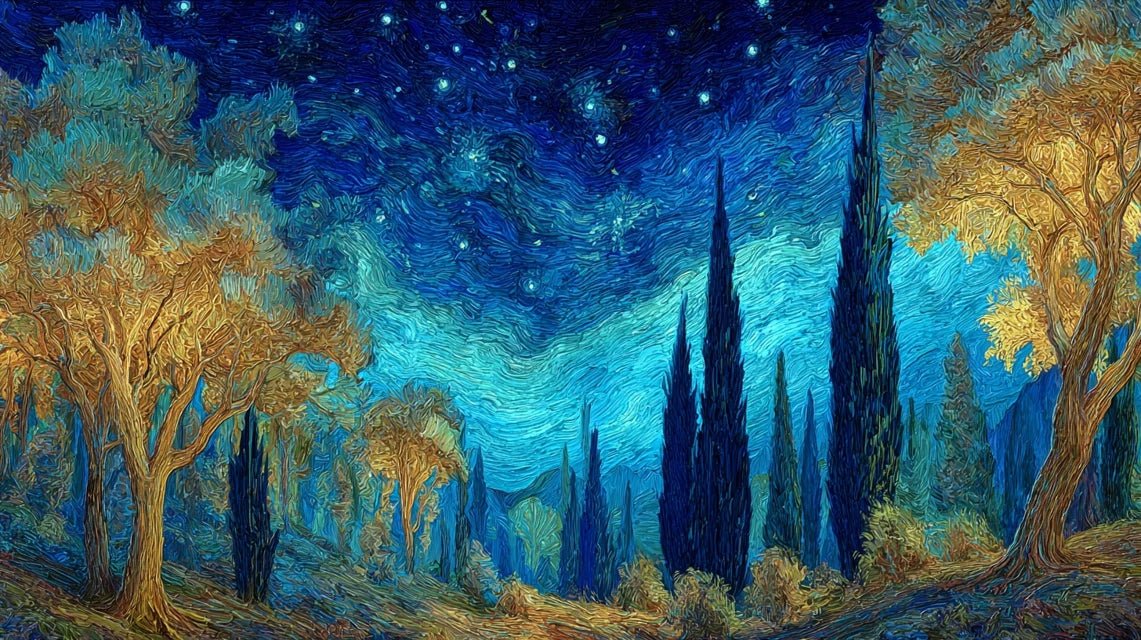
Van Gogh transforms his 1889 Olive Trees into spiritual witnesses. His twisted cypresses are not mere trees; they are prayers petrified in paint. He writes to his brother that he dreams of a "new religion" capable of consoling souls. In his canvases, man and nature merge in a disturbing cosmic unity.
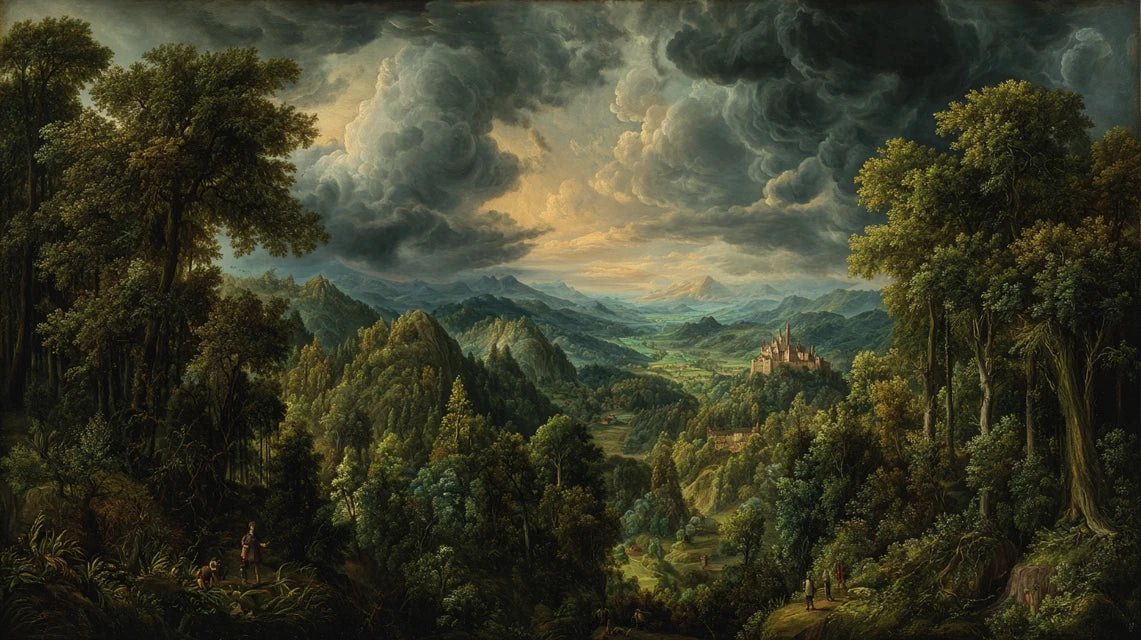
The Nabis, this group of visionary artists from the 1890s, painted forests resembling temples. Their woods are not decorations but places of meditation. As Baudelaire wrote, nature becomes that temple where man walks through a forest of living symbols.
If these landscapes full of meaning touch you, explore this collection of landscape paintings which perpetuates this mystical tradition.
Mystical Landscapes: Light as Spiritual Expression
With Monet, everything begins with light. His Haystacks do not show simple stacks of hay. They become visual meditations that transform the viewer into true contemplation. The philosopher Kandinsky analyzed the emotional power of these canvases capable of provoking inner elevation.
Van Gogh's Starry Night pushes this quest to its paroxysm. Painted from the Saint-Rémy asylum in 1889, it concentrates all his anguish and all his hope. The sky swirls like a cosmic prayer. The black cypress shoots like a flame towards the stars. Each touch of color vibrates with spiritual intensity.
The divisionists take another path. Segantini and Pellizza da Volpedo decompose light into thousands of colored points. The result? Landscapes where the divine seems to emanate from every particle of creation. Faced with the immensity of nature, man rediscovers that humility which nourishes all true spirituality.
Symbolism of Trees and Nature in Christian Art
The tree tells sacred stories. From the Tree of Life in paradise to the Cross, vegetation connects earth to sky. Mystical painters reactivate these ancestral symbols with a new power, creating a true religious symbolism.
The oak embodies divine majesty. Abraham receives his visions near an oak tree. Saint Louis renders justice under its protective shade. In landscapes, it becomes:
- Symbol of unwavering faith
- Bridge between human and divine
- Guardian of eternal wisdom
- Witness to celestial revelations
The cypress fascinates Van Gogh. He paints it as a dark flame piercing the sky. A tree of Mediterranean cemeteries, it transforms under his brush into a sign of the soul's immortality.
The olive tree carries peace. Since the dove of Noah brought back its branch, it evokes reconciliation between God and men. Gauguin represents it in his Christ in the Olive Garden, blending Christian tradition and personal vision in a landscape that becomes an intimate confession.
Nocturnal landscapes and cosmic spirituality in art
The night reveals more than it hides. For Van Gogh, the starry sky opens the doors to an inner revelation. His nights are never black. They vibrate with invisible cosmic forces during the day.
Canadian painters Lawren Harris and Emily Carr extend this vision in the 1920s. Harris simply affirms it: "When beauty moves us, it is the soul that awakens." Their landscapes of the Far North become spaces of pure contemplation, where nature joins the cosmos.
The Wheatfield with Crows shows the other face of the mystic. Painted by Van Gogh shortly before his death in 1890, it expresses anguish at the great mystery. The blackbirds swoop down on us. The colors crush the gaze. The mystical landscape is not always soothing. Sometimes it's a brutal confrontation with the ineffable.
Sacred nature: pictorial techniques of mystical landscapes
How to paint the invisible? Van Gogh invents black outlining that gives forms a visionary presence, a technique that will inspire German expressionism. His thick strokes affirm the pictorial matter while expressing the immaterial. Each brushstroke becomes a ritual gesture, a silent prayer.
Colors are freed from conventions. Yellow can express anguish as well as light. Blue shifts from serenity to metaphysical unease. Artists create their own chromatic language in service of spiritual experience.
Symbolists like Puvis de Chavannes choose softness. They study nature as a "landscape of the soul" where the divine finds its place harmoniously. Their serene approach proves that there are a thousand paths to the mystic.
These landscapes testify to a crazy ambition: to transform the canvas into a space of revelation. More than a century after their creation, they still touch our need for beauty, meaning, transcendence. Nature and spirituality merge to create works that go beyond art and border on the sacred.
FAQ: Mystical landscapes and Christian spirituality
What is a mystical landscape in Christian art?
A mystical landscape is a representation of nature that goes beyond simple observation to express a spiritual experience. In late 19th-century Christian art, painters like Van Gogh or Monet transform natural elements (trees, starry skies, fields) into symbols of transcendence and communion with the divine.
Why is Van Gogh considered a mystical painter?
Van Gogh sought to create a "new religion" through his painting. His landscapes do not reproduce reality but express a cosmic feeling where humanity and nature are one. His cypresses, starry nights, and wheat fields become visual prayers charged with intense personal spirituality.
What role do trees play in the symbolism of mystical landscapes?
Trees occupy a central place as they symbolically connect the earth to the sky. The oak represents divine strength, the cypress eternity of the soul, the olive peace and reconciliation. In Christian tradition, the tree recalls both the Tree of Life from paradise and the tree of the Cross, embodying the cycle of death and resurrection.