Imagine holding a fragment of rock in your hands. On its surface, the perfect imprint of a fern 300 million years old. This fossil tells a story that art has always sought to translate: how to represent the geological time that fossilizes in our landscapes?
When stone becomes memory
Geological landscapes are open books. Each stratum, each rock layer preserves the trace of a bygone era. Fossilization transforms life into mineral archives, creating a natural photograph etched in stone. Representing this phenomenon artistically is to capture that suspended moment where the ephemeral becomes eternal.
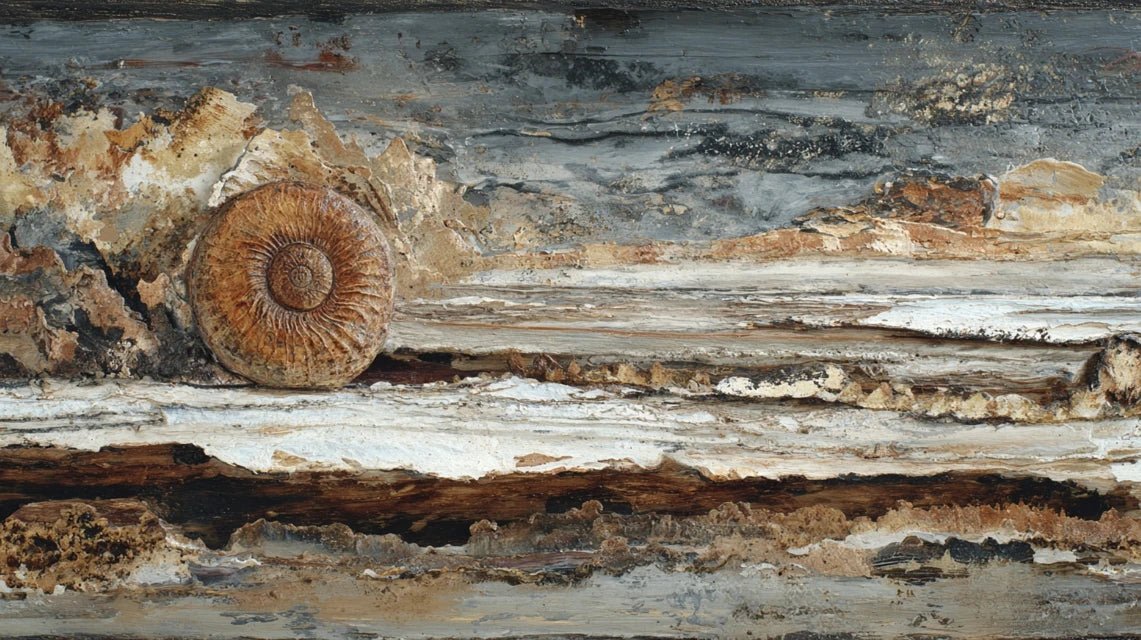
Take the example of a fossilized ammonite. This spiral shell tells of a tropical sea lost millions of years ago. In a painting, the artist must visually translate this stratified memory: each level tells a different chapter of our Earth, 4.5 billion years old (Source: International Commission on Stratigraphy). Repetitive patterns evoke strata, petrified organic forms create striking contrasts between soft and hard, between yesterday and today.
This artistic quest finds a powerful echo in contemporary creation, where artists materialize the invisible passage of eras through a true artistic stratigraphy.
Sculpting time with brushes
How to paint millions of years? Artists have developed specific techniques. The imprint, the trace, the relief become their allies. Some contemporary creators use molding to reproduce authentic fossil textures, combining sand, plaster or resin in their compositions.
The magic happens through superposition. As nature piles up sediments, the artist superimposes layers of paint:
- Successive glazes create temporal depth
- Scraping reveals buried layers (sgraffito technique)
- Mineral materials evoke progressive petrification
- The addition of fossilized organic elements creates a dialogue between art and nature
Anselm Kiefer has demonstrated this masterfully. His geological art works resemble monumental stratigraphic sections where time becomes almost palpable. To create these landscape paintings, one must think like a geologist: visually compress millions of years into a single striking image.
This approach naturally leads us to the central question: how to materialize these famous strata?
The lines of time
Have you ever contemplated the walls of the Grand Canyon? Over 1.6 kilometers deep, nearly 2 billion years of history are revealed in colored bands (Source: National Park Service). Each horizontal line represents a period of sedimentation, a frozen moment. In art, these superimposed rock layers become temporal horizons.
To translate this visual geology:
- Alternate bands of different colors and textures
- Create breaks to show tectonic upheavals
- Vary the thickness of the strata according to their formation duration
- Integrate angular discrepancies, witnesses of ancient cataclysms
The natural palette asserts itself: ferruginous ochres, intense oxidation reds, slate grays. These geological colors intrinsically carry the notion of temporal depth. The artist captures this vertiginous verticality, this feeling of falling into geological time.
But time does not simply accumulate. It sculpts, it carves, it moves.
The invisible ballet of erosion
Erosion and sedimentation work tirelessly, sculpting our landscapes grain by grain. Sedimentary processes act continuously: valleys are carved millimeter by millimeter, cliffs retreat year after year, deltas progress imperceptibly. Representing these forces is to show time in action.
The artist suggests movement through frozen lines of flow, contrasts eroded and deposited areas, uses subtle gradations to evoke progressive wear. Aerial photographs become sources of inspiration: sinuous meanders, alluvial cones, sculpted rock formations. These images reveal natural rhythms that painting amplifies and sublimates.
Textures tell their own story: roughness of aeolian abrasion, smoothness of aquatic polishing, cracks of desiccation. Each surface becomes a tactile testimony to geological time.
The color of time
How does time have a color? In geological landscapes, absolutely. Mineral hues – burnt sienna, calcined shadow, oxidized green – result from chemical reactions spanning millennia. These colors carry the memory of terrestrial transformations.
To create an authentic geological art atmosphere:
- Prioritize true natural earths
- Add mineral pigments for sensory authenticity
- Layer glazes for depth
- Integrate transparencies evoking light through rock layers
Some artists go further: they incorporate real sand, selected rock fragments. Their work becomes a micro-geological landscape itself. The mineral matter fossilizes natural elements, perpetuating the process it represents. Art thus joins geology in a fascinating dance between human creation and natural sedimentary processes.
Representing the fossilization of time in geological landscapes is ultimately creating a bridge between the infinitely slow and the instantaneous artistic, between the power of telluric forces and the sensitivity of the artist.
FAQ: Representing the fossilization of time in geological landscapes
How to visually translate geological strata in a painting?
To represent geological strata, use horizontal bands of varying colors and textures. Alternate ochres, sepia tones, and grays to evoke the different rock layers. Vary the thickness of each band according to the duration of formation it represents. Incorporate angular breaks or unconformities to show tectonic upheavals. This artistic stratigraphic technique allows you to visually materialize millions of years of geological history.
What materials should be used to evoke fossilization in a work?
To create an authentic fossilization atmosphere, prioritize natural earths such as burnt sienna, calcined shadow, and ochres. Incorporate real mineral materials: sand, rock fragments, plaster or resin. The molding technique allows you to reproduce fossil textures. Apply glazes to create temporal depth. Some artists even add fossilized organic elements to strengthen the dialogue between art and geology.
Which contemporary artists work on geological time?
Anselm Kiefer is one of the masters of representing geological time in contemporary art. His monumental works integrate raw materials evoking sedimentation and resemble stratigraphic sections. Other artists like Andy Goldsworthy explore natural processes of erosion and transformation. This approach to geological art creates a fascinating bridge between Earth sciences and artistic creation, materializing the invisible passage of eras into impactful visual compositions.