Between 1920 and 1950, while Fauvism seemed to belong to the past, some artists continued to explore this colorist path with a new maturity. Among them, painters like Félix developed a personal style that transcended the initial codes of the movement. Their Mediterranean landscapes bear witness to a fascinating evolution: that of a late Fauvism imbued with wisdom, where the initial chromatic violence gives way to a soothing harmony. The Mediterranean coasts, with their unique lights and striking contrasts, have become the ideal setting for this pictorial research. This little-known period deserves attention to understand how Fauvism continued to live and transform long after 1910.
Late Fauvism: a reinvention of the movement
Late Fauvism differs radically from the initial explosion of 1905. Where Matisse and Derain sought brutal rupture, artists of the second generation prefer a meditative approach. Félix and his contemporaries retain the bold use of pure color, but apply it with calculated restraint. The shades remain vivid, but their arrangement reveals a deep understanding of chromatic harmonies. This evolution also reflects a different context: the interwar period brings a quest for stability that is reflected in the composition of works. Landscapes no longer seek to shock, but to capture an emotional essence. For enthusiasts looking to be inspired by this colorist approach, contemporary landscape paintings offer interesting echoes of these historical research. Late Fauvism thus becomes a bridge between radical modernity and pictorial tradition.
The Mediterranean coasts as a creative laboratory
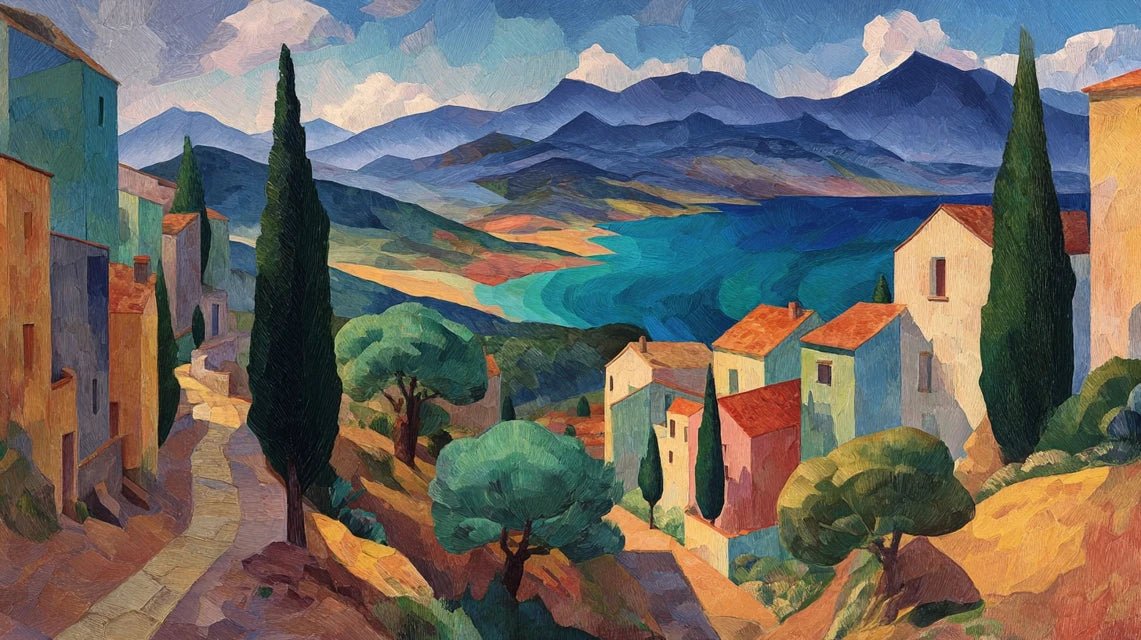
The Mediterranean exerts a constant fascination on Fauve artists. For Félix, the Mediterranean coasts represent much more than a simple motif: they constitute a veritable creative laboratory. The particular light of these shores, this intense clarity that dissolves contours and exalts colors, perfectly corresponds to the research of late Fauvism. Perched villages in Provence, rocky coves on the Côte d'Azur, fishing ports in Languedoc become recurring subjects. Félix finds an infinity of chromatic variations there: the deep blue of the sea contrasting with the ochre of the rocks, the silvery green of the olive trees playing with the pink tones of the facades. This geography also offers an architectural dimension that structures compositions, avoiding the total dissolution into color that some early Fauves had explored. Mediterranean landscapes thus become the privileged ground for a synthesis between construction and sensation.
Félix's palette: between tradition and innovation
The chromatic approach of Felix in his landscapes reveals a remarkable sophistication. His palette retains the fauve intensity while integrating more subtle nuances. We find these distinctive characteristics:
- Deep blues ranging from cobalt to ultramarine, applied in blocks to suggest the Mediterranean sea and sky
- Warm ochres declined in multiple tones to restore the Provençal land and vernacular architectures
- Bright greens ranging from emerald green to olive green, capturing the characteristic vegetation of the coasts
- Touches of pink and mauve that create harmonious transitions and evoke the evening lights
This color range is a testament to technical maturity. Felix does not simply juxtapose pure colors: he creates chromatic dialogues where each shade enhances the others. Late fauvism reaches here a form of paradoxical classicism, where color audacity serves a balanced vision.
Composition and structure in Mediterranean landscapes
The spatial construction of Felix's landscapes marks a significant evolution compared to the first fauvism. His paintings of the Mediterranean coasts reveal a particular attention to the organization of space. The vanishing lines are clearly established, guiding the gaze towards precise focal points: a village on top of a hill, a lighthouse on a promontory, a colorful boat in the foreground. This structuring never hinders chromatic freedom, but offers it a framework that reinforces the visual impact. Felix often uses a composition in successive planes: vegetation in the foreground, dwellings in the second, the sea in the background, the sky dominating everything. This approach creates a natural depth while allowing striking color contrasts between each level. Late fauvism thus affirms that chromatic audacity and compositional rigor do not oppose each other, but complement each other to produce works of lasting visual force.
The contemporary legacy of this pictorial approach
The influence of Mediterranean landscapes by Félix and the late Fauvism extends far beyond their time. Many contemporary artists draw on this tradition to nurture their own research. This lineage can be seen in the assumed use of pure color, in the rejection of photographic naturalism, in the desire to express an emotion rather than faithfully reproduce. Current art galleries bear witness to this living heritage: creators continue to explore Mediterranean coasts with a renewed Fauvist sensitivity. This continuity demonstrates that Fauvism, far from being a mere historical episode, has laid lasting foundations for thinking about the relationship between color, light and landscape. Félix and his contemporaries have thus contributed to establishing a visual grammar that remains relevant today. Their essential lesson? Color is not simply a descriptive tool, but an emotional language capable of transcending simple representation.
The landscapes of Félix embody a remarkable synthesis between the heritage of Fauvism and a personal vision matured in contact with the Mediterranean coasts. This period of late Fauvism deserves wider recognition, as it bears witness to the ability of an artistic movement to evolve and renew itself. Beyond their immediate beauty, these works invite us to reconsider our relationship with color and landscape, reminding us that art can transform our perception of the world around us.
Frequently Asked Questions
What is late Fauvism?
Late Fauvism refers to the period from the 1920s to the 1950s, during which some artists continued to explore the use of pure color characteristic of Fauvism. Unlike the initial chromatic violence of the 1905 movement, this second phase favors a more meditative and harmonious approach, while retaining the original color audacity.
Why did Mediterranean coasts inspire Fauvist artists?
The Mediterranean coasts offer intense light and natural chromatic contrasts that perfectly match the Fauvist research. The deep blue of the sea, the ochre of the land, the green of the vegetation and the warm tones of local architecture create a natural palette ideal for color experimentation sought by these artists in their compositions.
How to recognize a landscape of late Fauvism?
A landscape of late Fauvism is characterized by the use of pure colors but harmoniously arranged, a structured composition with clearly defined planes, and a less radical approach than early Fauvism. The works retain chromatic intensity while prioritizing balance and serenity, often with recurring Mediterranean subjects such as perched villages or ports.