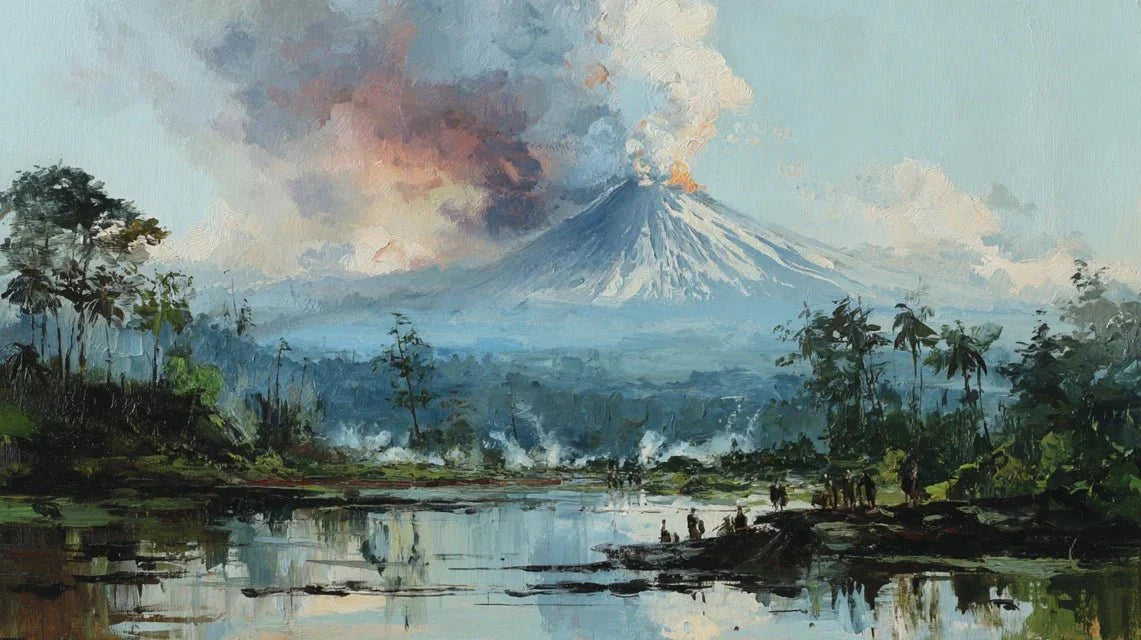
The volcanic landscape painting represents one of the most fascinating and intense artistic challenges. Capturing the fury of a volcanic eruption, the viscous texture of molten lava, or even the majestic desolation of a cooled lava field requires a deep understanding of contrasts and textures. Artists who venture into this theme do not merely reproduce a landscape: they attempt to transcribe the heat, movement, and raw energy emanating from these spectacular geological phenomena. Between scientific fascination and aesthetic emotion, painting volcanic activity is an exercise that pushes the limits of pictorial representation.
The chromatic palette of fire and earth
Painting lava landscapes begins with exceptional mastery of warm colors. The incandescent red, the bright orange, the dazzling yellow and even the blinding white of molten lava create a unique chromatic spectrum. Artists must understand how these shades interact with the deep blacks of cooled basaltic rock and the ashen grays of volcanic clouds. This juxtaposition creates a dramatic contrast that defines the very essence of volcanic art. For enthusiasts looking for inspiration, landscape paintings offer a rich source of exploration of these chromatic techniques. Masters of this genre know that the color of lava varies with its temperature: from dark red to bright yellow when it reaches 1200°C. This scientific knowledge considerably enriches the credibility and visual impact of the final work.
Capturing the movement of molten lava
The major challenge in volcanic activity painting lies in representing movement. Flowing lava is not static: it undulates, forms incandescent rivers, creates cascades of fire and solidifies into tortured formations. Artists use various techniques to translate this dynamism: directional brushstrokes following the flow of lava, superimposed glazes to suggest the depth and transparency of molten material, or even projection of pigments to evoke volcanic splashes. Some contemporary painters experiment with thick mediums such as acrylic modeling paste or textured gels to create a tangible volcanic relief on the canvas. This three-dimensional approach adds a tactile dimension that reinforces the impression of heat and viscosity. The movement must be perceptible even in a frozen image, creating visual tension that captivates the eye.
Incandescent light as a dramatic source
Lighting in volcanic landscapes follows unique rules. Unlike traditional landscapes where light comes from the sun or moon, here the lava itself becomes a source of light. This inversion creates spectacular lighting effects: glowing shadows, orange reflections on surrounding rocks, and an overall atmosphere saturated with radiance. Artists must understand how this internal light illuminates the scene in an unconventional way. Key elements to master include:
- The luminous halo: the diffusion of light around active lava flows
- Reflections on metallic surfaces: how lava illuminates surrounding minerals
- Extreme contrast: areas of absolute shadow against zones of intense light
- Smoke and gases: how they filter and diffuse volcanic light
- The nocturnal atmosphere: lava becomes more visible and dramatic in the dark
This understanding of multiple light sources transforms a simple representation into an immersive and memorable visual experience.
Volcanic textures: from liquid to solid
Textures in volcanic art offer unparalleled richness. The same landscape can present the bright fluidity of fresh lava, the cracked crust of cooling lava, and the porous roughness of solidified basalt rock. Experienced artists develop a varied gestural vocabulary to represent these different materials. For liquid lava, smooth and flowing brushstrokes evoke viscosity. For cooled formations, techniques such as rubbing, scraping or using palette knives create rough and authentic surfaces. Some painters even incorporate real materials like volcanic sand or pumice powder into their pigments to obtain an authentic volcanic texture. This mixed approach creates works that invite touch as much as contemplation, reinforcing the overall sensory experience of the viewer facing these extraordinary landscapes.
The atmosphere and scale of volcanic phenomena
Representing the monumental scale of volcanoes is a major artistic challenge. A volcanic eruption is a phenomenon that exceeds human understanding due to its power and dimensions. Artists use several strategies to communicate this grandeur: including tiny human silhouettes to establish a reference scale, employing dramatic bird's-eye or worm's-eye perspectives, and creating a dense volcanic atmosphere with smoke, ash, and vapors. Pyroclastic flows, these pyroclastic clouds that rush down the volcano's flanks, add a dimension of horizontal movement that contrasts with the verticality of the eruptive column. The representation of the atmosphere charged with volcanic particles also creates a diffuse and dramatic quality of light, tinted orange, red or gray depending on the intensity of activity. This particular atmosphere immediately distinguishes volcanic landscapes from any other form of natural landscape and gives them a powerful and instantly recognizable visual identity.
The painting of volcanic landscapes remains a demanding artistic genre that combines scientific knowledge, aesthetic sensitivity and technical mastery. Artists who dedicate themselves to it create works that capture the terrifying beauty of our planet in motion. Between chaos and creation, destruction and renewal, these paintings bear witness to humanity's eternal fascination with the primordial forces that have shaped our world. Each canvas becomes a tribute to the raw power of nature and our ability to transform this violence into contemplative beauty.
Frequently Asked Questions
What colors should be used to paint molten lava?
To represent molten lava realistically, prioritize a palette of deep reds, vibrant oranges, bright yellows and whites for the hottest areas. Add blacks and grays for the cooled rocks. The temperature of the lava influences its color: dark red for 700°C, orange-yellow for 1000°C, and white-yellow for 1200°C and above.
How to create the effect of movement of lava on a canvas?
To suggest the movement of lava, use directional brushstrokes that follow the natural flow of the stream. Glazes layered on top of each other create depth and transparency, while thick mediums such as acrylic gels add relief. Vary the thickness of the paint: thin for fluid lava, thick for viscous lava that solidifies.
What technique allows to represent volcanic light?
Volcanic light is unique because the lava itself becomes a source of light. Work by contrast creating deep shadows against incandescent areas. Add luminous halos around active flows and orange reflections on surrounding surfaces. Paint on a dark background to accentuate the dramatic effect of this internal light.