Louis Anquetin remains one of the most fascinating pioneers of cloisonnism, this pictorial movement that revolutionized the representation of landscapes at the end of the 19th century. Contemporary of Toulouse-Lautrec and close collaborator of Émile Bernard, Anquetin was able to develop a unique approach to landscape where outlined contours and color synthesis transform nature into bold compositions. His cloisonnist landscapes are characterized by areas of bright colors delimited by dark lines, creating works that oscillate between naturalist observation and decorative stylization. This aesthetic research, although brief in his career, has profoundly marked the evolution of modern painting and continues to inspire lovers of contemporary art.
Anquetin's cloisonnism: a revolution in landscape
The cloisonnism takes its name from the cloisonné technique used in enamelling, where metal partitions separate the different color areas. Anquetin applies this principle to his landscapes, creating compositions where each natural element is delimited by a black or dark brown contour. This approach radically transforms the perception of traditional landscape. Where Impressionists favored the dissolution of forms in light, Anquetin affirms the structure and geometry of natural elements. His works like Avenue de Clichy or his views of the Seine demonstrate this desire to simplify shapes while exalting their presence. Trees become cut-out silhouettes, paths transform into colored ribbons, and the sky organizes itself into distinct chromatic zones. This formal synthesis never sacrifices the expressiveness of the subject, creating a unique balance between abstraction and faithful representation of the atmosphere.
Color synthesis: a revolutionary palette
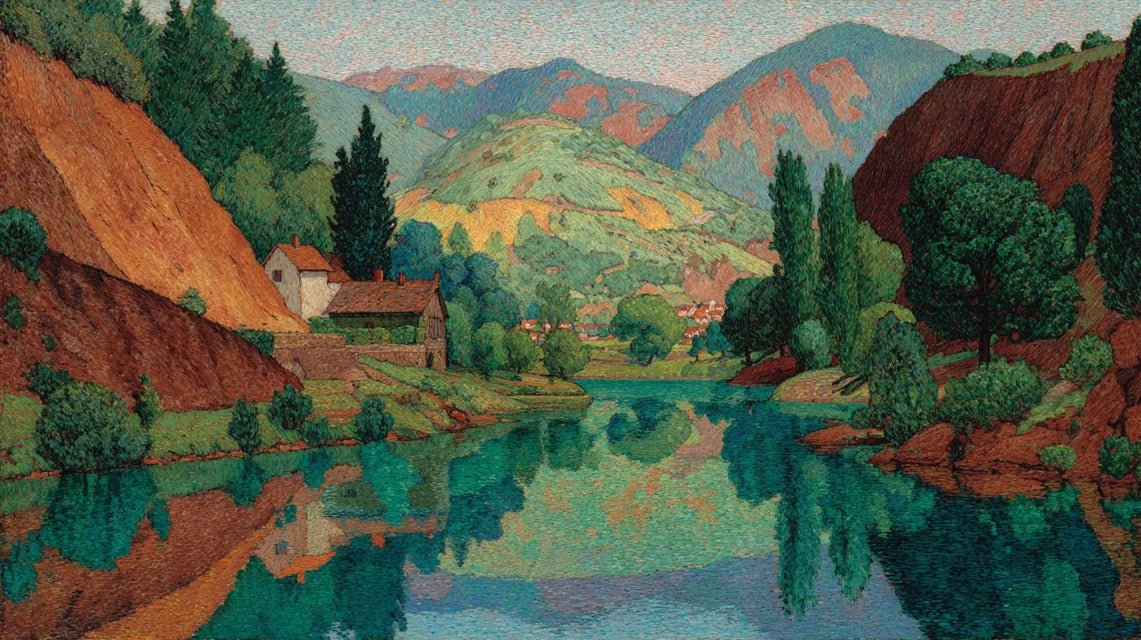
The color synthesis constitutes the second pillar of Anquetin's landscapes. This approach consists of reducing the chromatic palette to pure colors, applied in uniform areas without modeling or gradation. Anquetin rejects subtle nuances to favor frank contrasts and bold harmonies. In his representations of the Norman countryside or the banks of the Seine, he opposes intense greens to bright oranges, deep blues to luminous yellows. This color simplification is not a superficial decorative intention, but a search for the very essence of the landscape. For enthusiasts looking to discover contemporary interpretations of this approach, modern landscape paintings often take up these principles of chromatic synthesis. Anquetin demonstrates that a limited number of colors, judiciously chosen and organized, can express more than a complex palette. His skies sometimes contain only two or three tones, his meadows unify into monochrome surfaces, creating remarkable visual intensity.
The Japanese influence in landscape compositions
Anquetin’s cloisonnist landscapes reveal a profound influence of Japanese prints, which were then very fashionable in Paris. This influence is manifested in several characteristic aspects of his work. The block composition, the absence of traditional perspective, the bold framing and vertical formats directly recall Hiroshige or Hokusai. Anquetin also adopts the technique of spatial découpage typical of Japanese masters, where space is structured into successive planes without illusionistic transition. His representations of trees, often placed in the foreground as natural curtains, create unprecedented effects of depth. Diagonal lines of force, bird's-eye views, and asymmetrical composition testify to this creative assimilation. This synthesis between Western tradition and Eastern aesthetics characterizes the originality of his landscape approach, where nature becomes a pretext for almost abstract visual organizations.
The preferred motifs in Anquetin’s landscapes
Anquetin develops a preference for specific landscape motifs that lend themselves particularly well to his cloisonnist treatment. His favorite subjects include:
- Nocturnal urban scenes where artificial lights create dramatic contrasts and distinct color zones
- River landscapes with their simplified reflections and horizontally rhythmic compositions
- Roads and tree-lined paths offering perspectives naturally structured by the vertical vegetation
- Norman rural scenes with the geometric shapes of fields and agricultural buildings
Each motif allows Anquetin to explore different possibilities of color synthesis. Nocturnal scenes offer him the opportunity to work on extreme contrasts between light and darkness. River landscapes lead him to simplify reflections into pure color zones. This selection of motifs is never arbitrary: it always responds to a precise formal research where nature becomes a laboratory for plastic experiments.
The legacy of Anquetin’s cloisonnist landscapes
While Anquetin abandoned cloisonnisme after a few years to return to a more academic style, his influence on the development of modern landscape remains considerable. His research directly inspired the nabis, particularly Paul Sérusier and Maurice Denis, who continued this path of decorative synthesis. The Fauves, with their blocks of color and defined outlines, also owe much to these pioneering experiments. Beyond historical movements, Anquetin's approach resonates with contemporary concerns: formal simplification, affirmation of the pictorial surface, and the search for a synthetic expression find echoes in current art. His cloisonnist landscapes demonstrate that it is possible to represent nature without servilely copying it, but by revealing its essence through rigorous plastic organization. This aesthetic lesson, formulated in the 1880s, retains all its relevance for today's creators who seek to renew the landscape genre.
Anquetin’s landscapes represent a pivotal moment in painting history, where cloisonnisme and color synthesis opened new avenues for representing nature. This brief but intense creative period demonstrated that a landscape could be both decorative and expressive, simplified and powerful. Anquetin's formal audacity, his rejection of academic conventions, and his ability to transform naturalist observation into structured compositions continue to inspire artists and enthusiasts. His work recalls that landscape representation is never a simple reproduction, but always a personal interpretation where technique and vision combine to create a unique visual language.
Frequently Asked Questions
What is cloisonnisme in Anquetin’s landscapes?
Cloisonnisme is a painting technique where Anquetin defines each color area with black or brown outlines, like enameled partitions. This approach transforms the landscape into structured compositions of blocks of color, rejecting the subtle transitions of Impressionism to affirm the geometry and structure of natural forms.
How does color synthesis work in Anquetin?
Anquetin’s color synthesis consists of reducing the palette to pure colors applied in uniform blocks without gradations. He favors frank contrasts and bold harmonies rather than subtle nuances, creating a visual intensity that expresses the essence of the landscape with a limited number of tones.
What is the Japanese influence in Anquetin’s landscapes?
Japanese prints deeply inspire Anquetin: blocks of color composition, asymmetrical framing, spatial segmentation into successive planes, and the use of natural elements as compositional curtains. This influence is evident in his vertical formats, his non-traditional perspectives, and his decorative treatment of natural motifs, creating a unique synthesis between Eastern and Western aesthetics.