Winter transforms nature into a spectacular crystallization laboratory. Each frosty morning reveals an ephemeral architecture where ice draws patterns of fascinating complexity. Capturing these winter frost and crystallization landscapes represents a unique artistic challenge that combines careful observation, mastered photographic technique, and aesthetic sensitivity. Artists and photographers who specialize in this art capture fleeting moments: those few hours when the grazing light reveals the perfect geometry of ice crystals, when frozen mist envelops trees with a cottony cloak, when frozen rivers create ephemeral natural sculptures. This visual quest requires patience and presence at the right moment, because the beauty of these crystalline formations often lasts only the time of a frosty dawn.
The fleeting magic of frost crystals
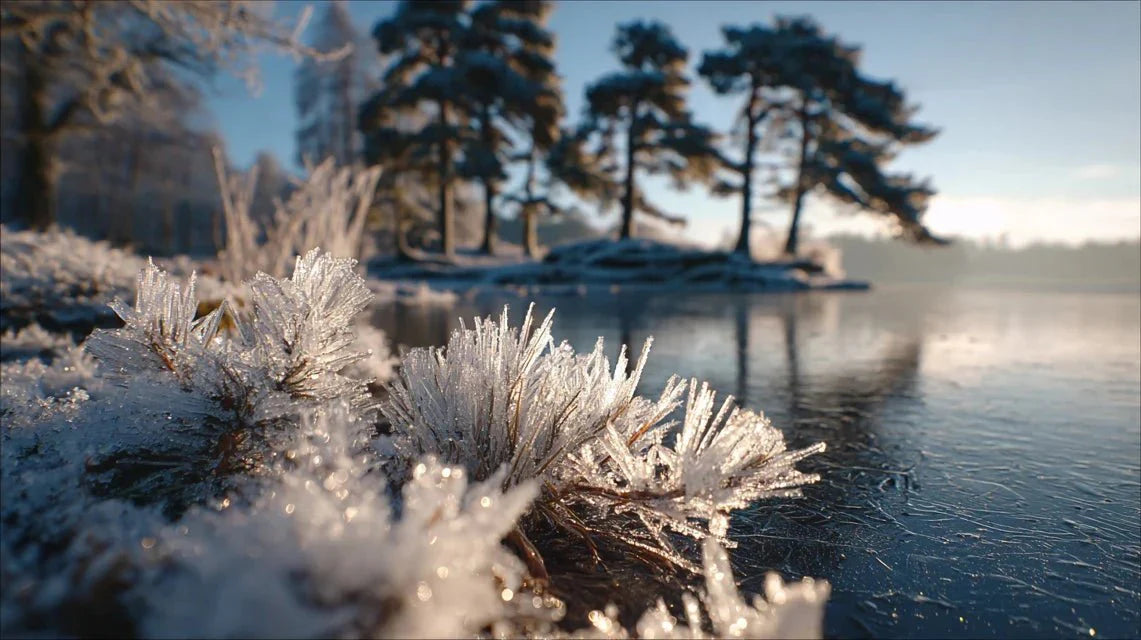
Frost crystals are one of the most delicate manifestations of winter crystallization. They form when water vapor deposits directly on cold surfaces, creating hexagonal structures with mathematical precision. On windows, fallen leaves or blades of grass, each crystal develops a unique architecture. Photographers specializing in these frost landscapes particularly seek the early morning hours, when golden light passes through these transparent formations. Macro photography then reveals a miniature universe: gardens of ice with infinite ramifications, crystalline feathers that seem drawn by an invisible artist. To immortalize these details, the technique requires a gentle approach – a simple breath can make these fragile works disappear. Wall art inspired by these frozen formations captures this poetic fragility and allows one to appreciate this fleeting beauty beyond its short natural existence.
White frost and its fairytale landscapes
White frost transforms ordinary landscapes into fairytale scenes worthy of Nordic tales. This phenomenon occurs when fog freezes on contact with cold surfaces, enveloping trees, fences and vegetation in a cottony layer. Forests under white frost offer exceptional photographic opportunities: each branch becomes a white sculpture standing out against the gray winter sky. The capture of these landscapes requires a fine understanding of exposure, as the dominant white can deceive sensors. Artists play with subtle contrasts, revealing the granular texture of the frost, its variable density depending on wind exposure. The most successful compositions integrate elements of depth: a path winding between frosted trees, a dark silhouette contrasting with the surrounding whiteness. These crystallization landscapes possess a particular atmospheric quality, a diffused luminosity that blurs distant details and creates a sense of contemplative isolation.
Ice formations in aquatic landscapes
Frozen waterways offer tables of winter crystallization. Frozen waterfalls create monumental ice sculptures, with their translucent flows sometimes trapping air bubbles or plant elements. Ice-covered lakes develop complex patterns on the surface: geometric cracks, trapped bubbles forming vertical columns in the thickness of the ice, areas of transparency revealing aquatic depths. The artistic capture of these frozen landscapes requires particular attention to safety, but rewards daring photographers with stunning images. Compositions can explore several approaches:
- The aerial view: reveals the abstract patterns of cracks and uneven freezing zones
- The immersive perspective: places the viewer at ice level to emphasize texture and transparency
- Close framing: isolates fascinating details such as trapped bubbles or plant inclusions
- Dynamic contrast: opposes free water and frozen formations on the edge
These frozen aquatic landscapes tell the story of progressive cold, each layer of ice documenting temperature variations and water movements before its petrification.
Light as a revealer of crystallization
The light plays a decisive role in the art of capturing frozen landscapes and crystallization. The golden morning hour, when the sun is low on the horizon, transforms frosted surfaces into shimmering fields where each crystal becomes a miniature prism. Photographers seek this magical moment when light passes through ice formations, revealing their internal structure and creating games of transparency and opacity. Backlighting amplifies the graphic dimension of frost-covered trees, transforming them into luminous white silhouettes against a pale sky. Diffuse light on cloudy days is perfect for intimate compositions of crystalline details, eliminating harsh shadows and allowing you to capture subtle nuances from white to icy blue. Reflections on smooth ice add an extra dimension: frozen lakes become imperfect mirrors, doubling winter landscapes in reflections distorted by surface irregularities. This understanding of light distinguishes simple documents from true works of art.
Compose and sublimate freezing scenes
The artistic composition of winter crystallization landscapes goes beyond the simple documentation of a natural phenomenon. Accomplished artists build their images around focal points: a solitary tree completely frosted, a frozen waterfall forming a translucent curtain, a close-up on the intertwining of crystals. The human element, used sparingly, can add dramatic scale to these frozen landscapes – a tiny silhouette facing an ice cliff emphasizes the monumentality of the formations. Natural guidelines guide the eye: frost-covered branches converging towards a point, cracks in the ice creating dynamic diagonals, rows of trees under frost establishing a pronounced perspective. The color palette, although dominated by whites and blues, offers subtle opportunities: rosy hues of dawn warming icy surfaces, deep blues of shadow areas in the snow, touches of brown from persistent vegetation. This compositional approach transforms naturalist observation into artistic interpretation, where the photographer becomes as much a creator as a witness to winter's beauty.
Capturing frozen landscapes and winter crystallization is more than just a technical exercise. It’s a meditation on the ephemeral, a celebration of nature’s ability to create fragile and temporary beauty. These images freeze moments that will never exist again in this exact form, offering artistic permanence to phenomena destined to melt with the warmth of the day. Whether through the lens of a camera or the brush of an artist, this visual quest reconnects us to the subtle magic of winter and its daily crystalline transformations.
Frequently Asked Questions
What is the best time to photograph frozen landscapes?
The early morning hours offer optimal conditions for capturing frozen landscapes and crystallization. The grazing light of dawn reveals the details of the crystals, while low temperatures preserve the formations. Frost often disappears as soon as the sun warms the surfaces, limiting the capture window to 1-2 hours after sunrise.
How to avoid fogging on the lens during winter photography?
To avoid condensation that ruins landscape shots, allow your equipment to acclimatize gradually to outdoor temperatures. Keep the camera in a waterproof bag until thermal stabilization. Use a hood to protect the front lens and always have cleaning cloths handy. Avoid breathing directly towards the lens in cold conditions.
What camera settings should be prioritized for ice crystals?
To capture the fine details of winter crystallization, use a small aperture (f/8-f/16) to maximize depth of field. Slightly overexpose (+0.3 to +1 EV) to compensate for the white dominance that fools automatic metering. In macro photography of crystals, prioritize manual mode with precise focus and remote shutter release to avoid vibrations.