Gustave Loiseau embodies a unique figure in French post-impressionism, that of a painter passionate about light and landscapes. Far from the Parisian boulevards and radical experiments of his contemporaries, he chose the Norman valleys as his preferred terrain for exploration. His paintings capture the changing essence of rural landscapes with an almost obsessive fidelity to atmospheric variations. Between 1890 and 1935, Loiseau developed a distinctive pictorial approach, marked by his mosaic touch and deep attachment to the landscapes of Normandy. Let's discover how this little-known artist transformed the banks of the Eure and the verdant valleys into true visual symphonies.
Gustave Loiseau: The Discreet Heir of Post-Impressionism
Born in 1865, Gustave Loiseau belongs to that generation of artists who inherited the Impressionist revolutions without embracing all their codes. Unlike Monet or Pissarro, he never sought worldly recognition. His post-impressionism is characterized by a unique method: the cross or mosaic touch, which he systematically applies to structure his compositions. This technique allows him to simultaneously capture fleeting light and the solidity of the landscape. Trained with Fernand Quignon in Pont-Aven, Loiseau quickly developed a particular sensitivity for rural landscapes. He rejects urban subjects and scenes of high society to focus exclusively on nature. His palette, dominated by deep greens, bright blues, and earthy ochres, reflects his love for authentic countryside. Post-impressionist landscape paintings like his testify to a quest for harmony between rigorous observation and poetic interpretation.
The Norman Valleys: An Inexhaustible Source of Inspiration
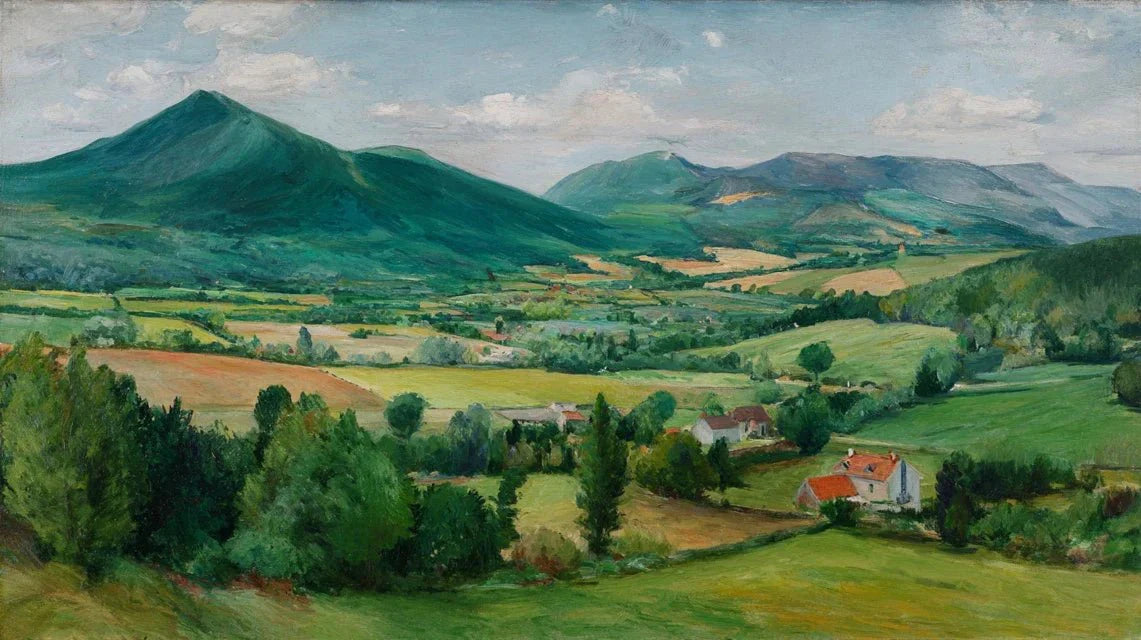
Normandy becomes for Loiseau much more than a simple motif: it is his open-air studio. He settles permanently in Pont-de-l'Arche, a small town in Eure, from which he radiates throughout the region. The Norman valleys offer him a remarkable diversity of landscapes: meanders of the Seine, green hedgerows, flowering orchards in spring, peaceful villages with slate roofs. Loiseau obsessively paints the same places at different seasons and times of day, in the manner of Monet's series. The banks of the Eure are his favorite motif, with their aligned poplars, trembling reflections, and changing light. He also captures the gentle hills of the region, scattered with apple trees and crossed by winding paths. This particular geography offers his brush endless variations of textures and lights. Loiseau’s landscapes are never spectacular: they celebrate the humble and everyday beauty of the French countryside, far from the cliffs of Etretat or the gardens of Giverny.
The Mosaic Touch: A Technical Signature of Loiseau's Landscapes
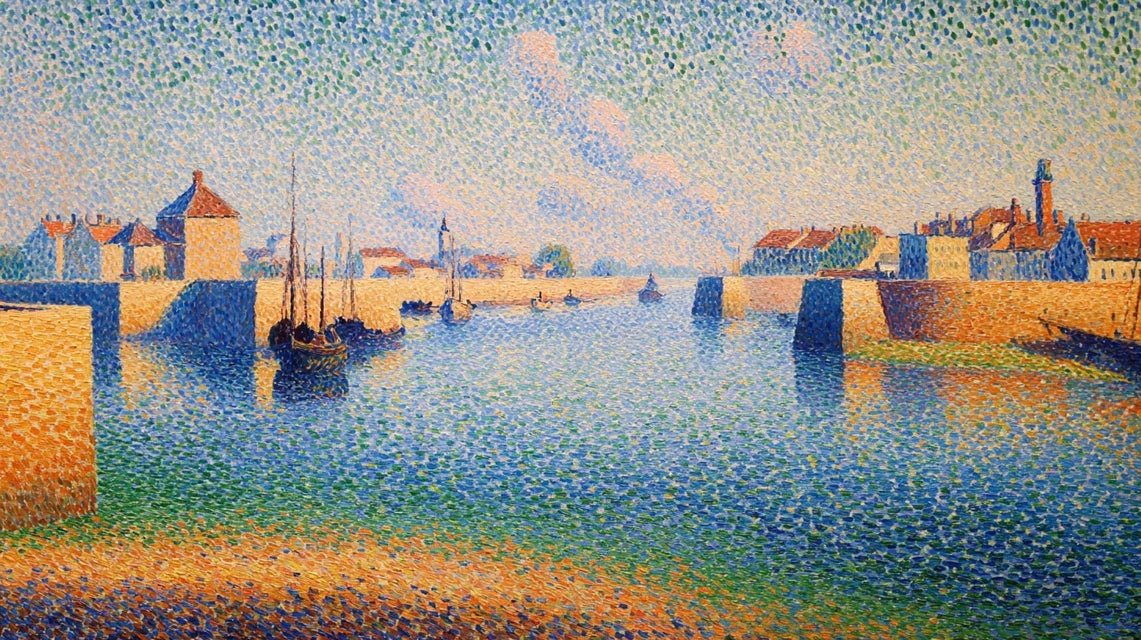
The most recognizable element of Loiseau’s landscapes remains his characteristic touch. Unlike the fragmented touches of pure Impressionists, he structures his canvases with small, regular brushstrokes arranged in a cross or checkerboard pattern. This method creates a vibrant surface where each element of the landscape seems to pulsate with inner life. Trees, water, sky: everything is treated with the same rhythmic discipline. This systematic approach allows Loiseau to build solidly architected compositions while preserving the spontaneity of perception. His technique stands out clearly:
- Rigorous structuring: each area of the painting follows a precise directional scheme
- Chromatic density: superposition of neighboring tones to create luminous vibrations
- Uniform treatment: same attention paid to the foreground as to the background
- Fidelity to the motif: scrupulous respect for the actual topography of the places
This demanding method is a testament to an exceptional work discipline. Loiseau often painted outdoors, in all weathers, to capture the authenticity of Norman lights. His post-Impressionism thus finds a subtle balance between naturalist observation and personal expression.
Norman light and atmospheric variations
What fascinates about Loiseau’s landscapes is his ability to translate the infinite nuances of Norman light. This region offers a particular atmosphere, often veiled, where changing skies filter a soft and diffused clarity. Loiseau excels at capturing these intermediate moments: the misty dawn on the river, the pale winter sun piercing through the branches, the silvery reflections after the rain. His Norman valleys are never crushed by Mediterranean sunlight: they bathe in this subdued luminosity that charms the landscapes of the North. The painter works in series, returning to the same place at different seasons to document the transformations of the landscape. His winter paintings, with their bare trees and low skies, exude a contemplative melancholy. In spring, orchards in bloom explode with white and pink touches. Summer brings the fullness of deep greens, while autumn gently ignites the foliage. This sustained attention to atmospheric variations places Loiseau in the lineage of great French landscape painters, while affirming his unique personality.
The artistic legacy: rediscovering a master of Norman landscape
Long overshadowed by the major figures of Impressionism, Gustave Loiseau is now experiencing a deserved critical reappraisal. His Norman landscapes bear witness to remarkable artistic consistency and a personal vision of Post-Impressionism. Unlike the Fauvist or Cubist experiments of his time, he maintained absolute fidelity to his preferred subject: the French rural landscape. This constancy might seem conservative, but it actually reveals an in-depth and meditative exploration of the countryside. Museums are gradually rediscovering his prolific work: more than 1500 paintings cataloged, most of which are dedicated to the Norman valleys. His influence can be seen in contemporary landscape artists who prioritize patient observation over formal innovation. Collectors particularly appreciate the contemplative serenity that emanates from his compositions. His canvases offer a window into a disappeared rural France, preserved in the luminous vibration of his mosaic touch. For those who want to understand the evolution of Post-Impressionism, Loiseau's work constitutes an essential chapter, too often neglected in favor of more famous names.
Conclusion
Loiseau’s landscapes embody a unique vision of Post-Impressionism, rooted in the intimacy of the Norman valleys. Through his methodical touch and fidelity to rural motifs, Gustave Loiseau created a consistent body of work that celebrates the discreet beauty of the French countryside. His canvases invite us to slow down, observe the subtle variations of light, and rediscover these familiar landscapes with a renewed gaze. An artist who richly deserves his place in the history of French painting.
Frequently Asked Questions
What is the characteristic technique of Loiseau's landscapes?
Gustave Loiseau uses a mosaic or cross-stroke, applying small, regular and structured brushstrokes. This technique creates a vibrant surface that simultaneously captures changing light and the solidity of the Norman landscape, clearly distinguishing his Post-Impressionist style.
Why did Loiseau choose the Norman valleys as his main subject?
Living in Pont-de-l'Arche in Eure, Loiseau found in the Norman valleys an inexhaustible variety of motifs: meanders of the Seine, green hedgerows, flowering orchards. The soft and changing light of this region perfectly matched his search for subtle atmospheric variations.
How does Loiseau differ from other Post-Impressionists?
Unlike the Fauvist or Cubist experiments of his contemporaries, Loiseau maintains absolute fidelity to the rural landscape and naturalist observation. His systematic mosaic touch and exclusive attachment to the Norman valleys create a unique, contemplative and profoundly consistent style.