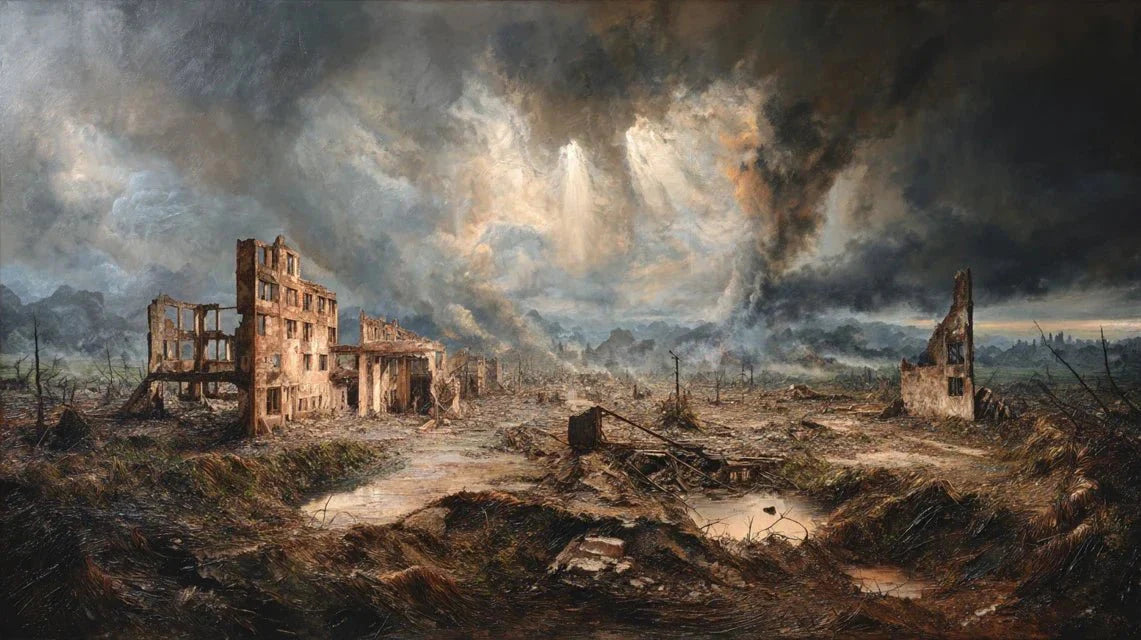
Ruins fascinate. For centuries, humanity has contemplated its own rubble with a mixture of terror and fascination. But today, contemporary art goes further: it transforms these landscapes of the end of the world into veritable visual manifestos.
Post-apocalyptic landscapes in contemporary art: definition and issues
Imagine a silent city where vegetation reclaims asphalt. Gutted skyscrapers, abandoned cars, a sky filled with ash. These scenes of desolation have been invading galleries and museums for decades. Post-apocalyptic landscapes represent environments after a major catastrophe: nuclear war, climate collapse, devastating pandemic.
The explosion of this artistic genre is spectacular. Out of 340 post-apocalyptic films listed since 1926, no less than 261 have been produced in the last thirty years (Source: Film studies). Environmental art follows this trend with the same intensity.
Why this obsession? Because these landscapes reflect our current fears. Global warming is no longer a distant hypothesis. Chernobyl, Fukushima, megafires in Australia or California: reality sometimes surpasses fiction. When Hurricane Katrina devastates New Orleans in 2005, the images are strikingly similar to apocalyptic paintings that adorn museums.
Artists do not just create imaginary worlds. They document our fragility, amplify our anxieties, and force us to look at what we would prefer to ignore.
Techniques for representing post-apocalyptic landscapes
How does one create a world after the end of the world? Approaches vary radically depending on the artists.
Lori Nix spends several months on a single photograph. With her partner Kathleen Gerber, she builds meticulous dioramas in her studio: libraries overgrown with vegetation, abandoned control rooms, collapsed museums. Each object is handmade and positioned precisely. The result? Troubling images where nature quietly reclaims human territory.
In Beijing, Chinese artist Jiang Pengyi develops a fascinating technique: he arranges miniature cities among real debris and industrial wastelands. These micro-cities gradually appear in his photographs, creating an effect of surprise. His message? To denounce the rampant urbanization that is already transforming his city into an apocalyptic landscape.
The main techniques of conceptual photography include:
- Photography of miniature dioramas built over several months
- Integrating raw materials (lead, ash, straw) into painting
- 3D modeling to create hyperrealistic digital scenes
- Staging models in real abandoned environments
- Large-scale immersive photographic installations
Painting reaches new heights with Anselm Kiefer. His monumental canvases incorporate straw, ash, lead, and earth. These materials are not mere decorative additions; they transform the surface into a veritable physical territory. Lead, a heavy metal laden with history, carries, according to the artist, the weight of collective memory. Some works measure several meters high, literally enveloping the viewer in an aesthetic of ruin.
More recently, Filip Hodas uses digital 3D to create striking images: a collapsed McDonald's logo covered in moss, a giant Game Boy colonized by plants. These works combine pop nostalgia and ecological critique with remarkable effectiveness.
Contemporary artists and post-apocalyptic landscapes
Anselm Kiefer dominates this artistic field like a giant. Born in 1945 during the final days of the Third Reich, this German transforms historical traumas into powerful landscapes. His work "Des Herbstes Runengespinst" (2006) perfectly illustrates his approach: a desolate plowed field, traversed by a monumental metal structure from which an open book emerges. The work simultaneously evokes battlefields, the memory of the dead, and the destruction of culture.
Kiefer, a major figure in neo-expressionism, superimposes photographs, painting, and organic materials. His surfaces resemble geological strata where history is inscribed. Each layer tells something: war, reconstruction, oblivion, memory.
Martin Wittfooth offers a different but equally chilling vision. His hyperrealistic paintings place animals in post-industrial settings. A polar bear sleeps in a pipe. A fox flees a forest ablaze. A deer contemplates a chemical plant. These scenes denounce our environmental impact by giving animals the role of tragic survivors in a world we have destroyed.
The work of Lori Nix and Kathleen Gerber fascinates with its obsessive precision. Their "The City" series imagines New York after the sudden disappearance of humanity. Why this attention to detail? Because realism makes fiction terrifying. These spaces could exist tomorrow.
If you want to enrich your interior with landscape paintings that capture these contemporary atmospheres and create a powerful visual environment, several collections allow you to integrate this aesthetic into your daily life.
Symbolism of post-apocalyptic landscapes in art
These representations carry multiple meanings that intertwine through contemporary symbolism.
First, a political dimension: the collapsed walls recall that everywhere in the world, new walls are being built. Palestine, Mexico-United States, Bulgaria. Post-apocalyptic landscapes become allegories of our fragmented societies, our fears of others, and our desperate attempts to protect ourselves.
Next, the ecological emergency: cracked lands, dead forests, toxic skies. Artists do not predict the future; they amplify the present. When Kiefer paints scorched fields, he evokes the bombings of 1945 but also the fires that ravage more and more territories each summer.
The psychological dimension also predominates. These landscapes devoid of humanity create a meditative space. The absence of human figures reinforces the feeling of abandonment. The viewer becomes the last survivor, wandering mentally through these ruins. This experience generates a form of anxious contemplation: what would remain of us?
Finally, a paradoxical beauty emerges. These works are often aesthetically powerful. The raking light on ruins, the muted colors, the majesty of destruction. This paradox forces reflection: why do we find beautiful what should horrify us?
Materials and supports for contemporary post-apocalyptic landscapes
The choice of materials is never neutral in contemporary art.
The lead that Anselm Kiefer uses carries an intense symbolic charge: heavy, radioactive metal, it evokes nuclear radiations and medieval alchemy. Ash refers to destruction by fire, the eternal cycle of death and rebirth. Straw evokes harvests, rural life, now carbonized.
Large-format photographs allow for physical immersion. Josef Koudelka photographs devastated mining landscapes in monumental dimensions. The visitor feels physically oppressed, as if crushed by desolation.
Digital techniques open up infinite possibilities: constructing impossible worlds, making different catastrophes coexist in a single image. This technical freedom allows artists to create visual syntheses of our multiple anxieties.
Working on watercolor paper brings a fragility that contrasts with the violence of the scenes. This contradiction reinforces the emotional impact: the delicacy of execution clashes with the horror of the subject.
Immersive installations transform the experience into a total sensory journey. The viewer no longer just looks, they traverse, they temporarily inhabit these spaces of desolation.
Post-apocalyptic landscapes in contemporary art are a testament to our time. They do not celebrate destruction. They do not wallow in catastrophism. These works function as visual warnings, spaces for reflection on our collective future. Between nightmare and meditation, they redefine the traditional genre of landscape, transforming it into an essential critical and philosophical tool for thinking about our time.
FAQ: Post-apocalyptic landscapes in contemporary art
Why are contemporary artists fascinated by apocalyptic landscapes?
This fascination reflects our collective anxieties about climate change, nuclear disasters and ecological collapse. Artists use these landscapes as mirrors of our fragile era, transforming our fears into works that force reflection.
What materials does Anselm Kiefer use for his apocalyptic landscapes?
Anselm Kiefer incorporates symbolic materials such as lead (evoking radiation and alchemy), ash (destruction and rebirth), straw (carbonized rural life) and earth. These elements transform his monumental canvases into veritable physical territories bearing the weight of history.
How does Lori Nix create her photographs of post-apocalyptic worlds?
Lori Nix and her partner Kathleen Gerber meticulously construct miniature dioramas in their studio for several months. Each object is handmade and positioned with precision before shooting, creating fictional scenes of disturbing realism.