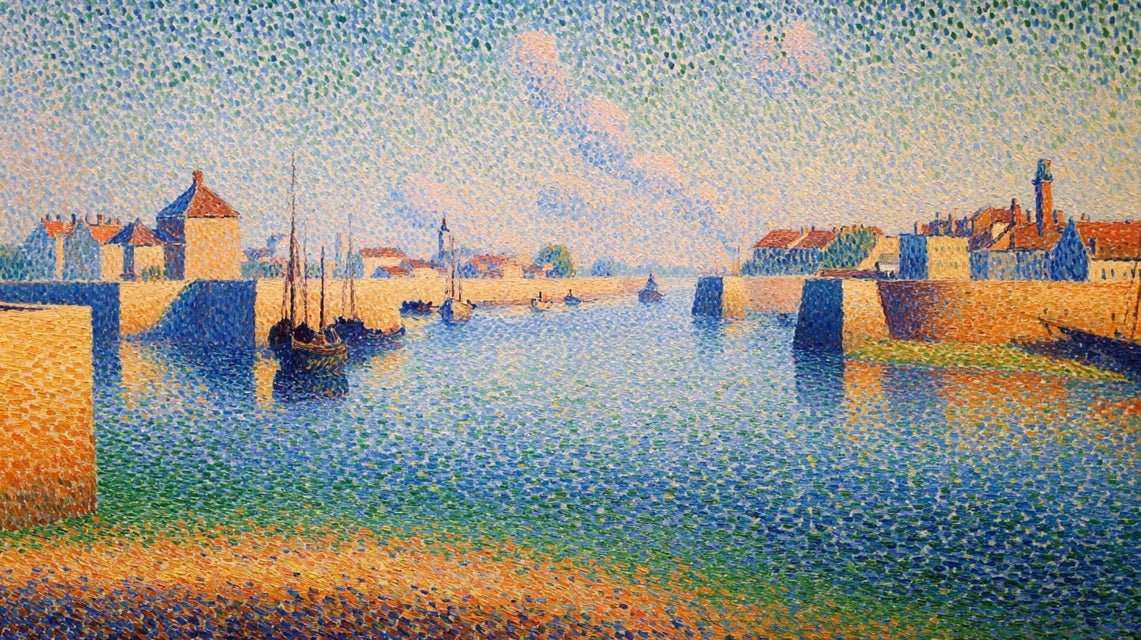
Imagine yourself standing before a Seurat painting. Up close, you see only a chaos of colored dots. Then you step back a few paces... and magic! The light comes alive, the water shimmers, the landscape breathes. That's the entire revolution of pointillism applied to landscapes.
Seurat’s Pointillism: A Revolution in Luminous Landscapes
Between 1884 and 1891, Georges Seurat revolutionized landscape painting. His secret weapon? Thousands of tiny colored dots applied one by one to the canvas. Blue next to orange. Red near green. Yellow against violet. These colors never truly touch each other, they never mix. It's your eye that does all the work.
This technique has a scholarly name: chromo-luminarism. But the idea is simple. Rather than mixing his colors on a palette like everyone else, Seurat juxtaposes them pure on the canvas. The result: a luminosity never seen before.
Take shadows, for example. Seurat categorically refuses black. Instead, he builds his dark areas with muted complementary colors. In The Seine at Chatou, the water reflects the sky thanks to hundreds of points of blue, green and orange. The river seems literally to vibrate with light.
This precision comes at a price. For a single canvas, the artist creates up to 60 preparatory studies (Source: Art Institute of Chicago). He meticulously analyzes each contrast, each value, each proportion. Some landscapes take him more than two years of work. Point by point. Day after day.
Decomposition of Light and Pointillist Techniques in Landscapes
Seurat draws on the scientific discoveries of his time. Chevreul and Rood demonstrated a fascinating phenomenon: optical mixing. When you place blue next to yellow without mixing them, your eye creates a green more vibrant than any physical mixture.
The artist applies this law to every element of his landscapes. The sky? A succession of light blue, white and orange dots. The water? Touches of blue, green and orange that vary depending on the angle of the light. Vegetation? Yellow and blue juxtaposed in changing proportions. Shadows? Violet, blue and green, but never black.
The touch itself evolves according to the desired effect. In Port-en-Bessin, you will find tight points for the calm areas of the water, directional dashes to suggest the movement of the waves, small rectangles to anchor the port jetties. This variation creates a subtle visual rhythm.
The management of light becomes almost mathematical. In the foreground of A Sunday on La Grande Jatte, the dots remain dark and dense. In the background, contrasts intensify. In the distance, the light explodes in clear, saturated points that dazzle.
Seurat’s Landscapes: Application of Pointillism to Natural Motifs
Every summer, Seurat flees Paris for the Normandy coast. According to the poet Emile Verhaeren, he seeks to "wash his eye" and "capture more faithfully the dazzling light." In 1888, Port-en-Bessin becomes his personal laboratory. He paints the same motif six times there: different angles, different tides, different lights.
Port-en-Bessin, harbor entrance, high tide reveals the full power of his method. The cliffs rise thanks to subtle gradations of ochre, beige and green dots. The breakwaters are cut out in geometric lines composed of light grays. The water shimmers under thousands of touches of cyan blue, emerald green and orange.
The artist structures his landscapes like an architect. Horizon, banks, tree trunks, masts create a classic geometric framework. But this rigor contrasts with the freedom of the pointillist treatment of light. This tension creates all the magic of the painting.
A tasty detail: the wild grasses in the foreground. These freer touches introduce a calculated irregularity that guides your eye to the depth of the landscape.
Discover how to enhance your interior with landscape paintings that capture different visions of nature.
Optical mixing and color decomposition in pointillist landscapes
The secret of pointillism lies in a simple optical law. Two juxtaposed colors retain their energy each. At two or three meters distance (Source: Chevreul's optical theory), your eye merges them into an agreement brighter than any palette mix.
To paint a sunny afternoon by the water, Seurat systematically combines pure yellow (solar light), orange (atmospheric warming), light blue (celestial brightness) and pale violet (colored shadows). This recipe produces what his contemporaries call a "pearly shimmer": a luminous vibration that seems to emanate from the canvas.
Some landscapes even have a painted border. A frame of complementary touches applied directly on the canvas picks up the interior palette and "closes" the light. This detail reinforces the chromatic unity of the whole.
Seurat organizes his landscapes according to pre-established color harmonies. A Seine bank favors blue-greens punctuated with orange: guaranteed river freshness. Circus scenes play on red-yellow balanced by violet: immediate artificial heat.
Port-en-Bessin and the Seine: laboratories of Seurat's pointillist landscape
Two places crystallize Seurat's experiments: Port-en-Bessin in Normandy and the banks of the Seine in Paris. Why these places? Intense maritime light, complex aquatic reflections, changing atmosphere. Everything to test the decomposition of light.
The summer of 1888 marks a turning point. In Port-en-Bessin, the artist systematically explores the same port under all its facets. Grazing morning light, afternoon dazzle, low tide, high tide, view from the cliffs... Each canvas tests the limits of pointillism.
The banks of the Seine offer other challenges. The calm water of the river becomes a perfect surface to study reflections decomposed into thousands of points. Trees create games of light and shadow that the painter translates by variations in density, size and color of the touches.
Fascinating technical detail: the method evolves depending on the location. On the Seine, Seurat uses finer and more closely spaced points to capture the misty Parisian atmosphere. In Port-en-Bessin, the touches become larger and more contrasting under the harsh Norman light.
These landscapes embody a radically new vision. The spontaneity of Impressionism is over. Make way for scientific reconstruction according to the laws of optics. Each painting becomes a methodical demonstration of divisionism applied to the natural world.
FAQ: Understanding Seurat's Pointillism in Landscapes
What is the difference between pointillism and Impressionism in landscapes?
Impressionism mixes colors on the palette before applying them, seeking spontaneity. Seurat's pointillism juxtaposes pure color dots directly onto the canvas, allowing the viewer's eye to perform optical mixing. This technique produces a more vibrant and structured light.
Why did Seurat paint his landscapes in dots?
Seurat relied on scientific theories of optics. By juxtaposing pure colors without physically mixing them, he hoped to achieve maximum luminosity. The dots allow each color to retain its own energy while merging in the viewer's perception at a distance.
How long did Seurat spend on a pointillist landscape?
The technique required extraordinary patience. Seurat would create up to 60 preparatory studies and could work for more than two years on a single major composition. Each dot was applied meticulously according to a precise calculation of chromatic ratios.