In 1893, Armand Guillaumin arrived in the Creuse valley with a treasure in his pocket: 100,000 francs won from a lottery (Source: Musée d'Orsay). No more night work at Ponts et Chaussées! He was free to practice plein air painting full-time. And it is here, in this remote corner of central France, that he will find his own artistic eldorado within French Impressionism.
The tormented banks of the Creuse, these cliffs plunging into dark water, these deep gorges... Everything fascinates him. Monet had passed through four years earlier and hated the capricious climate. Guillaumin, on the other hand, feels at home. This harsh nature corresponds to his temperament as a colorist.
The landscapes of Guillaumin in the Creuse valley
Between 1893 and 1920, Guillaumin painted more than one hundred canvases of the Creuse (Source: Galerie Durand-Ruel). His studio? The banks of Crozant, where the Creuse meets the Sédelle. He settles facing the ruins of the old fortified castle, easel planted in the grass, and begins to capture these embayed valleys with his characteristic divided touch.
His favorite spot is called Les Grandes Gouttes. He paints it repeatedly: glazed white in winter, vibrant orange in March, melancholic gray in autumn. The same place, a thousand different atmospheres. It's his way of saying "I know this place by heart".
His paintings tell:
- The sinuous meanders bordered by titanic rocks
- Winter mornings when white frost cracks underfoot
- Vaporous springs where forms dissolve
- Perspectives that recall Japanese prints
Pure color as a signature of Guillaumin's landscapes
"Furious colorist": this is how the critic Félix Fénéon describes him in 1886 (Source: Wikipedia). The qualifier sticks to Guillaumin’s skin for his entire life. In the Creuse, he pushes color even further. His color palette runs wild, moving away from reality to enter a post-Impressionist logic. So be it for resemblance, what matters is the emotional impact.
Take his snow landscapes exhibited at Durand-Ruel in 1894: even the whiteness of winter explodes with intense colors. Vincent van Gogh is a fan. He speaks of Guillaumin in at least 36 letters between 1888 and 1890 (Source: Wikipedia). For Van Gogh, this guy understands something essential about nature.
Techniques of pure color applied to Creusoise landscapes
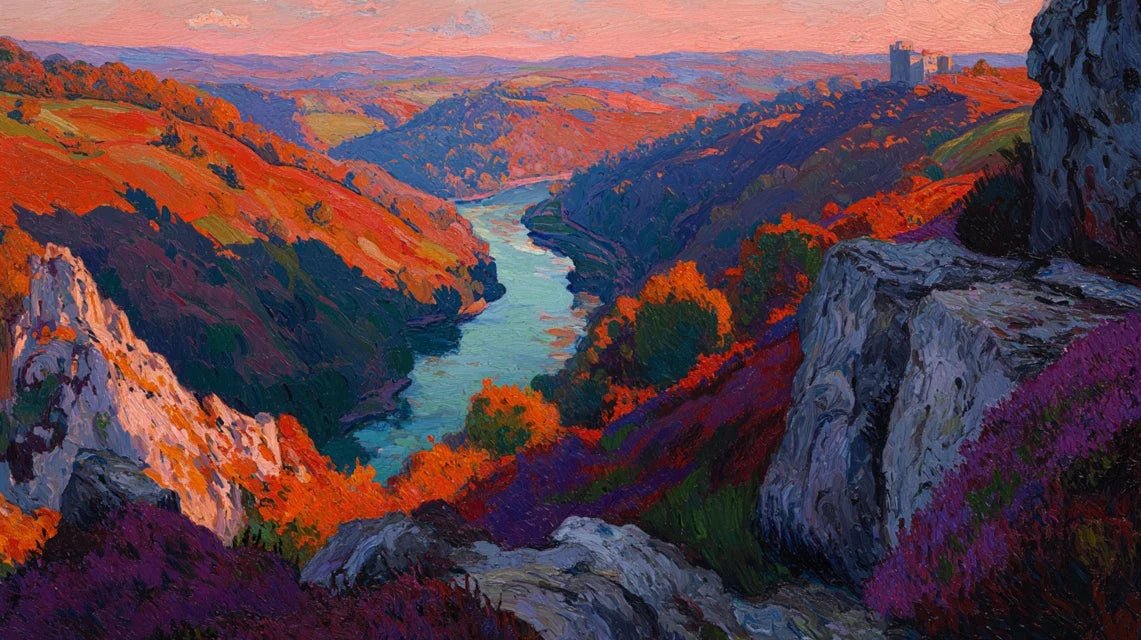
Guillaumin almost never mixes his colors on the palette. He applies them pure, directly onto the canvas. A blue next to an orange. A violet against a yellow. It is the eye that does the mixing. Want to see how this approach inspires contemporary art? Explore modern landscape paintings.
His Creusoise method rests on four pillars:
- Complementary colors that vibrate side by side
- A thick paste, almost sculpted (Monet worked more finely)
His "Snow Landscape at Crozant" (circa 1895, MuMa du Havre) perfectly illustrates his technique. We should shiver before this winter scene. Instead, we are dazzled: electric blues, soft pinks, deep violets, solar yellows. Everything sings together.
Landscapes of the Creuse: recurring motifs in Guillaumin's work
Guillaumin develops a repertoire of Creuse motifs that he revisits endlessly, actively participating in the rayonnement of the Crozant School. The Barrat mill by the water. The rocks of Sédelle emerging like giant sculptures. The panorama from the ruins of the castle. He knows every stone, every bend in the river.
What is he trying to capture? Those magical moments when light transforms everything. Winter mornings when frost makes the rocky landscapes covered with heather sparkle. Autumn afternoons when colors blaze. This valley has a wild, almost aggressive side. Guillaumin loves it.
He becomes the leader of the Crozant School. Other painters arrive: Léon Detroy, Émile-Othon Friesz, Clémentine Ballot (his only student, who joins him in 1912). They all fall under the charm of the Creuse valleys and adopt this approach to plein air painting.
The chromatic intensity of Guillaumin's landscapes at Crozant
In 1895, Guillaumin was already painting like a Fauve. Ten years before Fauvism officially existed! His red Agay rocks foreshadow the color (literally). But it is in the landscapes of Crozant that his chromatic audacity reaches its peak.
Today, the Musée d'Orsay owns 48 of his works, the Petit Palais 91 (Source: Wikipedia). Many depict the Creuse. These canvases tell the story of an artist who never feared pushing color to its limits. Swiss collectors Oscar Ghez and Gérard Corboud understood his value and accumulated dozens of his Creuse landscapes.
Then comes 1917. Construction begins on the Éguzon dam. Six years of work that will flood part of the landscapes that Guillaumin loves so much. For him, it is heartbreaking. This wild landscape he painted for nearly thirty years disappears under the water. He gradually turns away from Crozant, goes to Agay on the Mediterranean. But he carries with him his technique of pure color, forged in the valleys of the Creuse.
FAQ: Everything you want to know about Guillaumin's landscapes
Why did Guillaumin choose the Creuse valley?
Guillaumin discovered the Creuse in 1893 after winning a lottery. This wild valley with tormented landscapes perfectly corresponds to his temperament as an audacious colorist. Unlike Monet who finds the climate difficult, Guillaumin thrives in this harsh nature and produces more than one hundred canvases of the region between 1893 and 1920.
What is Guillaumin’s pure color technique?
Pure color refers to Guillaumin's method of applying pigments directly onto the canvas, without prior mixing on the palette. He juxtaposes complementary colors (blue/orange, violet/yellow) and allows the viewer's eye to create the nuances. This technique, described as "furious" by critics, foreshadowed Fauvism as early as 1895.
Where can we see Guillaumin’s Creusoise landscapes today?
The main collections are at the Musée d'Orsay (48 works) and the Petit Palais in Paris (91 works). The MuMa in Le Havre also preserves "Snowy Landscape in Crozant". Numerous international museums hold his paintings, including the Art Institute of Chicago and the Metropolitan Museum of New York.