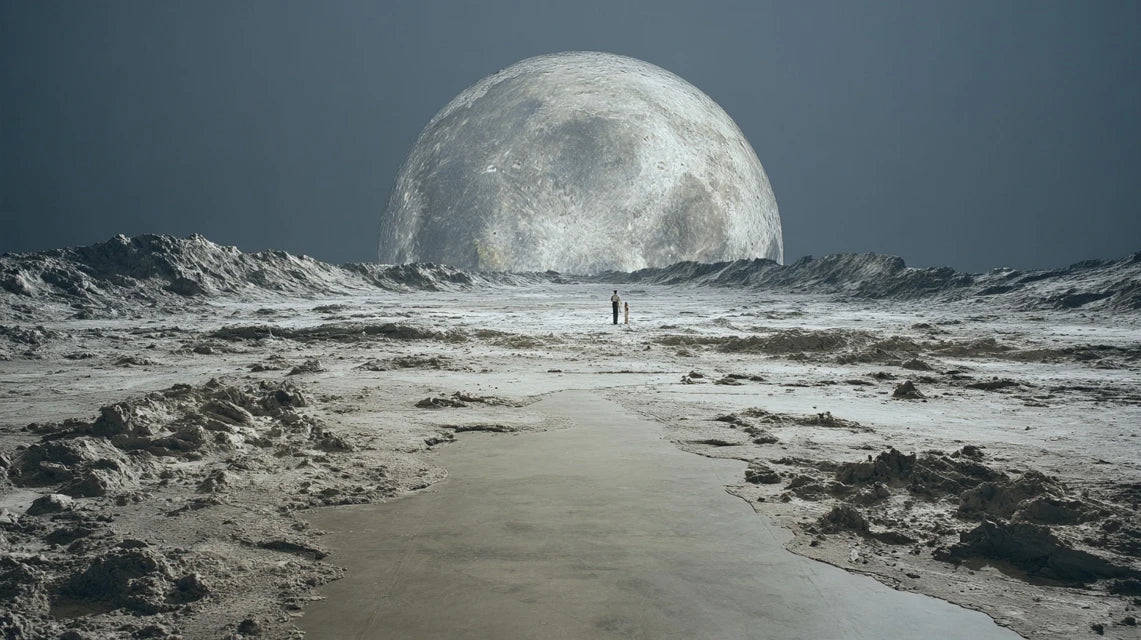
The Moon has always exerted a magnetic fascination on humanity. From the Apollo missions to recent space explorations, our natural satellite inspires contemporary artists who reinvent its representation. Lunar landscapes in contemporary art no longer simply reproduce craters and gray surfaces: they become metaphorical territories, projection spaces where science, poetry and existential questions blend. This artistic exploration transcends simple astronomical illustration to create a profound dialogue between the infinitely large and our human condition. How do creators today capture the essence of these extraterrestrial landscapes? What techniques and visions transform lunar desolation into captivating works of art?
Lunar photography reinterpreted by contemporary artists
NASA photographs serve as raw material for many contemporary creations. Artists like Michael Light or Vincent Fournier appropriate these scientific archives to make them works in their own right. Light, with his series Full Moon, meticulously reworked the Apollo mission clichés, revealing the aesthetic dimension of these historical documents. These photographic lunar landscapes play on extreme contrasts between light and darkness, creating an atmosphere that is both documentary and contemplative. For enthusiasts seeking inspiration from these extraterrestrial universes, contemporary landscape paintings often incorporate this monochrome and mineral aesthetic. The contemporary photographic approach to lunar surfaces transforms scientific precision into visual emotion, where each crater becomes a natural sculpture, each horizon an invitation to imaginary travel.
Lunar abstraction: when texture becomes language
Contemporary abstract art finds in lunar landscapes a particularly fertile source of inspiration. Artists like Vija Celmins or Tacita Dean explore the materiality of lunar surfaces through mixed techniques where texture takes precedence over figurative representation. Celmins, in particular, creates hyperrealistic drawings of lunar surfaces that paradoxically tip into abstraction due to their intense focus on detail. These works question our perception: are we facing a lunar cartography or a meditation on matter itself? Contemporary artists use graphite, ink, plaster or even industrial materials to recreate this powdery and mineral quality of the lunar regolith. This tactile approach to extraterrestrial landscapes creates a fascinating paradox: making palpable an environment that few humans will ever touch. Abstraction thus becomes the most authentic way to translate the radical strangeness of these territories.
Immersive installations: mentally inhabiting the Moon
Contemporary art installations offer a total experience of lunar landscapes. Artists like Luke Jerram with his Museum of the Moon or Katie Paterson with Earth-Moon-Earth transform the exhibition space into a lunar environment. These immersive works use projection, monumental sculpture and sound to recreate the atmosphere of lunar landscapes. Jerram, for example, created an inflatable moon seven meters in diameter, scientifically reproducing the lunar topography, which visitors can contemplate as if floating in space. These installations allow a sensory experience of extraterrestrial environments that goes far beyond simple visual contemplation. They often integrate:
- 360-degree projections simulating the perspective from the lunar surface
- Spatial soundscapes creating the illusion of cosmic silence
- Materials mimicking regolith for a tactile experience
- Scale games confronting the viewer with the immensity of the moon
The poetic and symbolic dimension of lunar surfaces
Beyond realistic reproduction, contemporary lunar landscapes convey a powerful symbolic charge. Artists like Anselm Kiefer or Tomás Saraceno invest the Moon as a metaphor for isolation, utopia or human exploration. Lunar representations then become spaces of philosophical projection where our climatic anxieties, exploratory aspirations or nostalgia for the absolute are read. The Japanese artist Yayoi Kusama, with her environments of infinite dots, evokes the cosmic infinity of which the Moon is only a fragment. This poetic approach to extraterrestrial landscapes dialogues with romantic tradition while updating it. Lunar soil becomes a blank page, virgin ground for our collective projections. Craters, scars of millennia-old impacts, tell a story of cosmic violence that resonates with our contemporary concerns. This symbolic dimension transforms lunar works into unsettling mirrors of our earthly condition.
Digital technologies and 3D reconstructions of lunar terrains
Contemporary digital art pushes the boundaries of lunar landscape representation through 3D technologies and virtual reality. Collectives like Squidsoup or individual artists like Refik Anadol use NASA's topographic data to create hyperrealistic reconstructions of lunar surfaces. These works allow for a virtual exploration where the viewer becomes a digital astronaut. 3D modeling offers unparalleled precision in reproducing lunar reliefs, each pixel corresponding to actual scientific measurements. But beyond accuracy, these digital creations introduce speculative elements: future colonies, terraformed transformations, or dystopian visions. Generative art applied to lunar landscapes produces infinite variations based on algorithms inspired by lunar geology. This fusion of science and artistic creation redefines our visual relationship with the Moon, transforming it from a distant celestial object into an accessible territory, at least virtually. Lunar digital artworks also question our relationship with authenticity in a world where virtual experience rivals reality.
Conclusion
The representation of lunar landscapes in contemporary art is a testament to an inexhaustible fascination with our satellite. Between scientific fidelity and poetic interpretation, between documentary photography and radical abstraction, contemporary artists are constantly reinventing our view of these extraterrestrial territories. These works do not simply reproduce the Moon: they transform it into a space for philosophical questioning, a ground for aesthetic experimentation, and a mirror of our human aspirations. Contemporary lunar art reminds us that artistic and scientific exploration share the same desire for transcendence.
Frequently Asked Questions
Which contemporary artists have specialized in lunar landscapes?
Several major artists explore lunar landscapes: Michael Light with his photographic series Full Moon, Vija Celmins for her hyperrealistic drawings of lunar surfaces, Luke Jerram with his Museum of the Moon immersive installation, and Katie Paterson who uses the Moon as a medium of communication. Tacita Dean and Anselm Kiefer also integrate lunar symbolism into their contemporary artworks.
Why does the Moon inspire so many contemporary artists?
The Moon represents a territory that is both familiar and totally alien, visible but inaccessible to most. It embodies exploration, isolation, utopia, and offers a unique mineral aesthetic. Lunar landscapes allow artists to question our human condition, our spatial aspirations, and our relationship with the unknown, while also offering a fascinating palette of textures and contrasts.
How do modern technologies transform the artistic representation of the Moon?
3D technologies, virtual reality and generative art enable hyperrealistic reconstructions of lunar surfaces based on real scientific data. Artists create immersive experiences where viewers can virtually explore lunar landscapes. Digital modeling also opens up speculative possibilities, imagining future colonies or terraformed transformations, pushing the boundaries between scientific documentation and artistic fiction.