Imagine Cezanne, alone facing his favorite motif. Every morning, he walks towards this limestone mountain that dominates Aix-en-Provence. But what he sees is not what an ordinary walker sees. Under his gaze, the Mount-Sainte-Victoire transforms into an assemblage of cones, cylinders and spheres.
This obsession lasts twenty-four years. Between 1882 and 1906, the painter creates more than sixty versions of this same mountain (Source: Metropolitan Museum of Art). Why so much persistence? Because Cezanne is conducting a revolutionary experiment: to transform a natural landscape into pure geometric architecture thanks to the principles of post-impressionism.
Cezanne's geometric technique on Mount Sainte-Victoire
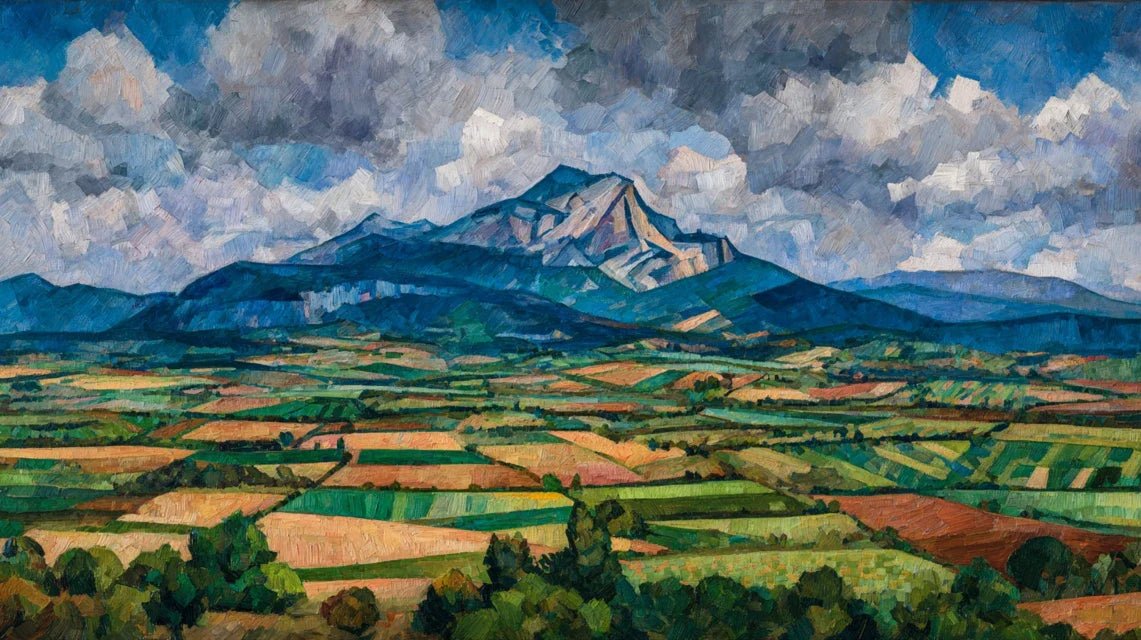
Cezanne does not paint what he sees, he paints what he understands. His method? To decompose the mountain into elementary volumes. The peak becomes a perfect cone, the hills spheres, the trees cylinders aligned like soldiers.
This geometrization is not brutal. The painter subtly distorts real proportions to create visual balance. He even goes so far as to enlarge some canvases during creation, adding strips of canvas on the sides to perfect his geometric calculations. His painting preserved at the Met bears witness to this obsessive research.
The buildings in the foreground? Cubes with sharp edges. The winding road? A calculated diagonal that guides the eye towards the triangular mass of the mountain. Nothing is left to chance. Each form dialogues with others in a meticulous geometric choreography, creating a true pictorial structure consistent.
Modulated colored touches: Cezanne's geometric language
But how does one build a volume with paint? Cezanne invents his own language: the "small colored sensations". Tiny brushstrokes juxtaposed, like colored bricks that assemble to build a form.
Take the slope of the mountain. Instead of a classic gradient, Cezanne superimposes touches of orange, blue, violet. These spots do not mix on the canvas, they vibrate side by side. The eye of the viewer does the work of fusion. Result: the relief is born from pure color, without any outline.
Emile Bernard, who observes the master at work, describes this fascinating method: "He would start with the shadow areas and apply a spot, then a second larger one, until these superimposed modulations model the object by their coloration" (Source: Maurice Merleau-Ponty, "Cezanne's Doubt").
Ochers punctuated with green dominate his Provençal palette. This chromatic restriction reinforces the effect of geometrization. In his later paintings of the Lauves, these touches become even more abstract, almost pure geometric signs. The chromatic modulation makes it possible to sculpt the superimposed planes without resorting to traditional drawing. Braque and Picasso will only have to push this logic one step further to invent cubism.
Multiple perspective: how Cezanne geometrizes the space of Mount Sainte-VictoireBut here's the stroke of genius: Cézanne breaks the rules of perspective. No single vanishing point, no lines converging neatly towards the horizon. Instead, he offers a kaleidoscopic vision.
Imagine being able to turn around the mountain while remaining still. That’s exactly what his paintings suggest. Mont Sainte-Victoire is painted as if the eye recorded multiple angles of view simultaneously. The valley in the foreground seems viewed from above, while the mountain itself appears at eye level.
This multiplicity of viewpoints creates a dynamic space where planes overlap and interpenetrate. The mountain appears both near and far, stable and vibrant. This is what philosopher Merleau-Ponty will call a "lived perspective" – not that of a camera or an instrument, but that of our real perception.
To explore this spatial geometry from every angle, Cézanne constantly moves his easel. From Bibémus, from Les Lauves, from Bellevue. Each position offers a different structure which he reorganizes according to his own internal logic. Art lovers who want to discover how this pictorial revolution influences contemporary art can explore landscape paintings that perpetuate this geometric heritage of artistic avant-garde.
The cylindrical, spherical and conical forms of Mont Sainte-Victoire according to CézanneOn April 15, 1904, Cézanne wrote to Émile Bernard a sentence that became the manifesto of modernism: "Treat nature by the cylinder, the sphere, the cone" (Source: Correspondence de Paul Cézanne). Simple advice from teacher to student? No, a revolutionary artistic program.
On his paintings of Mont Sainte-Victoire, this theory is literally embodied. Here are the three fundamental geometric forms applied by Cézanne:
- The cone: for the top of the mountain, emphasized by intense blue lines that draw the rocky edges
- The cylinder: for the trunks of trees and the parasol pines in the foreground, rendered by modulated vertical touches
- The sphere: for the copses, the rounded hills and even some clouds, creating volumes by color gradation
But be careful, Cézanne is not a cold geometer. He seeks the hidden architecture of nature, its invisible skeleton. Each curved surface is cut into facets that capture light differently. The transition from warm to cold, from clear to dark, models the volume without any outline. This geometric abstraction progressive opens the way for modernist research.
Observe the cubic houses in the valley facing the conical mass of the mountain. This opposition of pure forms creates an electric visual tension. Everything is weighed, calculated, balanced. No decorative element, only pure geometry at the service of sensation.
In 1908, Georges Braque discovered this lesson. His Houses at L'Estaque pushes Cézanne’s geometrization to its paroxysm. The critic Vauxcelles, stunned by these "little cubes", invents the word "cubism". The circle is complete: the geometrization of Mont Sainte-Victoire gives birth to the greatest artistic movement of the 20th century.
FAQ : Understanding Cézanne’s geometrization of Mont Sainte-Victoire
How does Cézanne geometrize Mont Sainte-Victoire?
Cézanne decomposes the mountain into elementary geometric volumes: cones for the summit, cylinders for the trees, spheres for the hills. He uses modulated color touches that construct these forms without resorting to traditional drawing.
Why did Cézanne paint Mont Sainte-Victoire more than 60 times?
This repetition allows him to refine his geometrization method. Each version explores a different spatial structure according to the angle of view, lighting conditions and geometric balance sought. It is an experimental laboratory for his theory of pure forms.
What is the link between Cézanne’s geometrization and cubism?
The geometric decomposition of Mont Sainte-Victoire by Cézanne directly inspires Braque and Picasso. When Braque paints his Houses at L'Estaque in 1908 pushing this geometric logic, the critic Vauxcelles invents the term "cubism". Picasso will also call Cézanne “father of us all”.